Calling an Ambulance in Mexico: How Emergency Services Operate
Navigating a medical crisis in a foreign country requires careful preparation. This guide explains how Mexican emergency services operate, detailing the 911 dispatch system, the critical differences between public and private ambulances, and how to safely manage urgent healthcare situations abroad.
Disclosure: This post may contain affiliate links. We may earn a commission at no extra cost to you if you make a purchase through these links. Read full disclosure.
The Basics of the Mexican Emergency Dispatch System
When a sudden health crisis strikes, knowing exactly who to call and what to expect on the other end of the line is critical. The emergency dispatch system in Mexico has undergone significant modernization over the last decade, streamlining how both locals and expatriates access urgent medical, police, and civil protection services.
The Transition to 911: A Unified National Number
Historically, Mexico operated under a fragmented system of multiple, highly confusing emergency numbers. Depending on whether you needed the police (060), the Red Cross (065), or a general emergency operator (066), you had to memorize different three-digit codes. This caused widespread confusion, especially during high-stress situations. Recognizing the need for international standardization, the Mexican government transitioned to the unified “911” emergency number.
Today, 911 is the single, nationwide emergency contact number across the entire country. The system is managed by the Secretariado Ejecutivo del Sistema Nacional de Seguridad Pública (SESNSP) and operates 24 hours a day, 365 days a year. When you dial 911 from a landline, a local Mexican cell phone, or even a roaming foreign mobile device, the call is automatically routed to the nearest regional C4 or C5 (Control, Command, Communication, and Computing) dispatch center based on your geographical location.
These dispatch centers process over 200 specific types of medical, civil, and security incidents. When requesting medical assistance, the operator acts as a triage coordinator. They will ask you standard assessment questions—such as the exact address, the nature of the injury or illness, and the current condition of the patient—before dispatching the appropriate first responders. Understanding how this centralized system functions is a key component of preparing for Medical Emergencies in Mexico: What Expats Should Know and Prepare.
Language Barriers When Calling Dispatch
While the 911 number is identical to the one used in the United States and Canada, the linguistic reality on the ground is profoundly different. The overwhelming majority of 911 dispatch operators in Mexico speak only Spanish. While highly tourist-centric areas like Cancún, Los Cabos, or certain neighborhoods in Mexico City might occasionally have bilingual operators on shift, relying on this possibility during a life-or-death crisis is incredibly dangerous.
If you call 911 and do not speak Spanish, the initial seconds of the call can be agonizingly frustrating. The operator will likely repeatedly ask “¿Cuál es su emergencia?” (What is your emergency?). If you cannot articulate your address clearly or describe the medical condition, the dispatch center cannot legally send an ambulance, as they lack the critical data needed to deploy a unit.
To mitigate this massive risk, expatriates must proactively prepare. Memorize and write down key emergency phrases in Spanish, such as “Necesito una ambulancia” (I need an ambulance) and “Ataque al corazón” (Heart attack). Even better, keep a written, translated document next to your phone that clearly states your exact Mexican address, cross streets, and any severe medical conditions. For a comprehensive strategy on managing these high-stress linguistic hurdles, reviewing Overcoming Language Barriers at the Doctor: Tips for Expats is absolutely essential. Furthermore, many expats rely on bilingual organizations like IAMAT (International Association for Medical Assistance to Travellers) to help coordinate care when the language barrier becomes insurmountable.
Average Response Times in Different Regions
A major adjustment for expatriates accustomed to rapid, highly standardized emergency responses in North America or Europe is the variability of ambulance wait times in Mexico. Response times are dictated heavily by geography, traffic congestion, and the stark divide between public and private healthcare resources.
In dense urban environments like Mexico City or Guadalajara, navigating gridlocked traffic can severely delay an ambulance. Public ambulances are frequently overextended, meaning a wait time of 30 to 45 minutes for a non-fatal emergency is not uncommon. Conversely, private ambulance fleets often strategically stage their vehicles near wealthy neighborhoods and major highway arteries to improve their response times, frequently arriving within 10 to 15 minutes of a dispatch call.
In coastal towns or rural expat enclaves like Lake Chapala or remote parts of Oaxaca, the dynamics shift entirely. Some smaller towns may only have one or two public ambulances to service a massive geographical radius. If those units are already dispatched to a highway accident, the wait time for a medical emergency at your home could stretch into hours. To deeply understand the realities of living outside the major urban hubs, expats should consult Emergency Medical Services in Rural Mexico: Challenges and Tips for Expats.
Types of Ambulances in Mexico
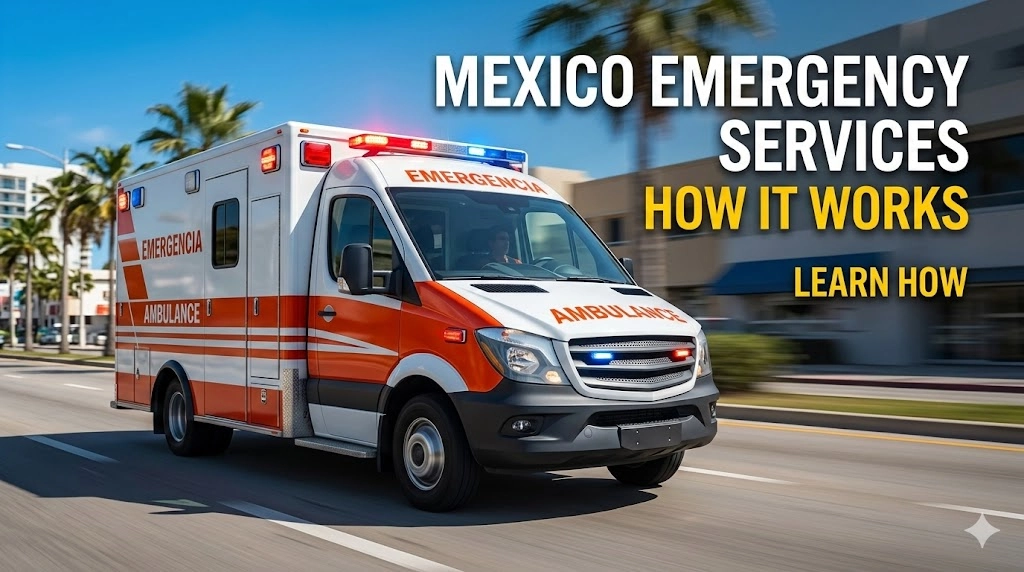
The visual landscape of emergency vehicles in Mexico is diverse. Because the state-funded healthcare system cannot cover the massive demand for emergency transport, the gap is filled by a mix of non-profit organizations, high-end private companies, and unregulated rogue operators.
Public Ambulances Cruz Roja and ERUM
The backbone of emergency medical transport in Mexico is the Cruz Roja Mexicana (Mexican Red Cross). Unlike in the United States, where the Red Cross is primarily a disaster relief organization, the Cruz Roja in Mexico acts as the primary public ambulance provider. In many municipalities, when you call 911 for a medical emergency, the dispatcher will send a Cruz Roja ambulance.
Cruz Roja ambulances are staffed by highly dedicated, formally trained paramedics and volunteers. They provide basic life support and trauma stabilization entirely free of charge at the scene of the accident. It is important to note that while the ride is free, the Cruz Roja relies heavily on public donations (especially during their annual “Colecta Nacional”) to fund their gasoline, medical supplies, and vehicle maintenance.
In major metropolitan areas like Mexico City, you will also frequently see ERUM (Escuadrón de Rescate y Urgencias Médicas) ambulances. ERUM is a specialized division of the local Ministry of Public Security. They operate alongside the police force to provide rapid medical rescue, particularly in high-trauma situations like severe car crashes or structural collapses. Like the Cruz Roja, ERUM operates as a public service and does not charge the patient for emergency stabilization or transport to a public IMSS or ISSSTE hospital. Understanding how these entities interact with the broader state network is detailed in Healthcare in Mexico: Complete Guide for Expats (Public vs Private).
Private Ambulance Services
Operating entirely outside the public sphere is a highly competitive, lucrative private ambulance industry. These fleets are owned by private hospital networks, independent medical transport corporations, or specialized intensive care transport companies. Private ambulances are generally newer, meticulously maintained, and frequently equipped as rolling Intensive Care Units (ICUs).
If an expat suffers a major cardiac event or requires an emergency transfer between facilities on life support, a private ambulance is the absolute gold standard. These vehicles carry advanced defibrillators, mobile ventilators, and a wider array of emergency pharmaceuticals than standard public units. Furthermore, private ambulances are far more likely to be staffed by a bilingual physician or an advanced critical care paramedic.
You generally do not access these private fleets by simply dialing 911. Instead, you must call the private ambulance dispatch center directly, or call a premium private hospital and request that they send their in-house ambulance to your location. Because this service is entirely commercial, it comes with a steep price tag, demanding that expats possess a solid understanding of Healthcare Costs in Mexico: Doctor Visits, Hospital Stays, and Surgery Expenses.
Identifying Legitimate vs Unofficial Ambulances
A unique and highly dangerous phenomenon in the Mexican emergency ecosystem—particularly prevalent in Mexico City—is the existence of “Ambulancias Patito” (literally translated as “duck ambulances,” a local slang term for fake, unofficial, or rogue ambulances).
These are privately owned vans that have been painted to look like legitimate emergency vehicles, complete with sirens and flashing lights, but they operate entirely outside the regulatory oversight of COFEPRIS (the federal health commission). These operators illegally monitor police radio scanners to intercept 911 dispatch calls. Because they are often stationed closer to accidents than the official Cruz Roja units, they frequently arrive at the scene first.
The danger of an Ambulancia Patito is twofold. First, they are rarely staffed by certified paramedics, meaning the medical care provided in transit is substandard or outright dangerous. Second, they operate on a predatory financial model. They will load a vulnerable, injured patient into their van and refuse to transport them to a free public hospital or the patient’s preferred private clinic. Instead, they will transport the patient to a specific, often overpriced private clinic that secretly pays the ambulance driver a massive cash “commission” for delivering a patient. Once there, the patient is extorted for exorbitant transport and admission fees.
Expats must be vigilant. A legitimate ambulance will have official, government-issued license plates starting with the letters “AM” (for Ambulancia), clear institutional branding (like the official Red Cross logo or a recognizable private hospital name), and personnel wearing standardized, professional uniforms. If a battered van with peeling decals arrives and the staff immediately begins demanding cash before touching the patient, it is a massive red flag.
The Financial Realities of Emergency Transport
Navigating a medical crisis is stressful enough without the added anxiety of financial extortion. The monetary expectations for ambulance transport in Mexico vary wildly depending on which specific vehicle arrives at your door and where they are taking you.
Cost Expectations for Public vs Private Rides
As previously established, emergency transport via a public Cruz Roja or ERUM ambulance is technically free. The paramedics will stabilize you, load you into the vehicle, and transport you to the nearest capable public hospital—such as an IMSS trauma center—without handing you a bill. However, it is a deeply ingrained cultural norm to offer a cash donation to the Cruz Roja paramedics if you are financially capable, as their resources are perpetually stretched thin.
Private ambulances, conversely, operate strictly on a fee-for-service model. The base rate for simply summoning a private ambulance to your home typically starts around $100 to $200 USD ($2,000 to $4,000 MXN). If the paramedics have to perform advanced life support interventions—such as administering IV medications, intubation, or using a defibrillator—those items are itemized and billed separately. Transporting a patient across town to a luxury hospital can easily result in a total invoice ranging from $300 to $800 USD, or significantly higher if an out-of-city transfer is required.
To provide a clear perspective on these financial liabilities, the following table compares the operational realities of public versus private emergency transport.
| Feature | Public Ambulances (Cruz Roja / ERUM) | Private Ambulances (Hospital Fleets / Independent) |
| How to Summon | Dial 911 | Call the specific hospital or private dispatch direct line. |
| Cost of Transport | Free (Donations highly encouraged) | $150 – $800+ USD depending on interventions. |
| Destination Protocol | Will transport to the nearest public or appropriate trauma hospital. | Will transport to the private hospital of your choice. |
| Equipment Level | Basic Life Support (BLS); limited advanced trauma gear. | Advanced Life Support (ALS); often equipped like mobile ICUs. |
| Language Dynamics | Almost exclusively Spanish speaking. | Higher likelihood of bilingual paramedics or doctors on board. |
How Payment is Collected on the Scene or at the Hospital
The method of payment for private ambulances often catches foreign residents off guard. In countries like the US or Canada, an ambulance transports you to the hospital, and a bill is mailed to your house weeks later. In the Mexican private sector, the financial transaction is highly immediate.
In many scenarios, the private ambulance crew will require a credit card swipe or a cash payment either before you are loaded into the vehicle (if the situation is non-life-threatening) or the moment you arrive at the emergency room receiving bay, before they formally hand you over to the hospital triage nurses. If you are unconscious, the financial responsibility falls immediately to your accompanying spouse or friend.
This immediate demand for payment means expats must always have access to liquid funds. Relying on a foreign bank card that might be instantly frozen by an overzealous fraud department in your home country can cause disastrous delays in care. Financially prepared expats mitigate this risk by utilizing secure, multi-currency platforms like Wise. By keeping a dedicated emergency fund in Mexican Pesos within a Wise account, you ensure that your local debit card will seamlessly process the ambulance fee at the mid-market exchange rate, avoiding hidden international surcharges and guaranteeing immediate admittance to the hospital.
The Role of International Health Insurance
While the upfront cost of a private ambulance is manageable for some, the resulting private hospital stay is where medical bills skyrocket. This highlights the absolute necessity of holding robust international health insurance. If you suffer a severe emergency and are transported to a top-tier facility like Hospitales Angeles, an uninsured surgery and a few nights in the ICU can easily exceed $30,000 USD.
Premium global policies, such as those provided by Cigna Global, are engineered specifically to absorb these catastrophic financial shocks. A comprehensive Cigna Global plan will not only cover the surgical and hospitalization costs, but it generally explicitly covers the cost of the initial local private ambulance transport required to get you to the hospital.
Furthermore, if your local Mexican hospital is unequipped to handle a highly complex trauma (such as severe burns or complex neurosurgery), premium international policies include medical evacuation clauses. This means Cigna Global will arrange and fully fund an air ambulance—a private jet equipped as an ICU—to transport you across the border to a world-class facility in the United States or your home country. Without insurance, an air ambulance flight costs tens of thousands of dollars out of pocket.
Alternative Emergency Protocols for Expats
Because relying entirely on the 911 dispatch system can be linguistically stressful and logistically unpredictable, seasoned expatriates in Mexico rarely leave their emergency response up to chance. They develop highly localized, alternative protocols to ensure rapid access to care.
Self Transporting to the Emergency Room
In a vast number of non-catastrophic medical emergencies—such as a broken arm, a deep laceration requiring stitches, or severe food poisoning—expats simply choose not to call an ambulance at all. Due to the potential wait times and the risk of encountering rogue operators, self-transporting to the emergency room is often the fastest and safest route to medical care.
If you are stable enough to sit upright in a car, having your spouse drive you directly to the nearest private hospital’s “Urgencias” (Emergency) entrance bypasses the entire dispatch process. If you live alone or your partner is too frantic to drive safely, utilizing a ride-sharing app like Uber is an incredibly common, reliable, and cheap alternative to an ambulance. Uber drivers in major Mexican cities are usually fast, heavily GPS-tracked, and completely eliminate the need for you to verbally explain driving directions in broken Spanish to a 911 operator. This practical approach is a core element of Navigating Hospitals and Clinics in Mexico: An Expat’s Guide to Medical Care.
Utilizing Private Hospital Direct Lines
If you decide that a specialized, highly equipped ambulance is absolutely necessary—for instance, if a family member is suffering a suspected stroke or cardiac arrest—you should bypass 911 entirely and utilize direct hospital lines.
When you establish your residency in a specific Mexican city, you should immediately identify the highest-rated private hospital nearest to your home. Locate the direct telephone number for their specific internal ambulance dispatch desk (which is separate from their general reception line). Save this direct number in your phone contacts, write it on your refrigerator, and give it to your domestic staff or regular taxi driver.
When you call a private hospital directly, you bypass the government triage system. The hospital knows exactly what level of care you expect, and they immediately dispatch their own vetted, certified private ambulance to retrieve you. Because these hospitals cater to expats and medical tourists, the person answering the direct emergency line is also far more likely to speak functional English, significantly reducing panic during the call.
Preparing a Personal Emergency Action Plan
The ultimate key to surviving a medical emergency in Mexico is proactive, militant preparation before the crisis actually occurs. Every expat household must construct a physical “Emergency Action Folder.” This folder should be brightly colored and kept in an easily accessible, universally known location within the home.
This folder must contain:
- A typed script in Spanish detailing your exact home address, including cross streets, neighborhood (colonia), and any complex gate codes required for an ambulance to enter your community.
- Printed, physical copies of your international health insurance cards and the provider’s 24-hour global emergency contact number.
- A translated summary of your medical history, including your blood type, chronic diagnoses, and a list of any severe allergies.
- A list of emergency contact numbers, including the direct line to your preferred private hospital, the number for your local trusted general practitioner, and the contact info for a bilingual local friend or lawyer who can act as an advocate.
Furthermore, preparation involves having the right tools to stabilize an injury while you wait for transport. Expats should proactively build a comprehensive, high-quality home trauma kit. You cannot rely on local convenience stores for advanced wound care products in the middle of the night. By ordering premium first aid supplies, sterile burn dressings, and holistic shock-recovery supplements from trusted international platforms like iHerb, you guarantee that you have the immediate tools necessary to manage the critical first ten minutes of any domestic accident. For a detailed checklist of what to include in this domestic setup, read Building a First Aid Kit: Essential Medical Supplies for Expats in Mexico.
References
Primary sources (official)
- Secretariado Ejecutivo del Sistema Nacional de Seguridad Pública (SESNSP) – 911 Emergencias: https://www.gob.mx/911
- Cruz Roja Mexicana (Mexican Red Cross): https://www.cruzrojamexicana.org.mx/
Other helpful sources
- U.S. Embassy & Consulates in Mexico – Emergency Assistance for U.S. Citizens: https://mx.usembassy.gov/
Disclaimer
The information provided in this article is for educational and informational purposes only and does not constitute formal medical or legal advice. Emergency response systems, private ambulance costs, and local health regulations in Mexico are subject to change. Always consult directly with local healthcare professionals, verify the direct emergency numbers for your specific Mexican neighborhood upon arrival, and ensure you possess the appropriate international health insurance to protect against catastrophic medical events abroad.