Will Hospital Staff Speak English? Navigating Language in Medical Emergencies
You are doubled over with abdominal pain at 2 a.m. in a Mexican emergency room. The triage nurse is asking rapid-fire questions, and the only Spanish you can manage is “me duele.” Whether hospital staff speak English depends on where you are, who is on shift, and how well you prepared. This guide covers what to realistically expect and how to get through it.
Disclosure: This post may contain affiliate links. We may earn a commission at no extra cost to you if you make a purchase through these links. Read full disclosure.
The Honest Answer: How Much English You Will Actually Hear in a Mexican Hospital
I’ll start with the part most guides skip. The answer to “will they speak English?” is not yes or no. It is “it depends, and it can change between the parking lot and the third floor.” I have lived here long enough to sit in waiting rooms in big private hospitals, small-town clinics and a public hospital where I was the only foreigner in the building. The English I heard ranged from fluent to none at all, sometimes inside the same building on the same night.
The most useful thing you can do is stop picturing “the hospital” as one place with one language level. Think of it as several layers: the front desk, triage, the attending physician, the nurses, the specialists, the lab, and the billing office. Each layer has its own odds of English. Once you see it that way, you can plan for the weak spots instead of being caught off guard by them.
Below is how this usually plays out across the main types of facilities. For a broader picture of how the system is organized before you get into language, see Navigating Hospitals and Clinics in Mexico: An Expat’s Guide to Medical Care.
Private Hospitals in Big Cities and Expat Hubs
The large private hospitals in Mexico City, Guadalajara, Monterrey, Querétaro and Mérida are where English is most likely. Mexico City has the Hospital ABC, Médica Sur and the Hospital Ángeles network. Monterrey has the Christus Muguerza hospitals. Guadalajara has Hospital San Javier and Puerta de Hierro, and Mérida has Faro del Mayab. Many of the doctors at these places trained or did fellowships in the United States, Canada or Europe. Reading English-language medical literature is part of their profession. Specialists in particular often speak excellent English, and some will switch to it the moment they hear your accent.
The front desk and triage are where many people get their first shock. At these top-tier private hospitals, the front desk and triage staff often have some English, but it varies by shift. On a weekday afternoon you may be greeted by a bilingual receptionist who walks you through registration with ease. At 3 a.m. on a Sunday, the person behind the desk may have only a few words of English and will rely on gestures, a colleague, or a translation app. Both experiences happen at the same hospital, so don’t read either one as the “real” standard.
Nurses are the group expats underestimate most. Mexican nurses are generally skilled and attentive, but English is not a routine part of their training. At top private hospitals some nurses speak conversational English, especially on floors that see many international patients. Many do not. You will usually find that the doctor who explained your diagnosis so clearly has gone home, and the nurse checking your IV at midnight is speaking only Spanish. That is where most of the day-to-day communication on a hospital stay happens.
Some of these hospitals have an international patient office, sometimes called “atención a pacientes internacionales.” Staff there help with insurance coordination, paperwork and sometimes interpretation. These offices tend to keep business hours. That is very helpful for a planned procedure and much less so for an emergency at night. If you are choosing a hospital ahead of time, ask whether one exists and what hours it keeps.
Public Hospitals: IMSS, ISSSTE and IMSS-Bienestar
If you are enrolled in IMSS, or end up in a public hospital after an accident, expect a mostly Spanish-speaking environment. This is not about attitude. The staff work under heavy patient loads, serve a domestic population, and have no institutional reason to run services in English. The front desk, social workers, nurses and billing or records staff will almost always communicate only in Spanish.
The doctors are a partial exception. Many public-sector physicians, especially younger ones and those in teaching hospitals, can read English and understand a fair amount. Some speak it well enough to explain a diagnosis. Many will still default to Spanish because that is the working language of the ward. They may also be uncomfortable with medical nuance in a second language, and they may have no time to slow down.
The real challenge in public settings is the system as much as the language. You will be told to take a form to another window, get a stamp, return to a different building for a lab order, and come back on a specific day. That is hard enough in your native language. In a language you are still learning, you will need a written plan and ideally a Spanish-speaking companion. For a practical rundown of what public facilities are like, see Public Hospitals and Clinics in Mexico: What to Expect.
Resort Towns, Small Towns and the In-Between
Resort areas like Cancún, Playa del Carmen, Tulum, Los Cabos and Puerto Vallarta work differently. Private clinics and hospitals there built their business around tourists and cruise passengers. English is often the operating language at the front desk, and staff are used to explaining things to confused visitors with sunburns and stomach bugs. Hospiten, Galenia and the Amerimed clinics are examples of facilities that serve many foreign patients. The convenience is real. The trade-off is that resort-oriented clinics sometimes treat foreigners as a premium revenue stream. Good English does not guarantee clear communication about costs, so ask early and ask often.
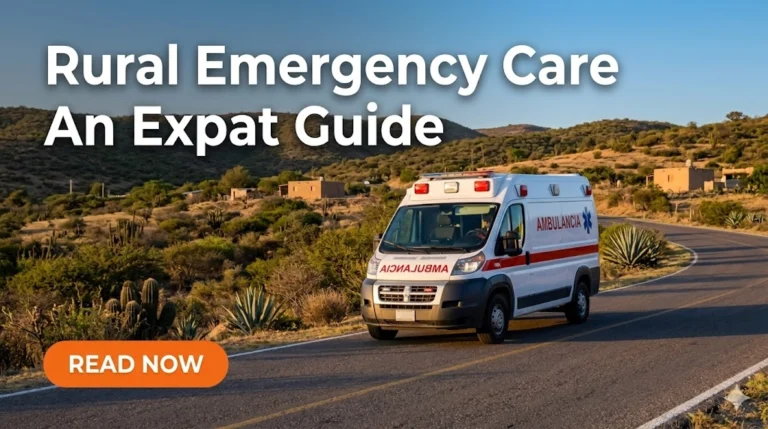
Small towns are the opposite. In a pueblo in the Sierra Gorda, the Oaxaca highlands or the interior of the Yucatán, the local clinic or Centro de Salud will almost certainly run only in Spanish. The doctor may be a recent graduate doing their social service year, often called a “pasante.” They may be capable and kind, but they work with limited equipment and rarely speak English. In a serious emergency in these areas, you are likely to be stabilized locally and transferred to a larger city, so you could face two language environments in one night. For more on this, read Emergency Medical Services in Rural Mexico: Challenges and Tips for Expats.
Mid-sized cities fall in between. In places like San Luis Potosí, Aguascalientes, Morelia or Xalapa, you will usually find doctors who speak English at the better private hospitals. Front desks and nursing staff will mostly use Spanish.
| Setting | Front Desk and Triage | Attending Doctors | Nurses | Forms and Paperwork |
|---|---|---|---|---|
| Top-tier private hospital in a major city | Often some English, but varies by shift | Frequently good English, especially specialists | Limited and inconsistent | Mostly Spanish, some bilingual forms |
| Private clinic in a resort area | Usually good English, built around tourists | Usually good English | Some English | Often bilingual or English available |
| Private hospital in a mid-sized city | Mostly Spanish | Some doctors speak English well | Rarely English | Spanish |
| Public hospital, IMSS or IMSS-Bienestar | Rarely English | Some can read or speak basic English | Rarely English | Spanish only |
| Small-town clinic or Centro de Salud | Rarely English | Rarely English | Rarely English | Spanish only |
Treat this table as a starting point, not a guarantee. One bilingual nurse on shift can transform your experience in a public hospital. A busy night can leave even an elite private ER short of English speakers.
Where the Language Barrier Bites Hardest During an Emergency
Over the years I have helped friends through emergency visits, and I have had a couple of my own. The language barrier is not evenly spread across a hospital visit. It hits hardest at a handful of predictable moments. If you know where they are, you can prepare a specific workaround for each one instead of panicking about everything at once.
The 911 Call and the Ambulance Ride
The first point of friction often comes before you reach the hospital. In most of the country, 911 is the national emergency number. Operators are generally Spanish speakers. In some cities and tourist zones, English-speaking operators may be available or can be patched in, but you cannot count on it in the critical first minutes. Have these ready to say in Spanish: your address, the nature of the emergency, and the patient’s condition.
Picture this. Your partner collapses in your rented apartment in Colonia Roma. You dial 911, and the operator asks “¿Cuál es su emergencia?” and then “¿Cuál es la dirección?” If you don’t know how to say your street address, including the colonia name and the nearest cross streets, you will lose precious time. Mexican addresses can be confusing even for locals. The operator will want the colonia and often a landmark, such as “frente a la farmacia” (in front of the pharmacy) or “a una cuadra del parque” (one block from the park).
The ambulance crew is the second layer. Cruz Roja paramedics and private ambulance crews are trained professionals, but most speak Spanish only. They will ask about allergies, medications and what happened. They will also ask, or you will need to tell them, which hospital to go to. Public ambulances may take the patient to the nearest public facility by default. If you have private insurance and want a specific private hospital, you need to say so clearly: “Queremos ir al Hospital Ángeles, tenemos seguro privado.” Many expats arrange a private ambulance service in advance for this reason. For a detailed breakdown of who to call and what happens next, see Calling an Ambulance in Mexico: How Emergency Services Operate.
Triage, Consent Forms and the Billing Desk
Once you arrive, triage is the most stressful language moment. The nurse needs your symptoms, when they started, your pain level, your allergies and your current medications, fast. At a top private hospital you may get some English here, depending on who is working. Elsewhere, assume Spanish. A written medical summary in Spanish, which I’ll cover in the next section, is the single best tool for this moment because it lets you hand over the critical information in seconds.
Consent forms are the second big friction point, and the one that worries me most. Before procedures, imaging with contrast, anesthesia or surgery, you will be asked to sign a “consentimiento informado.” These documents are typically in Spanish and full of dense medical and legal language. You have the right to understand what you are signing. Ask the doctor to explain it, use a translation app on the document, or call a bilingual friend. Don’t let anyone rush you into a signature on something you don’t understand unless it is a true life-or-death moment. Even then, ask the doctor to summarize it in one sentence.
The billing desk, called “caja” or “admisiones,” is the third. Private hospitals in Mexico commonly ask for a deposit or a guarantee before admitting you, or before certain procedures. This is where you need clear communication about what is being charged, whether your insurance is accepted directly, and what you will owe. Billing staff at elite private hospitals may have some English, but many use Spanish. These conversations involve numbers and policy terms, so misunderstandings are expensive. For the nuts and bolts of how this works, see Do Mexican Hospitals Require Payment Upfront? How Billing Works for Expats.
Nurses, Night Shifts and the Long Stay
If you are admitted, the language challenge changes shape. You are no longer dealing with one dramatic intake moment. Instead you face hundreds of small interactions: a nurse asking if you have had a bowel movement, whether you are dizzy, whether the pain is better or worse, whether you need a blanket, whether you want to eat. Each one is small. Together, across a few days in a language you don’t speak, they wear you down.
Night shifts are especially tough. Bilingual doctors and international patient coordinators are usually gone. The nurses on duty may be excellent clinicians, but they will mostly communicate in Spanish. If something feels wrong at 2 a.m., such as new chest pain, a reaction to a medication, or a sudden change in your breathing, you need to be able to say so clearly in Spanish or have a tool ready to help you.
A friend of mine spent four nights at a respected private hospital in Guadalajara after an appendectomy. During the day, her surgeon came by and explained everything in fluent English. At night, she struggled to tell the nurse that the pain medication made her nauseous. They ended up communicating through a mix of hand gestures and Google Translate on her phone. The care itself was excellent. What made it feel scary was being isolated in a language she didn’t speak. She later told me that a short list of Spanish phrases taped to her bedside table would have made those nights far easier.
Building Your Language Safety Net Before You Need It
You cannot control who is on shift when your emergency happens. You can control how much preparation you bring with you. Below are the tools I recommend to every new arrival, roughly in order of how much they help.
Create a Spanish Medical Card and Keep It Everywhere
This is the most useful thing you can do, and it takes an afternoon. Create a one-page document in Spanish with your key medical information. Keep a printed copy in your wallet, a photo on your phone’s lock screen or in an easy-to-find album, and a copy with your partner or a trusted friend. In triage, handing this over can replace five minutes of panicked charades.
Your medical card should include:
- Your full name exactly as it appears on your passport, with your date of birth.
- Your blood type, if you know it (“Tipo de sangre”).
- Allergies, especially to medications (“Alergias”). Write “Ninguna conocida” if you have none known.
- Current medications with the generic name, dose and frequency (“Medicamentos actuales”). Generic names matter because Mexican brand names often differ from those at home.
- Chronic conditions (“Enfermedades crónicas”), such as diabetes (“diabetes”), high blood pressure (“hipertensión”), asthma (“asma”) or heart disease (“enfermedad cardíaca”).
- Past surgeries (“Cirugías previas”).
- Your insurance company, policy number and the insurer’s assistance phone number (“Seguro médico”).
- An emergency contact in Mexico and one abroad (“Contacto de emergencia”).
- Your preferred hospital, if you have one (“Hospital preferido”).
- A line saying “Hablo poco español. Por favor, hable despacio.” (I speak little Spanish. Please speak slowly.)
Have a qualified translator or a bilingual medical professional check the translation if you can. A friendly Mexican neighbor or a Spanish teacher is better than nothing. For guidance on whether your fuller medical history also needs translating, read Do You Need to Translate Medical Records into Spanish for Mexican Doctors?.
Choose Your Hospital and Doctor Before the Emergency
The worst time to research hospitals is in the back of a taxi with a bleeding hand. Within your first few weeks in a new city, identify one or two private hospitals near home that you would want to go to in an emergency. If possible, visit during a calm moment. Find the ER entrance, ask at reception whether they have bilingual staff or an international patient office, and note the hours. Ask whether they work directly with your insurer. This short visit can save hours of confusion later.
Building a relationship with an English-speaking general practitioner is equally valuable. A doctor who knows you can be your advocate in an emergency, phone the ER on your behalf, recommend the right specialist, and sometimes meet you at the hospital. Many private doctors in Mexico share their WhatsApp number with patients, which is a huge help when you need a quick answer. For tips on finding one, see Finding English-Speaking Doctors and Specialists in Mexico.
Accreditation is a useful filter too. Hospitals that pursue international accreditation are more likely to have international patient processes and staff used to foreign patients. Accreditation alone does not mean English everywhere. Choosing a Good Hospital: What Accreditations to Look for in Mexico explains what the main accreditations signal.
Use Your Insurance Assistance Line as a Language Lifeline
Many expats overlook this. Many international health and travel medical insurers run 24-hour assistance lines. Depending on the policy, these can help you find an appropriate facility, coordinate with the hospital about coverage, and sometimes help bridge a language gap by speaking with staff. The details vary a lot between providers and plans, so read your policy documents or call the insurer to ask exactly what help is available.
For example, digital nomads and long-term travelers often use a travel medical product such as SafetyWing. If that is your coverage, check your policy wording for how its emergency assistance service works and whether its team can talk to Mexican hospital staff for you. Residents who want comprehensive long-term international coverage sometimes choose a global health plan like Cigna Global. Again, confirm what support the plan’s helpline offers, which hospitals it works with, and whether direct billing is possible. Do this before you need it.
The practical step is simple. Save your insurer’s assistance number in your phone under a clear name like “INSURANCE EMERGENCY” and write it on your Spanish medical card. When you reach the hospital, call the line, explain what is happening in English, and ask whether they can speak to the admissions desk or the doctor. Even when an insurer cannot translate a conversation directly, having them confirm coverage with the billing desk can ease one of the most stressful parts of the visit. If you are unsure whether your plan will be accepted at a particular facility, see Will Mexican Hospitals Accept International Health Insurance?.
Translation Apps and Human Backups
Translation apps are useful and far better than nothing, but in a medical setting they have real limits. Google Translate and similar tools handle simple sentences well. They can stumble over medical nuance, regional slang and fast speech. Their conversation mode, where the app listens and translates both sides, is useful during an emergency. So is the camera feature, which lets you point your phone at a consent form and see a rough translation.
Download the Spanish language pack for offline use before you need it. Hospital Wi-Fi can be unreliable, and mobile signal inside big concrete buildings is often weak. A dead battery or no connection at the wrong moment can leave you with no translation tool at all, so carry a power bank in your emergency bag. For a comparison of which tools work best on the ground, see Using Translation Apps in Mexico: What Works Best.
Human backups are still the gold standard. Make a short list of two or three bilingual people you can call at any hour: a Mexican friend, a fluent expat neighbor, your Spanish teacher, or your landlord if you have a good relationship. Ask them ahead of time whether they would be willing to help in an emergency. Most people are touched to be asked. Over speakerphone, a friend can relay the doctor’s explanation, ask follow-up questions and confirm what you are agreeing to far better than any app can.
Learn the Medical Spanish That Matters Most
You don’t need to become fluent to handle a medical emergency much better. Even fifty well-chosen words and phrases change the experience. Focus on describing pain (where, how much, what kind), symptoms (nausea, dizziness, fever, shortness of breath), and the key questions you’ll want to ask (what is it, is it serious, what are you giving me, how much will it cost).
Practice these phrases out loud before you need them. In a stressful moment, your brain will reach for what it has rehearsed, not what you once read. Some expats work with a tutor specifically on medical role-play, which builds confidence quickly. For structured practice ideas, see Medical Spanish Practice: Rehearsing Symptoms Before You Need To.
| Situation | Spanish Phrase | English Meaning |
|---|---|---|
| Getting help | Necesito un médico, es una emergencia | I need a doctor, it’s an emergency |
| Asking for English | ¿Hay alguien que hable inglés? | Is there someone who speaks English? |
| Describing pain location | Me duele aquí | It hurts here |
| Describing severe pain | El dolor es muy fuerte | The pain is very strong |
| Sharp versus dull pain | Es un dolor punzante / es un dolor sordo | It’s a sharp pain / it’s a dull pain |
| Breathing problems | No puedo respirar bien | I can’t breathe well |
| Chest pain | Tengo dolor en el pecho | I have chest pain |
| Dizziness | Estoy mareado / mareada | I’m dizzy |
| Nausea | Tengo náuseas | I’m nauseous |
| Fever | Tengo fiebre | I have a fever |
| Allergies | Soy alérgico / alérgica a la penicilina | I’m allergic to penicillin |
| Medication question | ¿Qué medicamento me está dando? | What medication are you giving me? |
| Understanding | No entiendo, ¿puede repetirlo más despacio? | I don’t understand, can you repeat it more slowly? |
| Before signing | ¿Me puede explicar este documento? | Can you explain this document to me? |
| Cost question | ¿Cuánto va a costar aproximadamente? | Approximately how much will it cost? |
| Insurance | Tengo seguro médico internacional | I have international health insurance |
For the companion set of phrases you’ll need when picking up prescriptions after discharge, see Pharmacy Spanish: Phrases to Help You Buy Medicine in Mexico.
Step-by-Step: What to Do When You Arrive at the ER and Nobody Speaks English
Even with the best preparation, you may still walk into an emergency room where nobody in sight speaks English. It happens, and it is not a sign that you are in the wrong place or getting worse care. Here is a practical sequence that has worked for me and the friends I’ve helped.
The Arrival Sequence
- Stay calm and lead with the most critical information. Say “Es una emergencia” and point to the problem area or describe it in one short sentence. Triage staff prioritize by severity, so make the severity clear immediately.
- Hand over your Spanish medical card. This instantly communicates allergies, medications, chronic conditions and insurance. It answers most of the questions triage needs and saves several minutes of confusion.
- Ask once, politely, if anyone speaks English. Say “¿Hay alguien que hable inglés?” Sometimes a bilingual doctor, nurse or administrative staff member is nearby and can be called over. If not, move on quickly. Don’t let the search for English delay care.
- Call your insurance assistance line. Explain the situation in English and ask whether they can coordinate with the hospital. Ask whether the facility works with your insurer and what the next steps are for coverage.
- Call your bilingual backup contact. Put them on speakerphone with the doctor or the admissions desk. This is especially important for consent forms and billing conversations.
- Open your translation app in conversation mode. Use short, simple sentences. Speak slowly and avoid idioms. Check key points by asking the staff member to repeat or confirm.
- Ask for written information. Request the diagnosis (“el diagnóstico”), prescribed medications and instructions in writing. Then you can translate them carefully later or have them reviewed by your regular doctor.
- Confirm costs before major procedures when possible. In a private hospital, ask what deposit or guarantee is required and whether your insurance will pay directly or reimburse you. Ask for a written estimate (“un presupuesto”) for anything non-urgent.
- Keep every document. Hold on to receipts, medical reports and invoices. Ask for a “factura” if your insurer will need it for reimbursement. Insurers usually require itemized documentation, and getting it later is much harder than getting it now.
A Real-World Walk-Through
Let me walk you through a scenario I have seen versions of many times. Imagine Mark, a retiree from Ohio who has lived in Querétaro for six months. He wakes up at night with crushing chest pressure and pain spreading into his left arm. His wife, Linda, speaks only basic Spanish.
Linda calls 911 and says “Mi esposo tiene dolor en el pecho, creo que es un infarto” (My husband has chest pain, I think it’s a heart attack). She reads their address from a note on the fridge: the street, number, colonia and a nearby landmark. She did this because a neighbor told her to keep the address written in Spanish by the phone. She tells the operator they want to go to the private hospital they visited a few months earlier, and that they have private insurance.
At the hospital, Linda hands Mark’s Spanish medical card to the triage nurse. It lists his blood pressure medication, his aspirin use and his allergy to sulfa drugs, all things the cardiology team needs to know right away. The nurse speaks only a little English, but she reads the card, nods and takes Mark straight back. While the team works, Linda calls their insurer’s assistance line. The representative confirms that the hospital is one they work with and speaks with the admissions desk about the guarantee. Then Linda calls their bilingual friend Sofía, who stays on speakerphone while the cardiologist explains the need for a catheterization and walks through the consent form.
The cardiologist turns out to speak decent English, but Linda is grateful that Sofía is there for the fine print. Mark recovers. Linda later says the three things that made the difference were the card, the pre-chosen hospital and the friend on speakerphone. Not one of them depended on the hospital staff speaking English. That is the point: the more preparation you bring, the less your outcome depends on luck. For a broader emergency playbook, see Medical Emergencies in Mexico: What Expats Should Know and Prepare.
Advocating for Yourself Without Causing Friction
Mexican hospital culture tends to be respectful and somewhat formal, and doctors are often treated with a degree of deference. Pushing hard or raising your voice in frustration can backfire, even when you are scared and the language barrier is overwhelming. A calm, polite approach that uses “usted” and phrases like “por favor” and “disculpe” will get you much further. “Disculpe, no entiendo bien. ¿Me lo puede explicar otra vez, por favor?” (Excuse me, I don’t understand well. Can you explain it again, please?) is a phrase I have used countless times, and it almost always earns patience.
At the same time, being polite does not mean being passive. You have every right to understand your diagnosis, your treatment and what you are signing. If you feel something is wrong, say so. If you want a second opinion, you can ask for one. If you don’t understand a medication, ask what it is before you take it. A useful middle ground is to frame questions as wanting to understand rather than doubting the doctor. For example: “Quiero entender bien mi tratamiento” (I want to understand my treatment well).
Also bring a companion whenever possible. In Mexican hospitals, family members routinely stay with patients, help with small needs and act as go-betweens with staff. If you have no family nearby, a friend, neighbor or even a paid “acompañante” can fill that role. A companion who speaks Spanish is the most powerful resource you can have, because they can handle the endless small conversations on a hospital stay that no app does well. For more strategies on communicating with doctors day to day, see Overcoming Language Barriers at the Doctor: Tips for Expats.
Packing a Language-Ready Emergency Bag
Here is one last practical tip that ties everything together: keep a small grab bag ready near your front door or in your car. When an emergency happens, nobody thinks clearly enough to gather documents. Having them already packed takes away one source of stress at the worst possible moment.
Your language-ready emergency bag should include:
- Two printed copies of your Spanish medical card.
- A photocopy of your passport and residency card, if you have one.
- A printed sheet with your insurance policy number and the assistance line number.
- A printed list of your bilingual emergency contacts with their phone numbers.
- A printed sheet of the key medical phrases from the table above.
- A fully charged power bank and charging cable.
- A copy of your current medications list with generic names, plus a few days’ supply of essential prescriptions.
- A pen and a small notebook for writing down what doctors tell you, so you can translate it carefully later.
Hospitals in Mexico, public and private, are often staffed by skilled, caring professionals. The language gap is real, and it can be scary, but you can manage it. If you prepare your tools, choose your hospital in advance, line up your human backups and learn a handful of key phrases, you will go into any emergency far better equipped than most visitors.
Disclaimer
This article is for general informational purposes only and does not constitute professional advice. Laws, prices and regulations vary by location and change over time. Consult a qualified professional for guidance on your specific situation.