Mobile Data and eSIMs for Travel in Mexico
Arriving at Benito Juárez International Airport and realizing your home cellular provider’s roaming plan has failed is a stressful rite of passage for many. Whether you are trying to call an Uber, navigate to your hotel, or translate a quick phrase at customs, a lack of data feels like losing a limb. This guide solves the connectivity puzzle by detailing the best eSIM and local SIM options for your Mexican adventure.
Disclosure: This post may contain affiliate links. We may earn a commission at no extra cost to you if you make a purchase through these links. Read full disclosure.
The Reality of Staying Connected in Mexico
Staying connected in Mexico isn't just about posting sunset photos from a beach in Tulum; it is a fundamental safety and logistics requirement. Many first-time visitors assume that "international roaming" from their home country will suffice, only to be met with throttled speeds that barely load a text message or, worse, a bill that costs more than their flight. As someone who has spent years navigating the administrative labyrinth of this beautiful country, I can tell you that having a local data solution is the single best thing you can do for your peace of mind.
Why You Can’t Rely on Free Wi-Fi
Public Wi-Fi in Mexico has improved significantly, but it remains notoriously unreliable for anything beyond basic browsing. In major hubs like Mexico City or Guadalajara, you will find "Cdmx-WiFi" in public parks and plazas, but the connection often drops the moment you move ten feet. Furthermore, security is a major concern. Using open networks for sensitive tasks like checking your bank balance or confirming a reservation on Booking.com can expose your data to bad actors.
In smaller towns or coastal areas, the situation is even more precarious. You might find a café with a sign promising "High-Speed Internet," but once you order your latte, you realize the router is shared among fifty people and struggling to maintain a signal. If you are planning on Getting Around Mexico: Buses, Flights, and Car Hire, you need a stable connection to track your transit in real-time, which public Wi-Fi simply cannot provide.
The Hidden Costs of International Roaming
If you are coming from the US or Canada, your provider might offer a "Travel Pass" for $10 or $15 a day. While this sounds convenient, these costs add up fast on a two-week trip. Even more frustrating is the "Fair Usage Policy" buried in the fine print. After using a few hundred megabytes of high-speed data, many carriers will throttle your speed to 2G or 3G levels.
In the heat of a Mexican afternoon, trying to load a map on a 2G connection is an exercise in futility. I have seen countless travelers stranded at bus stations because they couldn't load their digital tickets on Busbud. By contrast, a local Mexican SIM or a dedicated travel eSIM provides native speeds on local towers, often at a fraction of the cost of roaming. For more on managing your trip logistics, see our guide on Travel Logistics in Mexico: Safety, Money, and Connectivity.
Understanding the Big Players: Telcel vs. the Rest
Mexico’s telecommunications landscape is dominated by a few major players, and understanding their strengths and weaknesses is key to choosing the right service. While new virtual operators (MVNOs) are entering the market, the infrastructure remains largely in the hands of the "Big Three."
Why Telcel is the Undisputed King of Coverage
If you ask any veteran expat which carrier to choose, the answer is almost always Telcel. Owned by Carlos Slim’s América Móvil, Telcel has the most extensive infrastructure in the country. If you are heading into the mountains of Chiapas, the deserts of Sonora, or remote beaches in Oaxaca, Telcel is often the only provider with a signal. Their "Amigo Sin Límite" prepaid plans are the gold standard for travelers, offering generous data buckets and unlimited social media usage (WhatsApp, Facebook, Instagram) that doesn't count against your primary data.
Choosing Telcel means you are less likely to experience "dead zones" when you are using a mapping app to find a hidden cenote you booked through Viator. However, the downside to Telcel is that their physical stores (Centros de Atención a Clientes) can be incredibly crowded, with wait times occasionally stretching into hours. Knowing How to Get a SIM Card in Mexico as a Foreigner can help you bypass some of these administrative headaches by looking for smaller authorized retailers instead.
AT&T Mexico and Movistar: Worth the Risk?
AT&T Mexico has a significant presence, particularly in urban areas and along the US-Mexico border. If you are spending your entire trip in a major city like Monterrey or Mexico City, AT&T's speeds can sometimes even outperform Telcel. They often have aggressive pricing for their prepaid "Unefon" brand, which can be very attractive for budget-conscious travelers. However, the moment you head into more rural territory, you may find your bars disappearing.
Movistar is generally the third-place contender. While they offer very cheap data packages, their coverage is the most limited of the three. I usually only recommend Movistar if you are on a very tight budget and plan to stay strictly within the confines of a major metropolitan area. For those who want to compare the technical reliability of these providers further, our article on Best Internet Providers in Mexico: Expats' Top Picks for Reliability offers a deep dive into the infrastructure.
| Provider | Best For | Coverage Quality | Ease of Topping Up |
|---|---|---|---|
| Telcel | Rural Travel & Nationwide | Excellent | Very Easy (OXXO, Apps) |
| AT&T | City Dwellers & Border Areas | Good (Urban) | Easy |
| Movistar | Budget Travelers | Fair (Cities Only) | Easy |
| Bait (Walmart) | High Volume Data | Good (Uses Altan Red) | Easy (Walmart/Bodega) |
The Rise of the eSIM: Convenience vs. Cost
In the last two years, the eSIM (embedded SIM) has revolutionized how people travel. No more fumbling with tiny metal tools or worrying about losing your home SIM card in a hotel drawer. For many, the ability to download a plan before even boarding the plane is worth the slight premium in price.
How eSIMs Work for Short-Term Travelers
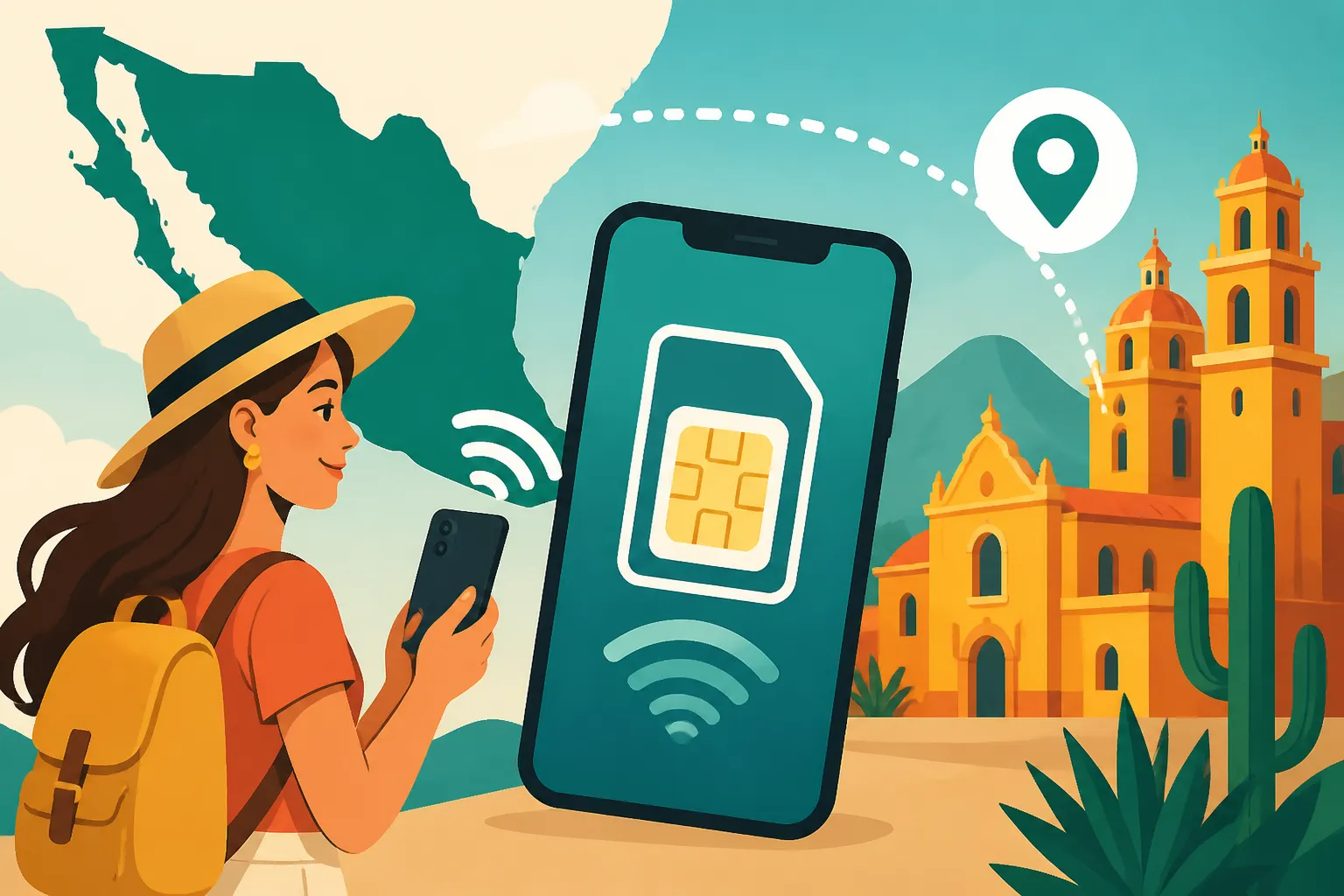
An eSIM is essentially a digital version of the physical SIM card already built into most modern smartphones (iPhone XS and newer, or most recent Samsung and Google Pixel phones). You purchase a plan online, scan a QR code, and your phone connects to a local network as soon as you land. This is a game-changer for those who want to hit the ground running.
The beauty of the eSIM is that it allows you to keep your home number active for SMS and two-factor authentication while using the eSIM for all your data needs. This is particularly useful when you need to receive a security code from your bank or a confirmation for a hotel stay on Booking.com. It eliminates the "blackout period" between landing and finding a local shop. For a detailed walkthrough, check out How to Get a Local eSIM for Travel in Mexico.
Comparing Popular International eSIM Providers
There are several international providers like Airalo, Holafly, and Nomad that offer Mexico-specific plans. Airalo is often the favorite for those who only need a few gigabytes of data for navigation and messaging. Holafly, on the other hand, is famous for its "unlimited" data plans, though they can be more expensive and do not always allow for data tethering (hotspotting).
One thing to keep in mind is that these international eSIMs are "roaming" onto local networks (usually Telcel or Movistar). While convenient, they may have slightly higher latency than a local SIM. If you are a digital nomad needing to do Zoom calls while Living in Playa del Carmen: A Digital Nomad’s Beach Town Guide, you might find that a local physical SIM provides a more stable ping. However, for the average tourist, the convenience of an eSIM is hard to beat.
Local Physical SIM Cards: The Veteran Expat Choice
Despite the convenience of eSIMs, many long-term residents and savvy travelers still prefer a physical local SIM card. This is often the most cost-effective way to get high-speed data and a local Mexican phone number, which is surprisingly useful for making restaurant reservations or calling local businesses that aren't on WhatsApp.
Where and How to Buy a Physical SIM Card
The easiest place to buy a Telcel "Chip" (the local word for SIM) is at any OXXO convenience store. You will see these red-and-yellow stores on almost every street corner in Mexico. Simply walk up to the counter and ask for a "Chip de Telcel." It usually costs around 100 to 150 pesos (approx. $6-$9 USD) and often comes with a small amount of pre-loaded credit.
Once you have the SIM, you need to "activar" it. This usually involves sending a text message or making a quick call, and the clerk at OXXO can often help you with this if your Spanish is a bit shaky. After activation, you can "recargar" (top up) your balance. I recommend the "Paquete Amigo Sin Límite 200," which gives you several gigabytes of data and unlimited social media for 30 days.
Understanding Prepaid (Prepago) vs. Postpaid
For 99% of travelers, a prepaid (prepago) plan is the only way to go. Postpaid contracts (planes de renta) require a Mexican tax ID (RFC), proof of residency, and a local bank account. As a visitor, you don't want to get tangled in that bureaucracy. Prepaid plans in Mexico are incredibly flexible; you only pay for what you use, and there are no contracts to cancel when you leave.
The "Sin Límite" packages are essentially a hybrid; they act like a monthly plan but are paid for in advance. If you run out of data, you can simply go back to an OXXO or use the "Mi Telcel" app to add more. This flexibility is vital when you are booking last-minute bus tickets on Busbud and realize you've burned through your data watching YouTube videos on a long haul. For more on the local costs of living and services, see Cost of Living in Mexico: 2026 Comprehensive Guide.
Setting Up Your Device for Success
Even with the best SIM card in the world, your connection won't work if your device isn't configured correctly. This is where many travelers encounter their first "administrative hurdle" in Mexico.
Unlocking Your Phone: The Step You Can’t Skip
This is the most common mistake I see: a traveler buys a local SIM, inserts it, and gets a "SIM Not Valid" error. This happens because the phone is "locked" to a specific carrier back home (like Verizon, AT&T US, or Rogers). Before you leave for Mexico, you must contact your home provider and ensure your device is unlocked for international use.
Most carriers will unlock your phone for free once it is paid off, but this can take a few days to process. Do not wait until you are at the airport to check this. If your phone is locked, your only options are to use a portable Wi-Fi "puck" or rely on expensive roaming. This is a critical part of Will Your Foreign Phone Work in Mexico? Using SIM Cards and Unlocked Phones and should be handled weeks in advance.
APN Settings and Troubleshooting Connectivity
Sometimes, after inserting a local SIM, your phone will show signal bars but won't load any data. This is usually due to the Access Point Name (APN) settings. While most modern phones update these automatically, sometimes you have to go into your cellular settings and manually enter the Telcel or AT&T APN details.
If you find yourself in this situation, don't panic. Most major airports and malls have a Telcel kiosk where the staff are wizards at fixing these settings. If you are experiencing issues while trying to coordinate a tour through Viator, finding a local technician is usually a quick and cheap fix. Also, remember to keep your "Data Roaming" toggle turned ON in your settings, even for a local SIM, as some Mexican carriers utilize domestic roaming to fill in coverage gaps.
Practical Tips for Data Management
Mexico is a vast country with varied topography, which means even the best data plan will have its limits. Managing your data wisely ensures you aren't left stranded when you need it most.
Using Offline Maps and Tools to Save Data
One of the best habits you can develop is downloading offline maps for the areas you plan to visit. Google Maps allows you to download entire cities or regions. This means that even if you lose signal while driving through the mountains of Querétaro, your GPS will still work perfectly.
I also recommend downloading Google Translate's Spanish dictionary for offline use. Being able to translate a menu or a sign without needing an active data connection is a life-saver in rural areas. These small steps are part of a larger strategy for Staying Safe in Mexico: What Expats Need to Know About Staying Safe, as they prevent you from appearing lost or vulnerable when your technology fails.
Managing Your Balance via Apps and OXXO
Most Mexican carriers have decent apps (like "Mi Telcel" or "Mi AT&T") where you can check your remaining data balance. However, these apps can sometimes be finicky with foreign credit cards. If the app won't accept your payment, simply head to an OXXO. You can give the clerk your phone number and the amount you want to top up, and the credit hits your phone almost instantly.
Always keep a screenshot of your phone number and your current plan details. In Mexico, things sometimes move slowly, and having your information ready makes the process much smoother. If you are staying in a vacation rental you found on Booking.com, ask your host for the nearest "tienda" where you can "hacer una recarga." It's a great way to start a conversation with a local and practice your Spanish.
Disclaimer
The information provided in this guide is for informational purposes only. Telecommunications laws, pricing, and coverage in Mexico are subject to change. Always verify current requirements and terms with your service provider before making any financial commitments.
By following this guide, you can navigate the complexities of mobile data in Mexico with the confidence of a seasoned expat. Whether you choose the cutting-edge convenience of an eSIM or the reliable affordability of a local Telcel SIM, staying connected will allow you to focus on what really matters: enjoying the incredible culture, food, and landscapes that Mexico has to offer. For more advice on settling into your new environment, don't miss our Settling in Mexico: Step-by-Step Guide to Your First 30 Days as an Expat.