Medical Evacuation Insurance: Do Expats in Mexico Need Airlift Coverage?
This guide explains the true limitations of remote Mexican healthcare, air ambulance costs, and how to secure reliable medical evacuation coverage.
Disclosure: This post may contain affiliate links. We may earn a commission at no extra cost to you if you make a purchase through these links. Read full disclosure.
The Reality of Rural and Coastal Medical Infrastructure
Mexico boasts incredible, world-class medical facilities, but the distribution of this apex-level care is highly concentrated. If you are retiring to a major metropolitan hub, your need for an airlift is virtually zero. However, if your dream is a quiet beach town or a remote mountain village, understanding local medical limitations is a matter of life and death.
The Illusion of the Local Hospital
Many expats move to idyllic locations like Sayulita, Mazunte, or remote areas of the Baja California peninsula under the assumption that the local “hospital” can handle any crisis. In reality, these facilities are often small stabilization clinics or Centros de Salud. They are staffed by dedicated, hardworking local doctors and nurses, but they are generally equipped only for basic triage, minor suturing, and dispensing standard medications.
If you suffer a massive myocardial infarction (heart attack), a complex stroke, or severe blunt force trauma from an ATV accident, these local clinics simply do not possess the infrastructure to save your life. They do not have dedicated catheterization labs, specialized neurosurgeons on call, or comprehensive intensive care units. Their primary goal during a catastrophic event is to stabilize your vital signs just long enough to transfer you to a higher-tier facility. To understand exactly what you are walking into when moving away from the cities, you should review Emergency Medical Services in Rural Mexico: Challenges and Tips for Expats.
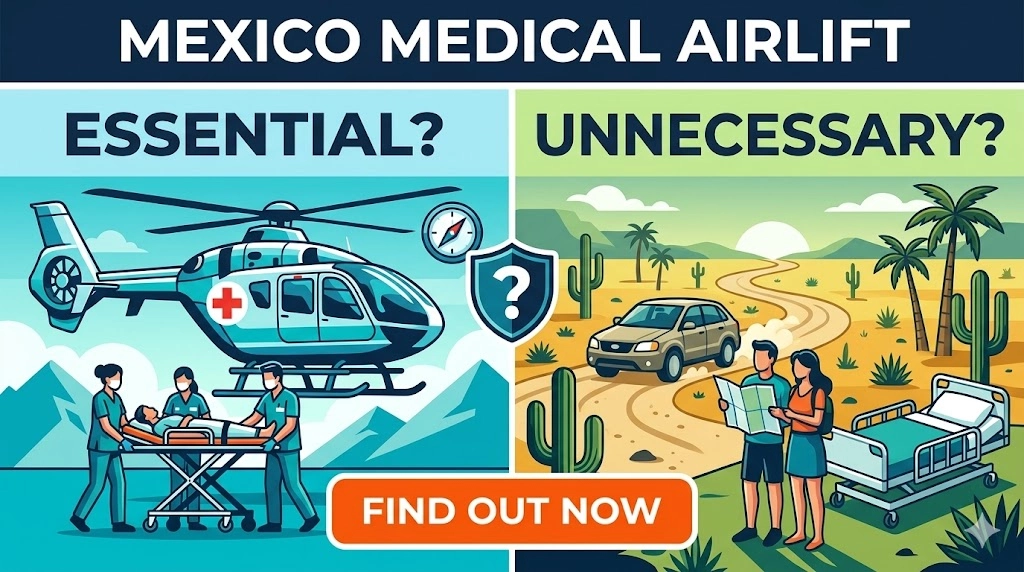
The geographic isolation of many expat havens compounds this danger. Driving a critically unstable patient four hours over winding, unpaved mountain roads to reach Guadalajara or Monterrey is incredibly dangerous. In these “golden hour” scenarios—where immediate surgical intervention is required to prevent permanent brain damage or death—a medical airlift is not a luxury; it is the only viable option. This stark contrast in regional capabilities is explored deeply in Quality of Care in Small Towns vs Big Cities: Healthcare Access in Different Regions.
Domestic Evacuation vs International Repatriation
When discussing medical evacuation, you must distinguish between the two primary types of flights: domestic evacuation and international repatriation.
Domestic evacuation involves moving you from a poorly equipped rural clinic to a JCI-accredited center of excellence within Mexico, such as the ABC Medical Center in Mexico City or Hospital San José in Monterrey. Because the quality of top-tier Mexican private healthcare is exceptional, a domestic transfer is often the fastest, safest route to life-saving surgery.
International repatriation involves flying you completely out of Mexico and back to a hospital in your home country (typically the United States or Canada). This is a vastly more complex logistical operation. It requires navigating international airspace clearances, coordinating with border customs, and ensuring a receiving hospital bed is waiting for you across the border. Many expats incorrectly assume that simply calling a local ambulance service will handle this. Understanding the local ground-level logistics first is crucial, which you can read about in Calling an Ambulance in Mexico: How Emergency Services Operate.
The Staggering Financial Risk of Air Ambulances
If you require an air ambulance, you are essentially chartering a private jet that has been retrofitted into a flying intensive care unit, complete with a specialized flight nurse, a respiratory therapist, and highly advanced life-support equipment. The costs associated with this are astronomical.
Out of Pocket Costs and Deposit Demands
Air ambulance companies operate strictly as private, for-profit entities. Unless an established insurance company provides them with an ironclad Guarantee of Payment (GOP) prior to takeoff, they will demand the entire cost of the flight upfront. They will not put wheels in the air based on a promise to pay later.
If your family is standing in a small rural clinic trying to authorize a $35,000 USD SWIFT transfer from a regional bank account on a Sunday night, the transaction will almost certainly be flagged for fraud and blocked, delaying your life-saving flight. This is a critical vulnerability. Expats who choose to self-insure must have highly liquid, accessible emergency funds. Utilizing a borderless financial platform like Wise is an excellent contingency. By holding your emergency funds in a Wise account, your family can execute massive, secure digital transfers directly to an aviation company’s account without being derailed by standard banking hours or automated international fraud triggers.
To illustrate the financial devastation an uninsured airlift can cause, here is a breakdown of estimated out-of-pocket costs for medical flights originating in Mexico:
| Type of Medical Flight | Origin to Destination Example | Estimated Out-of-Pocket Cost (USD) |
| Helicopter Evacuation | Tulum to Cancun (Domestic) | $5,000 – $8,000 |
| Fixed-Wing Air Ambulance | Cabo San Lucas to San Diego (Repatriation) | $20,000 – $30,000 |
| Fixed-Wing Air Ambulance | Oaxaca City to Houston (Repatriation) | $35,000 – $50,000 |
| Commercial Stretcher Flight | Mexico City to London (Repatriation) | $40,000 – $60,000 |
These costs are strictly for the transportation itself. They do not include the medical bills you will incur once you arrive at the destination hospital. For a realistic look at what those subsequent inpatient costs will look like, review Healthcare Costs in Mexico: Doctor Visits, Hospital Stays, and Surgery Expenses and Do Mexican Hospitals Require Payment Upfront? How Billing Works for Expats.
Why Your Current Insurance Likely Will Not Pay
One of the most dangerous assumptions an expat can make is believing that their home-country health insurance or their credit card travel protection will cover a massive medical evacuation.
If you are a U.S. citizen relying on Medicare, you are entirely exposed. Original Medicare absolutely does not cover any services, including air ambulances, outside of the United States. While some Medicare Advantage plans offer minor foreign travel emergency benefits, they generally have low lifetime caps that will not cover a $40,000 flight. To fully understand these strict limitations, you must read Does Medicare Cover You in Mexico? A Guide for U.S. Retirees.
Similarly, premium travel credit cards often advertise “evacuation coverage,” but the fine print is notoriously restrictive. They often cap payouts at $10,000, only cover trips shorter than 30 days, or require that their own proprietary medical team deems the evacuation “medically necessary.” If the local Mexican doctor says you need to fly to Houston, but the credit card’s doctor sitting in an office in New York disagrees, the flight will be denied. If you find yourself in this catastrophic gap, exploring your harsh realities in What If You Get Sick in Mexico Without Insurance? Options and Costs is essential.
Securing the Right Evacuation Coverage
Because the financial and logistical risks are so severe, proactive expats secure dedicated coverage well before an emergency strikes. You generally have two distinct paths: standalone evacuation memberships or comprehensive international health insurance.
Standalone Evacuation Memberships
Companies like Medjet, Global Rescue, and SkyMed offer standalone evacuation memberships. These are not health insurance policies; they are transport contracts. You pay an annual membership fee, and if you are hospitalized more than a certain number of miles from home, they will fly you to the hospital of your choice in your home country.
The primary advantage of these memberships is that they typically do not require “medical necessity” for the transfer location. As long as you are inpatient at a Mexican facility and stable enough to fly, they will move you simply because you prefer to be treated back home. However, once the plane lands and hands you over to the destination hospital, the membership’s responsibility ends entirely. They do not pay a single cent toward the actual surgery, the hospital stay, or the medications you need.
Comprehensive International Health Insurance
The far more secure route for long-term residents is securing a premium international health insurance policy. A top-tier policy from a provider like Cigna Global includes robust medical evacuation and repatriation benefits built directly into the core health coverage.
When a crisis occurs, the massive advantage of a Cigna Global policy is coordination. Their 24/7 emergency response team takes over the entire logistical nightmare. They communicate directly with the local Mexican clinic, arrange the air ambulance, issue the Guarantee of Payment to the aviation company so no out-of-pocket deposit is required, and ensure the receiving hospital is prepped for your arrival. Most importantly, because it is a comprehensive health plan, Cigna Global continues to pay for your actual medical treatment and surgeries once you arrive at the apex hospital. If you are comparing this seamless integration against piecemeal local options, carefully review Choosing Private Health Insurance: Local Mexican Plans vs International Coverage.
Managing the Aftermath and Recovery
Surviving the airlift and the subsequent surgery is only the beginning of your medical journey. Once you are stabilized and eventually discharged, the reality of long-term recovery sets in. You will likely require specialized wound care, aggressive physical therapy, and strict nutritional support.
Mexican pharmacies are highly efficient at dispensing basic antibiotics and painkillers, which you can learn to navigate in Pharmacies in Mexico: How to Get Medications (OTC vs Prescription). However, they often lack highly specific post-trauma recovery items. Finding clinical-grade scar reduction silicone sheets, specialized compression garments, or premium probiotic strains to restore your gut flora after massive doses of IV antibiotics can be incredibly difficult in standard local stores.
To bridge this crucial gap in their recovery protocol, expats consistently rely on iHerb. Because iHerb ships massive global wellness brands directly to Mexican residential addresses, your family can order the exact, highly specialized nutritional supports and holistic recovery aids your surgeon recommended, ensuring they arrive securely at your door while you focus entirely on healing. Paying for these recurring iHerb recovery orders is another scenario where utilizing your Wise debit card ensures you are getting the best exchange rate possible, protecting your budget during a vulnerable time.
References
Primary sources (official)
- Centers for Disease Control and Prevention (CDC) – Travel Insurance, Travel Health Insurance, & Medical Evacuation Insurance: https://wwwnc.cdc.gov/travel/page/insurance
Other helpful sources
- International Citizens Insurance – Medical Evacuation Insurance for Expats: https://www.internationalinsurance.com/
Disclaimer
The information provided in this guide is for educational and informational purposes only and does not constitute formal medical, financial, or legal advice. Air ambulance logistics, out-of-pocket flight costs, and insurance underwriting policies (including those for evacuation and repatriation) are highly variable and subject to change. Always consult directly with a certified international insurance broker to verify the exact terms, evacuation triggers, and exclusion clauses of your policy before relying on it for emergency cross-border transport.