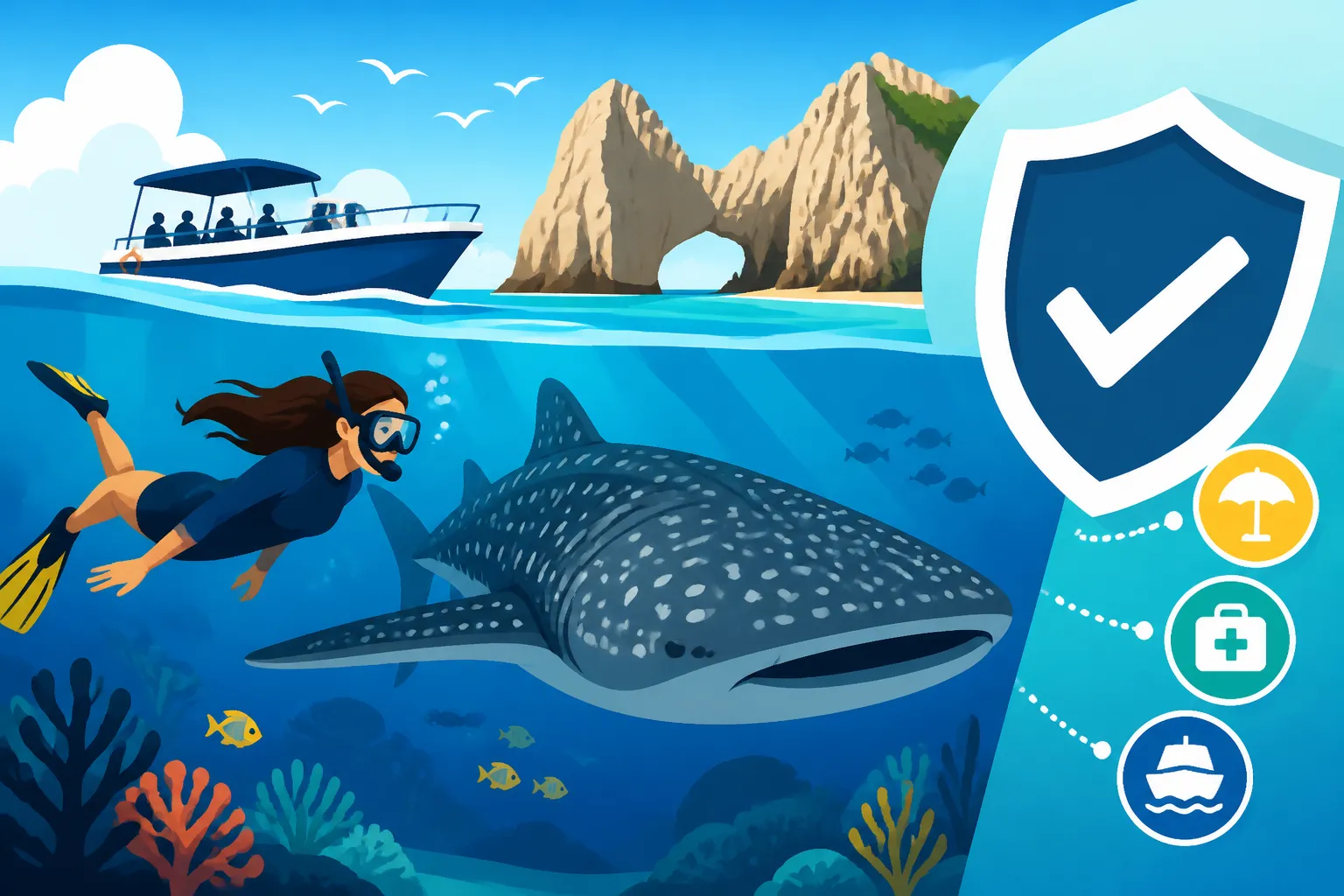
Snorkelling, Whale Sharks, and Marine Tours: Coverage Gaps to Check
Picture this: you’ve booked a whale shark tour out of Isla Mujeres or a two-tank dive off Cozumel, and halfway there you wonder whether your travel insurance covers any of it. Many visitors find out only after a coral gash, a bad ascent or a rough boat ride. This guide shows where marine tour coverage usually fails, and how to close those gaps before you get in the water.
Disclosure: This post may contain affiliate links. We may earn a commission at no extra cost to you if you make a purchase through these links. Read full disclosure.
Where Marine Tours in Mexico Fall Through Insurance Gaps
I have lived on this coast long enough to watch many friends go through the same moment. Someone climbs back onto the panga after an amazing snorkel, notices blood running down a shin from a brush with fire coral, and asks the group, “Wait, does my insurance even cover this?” Nobody knows. Everyone pulls out their phones, and the policy PDF won’t load on one bar of signal halfway between Holbox and the open Gulf.
The ocean is the main reason most people come to the Mexican coast. Snorkelling, scuba, swimming with whale sharks, turtle tours and cenote trips make up most of the itineraries I see. Insurance wording, though, is written by people who group activities into categories, and those categories rarely match how your day actually goes. A single tour can cross three different policy definitions before lunch.
If you’re still choosing where to go, our guide to Snorkeling and Diving on Mexico’s Coasts covers the main regions. This article is about the paperwork behind those trips.
Snorkelling Is Not Diving in Policy Language
The first trap is vocabulary. You may think of snorkelling and scuba as two versions of the same hobby. Insurers don’t. For most policies, snorkelling is surface swimming with a mask and fins. Scuba diving means breathing compressed air underwater, which carries pressure-related risks such as decompression illness and barotrauma. Those risks can lead to expensive treatment, including time in a hyperbaric chamber.
So a policy can cover your snorkel in the Puerto Morelos reef lagoon and exclude your discover-scuba session the next morning in the same water, with the same operator. Here’s a common scenario. A couple from Toronto does a combined tour that includes a snorkel stop at Akumal and then an “intro dive” the guide offers on the boat. They assume one tour means one coverage decision. It doesn’t. The snorkel and the dive are judged separately, and the dive is usually the one that needs extra cover.
The fix is simple but easy to forget. Before you book, list every activity in the tour description, including the optional add-ons the crew might offer once you’re on board. Then check each one against your policy wording.
Whale Shark Days and the Open Water Problem
Whale shark tours from Cancún, Isla Mujeres and Holbox, and the separate season around La Paz in Baja California Sur, are some of the most memorable days you can have in Mexico. They also put you in exposed conditions. The boats often run a long way offshore, the swell can be serious, and you jump into deep open water next to the largest fish on the planet. Our piece on Whale Shark Tours Near Cancun and La Paz: Operators and Season goes into timing and which operators to choose.
From an insurance point of view, the swimming part is usually snorkelling. Regulated whale shark tours in Mexico generally don’t allow scuba near the animals, so you’ll be at the surface in a mask, fins and often a life vest. That helps, because snorkelling sits in a friendlier coverage category. The injuries that actually happen on these days, though, often aren’t in the water. People slip on wet decks, get thrown around by chop, suffer severe seasickness and dehydration, and get badly sunburned after hours on an unshaded boat.
These everyday injuries are where your general medical cover does most of the work. A sprained wrist from a fall on deck isn’t an adventure sports claim. It’s an ordinary accident that happened on a boat. What you need to know is whether your policy treats the whole tour as a covered activity, or whether an exclusion for the excursion could pull the deck injury in with it.
How SafetyWing Handles Snorkelling and Scuba
For long-stay visitors, digital nomads and anyone spending a season on the Mexican coast, SafetyWing comes up again and again. I think it’s one of the most practical options for people whose ocean time is mostly snorkelling and the occasional guided dive. Here is how the policy wording works, using the Nomad Insurance Essential policy document effective September 2025. Always read the latest version on SafetyWing’s own site before you buy, because wording can be revised.
What the Base Plan Covers
On the base Essential plan, snorkelling is covered. That matters, because snorkelling is the activity most visitors to Mexico do most often. Reef snorkelling off Cozumel, swimming with turtles in Akumal, a snorkel stop on a Bacalar boat tour, and swimming at the surface next to whale sharks all fall under snorkelling.
Think about a typical month on the Riviera Maya. You might snorkel four or five times, often on a whim because a friend has a spare mask or a beach club rents gear by the hour. You don’t want to call your insurer before every swim. Base-plan snorkelling cover means those spontaneous swims aren’t a paperwork problem.
As always, covering an activity doesn’t mean covering everything that happens around it. Your claim still depends on the normal policy conditions, such as reasonable care and no other exclusions applying. Going out drunk in red-flag conditions is an example of what can undo a claim. For a full list of what falls outside the policy, see What SafetyWing Does Not Cover in Mexico: The Exclusion List, Line by Line.
The Adventure Sports Add-On and the Instructor Condition
Scuba is where people get caught out. Under the Essential policy document, scuba diving is excluded from the base plan. To have scuba covered, you need the paid Adventure Sports add-on. Even with the add-on, the cover applies when you are diving accompanied by an instructor certified by PADI, NAUI, SSI or BSAC.
That second condition matters more than many divers realise. Imagine you’re a certified Open Water diver. You’ve bought the add-on and feel protected. Then you meet a dive buddy in Playa del Carmen and the two of you hire a boat captain for a casual reef dive with no instructor along. Under the condition described above, that dive is outside the cover. Your certification and the add-on aren’t enough without the accompanying instructor.
In practice, this works well for most visitors. Most recreational divers here dive through shops that send a certified instructor or guide on every trip. My advice is to confirm before you board that the person leading your dive holds an instructor credential from one of those four agencies, not just a divemaster rating or “lots of experience.” Ask to see the card. Good shops expect this question, and I’ve never had a reputable Cozumel operator object. For more on choosing shops and boats on the island, read Diving and Snorkelling Trips in Cozumel: Booking Boats and Gear.
Depth Limits and Why Wording Beats Rumour
Expat forums are full of half-remembered rules about insurance depth limits. Some policies do cap diving depth, and the cap can differ depending on your certification level. The SafetyWing Essential policy document doesn’t state a depth limit for scuba covered under the Adventure Sports add-on. The condition it sets is the instructor requirement, not a depth number.
Don’t read “no depth limit stated” as “anything goes.” Your instructor’s limits, your certification level, the operator’s rules and basic safety still apply, and diving beyond your training is reckless whatever the policy says. The practical point is that if you’re comparing SafetyWing against another policy that does set a depth cap, you’re comparing two different kinds of restriction. One limits depth. The other requires an accompanying instructor. Work out which one fits how you actually dive.
The deeper wall dives off Cozumel, the cenote systems near Tulum and the drop-offs at Cabo Pulmo are where this comparison counts. For a closer look at depth wording and recompression costs in general, see Diving and Cenote Swimming: Depth Limits and Chamber Costs in Your Policy.
Coverage Gaps to Check Before You Board
Here is a side-by-side summary of the activities that come up most often on Mexican marine tours, based on the SafetyWing Essential policy document described above. Use it as a starting point, then confirm against the latest wording.
| Activity | SafetyWing base Essential plan | With Adventure Sports add-on | What to check yourself |
|---|---|---|---|
| Reef or beach snorkelling | Covered | Covered | Sea conditions, flag warnings, sober participation |
| Snorkelling with whale sharks at the surface | Covered as snorkelling | Covered as snorkelling | That the tour involves surface swimming only, and no other exclusion applies |
| Guided scuba with a PADI, NAUI, SSI or BSAC instructor | Not covered | Covered | The instructor’s credential, not just a divemaster rating |
| Scuba with a buddy and no instructor | Not covered | Outside the instructor condition | Avoid this, or accept that you are uninsured for the dive |
| Discover or intro scuba dive offered on a tour | Not covered | Covered when led by a certified instructor | Who is actually leading the session in the water |
| Guided cenote scuba | Not covered | Covered when accompanied by a certified instructor | Instructor credential, plus any separate exclusions for overhead environments in the wording |
| Depth restriction for covered scuba | Not applicable | No depth limit stated | Your own training limits and the operator’s rules |
| Freediving or breath-hold diving | Read the wording | Read the wording | Whether it is named, excluded or treated as an adventure sport |
Cenotes, Freediving and the Grey Areas
The cenotes of the Yucatán blur the categories. Swimming in an open cenote like a sunlit swimming hole is very different from a cavern dive under a rock ceiling, which is different again from full cave penetration. Many policies treat overhead environments as a separate risk. Read the exact wording before you assume a cenote dive is the same as a reef dive. The instructor condition still applies to any covered scuba, and you should check whether anything else in the wording addresses cave or cavern environments. Our guide to Cave Diving and Cenote Dives: Certification Checks Before You Book explains how to vet cenote operators and what credentials to ask for.
Freediving is the other grey area. It’s increasingly popular in Mexico, with courses running in Mahahual, Cozumel and the cenotes. It isn’t snorkelling in any real sense, because you’re descending on a breath-hold, but it isn’t scuba either. If you plan to take a freediving course, contact your insurer and ask how they classify it. Get the answer in writing. A chat transcript or email will help you far more than a phone call you can’t prove later.
Wildlife encounters raise their own questions. Turtle tours, sea lion swims at Espíritu Santo near La Paz and dolphin experiences are usually snorkelling in practice. It’s still worth checking that nothing in the policy wording singles out animal contact. Choosing ethical, well-run operators also lowers your risk. For that, see Sea Turtle and Marine Wildlife Tours: Ethical Operators and Booking.
Medical Logistics on the Coast
Coverage is only half the story. The other half is where you’ll be treated if something goes wrong. Cancún, Playa del Carmen and Cozumel have private hospitals that see foreigners all the time. Cozumel also has hyperbaric facilities because of its dive industry. More remote spots like Holbox, Mahahual, Cabo Pulmo or the beaches of Bahía Concepción are a different situation. A serious injury there could mean a long transfer by boat, road or air.
This is where emergency evacuation cover matters, often more than the activity cover. Before your trip, check how your policy handles moving you from a small clinic to a facility that can actually treat you. Our guide to Air Ambulance Cover in Coastal and Rural Mexico: Where the Nearest Trauma Centre Is maps the realistic options. For the Caribbean side in particular, Healthcare in Cancún and Riviera Maya: Hospitals and Clinics for Expats covers the main facilities.
Hospitals on the coast are very used to foreign patients, but many still ask for a guarantee of payment or a deposit before non-emergency treatment, especially if your insurer doesn’t bill them directly. Keep a working credit card with you on tour days, not locked in your hotel safe. The worst position to be in is lying on a gurney with your card forty minutes away.
Your Pre-Tour Insurance Checklist
After years of watching friends work this out the hard way, I go through the same routine before every marine trip. It takes about fifteen minutes, and I’ve never regretted the time.
Steps to Take Before You Book
- Write down every activity the tour includes, including optional extras such as intro dives, cliff jumps, kayak legs or cenote stops on the way back.
- Match each activity to your policy category: snorkelling, scuba or something unnamed that needs a question to your insurer.
- If any activity is scuba, confirm you have the SafetyWing Adventure Sports add-on active for the dates of your dive, not just for the start of your trip.
- Email or message the operator and ask whether every dive is led by an instructor certified by PADI, NAUI, SSI or BSAC, and ask for the instructor’s name.
- Download your policy document and insurer contact details to your phone so you can read them offline. Signal on boats and in cenote parks is unreliable.
- Save the name and address of the nearest private hospital to your departure point, plus the nearest hyperbaric facility if you’re diving.
- Pack a waterproof pouch with a photo of your passport, your policy number and a payment card.
- Check the beach flag conditions and marine forecast on the morning of the trip, and use Beach Safety 101: How to Read Warning Flags and Stay Safe in the Ocean if you’re unsure what the colours mean.
Steps to Take If Something Goes Wrong
- Get medical care first. Paperwork comes later, and no policy expects you to delay emergency treatment to make a phone call.
- Contact your insurer’s emergency line as soon as it’s safe. With SafetyWing, early contact helps with arranging care and any transfer.
- Ask the tour operator for a written incident note on letterhead, signed if possible, stating the date, location, activity and what happened.
- If you were diving, get the instructor’s full name and certification number in writing. This shows the dive met the instructor condition.
- Keep every receipt, prescription and medical report, and ask the hospital for itemised bills rather than a single total.
- Photograph your injury, the equipment involved and the conditions if you can, because these details help when you file.
- Submit your claim with all documents together. Our guide to Filing a Claim From Mexico: Documents Hospitals Will and Won’t Give You explains which papers Mexican hospitals provide routinely and which you’ll need to request.
Choosing Operators Who Make Your Claim Easier
A well-run operator lowers your risk of injury and also makes a claim much easier. Good shops keep passenger manifests, have emergency oxygen on board, know the nearest chamber, and readily provide instructor credentials and incident reports. Fly-by-night operators selling cheap tickets on the beach often can’t do any of that, and some won’t even give you a receipt.
If you’re comparing operators, prioritise visible certifications, recent and detailed reviews, safety briefings before you get in the water and reasonable passenger numbers. Our checklist in Tour Safety in Mexico: Vetting Operators and Reading Reviews Properly covers the warning signs. If the crew won’t tell you who’s leading the dive, walk away. A refund is cheaper than an uninsured accident.
For most visitors, the best approach is simple. Rely on SafetyWing’s base-plan snorkelling cover for the reef days and whale shark trips, add the Adventure Sports add-on before any scuba, and only dive with certified instructors. Check the plan details and current pricing on SafetyWing’s own site, match them to your itinerary, and you can enjoy the water without worrying about your coverage.
Disclaimer
This article is for general informational purposes only and does not constitute professional advice. Laws, prices and regulations vary by location and change over time. Consult a qualified professional for guidance on your specific situation.