Booking Platforms vs Direct Booking in Mexico: When Calling the Hotel Wins
Picture the Friday before a long weekend in Oaxaca. One tab shows a lovely courtyard hotel at one price. The hotel’s own website shows something slightly different. The owner’s WhatsApp says “call us for a better rate.” You have no idea which option is safe, cheapest, or refundable. This guide shows when a booking platform protects you and when picking up the phone gets you more.
Disclosure: This post may contain affiliate links. We may earn a commission at no extra cost to you if you make a purchase through these links. Read full disclosure.
Why Booking a Hotel in Mexico Feels So Confusing
I have booked rooms in Mexico every way possible over the years. I have used apps from my sofa, sent emails in shaky Spanish, called a posada in Pátzcuaro from a bus station payphone, and once turned up at a hotel in Bacalar with nothing but a hopeful smile. Every method worked at some point. Every method also failed me at least once. That is the frustration worth naming first. In Mexico there is no single “right” way to book, because the hotel landscape is split between two worlds.
How Mexican Hotels Actually Sell Their Rooms
The first world is the big, polished one. Resort chains in Cancún, business hotels in Polanco and Monterrey, and boutique properties in Roma Norte and San Miguel de Allende all run proper revenue management. They load their rooms onto several online channels at once. Software updates prices automatically, and a reservations team in an office somewhere handles thousands of bookings. For these properties, a booking platform is part of the plumbing, not an extra.
The second world is the one that makes Mexico so wonderful to travel. It includes family-run posadas, guesthouses above a hardware store, haciendas with six rooms, and beach cabañas where the owner’s nephew answers the phone. Many of these places list on one platform, or none. Their “system” might be a paper calendar behind the front desk and a WhatsApp chat. Prices can shift depending on who answers, whether it is a holiday week, and whether you sound like you will stay a while.
When you understand this split, the whole booking question gets simpler. You are not really choosing between “platform” and “direct.” You are working out which world your hotel lives in, and then using the tool that fits. For a deeper look at the second world, see Posadas and Small Family Hotels: Booking Mexico’s Budget Tier.
Rate Parity and Why the Direct Price Is Not Always Lower
Many travelers expect the hotel’s own price to be cheaper, because the hotel saves the commission it pays a platform. Sometimes that holds. Often it does not. Larger hotels commonly agree to keep their public prices aligned across channels. The rate you see on a platform and the rate on the hotel’s own website are frequently identical for the same room and the same conditions.
Where differences appear, they tend to come from the conditions rather than the headline price. A hotel may offer its direct customers a free breakfast, a later checkout, or a room upgrade instead of a lower rate. A platform may offer a member discount or a promotional price that the hotel cannot advertise publicly on its own site. That means you need to compare the whole package, not one number.
There is also currency. A hotel website in a resort town may quote in US dollars while a platform shows pesos, or the reverse. The conversion your card applies can turn two “identical” prices into different totals. Before you decide one channel is cheaper, read Paying in Pesos vs Dollars at Mexican Hotels: Which Rate You Actually Get.
Why Booking.com Should Be Your Default Starting Point
I will be honest about my own habit. For most trips across Mexico, I open Booking.com first. That is not because it always wins. It is because it gives me the clearest picture of the market in the shortest time, and it protects me in situations where a phone call cannot. Even when I end up booking direct, I usually started my search there.
Seeing the Real Total Before You Commit
The biggest hidden headache in Mexican hotel pricing is the gap between the advertised rate and what you actually pay at checkout. IVA, the national sales tax, is usually built into the price, but the state lodging tax and occasional local environmental or sanitation charges can be shown separately or added at the property. The rules differ from state to state, and they change. For the full breakdown, see Mexico’s Lodging Tax by State: What You Pay on Top of the Room Rate.
On Booking.com, the price summary typically separates what is included from what is payable at the property. You can compare five hotels in Tulum or Mérida side by side and see which ones add charges on arrival. Doing the same thing by phone means asking each hotel the same set of questions, writing down the answers, and hoping the person who answered was right. I have spent whole afternoons doing that. A filtered search does it in minutes.
Transparency also helps with room types. Mexican hotels use descriptions like “habitación estándar,” “junior suite,” and “matrimonial,” which can mean very different things depending on the property. A “matrimonial” bed might be a double, not a queen. Platform listings usually show bed sizes, room size, photos per room type, and whether air conditioning is included, which matters enormously in Mérida in May.
Cancellation Clarity When Your Plans Fall Apart
Travel in Mexico has a way of rearranging itself. A bus gets cancelled on a mountain road in Chiapas. A hurricane warning goes up on the Pacific coast. A friend invites you to their cousin’s wedding in Guadalajara and suddenly your Puerto Vallarta days shrink. When plans change, cancellation terms matter more than almost anything else.
On a platform, the cancellation terms are spelled out in writing before you pay. You can filter for free cancellation, see the exact deadline in your booking confirmation, and cancel with a button rather than a negotiation. Refundable and non-refundable rates sit side by side, so you can make a conscious decision about how much flexibility you are paying for. That trade-off is covered in Refundable vs Non-Refundable Rates in Mexico: When the Discount Is Worth It.
Direct bookings are a different animal. Some hotels, especially friendly small ones, can be more flexible than any platform if you call and explain your situation. Others ask for a deposit by bank transfer or cash payment at a convenience store, and getting that money back if you cancel can depend entirely on the owner’s goodwill. Neither outcome is guaranteed. That variability is the real issue. With a platform rate, you know the rules in advance. With a direct booking, you need to get them written down yourself.
During storm season this difference becomes very real. Before booking anything on the coast between early summer and late autumn, read Hurricane Season in Mexico: Refundable Rates and Booking Strategy.
Reviews, Language, and Booking From Abroad
If your Spanish is limited, the platform route removes an entire layer of stress. You book in your own language, the confirmation arrives in your own language, and the in-app messaging often includes translation. You can message the property about late arrival, airport pickup, or a crib for your toddler without fumbling through verb conjugations on the phone.
Verified guest reviews are the other big advantage. A hotel’s own website will only show its best photos. On a platform, the reviews come from people who actually stayed, and you can sort them by recent date or traveler type. I always read the low-scoring reviews first. If three people mention street noise from the Saturday night market or a weak water heater, I know exactly what I am getting.
Booking from overseas also brings practical hurdles: cards that get declined, guest names that must match passports, and pre-authorisations that freeze money on your card. Platforms handle much of this smoothly, but it is still worth reading Booking Mexican Hotels From Abroad: Cards, Names, and Passport Matching before your first trip.
When Calling the Hotel Wins
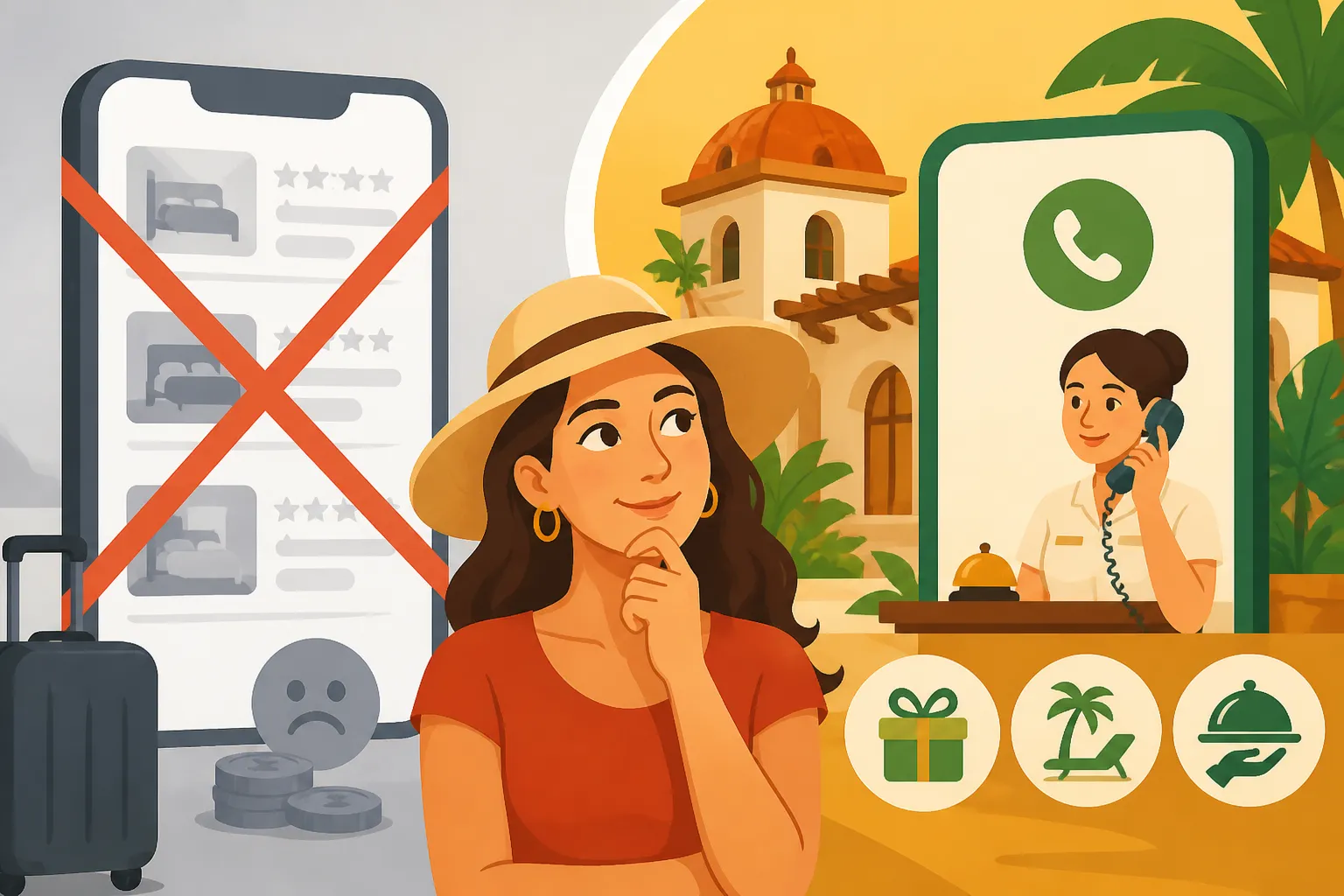
Now for the part of the title that makes this interesting. Booking.com is my starting point, but there are clear situations where a phone call, an email, or a WhatsApp message beats any platform. Learning to spot them is what separates a good Mexico trip from a great one.
Small Posadas and Places Off the Platforms
In many smaller towns, the best room in the village is simply not listed anywhere online. I found my favorite guesthouse in Cuetzalan this way. A woman at the market pointed me to her sister’s place, I called, and I got a room with a view of the cloud forest that no app could have offered. In towns like Real de Catorce, Mazunte, or the mountain villages around Oaxaca, a lot of lodging still runs on word of mouth.
Even when a small property is listed on a platform, it may only release a few of its rooms there. When the platform shows “sold out,” the hotel might still have rooms it keeps for direct guests or repeat visitors. If the place you want looks full online, call before you give up. I have been told “no availability” by an app and then had a room within two minutes on the phone.
Small family hotels may also prefer cash or bank transfer and may offer a modest discount to avoid card fees and platform commission. That can be a genuine saving. Just make sure you get the price, dates, and cancellation terms in writing, even if it is a WhatsApp message.
Long Stays, Groups, and Special Requests
The moment your stay stretches beyond a week or two, direct contact becomes powerful. Hotels and aparthotels in places like Mérida, Oaxaca City, and San Cristóbal often have weekly and monthly rates that never appear on any platform, because they do not fit the standard nightly pricing. The negotiation tactics are covered in Long-Stay Discounts in Mexico: Negotiating Weekly and Monthly Rates.
Groups are similar. If you are booking five rooms for a family reunion in San Miguel de Allende or a wedding party in Puerto Vallarta, a platform will treat you as five separate bookings. A sales manager on the phone can treat you as one group, block adjoining rooms, waive a resort fee, or throw in a welcome dinner. Those deals are made person to person.
Special requests also land better when you talk to a human. Ground-floor rooms for a parent with bad knees, a quiet room away from the bar, a very early arrival after an overnight bus, a crib, or a late checkout before a night flight are all easier to arrange when the staff know your name. For how flexible Mexican hotels tend to be with arrival and departure times, see Early Check-In and Late Check-Out in Mexico: Who Actually Offers It.
Facturas and Business Travel
If your employer or your own business needs an official Mexican invoice, called a factura or CFDI, booking direct can save you real trouble. To issue a factura, the hotel needs your RFC (tax ID), your registered business name, your tax regime, and a usage code. When you book directly, you can give the hotel this information up front and make sure the invoice is issued in the right name and before the deadline.
When you book through a platform, the factura question can get complicated. Depending on how the payment flows, the hotel may issue the invoice for the room, but questions can arise about service fees or about who the invoice should be addressed to. It is usually solvable, but it requires an extra conversation at the front desk. The full process is explained in Business Trip Bookings in Mexico: Facturas, IVA, and Reimbursement.
Platform vs Direct Booking: The Side-by-Side Comparison
Here is how the two approaches compare across the issues that matter most in Mexico. Use it as a quick decision tool before every trip.
| Factor | Booking.com | Calling or Messaging the Hotel Directly |
|---|---|---|
| Price comparison | Many hotels compared side by side in minutes | One hotel at a time, by phone or message |
| Headline price at larger hotels | Usually the same as the hotel’s own website | Usually the same, sometimes with perks like breakfast or an upgrade |
| Price at small posadas | Only shows properties that list there | Can be lower, especially for cash or bank transfer |
| Cancellation terms | Written, filterable, shown before payment | Varies by property; can be more flexible after a friendly conversation, or a deposit may be hard to recover |
| Long stays of several weeks | Standard nightly pricing, some long-stay discounts | Weekly and monthly rates often negotiable |
| Group bookings | Separate bookings per room | One group deal with a sales contact |
| Language | Your own language, with in-app translation | Often Spanish only, especially in small towns |
| Reviews | Verified guest reviews | Word of mouth and the hotel’s own claims |
| Facturas for business | Possible, but may need extra steps at the desk | Easier to set up correctly from the start |
| Special requests | Sent by message; the hotel may or may not see them in time | Agreed directly with staff |
| Dispute support | Platform customer service can step in | Only you and the hotel |
Reading the Table for Your Kind of Trip
If you are a first-time visitor doing a classic route of Mexico City, Oaxaca, and the Yucatán, most of the decisive rows point to the platform. You need comparison, clear cancellation, reviews, and support in your own language. That is precisely what Booking.com is built for, and it is why I tell friends planning their first trip to book the bulk of their nights there.
If you are a slow traveler staying a month in one town, the long-stay and price rows tilt toward direct. If you are on a work trip where accounting needs a proper factura, the invoicing row decides it. And if you are chasing a tiny guesthouse in the Sierra Norte of Puebla, the small-posada row makes the call for you.
Most trips are mixtures. You might book Mexico City and Cancún on a platform because those are big, competitive markets, then call a family hotel in Valladolid or Izamal because that is where the personal touch shines.
The Hybrid Method I Actually Use
Over time I settled on a hybrid approach that gets me the best of both worlds. It looks like this:
- Search the destination on Booking.com with my dates, budget, and must-haves such as air conditioning, parking, or a pool.
- Shortlist three or four properties based on location, recent reviews, and total price including taxes.
- Check each shortlisted hotel’s own website for the same room and dates.
- For small properties or long stays, send a WhatsApp message or call asking for their direct rate and conditions.
- Compare the full packages, not just the numbers: price, cancellation, breakfast, and payment method.
- If prices and terms are similar, book on the platform for the written protection.
- If the hotel offers a clearly better deal directly, accept it only after getting the terms in writing.
The beauty of this method is that the platform does the heavy research, and the phone call is a focused, targeted negotiation. You are not calling blind. You already know the market price, which gives you real confidence when you talk to the hotel.
How to Call or Message a Mexican Hotel Step by Step
Calling a hotel in another language is genuinely nerve-wracking. I still remember my hands shaking before my first call to a hotel in Guanajuato. The good news is that hotel staff deal with confused foreigners every day, and a little preparation makes the whole thing far easier.
Before You Make Contact
Preparation is half the battle. Have these details ready before you dial or type:
- Your exact arrival and departure dates.
- The number of adults and children, and the ages of the children.
- The room type you want, with a backup option.
- The rate you saw on the platform or the hotel’s website, so you have a benchmark.
- Your questions about taxes, breakfast, parking, and cancellation.
- Your preferred payment method and any questions about deposits.
WhatsApp is often the best first step. Most Mexican hotels, from boutique properties in Condesa to cabañas in Holbox, have a WhatsApp business number on their website or social media. Messaging gives you time to write carefully and use a translation app, and it automatically creates a written record. For larger hotels, a short email to reservations also works well.
Timing matters. Avoid calling small hotels during the busy check-in hours in the afternoon or over lunch. Mid-morning on a weekday is usually the calmest time, and the person who answers will have more patience for your questions.
The Conversation in Spanish
You do not need fluent Spanish. You need a handful of polite, clear phrases. Here is a script that has served me well across the country:
- “Buenas tardes, quisiera saber si tienen disponibilidad del (fecha de llegada) al (fecha de salida).” Good afternoon, I would like to know if you have availability from (arrival date) to (departure date).
- “Somos (número) personas.” We are (number) people.
- “¿Cuál es la tarifa por noche con impuestos incluidos?” What is the nightly rate with taxes included?
- “¿Incluye desayuno?” Does it include breakfast?
- “¿Cuál es la política de cancelación?” What is the cancellation policy?
- “¿Tienen tarifa por semana o por mes?” Do you have a weekly or monthly rate?
- “¿Necesitan un anticipo? ¿Cómo se paga?” Do you need a deposit? How is it paid?
- “¿Me lo pueden confirmar por WhatsApp o correo?” Can you confirm it by WhatsApp or email?
Use “usted” rather than “tú” with hotel staff. It sounds respectful and slightly formal, which is exactly right. For more useful phrases, see Survival Spanish for Travelers in Mexico: Key Phrases.
Do not be afraid to ask, gently, whether they can improve on the rate you have seen elsewhere. Phrasing it as a question rather than a demand works far better in Mexico. Something like “Lo vi en otra página por (precio). ¿Me lo pueden dejar igual o con desayuno?” means “I saw it on another site for (price). Could you match it or include breakfast?” Mexican business culture tends to reward warmth and patience over hard bargaining.
Locking It In Without Losing Your Money
This is the step where many direct bookings go wrong. A friendly phone call is not a reservation. Before you send any money, get a written confirmation that includes:
- The guest name.
- The exact dates.
- The room type.
- The total price and which taxes are included.
- The deposit amount and when the balance is due.
- The cancellation terms, including any deadline.
Small hotels often ask for a deposit, called an anticipo, by bank transfer or cash payment at a convenience store. Pay only to an account in the hotel’s or owner’s name that matches the business you contacted. Check that the WhatsApp number is the same one published on the hotel’s official website or verified social profile. Fake listings and impostor accounts do exist, especially around popular beach towns.
Keep screenshots of everything, including the transfer receipt. If anything goes wrong on arrival, those screenshots are your only evidence. On a platform booking, the confirmation and support channel handle that for you. For a direct booking, you are your own customer service department. The way card holds and deposits work at check-in is explained in Deposits and Pre-Authorisations at Mexican Hotels: What Gets Held.
Real Scenarios: Which Booking Method Wins
Abstract advice only goes so far. Here are real-life situations I have lived through or watched friends navigate, and which approach came out ahead.
A First-Timer’s Week Between Mexico City and Oaxaca
My friend Laura flew in from Toronto for her first trip, with four nights in Mexico City and three in Oaxaca. She had very little Spanish and a fixed budget. Every factor pointed to the platform. She needed to compare neighborhoods in Mexico City quickly, read recent reviews about noise and safety, and have free cancellation in case her flight changed.
She booked both stays on Booking.com, filtered for free cancellation, and checked the property-payable charges in the price summary. When her Oaxaca bus was delayed, she messaged the hotel through the app, and the translation tool handled the exchange. Nothing about her trip would have improved by calling. The platform gave her clarity and calm, which is exactly what a first-timer needs.
The one thing she could have done differently was to message the Oaxaca hotel directly after booking to ask about breakfast and a quiet room. Hotels are usually happy to accommodate platform guests too, and it costs nothing to ask.
A Semana Santa Beach Escape
Holy Week is the most intense travel period of the year in Mexico. Mexican families head to the coast in huge numbers, and popular destinations like Acapulco, Puerto Escondido, Huatulco, and the Riviera Maya fill up fast. To plan the timing, see Semana Santa in Mexico: Which Destinations Sell Out and When.
During peak weeks, I strongly favor the platform for the initial booking, because inventory moves by the hour. Securing a refundable room early on Booking.com gives you a safety net. Then, if you want, you can contact the hotel directly to ask about a better room or a package with meals. If they offer something better with written terms, you can switch and cancel the platform booking before the deadline.
The danger during Semana Santa is relying solely on a direct phone promise. When demand is extreme, a small hotel juggling bookings on a paper calendar can accidentally double-book. I have seen travelers arrive in Zipolite at dusk to discover their “confirmed” room had gone to someone else. A written, platform-backed reservation is far harder to lose.
Two Months in Mérida as a Slow Traveler
Now the opposite case. A couple I know wanted to spend two months in Mérida during the winter to test whether they liked the city enough to move. Nightly rates on any platform added up to a painful total for that length of stay. Here, calling won decisively.
They used a platform to find a few aparthotels in Centro and Santa Ana with good reviews and kitchens. Then they messaged each one directly asking for a monthly rate. Two properties offered substantial discounts for a two-month stay, and one included weekly cleaning and utilities. They paid a deposit after getting everything confirmed in writing, and had a much better experience than they would have had booking night by night.
They did take one sensible precaution. They booked the first few nights on Booking.com, so they could see the apartment, the street noise, and the water pressure in person before committing to the full stay. That bridge booking cost a little extra but removed the risk of locking into two months somewhere they did not like.
Disclaimer
This article is for general informational purposes only and does not constitute professional advice. Laws, prices and regulations vary by location and change over time. Consult a qualified professional for guidance on your specific situation.