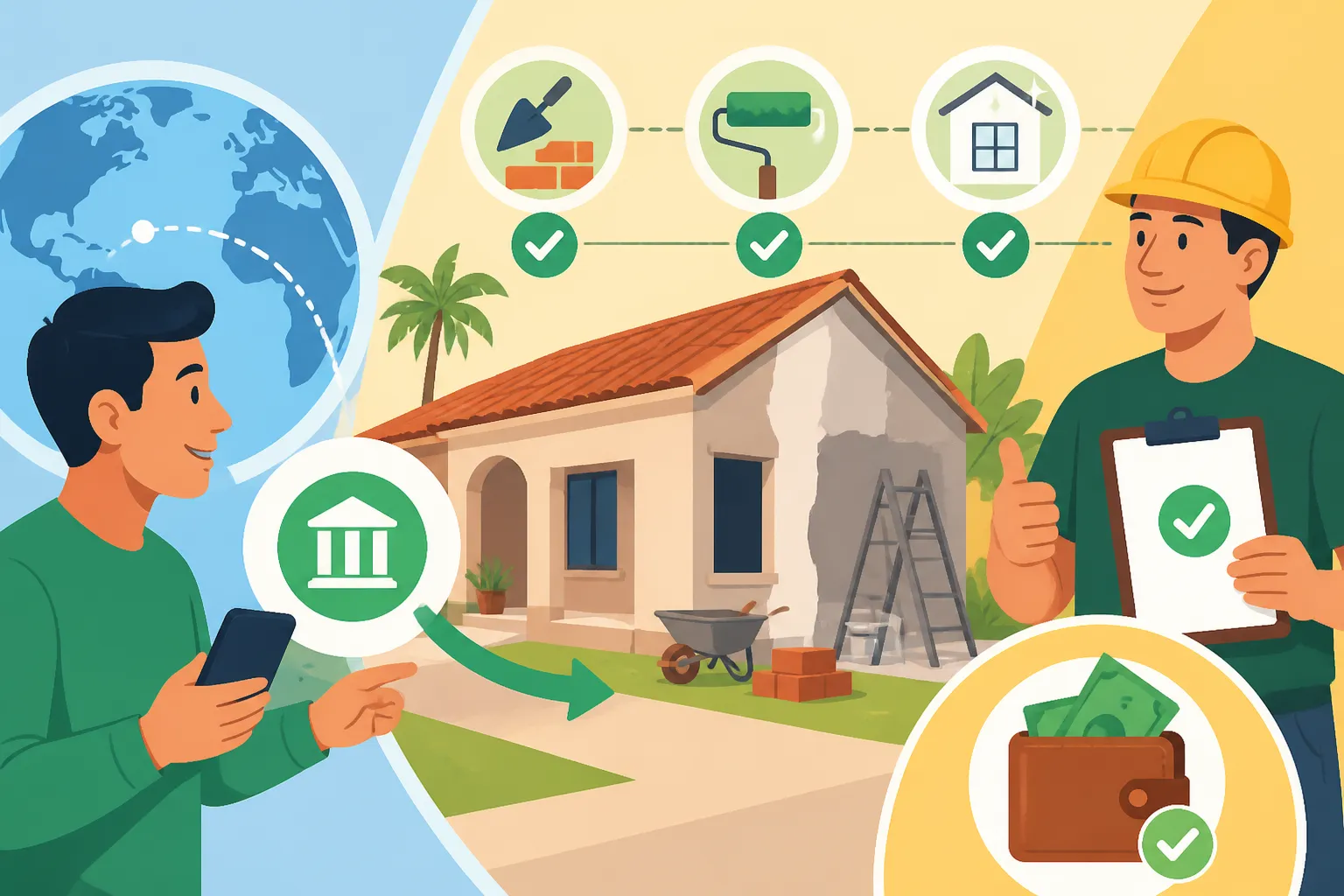
Funding a Mexican Home Renovation From Abroad: Staged Payments and Receipts
Embarking on a home renovation in Mexico while you're living miles away can feel like an overwhelming odyssey, fraught with potential miscommunications, unexpected delays, and financial anxieties. This guide is here to walk you through the essential strategies of managing staged payments and securing proper receipts, specifically designed to protect your investment and sanity when funding your dream Mexican home upgrade from abroad.
Disclosure: This post may contain affiliate links. We may earn a commission at no extra cost to you if you make a purchase through these links. Read full disclosure.
The Unique Challenges of Renovating from Afar in Mexico
If you’ve ever tried to coordinate a project in Mexico, you know it operates on a slightly different rhythm than back home. Add an international border to the mix, and what seems like a simple renovation can quickly become a complex juggling act. It’s not just about finding a good contractor; it’s about navigating cultural norms, legal requirements, and the sheer logistics of making sure your money is working for you, even when you’re not physically present.
Trust and Communication Gaps
One of the biggest hurdles for expats renovating from abroad is the inherent trust deficit and the communication breakdown that can occur. You're relying heavily on photos, videos, and phone calls, which can only tell you so much. What's a minor detail to you might be a huge misunderstanding when translated, or vice versa. This isn't always malicious; sometimes it's simply a difference in how work is prioritized, understood, or communicated. When you're not there to supervise daily, the temptation for a less-than-scrupulous contractor to cut corners or misrepresent progress increases. You might find yourself constantly questioning if what you’re being told is the full picture, leading to stress and doubt about your investment.
The "Mexican Time" Phenomenon and Project Delays
Ah, "Mexican Time." It's a charming aspect of life here when you're enjoying a leisurely lunch, but when it applies to your renovation timeline, it can be a nightmare. Projects often take longer than initially estimated, and unforeseen issues can emerge that push deadlines back further. This isn't necessarily due to incompetence, but rather a combination of factors: availability of materials, unexpected permits, local holidays, or simply a different approach to project management. When you're trying to schedule payments around these shifting timelines, it creates a constant source of frustration. Imagine wiring funds for the next stage, only to find the previous one still incomplete because a key material shipment is delayed by una semana más (just one more week). This constant uncertainty makes proper financial planning from a distance incredibly challenging.
Unexpected Costs and Scope Creep
Even with a detailed contract, renovations almost always encounter unexpected costs. In Mexico, these can range from sudden increases in material prices (especially for imported goods), permit fees you weren't aware of, or additional labor needed for unforeseen structural issues. "Scope creep," where the project gradually expands beyond the original agreement, is also a common occurrence. A contractor might start on one task and then suggest a "small improvement" that seems minor but adds up. Without being on site to discuss these changes face-to-face and approve every adjustment, you might find yourself receiving requests for additional funds that weren't in your original budget. This can be particularly stressful when you're trying to keep a handle on your overall Cost of Living in Mexico: 2026 Comprehensive Guide.
Why Staged Payments Are Your Renovation Lifeline
If there's one golden rule for funding a renovation in Mexico from abroad, it's this: never pay the full amount upfront. Staged payments are not just a good idea; they are absolutely critical to protecting your investment, maintaining leverage, and ensuring your project moves forward as intended. Think of them as your personal project manager, ensuring that work is actually completed before you release more funds.
Protecting Your Investment with Milestones
The concept of staged payments is simple: you pay a percentage of the total project cost upon the completion of agreed-upon milestones. This strategy dramatically reduces your risk. If a contractor demands 50% or more upfront, it's a huge red flag. A typical payment structure might look like this: 10-20% upfront for materials and mobilization, followed by payments of 20-30% at significant stages, such as foundation completion, roof installation, or plumbing rough-in, with a final payment of 10-15% upon satisfactory completion of the entire project.
By tying payments to observable progress, you motivate your contractor to complete each phase to receive their next installment. If work stalls or quality is subpar, you retain a significant portion of the funds, giving you leverage to demand corrections or, in a worst-case scenario, to hire another contractor to finish the job without losing your entire investment. This also makes the process of Transferring Money Internationally: Best Ways to Send Money to/from Mexico much more manageable and less anxiety-inducing.
Setting Up a Clear Payment Schedule
A robust contract is your best friend here. It must clearly outline each payment stage, the specific work that needs to be completed for that payment to be released, and the exact amount or percentage. This isn't just a verbal agreement; it needs to be written down, signed by both parties, and, ideally, witnessed or notarized. Even better, have a local representative (a trusted friend, a property manager, or even an immigration lawyer) visually inspect the work and confirm milestone completion before you initiate a transfer.
For example, a milestone could be "completion of all rough plumbing and electrical wiring for the main bathroom, inspected and approved by client's representative." Get photos and videos as proof. This level of detail protects both you and the contractor by providing clear expectations. Without this, you're essentially handing over blank checks, hoping for the best. Remember, clear expectations prevent disappointment and costly disputes down the line.
The Power of Funds Transfers via Wise
When it comes to executing these staged payments from afar, you need a reliable, cost-effective, and transparent way to send money. This is where a service like Wise really shines. Traditional bank wires can be slow, expensive, and often involve fluctuating exchange rates and hidden fees. Trying to send money from your home country bank to your contractor's Mexican bank account can quickly eat into your renovation budget with unfavorable exchange rates and wire transfer fees.
Wise, formerly TransferWise, offers a significantly better solution. It allows you to send money internationally at the real mid-market exchange rate, with only a small, upfront fee. This means more of your money goes towards your actual renovation, not bank charges. You can easily set up recurring payments or send funds on demand, directly to your contractor's Mexican bank account (or your own if you have a local account – more on that later), giving you control and transparency over each transaction. For expats, this kind of service is invaluable because it takes away much of the stress and financial drain of cross-border transfers, making sure your contractor gets their pesos efficiently when a milestone is met. It truly simplifies the process of making payments for your Buying Property in Mexico: Comprehensive Guide for Foreign Buyers.
Receipts: Your Unsung Hero for Financial Clarity and Protection
In Mexico, receipts are more than just proof of purchase; they are legal documents that can save you significant headaches, especially when dealing with property and taxes. For renovation funding, securing proper documentation for every penny spent is not just good practice – it's crucial.
The Non-Negotiable Necessity of Facturas
When dealing with a formal contractor or purchasing materials from larger stores, always insist on a factura. A factura is a legitimate, government-recognized electronic invoice (CFDI – Comprobante Fiscal Digital por Internet) that includes the vendor’s tax ID (RFC) and often your own. It's not just a printed slip of paper; it's a digitally stamped document that is verifiable with the Mexican tax authority (SAT).
Why is this so important? Firstly, it provides undeniable proof that you paid for goods or services. In case of a dispute, a factura holds far more weight than a handwritten note. Secondly, and perhaps more importantly for property owners, these facturas can be critical when you eventually sell your property. Renovation costs, when properly documented with facturas, can often be deducted from capital gains taxes. Imagine selling your beautifully renovated Mexican home years down the line and being able to significantly reduce your tax burden because you kept meticulous records. This insight is also crucial for understanding Property and Capital Gains Tax in Mexico: A Guide for Foreigners. If your contractor is unwilling or unable to provide facturas, it's a major red flag, potentially indicating they are not a legitimate, tax-paying business. You need to understand How to Issue a Factura (CFDI) in Mexico yourself, or ensure your contractor does.
Tracking Expenses for Your Budget and Potential Tax Benefits
Beyond capital gains, keeping detailed records of all your renovation expenses helps you stay on budget and offers immense financial clarity. When funding from abroad, it's easy for small costs to slip through the cracks or for you to lose track of how much you've actually spent in a different currency. A clear system for collecting, organizing, and reviewing facturas and other receipts is paramount.
Consider using a digital ledger or spreadsheet, updating it regularly with each payment and corresponding receipt. This allows you to compare actual costs against your budget, identify any overruns early, and make informed decisions. Furthermore, should you ever need to justify expenses for insurance purposes, or for future property valuations, having a comprehensive paper trail is invaluable. This is part of the overall financial discipline expats need for Managing Your Money in Mexico: Budgeting, Saving, and Currency Tips.
Dealing with Cash Payments and Informal Receipts
While facturas are ideal, the reality in Mexico is that many smaller contractors, individual laborers, or even local hardware stores might operate primarily on a cash basis and not issue formal facturas. This doesn’t mean you’re out of luck, but it does require extra vigilance. For these situations, insist on a written receipt, even if it's handwritten. This receipt should include:
- The date of payment
- The amount paid (in MXN and potentially USD equivalent)
- A clear description of the goods or services rendered
- The name and signature of the person receiving the payment
- Their phone number or ID number, if possible.
While a handwritten receipt won't suffice for tax deductions in the same way a factura would, it still serves as proof of payment in case of a dispute. Take a photo of the receipt immediately after receiving it, and cross-reference it with your payment schedule. It's a compromise you might have to make in certain situations, but always prioritize facturas where possible, especially for larger sums and materials. If you're a foreigner starting a business here, understanding Do You Need an RFC Number? Why a Tax ID Matters for Expats' Finances becomes even more important.
Streamlining Your Renovation Finances with Wise
Managing renovation funds from another country is inherently challenging, but a smart financial strategy can make all the difference. Integrating a service like Wise into your payment process is not just convenient; it's a strategic move that saves you money and provides critical transparency.
How Wise Simplifies International Payments
The beauty of Wise lies in its straightforward approach to international money transfers. When you send money from your home country bank account, Wise converts it at the mid-market rate – the same rate you see on Google – and sends it to the recipient's bank account in Mexico. You know exactly what you're paying in fees upfront, and there are no hidden markups on the exchange rate, unlike many traditional banks. This clarity is invaluable when you're working with a renovation budget that's constantly being adjusted.
Consider a scenario: you need to send $5,000 USD for the next phase of your kitchen renovation. With a traditional bank, you might pay a $30-$50 wire fee, and then their exchange rate could be 2-3% less favorable than the market rate, costing you another $100-$150. With Wise, you'll see a small, transparent fee (often less than $50 for this amount) and get the true exchange rate, meaning hundreds of dollars more actually make it to your contractor, or into your local Mexican bank account, allowing you to maximize your renovation budget. It integrates seamlessly with your banking, whether you're using a Mexican Fintech and Digital Banks (Nu, Klar, and More) or a more traditional institution.
Managing Your Budget and Payment Records
Wise isn't just for sending money; it also helps you manage your financial trail. Every transaction is recorded in your account, showing you the exact amount sent, the exchange rate applied, and the fees paid. This creates a clear, chronological record of your transfers, which perfectly complements your system for collecting facturas and informal receipts. When you need to reconcile your budget, you have a precise record of every amount sent for the renovation. This detailed history is perfect for matching up with your contractor's invoices and ensuring every peso is accounted for.
If you have a local Mexican bank account, you can transfer money to yourself via Wise first, converting it to pesos at a great rate, and then make local payments to your contractor or suppliers using local bank transfers (SPEI) or even cash withdrawals. This gives you even greater control and can be useful for managing smaller, day-to-day renovation expenses that arise. Understanding Banking in Mexico: Complete Guide for Foreigners is a crucial first step.
Best Practices for Remitting Funds for Renovations
To make the most of Wise and your renovation project, follow these best practices:
- Only Send When Milestones Are Met: Stick to your agreed-upon payment schedule. Have a local contact verify progress, or insist on high-quality photos/videos before initiating a Wise transfer.
- Communicate Clearly with Your Contractor: Inform your contractor that payments will be made via Wise and ensure they have all the necessary bank details. Explain that funds will be released upon completion of agreed-upon stages.
- Keep All Records: Screenshot your Wise transfer confirmations, pair them with the corresponding facturas or receipts, and store everything digitally (e.g., in a cloud folder) and physically.
- Consider a Local Account: While not strictly necessary, having your own Mexican bank account (you can learn How to Open a Bank Account in Mexico: Requirements and Tips) allows you to use Wise to send larger sums to yourself, convert to pesos, and then disburse funds locally as needed, which can sometimes streamline payments for smaller vendors or cash needs.
- Utilize Wise for Supplier Payments: If you're managing materials procurement directly, you can also use Wise to pay larger suppliers who accept bank transfers, further reducing costs and tracking everything in one place.
By adopting these strategies and leveraging the efficiency of Wise, you can navigate the financial complexities of funding your Mexican home renovation from abroad with far greater confidence and significantly less stress. It turns a potential financial headache into a well-managed operation, leaving you free to anticipate enjoying your beautifully updated Mexican home.
| Feature | Wise (Recommended) | Traditional Bank Wire Transfer | Cash Payments (Informal) |
|---|---|---|---|
| Exchange Rate | Mid-market rate (real rate) | Bank's marked-up rate (less favorable) | Directly negotiated/assumed local rate |
| Fees | Low, transparent upfront fee | Often higher fees, sometimes hidden intermediary fees | No direct fees, but risk of carrying large sums |
| Speed | Often same-day or next-day (depending on currencies) | 1-5 business days | Instant (but physical presence required) |
| Transparency | Full cost visible upfront, clear transaction history | Often unclear final cost until transaction completes | No formal digital record; relies on paper/verbal |
| Payment Control | You control when to send staged payments | You control when to send staged payments | You control when to pay, but no digital audit trail |
| Receipt Tracking | Digital transfer record to match with contractor's invoices/facturas | Digital transfer record to match with contractor's invoices/facturas | Relies on handwritten receipts or trust |
| Tax Implications | Transfer record aids in proving payments for facturas | Transfer record aids in proving payments for facturas | Difficult to prove for tax deductions |
| Risk | Low financial risk if used for staged payments | Moderate financial risk (higher fees, less favorable rates) | Higher risk (theft, loss, lack of formal proof) |
Disclaimer
The information provided in this guide is for general informational purposes only and does not constitute financial, legal, or immigration advice. While we strive to provide accurate and up-to-date information for expats in Mexico, laws, regulations, and financial requirements can change rapidly. Always consult with qualified professionals, such as an immigration lawyer, a financial advisor, or a Mexican tax accountant, for advice tailored to your specific situation. Reliance on any information in this guide is solely at your own risk.