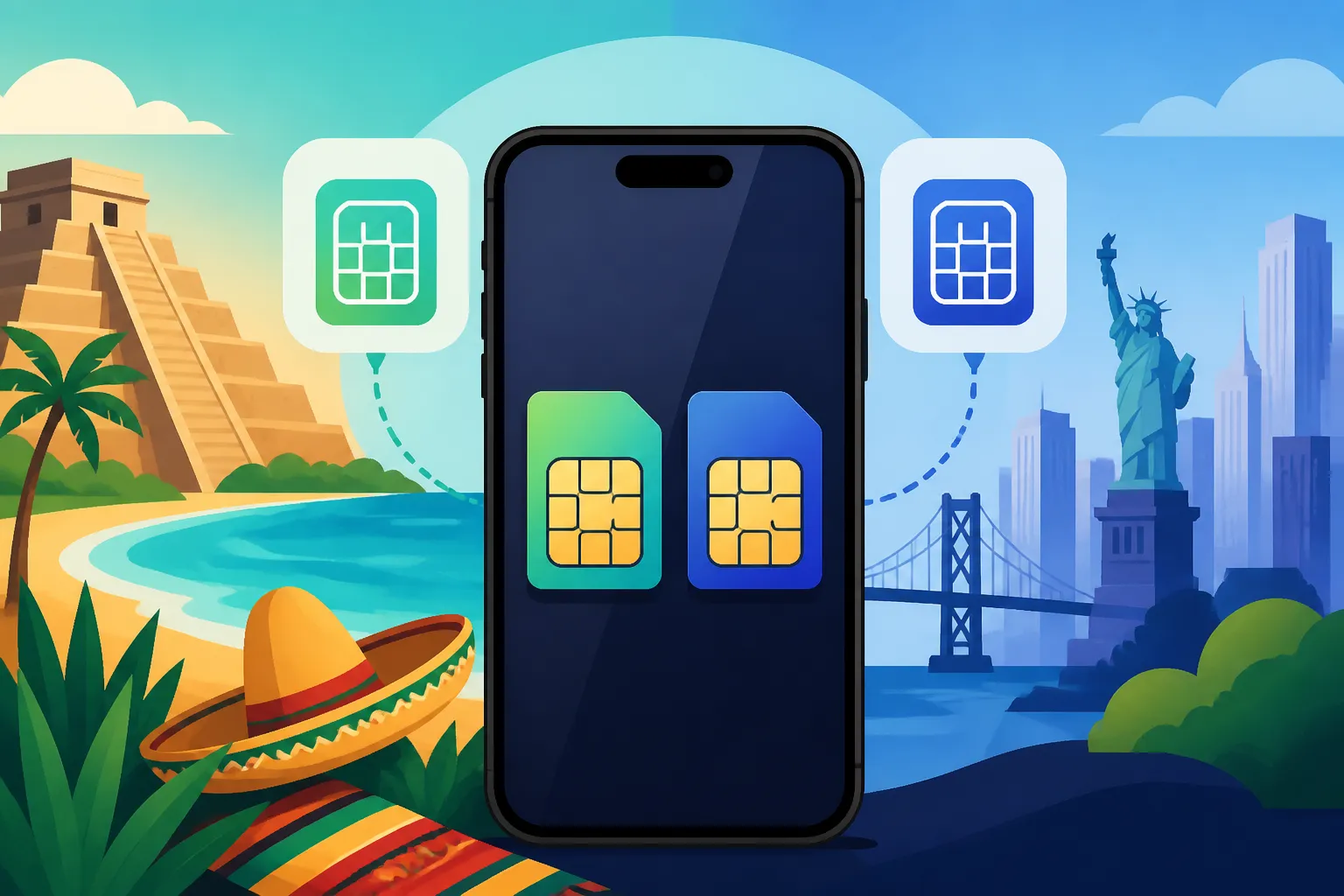
Two eSIMs at Once: Running a Mexico Plan Alongside a US Plan
One of the trickiest things when you first move to Mexico, or even just plan an extended stay, is figuring out how to stay connected without losing touch with your home country. Many of us arrive clutching our familiar US phone number, terrified of disconnecting from banks, family, and essential online services, only to be hit with astronomical roaming charges or the frustration of unreliable public Wi-Fi. This guide will walk you through the liberating process of running two eSIMs simultaneously – keeping your precious US plan active for calls and texts while leveraging a cost-effective Mexican data plan, with a focus on how Airalo can make this incredibly easy.
Disclosure: This post may contain affiliate links. We may earn a commission at no extra cost to you if you make a purchase through these links. Read full disclosure.
The Expat's Connectivity Conundrum: Why Two Plans are Better Than One
When you're navigating life in a new country like Mexico, having reliable phone service isn't just a convenience; it's a lifeline. But the reality for most expats is that one phone number simply isn't enough, at least not initially. You're caught between the need for local services and the imperative to maintain ties to home.
Keeping Your Home Country Connection Secure
Let's be honest, your home country phone number – especially if you're from the US or Canada – is likely tied to everything. We're talking about two-factor authentication for your banking apps, your email recovery, communication with family, friends, doctors back home, and countless online accounts. The thought of losing access to that number, even temporarily, can induce a cold sweat.
Imagine trying to log into your US bank account only to realize the two-factor authentication code is being sent to a number that's now inactive, or racking up a massive bill because you had to answer an urgent call from home while roaming internationally. It’s a pain point many of us have experienced firsthand. Relying solely on Wi-Fi for these crucial connections is a gamble; Wi-Fi isn't always available, secure, or fast enough, especially when you're out and about trying to register for things or handle an emergency. For a seamless transition into expat life, maintaining that familiar connection is paramount. It allows you to continue managing your affairs back home without interruption, offering a significant sense of security as you settle into your new Mexican routine.
The Absolute Necessity of a Local Mexican Data Plan
While holding onto your home country number is vital, attempting to use it for all your daily needs in Mexico is simply not sustainable. International roaming data, even with "unlimited" plans, is often throttled, expensive, and unreliable once you step outside major cities. Trying to navigate unfamiliar streets using a constantly buffering map, or waiting for an important message to load while stuck in a café with spotty Wi-Fi, is incredibly frustrating.
A local Mexican data plan is a game-changer. It provides consistent, high-speed internet access for everything from calling an Uber or Didi to translating menus, looking up bus routes, or simply staying connected with new local friends via WhatsApp. Crucially, a local data plan also allows you to use Mexican apps that often require a local number for registration, like delivery services (Uber Eats, Rappi) or even some local banking apps once you eventually open a Mexican bank account. Having your own reliable data means true independence and efficiency in your new environment, allowing you to explore and adapt without constantly hunting for Wi-Fi.
Enter the eSIM: Your Modern Solution to Dual Connectivity
The advent of eSIM technology has truly revolutionized how expats and frequent travelers manage their phone service. Gone are the days of fumbling with tiny physical SIM cards, paperclip tools, and worrying about losing your home SIM. Now, your phone can be a chameleon, adapting to your location with digital ease.
What Exactly is an eSIM and How Does it Work?
Think of an eSIM as a digital SIM card embedded directly into your phone's hardware. Instead of a physical chip that you insert, the "profile" for your cellular plan is downloaded and activated electronically. Most modern smartphones (iPhone XS and newer, many Android flagships like Samsung Galaxy S20/Pixel 3 and up) come equipped with eSIM capabilities, and many can store multiple eSIM profiles simultaneously.
This technology allows your phone to be a multi-tasking communication hub. You can have one eSIM profile for your US plan, another for a Mexican data plan, and even more for other countries you might visit. It simplifies the process of switching between carriers and plans, making it incredibly convenient for anyone living an international lifestyle. No more frantic searches for local phone stores or dealing with language barriers just to get connected.
Running Two eSIMs: Mexico Data with Your US Number Intact
This is where the magic happens for expats in Mexico. With dual SIM/eSIM enabled phones, you can maintain your crucial US phone number for calls and texts on one eSIM (or even a physical SIM if your phone has a slot for one alongside an eSIM), while simultaneously activating a data-only eSIM for Mexico. This setup offers the best of both worlds.
Your phone's settings allow you to designate which "line" handles data, which handles calls, and which handles SMS. The typical setup for an expat in Mexico would be:
- Primary Line (e.g., US eSIM/Physical SIM): Used for incoming and outgoing calls, and sending/receiving SMS messages. This ensures you never miss a call from your bank, family, or any service tied to your home number.
- Secondary Line (e.g., Mexican Data eSIM): Designated specifically for all your data needs. This handles your internet browsing, app usage, WhatsApp messages, GPS navigation, and anything else requiring an internet connection.
This configuration means your phone effectively has two "brains" operating in tandem, giving you a local data connection without compromising your essential link back home. It's the most efficient and cost-effective way to manage your mobile connectivity as an expat in Mexico.
Setting Up Your Dual eSIM System with Airalo in Mexico
Now that you understand the "why," let's dive into the "how," and this is where a service like Airalo shines. Airalo specializes in providing affordable, short-term eSIM data plans for nearly every country in the world, including Mexico. It's designed for travelers and expats who need immediate, reliable data without the hassle of local contracts or physical SIM cards.
Choosing the Right Airalo Plan for Mexico
Airalo offers a range of "Mexicanna" data-only eSIM packages specifically for Mexico, catering to different needs and durations. The beauty of these plans is their flexibility. You can pick a package that perfectly suits your initial arrival or ongoing usage, and easily top it up when needed.
For example, you might find options like:
- 1 GB for 7 days: Perfect for a quick trip or to get you started while you assess your longer-term needs. Costs around $8 USD.
- 3 GB for 30 days: A solid choice for a more extended visit or for moderate data users settling in. This might be around $21 USD.
- 5 GB or 10 GB for 30 days: Ideal for heavier data users, digital nomads, or families who need consistent connectivity. These can range from $30 to $48 USD.
These plans are prepaid and data-only, meaning they don't come with a local Mexican phone number for calls or SMS, but that's precisely why they work so well alongside your existing US plan. You buy exactly what you need, avoiding any long-term commitments or hidden fees. Before you even set foot in Mexico, you can browse and purchase the plan that aligns with your anticipated data consumption.
Step-by-Step Installation and Activation
Setting up your Airalo eSIM is surprisingly straightforward, designed with the user in mind, eliminating many of the typical expat frustrations you might encounter when dealing with local services. You can do this from the comfort of your home country, even before your flight.
- Download the Airalo App: Find the Airalo app on your smartphone's app store (iOS or Android). This app is your portal to purchasing, installing, and managing your eSIMs.
- Select Your Destination: Open the app and search for "Mexico" (or "Mexicanna"). You'll see the available data packages with their respective data allowances and validity periods.
- Purchase Your Plan: Choose the plan that best fits your needs and complete the purchase through the app. The process is secure and usually takes just a few clicks.
- Install the eSIM: Once purchased, the app will guide you through the installation. This is typically done in one of three ways:
- Direct Installation: The easiest method. The app will prompt you to install the eSIM profile directly onto your phone's settings with a few taps.
- QR Code Installation: If direct installation isn't possible (e.g., on some Android devices), the app provides a QR code. You'll go to your phone's cellular settings, select "Add eSIM" or "Add Cellular Plan," and scan the QR code using another device or print it out.
- Manual Installation: For those rare cases, manual details (SM-DP+ Address, Activation Code) are provided to enter directly into your phone's settings.
- Activate and Configure: After installation, go to your phone's cellular settings. You'll now see your new Airalo eSIM listed alongside your existing US plan. Crucially, you need to:
- Label your eSIMs: Rename them something clear, like "US Line" and "Mexico Data."
- Set Default Data Line: Select your "Mexico Data" (Airalo) eSIM as your primary line for Cellular Data.
- Set Default Voice Line: Keep your "US Line" as your primary line for Voice and SMS.
- Enable Data Roaming: For your Airalo Mexico eSIM, make sure "Data Roaming" is ON. This allows it to connect to local networks. For your US eSIM, ensure data roaming is OFF to avoid unexpected charges, as it will only be used for calls/texts.
You are now set up! Your phone will use Airalo for all internet activity while keeping your US number ready for any calls or texts from back home. It’s a simple process that provides immense peace of mind.
Managing Your Lines and Data Usage
Once your dual eSIM setup is active, managing it becomes second nature. Your phone's settings are your control panel, allowing you to fine-tune how each line operates. This is key to preventing accidental roaming charges and ensuring you always have data when you need it.
You can easily switch your default data line between your Airalo plan and your US plan if, for instance, you temporarily need to use your US data (though generally not recommended due to cost). However, for daily use in Mexico, your Airalo eSIM should always be set as the data provider. The Airalo app also provides real-time tracking of your data usage, so you'll know exactly how much you have left and when it's time to top up. Topping up is as simple as purchasing a new package through the app – no need to reinstall anything. Just select a new plan and it activates on your existing eSIM profile.
It's a good habit to periodically check your phone's cellular settings to ensure everything is configured correctly, especially after software updates. This prevents those dreaded "Oops, I forgot to turn off roaming!" moments. By understanding these simple settings, you maintain full control over your connectivity and costs.
Practical Considerations and Benefits for Expats
Embracing the dual eSIM approach, particularly with a reliable service like Airalo, offers a wealth of practical benefits that significantly smooth the expat transition and daily life in Mexico. It's a smart strategy that addresses common pain points with modern convenience.
Cost-Effectiveness and Unparalleled Convenience
Let's talk money, because for expats, every peso saved counts. Relying on international roaming from your home country provider is almost universally expensive. Those daily rates or per-megabyte charges can quickly turn a quick map check into a financial headache. Airalo's data packages, on the other hand, are designed to be affordable. You pay a set price for a specific amount of data, giving you predictable costs and far more data for your buck than any roaming plan.
The convenience factor is massive. Imagine landing at Mexico City International Airport (AICM) and already having working data on your phone. No need to hunt for a local SIM card vendor, navigate crowded shops, or stumble through a purchase in nascent Spanish. You activate your Airalo eSIM, and poof, you're connected. This immediate connectivity is invaluable for calling your ride-share, checking directions to your accommodation, or letting family know you've arrived safely. It bypasses the initial bureaucratic hurdles and language barriers that are often a frustrating part of early expat life. This ease of setup also extends to your ongoing needs; replenishing data with Airalo is just a few taps in an app, unlike the more convoluted processes some local providers might require.
Maintaining Seamless Communication and Essential Services
The core benefit of this dual eSIM setup is the ability to maintain seamless communication both locally and internationally. You get reliable high-speed data for all your internet-dependent activities in Mexico, from using Google Maps to finding local attractions, to ordering food via apps like Uber Eats or Rappi, or connecting with new friends on WhatsApp. You'll have constant access to information and services that make daily life smoother.
Simultaneously, your home country number remains active for critical communications. This means you won't miss important calls from your bank for fraud alerts, your doctor for urgent results, or family emergencies. More importantly, two-factor authentication (2FA) for banking, email, and other security-sensitive apps will continue to function flawlessly, as the SMS codes will arrive directly to your US number. This prevents being locked out of essential services, a common expat nightmare. It truly is the "have your cake and eat it too" solution for global connectivity. This level of connectivity means you can easily research things like Healthcare in Mexico: Complete Guide for Expats (Public vs Private) or find out How to Find an Apartment in Mexico: Best Websites and Tips for Expats without stress.
Potential Drawbacks and Workarounds
While the dual eSIM setup with Airalo is fantastic, it’s not without a few minor considerations that new expats should be aware of. Knowing these ahead of time helps manage expectations and avoid any surprises.
Firstly, remember that Airalo plans are data-only. This is crucial. Your Airalo eSIM will not give you a local Mexican phone number for traditional calls or SMS messages. If you need to make a local call to a Mexican landline or receive a local SMS from a service that doesn't use internet-based messaging (like some local businesses or government services), your Airalo eSIM won't help directly. The workaround here is simple: use internet-based calling apps like WhatsApp, Google Voice, or Skype over your Airalo data connection. Most Mexicans rely heavily on WhatsApp, so for most peer-to-peer communication, this isn't an issue. For formal local needs, you might eventually consider a secondary physical SIM from a local provider like Telcel or Movistar, but for initial setup and general expat life, data-only is sufficient.
Secondly, there’s a slight initial learning curve to managing your phone's dual SIM settings. It involves designating which line handles data, calls, and texts. While relatively intuitive, it requires a bit of attention during setup to ensure you don't accidentally incur roaming charges on your US line by forgetting to disable its data roaming. Most modern smartphone interfaces are quite user-friendly in guiding you through this, but a quick YouTube tutorial or a friend's help can make it even smoother.
Finally, eSIM technology is relatively new, so not all devices are compatible. Older smartphones might not support eSIMs, requiring you to stick with a physical SIM for your home country plan and perhaps a physical local SIM for Mexico. Before relying on this setup, always check if your specific phone model supports eSIM functionality.
Beyond the Basics: Enhancing Your Connectivity in Mexico
While your dual eSIM setup with Airalo and your US plan will cover most of your needs, understanding the broader connectivity landscape in Mexico can further enhance your expat experience. There are always ways to optimize, save money, and ensure you're always connected, even when deep in the Yucatán or high in the mountains of Oaxaca.
Local Data Alternatives and Complementary Services
While Airalo is a superb solution for immediate and flexible data, especially for new arrivals or those not ready for a long-term commitment, it's worth knowing about other options down the line. Once you're more settled and maybe have your Mexico Temporary Resident Visa: Comprehensive Guide for Expats (2026 Update) in hand, you might consider obtaining a local physical SIM card from a major Mexican carrier like Telcel, Movistar, or AT&T Mexico. These providers offer plans that include a local Mexican phone number for traditional calls and texts, along with data.
Many expats eventually transition to a local physical SIM for their primary data and local calling needs, while still keeping their home country number active on an eSIM for critical contacts. The beauty of Airalo is that it gives you the breathing room to make this transition at your own pace, without rushing into a local plan that might not be right for you. You can scout out the best options, compare coverage, and understand local pricing without the pressure of immediate connectivity needs. This flexibility is a significant advantage in the often-unpredictable world of expat administration.
Leveraging Wi-Fi and Offline Resources Effectively
Even with a robust data plan, being smart about your connectivity can save data and enhance your experience. Mexico has a decent, though not always perfect, Wi-Fi infrastructure. Most cafes, restaurants, hotels, and even some public squares offer free Wi-Fi. Make it a habit to connect to secure Wi-Fi networks whenever available, especially for large downloads, streaming, or video calls. This conserves your Airalo data for when you truly need it on the go.
Furthermore, don't underestimate the power of offline resources. Before heading out on an adventure, download offline maps (Google Maps allows you to download entire regions). This means you'll still be able to navigate even if you lose signal or run out of data temporarily. Similarly, download language translation packs, important documents, and entertainment (like podcasts or movies) to your device when on Wi-Fi. This proactive approach ensures you're never truly stranded, even in the most remote corners of Mexico. These strategies are part of Money-Saving Tips: How Expats Can Cut Costs Living in Mexico, ensuring you get the most out of your connectivity budget.
Here's a quick comparison of popular connectivity options for expats in Mexico:
| Option | Data Access | Call/Text Access (Local) | Cost & Billing | Convenience | Best For |
|---|---|---|---|---|---|
| Dual eSIM (Airalo + US Plan) | Excellent (Airalo) | US plan only (no local number) | Predictable, Prepaid Data | High: Easy setup, no physical SIM hassles | New arrivals, short/mid-term expats, those needing to keep home number |
| US/Home Country Roaming | Fair to Poor | Excellent | Very High, Unpredictable | Low: Very expensive, data often throttled | Emergencies only, very short trips |
| Local Physical SIM (Telcel, Movistar) | Excellent | Excellent | Prepaid/Contract, Pesos | Medium: In-person setup, language barrier | Long-term residents, those needing a local number for all services |
| Relying Solely on Wi-Fi | Spotty | Via Apps Only | Free, but often unreliable | Very Low: Limited mobility, security risks | Budget travelers, highly prepared individuals in specific locations |
This table clearly illustrates why the dual eSIM approach, especially with an Airalo data plan, is often the most balanced and practical solution for expats wanting to seamlessly integrate into life in Mexico while staying connected to their home country. It mitigates the financial risks of roaming and the logistical headaches of solely relying on local services from day one.
Disclaimer
The information provided in this guide is for general informational purposes only and does not constitute professional advice. While we strive to keep the content accurate and up-to-date, telecommunication policies, pricing, and service availability in Mexico can change rapidly. Always verify the latest information with Airalo and your home country's mobile provider directly. Expat life often comes with administrative changes, so always check current requirements and recommendations.