Mortgage Options for Expats: Financing a Property Purchase in Mexico
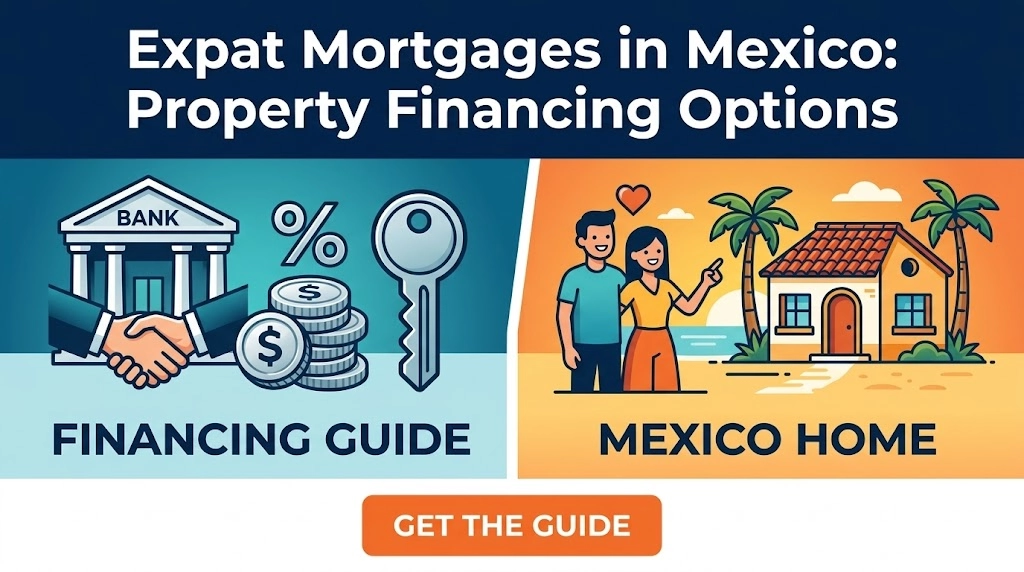
Staring at a gorgeous beachfront condo in Puerto Vallarta, I remember the sinking feeling of realizing my flawless 800+ credit score back home meant absolutely nothing to Mexican banks. Securing a mortgage here as a foreigner feels like navigating an opaque financial labyrinth designed to keep you out. This guide breaks down the realistic mortgage options, interest rates, and financing workarounds for expats buying property in Mexico without losing their minds or life savings.
Disclosure: This post may contain affiliate links. We may earn a commission at no extra cost to you if you make a purchase through these links. Read full disclosure.
The Harsh Reality of Mexican Mortgages for Expats
Why Your Home-Country Credit Score Doesn’t Matter Here
Moving to Mexico often feels like hitting a hard reset on your entire financial identity, especially when you confidently sit down with a loan officer. You might have decades of responsible borrowing history, a paid-off primary mortgage in your home country, and a wallet full of premium rewards cards. But the moment you apply for a loan in Mexico, you are effectively a financial ghost. Mexican banks rely exclusively on the Buró de Crédito (the national credit bureau), and there is absolutely no cross-border data sharing between North American bureaus and the Mexican system.
Because your foreign history does not exist in their localized system, domestic banks view you as an unproven, high-risk borrower. Even if you can show substantial foreign income through years of pristine bank statements, the lack of a localized credit file means your application is often dead on arrival. Many expats have to start entirely from scratch, applying for secured local credit cards or basic cellular plans just to generate a few months of data points. Understanding this baseline reality is crucial for managing your expectations when house hunting.
If you do not want to wait a year or more to build local credit before buying property, you will have to look for alternative financing routes. The traditional path of walking into a local branch, chatting with a friendly mortgage broker, and getting pre-approved in an afternoon simply does not apply to us as immigrants. For a broader look at establishing yourself financially from day one and building that elusive local score, see our guide on Banking in Mexico: Complete Guide for Foreigners.
The Shocking Truth About Local Interest Rates in 2026
If you manage to break through the credit history barrier by diligently building your Buró de Crédito profile, the next shock waiting for you is the cost of the money itself. Expats coming from North America or Europe are often accustomed to single-digit interest rates on home loans, historically hovering in the low single digits. In Mexico, the baseline interest rate (the TIIE) set by the Banco de México (Banxico) is significantly higher to combat inflation and stabilize the peso against foreign currencies. Consequently, consumer borrowing is incredibly expensive.
In 2026, it is not uncommon to see standard Mexican mortgage rates hovering between 10% and 14%, even for prime borrowers with excellent local credit and substantial down payments. When you compound a 12% interest rate over the life of a 15-year or 20-year mortgage, the total amount of interest you end up paying is staggering compared to what you would pay back home. In many cases, if you take the loan to term, you will pay double the principal over the life of the mortgage.
Because debt is so aggressively expensive locally, it completely changes the math on whether it makes sense to finance an asset in Mexico. For many expats, taking on double-digit debt on a vacation home or primary residence is a non-starter that destroys the financial benefits of moving abroad. Before committing to a high-interest local loan, you must thoroughly evaluate your monthly overhead and long-term liquidity. We break down these lifestyle economics and how to prepare for them in our Cost of Living in Mexico: 2026 Comprehensive Guide.
How Your Visa Status Dictates Your Borrowing Power
Your formal immigration status is the master key to unlocking any formal financial service in Mexico. If you are in the country on a standard 180-day tourist visa (FMM), you can forget about securing a mortgage from a domestic Mexican bank. Financial institutions require a permanent, legal tie to the country before they will even sit down at the desk with you to discuss long-term lending involving real estate collateral.
To apply for significant credit, you must possess either a Residente Temporal (Temporary Resident) or Residente Permanente (Permanent Resident) card. Furthermore, banks will closely examine the exact expiration date on your temporary residency card. If your card expires in three months and you are awaiting renewal, they will likely deny or stall a 15-year mortgage application because there is a perceived legal risk you might leave the country, lose your status, and default on the debt.
Additionally, you will need an RFC (Registro Federal de Contribuyentes) with a tax tracking number to legally sign a mortgage deed in front of a Notario Público. Securing these documents requires navigating the Mexican bureaucracy and, in many cases, proving localized income through official SAT tax returns. If you need help understanding these critical first administrative steps before you start house hunting, review The Ultimate Guide to Mexico’s Visa and Residency Options (2027 Edition).
The Fideicomiso Factor: Buying in the Restricted Zone
Understanding the Bank Trust Structure
Buying property in Mexico as a foreigner comes with a unique set of constitutional rules that fundamentally alter the financing and ownership process. According to Article 27 of the Mexican Constitution, foreigners cannot directly hold the fee-simple title to residential property located within the “Restricted Zone”—which is strictly defined as 50 kilometers from the coast or 100 kilometers from any international border. Given that most expats want to live on the beach in places like Los Cabos or the Riviera Maya, this rule applies to a vast majority of foreign buyers.
To legally purchase a residential home in these zones, you must establish a fideicomiso, which is a formalized bank trust. The Mexican bank holds the actual deed to the property on paper, but you (the foreigner) are the primary and sole beneficiary of the trust. You have complete legal control: you can sell the home, rent it out on Airbnb, renovate it extensively, or pass it on to your heirs via a will. However, because the bank technically holds the title, it severely complicates the mortgage underwriting process for local lenders.
For many expats, the concept of not holding the physical deed in their own name is unsettling at first. It feels like a loophole that could be closed at any time. However, it is an incredibly secure, constitutionally protected, and formalized system used by millions of foreigners over decades.
Hidden Costs and Setup Fees of the Fideicomiso
Setting up the fideicomiso itself carries significant upfront costs that you must aggressively factor into your mortgage calculus. First, your Notario must obtain a permit from the Ministry of Foreign Affairs (SRE), and then you must pay the trustee bank to establish the trust. The initial setup fees usually range from $2,000 to $3,000 USD, depending on the bank chosen and the appraised complexity of the property.
In addition to the massive setup fee, you are responsible for an annual maintenance fee paid directly to the bank acting as the trustee. This fee typically ranges from $500 to $1,000 USD per year, every single year you own the home. When you are budgeting for a mortgage and calculating your monthly carrying costs, these hidden fees can easily disrupt your financial planning if you are caught off guard at the closing table.
When it comes time to pay these setup and annual maintenance fees, do not rely on a traditional international wire transfer from your home bank. The hidden currency exchange markups and intermediary wire fees will bleed your budget dry. I always use Wise to transfer my yearly fideicomiso fees directly to the Mexican trustee. Wise provides the true mid-market exchange rate and processes the SPEI transfer instantly, ensuring my trust remains in good standing without overpaying on predatory bank fees.
Why Local Banks Hesitate to Finance Trust Properties
Even if you have the perfect permanent residency status, pristine local credit, and verified local income, many traditional Mexican banks are hesitant to issue a mortgage on a property held in a trust for a foreign national. The bureaucracy creates massive legal friction. Because another bank acts as the trustee for the fideicomiso (e.g., Scotiabank might be the trustee, while BBVA is the lender), the lending bank must navigate complex inter-bank agreements to secure the property as collateral.
Furthermore, foreclosure laws in Mexico heavily favor the occupant rather than the lender, making the eviction and repossession process incredibly lengthy, bureaucratic, and expensive for banks. When you combine this legal friction with a foreign borrower who could theoretically fly back to their home country at any time and abandon the property, banks view the loan as an exceptionally high risk.
As a result, if a domestic Mexican bank does approve you for a mortgage on a fideicomiso property, they will demand an enormous down payment to mitigate their exposure. You will rarely see the 5% or 10% down payments common in the US; Mexican banks frequently demand 30% to 40% down in cash upfront from foreign buyers to ensure you have enough equity to prevent you from walking away.
Cross-Border Mortgages: The Expat Workaround
How Cross-Border Lenders Operate
Because domestic Mexican mortgages are so punitive and difficult for foreigners to obtain, a highly specialized niche industry of cross-border lenders has emerged. These are financial institutions—often headquartered in the United States or Canada but operating legally in Mexico with registered ties to Mexican Notarios—that cater specifically to expats looking to buy a second home or retire south of the border.
The beauty of a cross-border lender is that they underwrite the loan using your home-country financial profile rather than forcing you into the Mexican system. They will pull your US or Canadian credit score (like your FICO score), review your foreign tax returns, and verify your home-country W2 or 1099 income. This completely bypasses the local Buró de Crédito Catch-22 that makes domestic borrowing so frustrating for newcomers.
For many expats, this is the only viable way to finance a property in Mexico without liquidating their entire life savings. The paperwork is typically presented in English, the loan officers understand cross-border nuances, and the underwriting process feels very familiar to anyone who has purchased a home in North America.
The Catch: Massive Down Payments and Stiff Terms
While cross-border mortgages are an incredible lifeline, they are not a perfect, cheap solution. These lenders intimately understand that they are taking on international jurisdictional risk, and their terms reflect that elevated exposure. First, there is usually a strict minimum loan amount, often hovering around $100,000 to $250,000 USD. If you are looking to finance a small, inexpensive $60,000 casita in a rural village, these lenders will not take the deal.
Second, cross-border lenders require massive down payments to secure the loan-to-value (LTV) ratio. You should expect to put down between 35% and 50% of the property’s appraised value in cash. Finally, while the interest rates are generally better than local Mexican banks, they are still significantly higher than domestic US rates. In 2026, cross-border mortgage rates typically range from 8% to 11.5%, depending on the term length and your credit tier.
You also need to be aware of significant prepayment penalties that are often aggressively written into these contracts. Before signing, you must carefully calculate whether taking on a 9.5% mortgage is truly better than paying in cash or renting long-term. For more on structuring your long-term finances and evaluating debt, see Managing Your Money in Mexico: Budgeting, Saving, and Currency Tips.
Moving Your Capital Across Borders Safely
If you choose a cross-border lender or simply need to wire a massive 40% down payment from your home country to the Mexican Notario’s escrow account, you must be extremely careful about exchange rates. Sending hundreds of thousands of dollars through a traditional retail bank wire will result in losing a massive percentage to hidden currency conversion spreads. A 3% markup on a $200,000 transfer is $6,000 instantly vaporized.
For standard down payments, monthly mortgage installments, and earnest money deposits, I heavily rely on Wise. By executing the transfer through Wise, you guarantee the mid-market exchange rate, saving you thousands of dollars on a single real estate transaction compared to letting a traditional bank handle the conversion. The transparency and tracking features also provide immense peace of mind when moving large sums.
However, if you are transferring massive, multi-million dollar sums to buy luxury real estate outright or fund a massive development project, you need institutional-grade tools. Many high-net-worth expats use Interactive Brokers to convert massive blocks of currency at absolute spot-market institutional rates. Using Interactive Brokers ensures that your life savings are not decimated by retail bank spreads when you move your capital across the border to close on your dream home.
Developer Financing: The Pre-Construction Route
Bypassing the Bank Entirely
Because traditional mortgages are so difficult and expensive for foreigners to obtain, a massive parallel market has emerged in coastal expat hubs like Tulum, Puerto Vallarta, and Los Cabos: developer financing. When you buy a pre-construction condo directly from the builder (desarrollador), the developer essentially acts as the bank, completely bypassing formal financial institutions and their rigid underwriting rules.
In a typical developer financing scenario, you are not subjected to a strict credit check, nor are you required to provide complex tax returns translated into Spanish. Instead, you agree to a structured payment plan based on construction milestones. A standard model requires a 30% down payment to secure the unit, another 40% paid in monthly or quarterly installments during the active construction phases, and the remaining 30% balance upon physical delivery of the keys.
Some well-capitalized developers even offer to finance the final 30% over three to five years post-delivery. These post-delivery interest rates usually range from 7% to 10%, which is highly competitive in the Mexican market. For expats who cannot get a cross-border loan but don’t have 100% of the cash upfront, this is often the most accessible and heavily marketed path to homeownership in resort towns.
The High Risks of Unfinished Projects
While developer financing sounds appealingly simple and avoids bank bureaucracy, it carries immense, sometimes catastrophic risk. In Mexico, there is no standardized, legally mandated escrow system for pre-construction real estate. When you make your down payment and your construction milestone payments, that money often goes directly into the developer’s operating account to fund the build.
If the developer goes bankrupt, faces permitting issues with the municipality, or simply absconds with the funds, your money is tied up in an incomplete concrete shell (known locally as obra negra). As a foreign buyer, your legal recourse in the Mexican court system will take years and cost a fortune in attorney fees, often with very little chance of recovering your initial investment if the developer’s corporate entity is dissolved.
You must never enter into a developer financing agreement without hiring an independent, bilingual Mexican real estate attorney. Your attorney must vet the developer’s track record, investigate the master land title to ensure it isn’t encumbered by existing debt, and review the specific penalty clauses in the contract before you send a single peso. To understand the intricacies of navigating these legal contracts, read Hiring a Lawyer in Mexico: When You Need One and What to Expect.
Negotiating Terms Like a Local
In the world of Mexican pre-construction, cash flow is everything to the developer. Because they rely heavily on buyer deposits to fund the ongoing construction, you hold significant leverage if you have liquid capital. If you can offer a larger initial down payment—say 50% or even 80% instead of the standard 30%—you can almost always negotiate a significant discount on the final purchase price of the unit.
When negotiating these payment schedules, ensure that the milestones are tied to actual, verifiable construction progress (e.g., “10% upon completion of the foundation and concrete pour”) rather than arbitrary calendar dates. This strictly protects you if the project falls behind schedule, ensuring you aren’t paying for work that hasn’t been completed.
To execute these monthly milestone payments efficiently without dealing with international wire delays that could put you in breach of contract, expats use Wise. Setting up scheduled transfers through Wise ensures the developer receives the exact peso amount on time, keeping your pre-construction contract in perfect standing while minimizing your conversion fees.
Leveraging Your Global Assets Instead of Local Debt
Why Cashing Out Your Retirement is a Mistake
Faced with 12% Mexican mortgage rates, the massive down payments of cross-border loans, and the extreme risks of developer financing, many expats decide the easiest route is to simply pay cash. However, to generate that cash, they often make the massive financial mistake of liquidating their entire retirement portfolio or cashing out their 401(k) back home.
While living completely debt-free in a beach house sounds idyllic, dumping your entire life savings into an illiquid Mexican asset leaves you financially vulnerable. You trigger massive capital gains taxes in your home country, lose out on decades of future compound interest in the global stock market, and tie your entire net worth to the localized real estate market of a developing nation.
Furthermore, many traditional North American brokerages will freeze your account if they realize you have moved to Mexico permanently due to complex international compliance laws. To protect your nest egg while living abroad, you should migrate your portfolio to Interactive Brokers. Because Interactive Brokers caters explicitly to international residents, you can legally maintain your global investments while living in Mexico, ensuring your money continues to grow seamlessly.
Using Margin Loans and Portfolio Backing
Instead of cashing out completely to buy a house in Mexico, financially savvy expats use their global portfolios to their immense advantage. If you have a substantial investment account, you can use a platform like Interactive Brokers to take out a margin loan (or portfolio line of credit) against your own stock portfolio.
By borrowing against your own assets, you can access the cash needed to buy a Mexican property outright without ever selling your stocks and triggering a tax event. More importantly, the interest rates on institutional margin loans at Interactive Brokers are vastly lower than the 12% to 14% you would pay a Mexican retail bank, often sitting in the low-to-mid single digits depending on the benchmark rate.
This advanced strategy allows your underlying portfolio to continue compounding in the global market, effectively covering the low cost of the margin loan, while providing the immediate liquidity needed to navigate the Mexican real estate market as a highly desirable cash buyer. For more information on managing your international tax burden when utilizing these strategies, see Taxes in Mexico for Expats: A Complete Guide to Income Tax and More.
The “Cash is King” Advantage in Mexican Real Estate
Because credit is so prohibitively expensive and difficult to obtain in Mexico, “cash is king” is a fundamental economic reality that entirely dictates the property market. When you make an offer on an existing resale house with the ability to pay in cash (via an immediate SPEI bank transfer at the Notario), you hold absolutely all the leverage in the room.
Sellers know exactly how difficult the mortgage process is, and they know that deals financed by banks frequently fall through at the last minute due to strict underwriting or low appraisal issues. If you can bypass the bank entirely, you can often negotiate significant discounts, sometimes 5% to 15% off the asking price for a quick close. By leveraging your global assets smartly, you completely escape the Mexican mortgage trap and secure your piece of paradise on your own terms.
| Mortgage / Financing Type | Expat Accessibility | Typical Interest Rate | Required Down Payment | Best Use Case |
| Mexican Domestic Bank | Very Difficult | 10% – 14% | 30% – 40% | Expats with Permanent Residency and years of localized Mexican income. |
| Cross-Border Lender | Moderate | 8% – 11.5% | 35% – 50% | Buyers with strong US/CAN credit who lack Mexican financial history. |
| Developer Financing | Very Easy | 0% (during build) to 10% | 30% initial, structured | Pre-construction buyers willing to accept project completion risks. |
| Portfolio Margin Loan | Easy (if asset-rich) | Benchmark + 1-2% | N/A (Asset Backed) | Wealthy expats avoiding capital gains taxes and high local interest rates. |
References
Primary sources (official)
- Banco de México (Banxico) – Official central bank data on benchmark interest rates (TIIE) and monetary policy: https://www.banxico.org.mx/
- Secretaría de Relaciones Exteriores (SRE) – Official governmental guidelines on the Fideicomiso and purchasing property in the Restricted Zone: https://portales.sre.gob.mx/tramites/fideicomisos
Other helpful sources
- Trading Economics – Current and historical data for Mexico Interest Rates: https://tradingeconomics.com/mexico/interest-rate
- Wise – Transparent tools and mid-market rates for sending large capital transfers to Mexico via SPEI: https://wise.com/
Disclaimer
The information provided in this article is for educational and informational purposes only and does not constitute financial, real estate, investment, tax, or legal advice. Interest rates, immigration laws, and financial regulations in Mexico are subject to frequent volatility and changes by the government. Always consult with a certified cross-border financial advisor, a licensed Mexican real estate attorney, and a qualified tax professional before entering into any loan agreements, real estate purchases, or transferring large sums of capital. Ensure that any financial platforms or services mentioned meet your specific individual legal residency and compliance requirements.