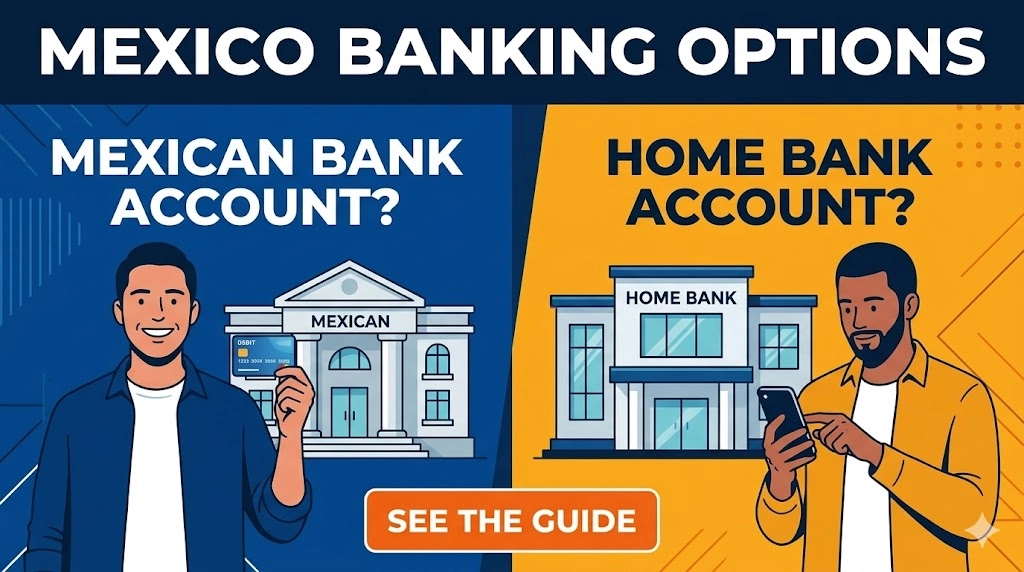
Do You Need a Mexican Bank Account or Can You Rely on Your Home Bank?
Attempting to build a permanent life in Mexico while remaining tethered exclusively to a bank in the United States, Canada, or Europe is a recipe for daily financial friction, massive hidden fees, and severe security risks. This comprehensive guide breaks down exactly why you need a local account, the hidden dangers of relying on foreign cards, and the exact steps to navigate the Mexican banking bureaucracy without losing your mind.
Disclosure: This post may contain affiliate links. We may earn a commission at no extra cost to you if you make a purchase through these links. Read full disclosure.
1. The Illusion of Surviving Solely on Your Home Bank
The Appeal of the “No Foreign Transaction Fee” Card
Before relocating, almost every expat secures a premium travel credit card or a debit card that boasts “Zero Foreign Transaction Fees.” On paper, this sounds like a golden ticket. It implies that you can swipe your card at a restaurant in Puerto Vallarta or a supermarket in Mérida, and your home bank will seamlessly convert the purchase at the perfect exchange rate without charging you an extra 3%.
For the first few weeks of a vacation, this system works flawlessly. You pay for your Airbnb online, use your travel card for dinners out, and grab a little walking-around cash from a local ATM. This effortless tourist experience leads many to mistakenly believe they can sustain this model indefinitely. However, living in a country is fundamentally different from vacationing in it. The moment you transition from short-term rentals to long-term living, the limitations of your foreign cards become painfully apparent.
The Hidden Trap of Dynamic Currency Conversion (DCC)
If you attempt to rely on your home bank for physical cash, you will be interacting frequently with Mexican ATMs. This exposes you to one of the most lucrative and deceptive banking traps in the world: Dynamic Currency Conversion (DCC).
When you insert a foreign debit card into a Mexican ATM, the machine recognizes that your account is denominated in US Dollars, Euros, or Canadian Dollars. After you select the amount of pesos you wish to withdraw, the ATM will present a screen offering to “lock in” the exchange rate for your convenience, showing you the exact total in your home currency. The screen is heavily designed with green “Accept” buttons, making it look like a mandatory step.
If you click “Accept,” you have just authorized the Mexican bank to execute the currency conversion using their own arbitrary, highly inflated retail exchange rate, rather than the true interbank rate. This effectively skims 5% to 10% off the top of your withdrawal. Over a year of expat living, falling for the DCC trap will drain hundreds, if not thousands, of dollars from your budget. We detail exactly how to navigate these screens and safely decline this conversion in Using ATMs in Mexico: Avoiding Fees and Staying Secure.
The Threat of Algorithmic Account Freezes
Perhaps the most terrifying risk of relying entirely on your home-country bank is the looming threat of an algorithmic account freeze. Mainstream banks in the US, UK, and Canada utilize highly aggressive anti-money laundering (AML) and fraud-detection software. These algorithms are notoriously suspicious of repeated, high-volume transactions originating from Latin America.
Even if you meticulously set “travel notices” on your account, withdrawing the maximum limit of pesos from a Mexican ATM for three consecutive days to pay your landlord in cash will eventually trigger a security freeze. Without warning, your debit card will be locked. To unlock it, the bank will require you to call their fraud department and undergo two-factor authentication. If your home-country SIM card cannot receive international SMS verification texts, you will find yourself completely locked out of your life savings while living in a foreign country. You cannot risk your entire financial existence on an algorithm that views your daily life as inherently suspicious.
2. Why a Mexican Bank Account is a Non-Negotiable Necessity
Accessing the SPEI Network
The primary reason you absolutely must open a local Mexican bank account is to gain access to the SPEI network (Sistema de Pagos Electrónicos Interbancarios). Developed and maintained by the Banco de México (the central bank), SPEI is a massive, instantaneous domestic electronic funds transfer system. It is the backbone of the modern Mexican economy.
In Mexico, checks are virtually obsolete, and local bank wires do not take three business days to clear like they do in North America. When you send an SPEI transfer using a recipient’s 18-digit CLABE (Clave Bancaria Estandarizada) number, the funds arrive and clear in their account within seconds, 24 hours a day, 365 days a year.
As a resident, you will use SPEI for almost everything. You will use it to pay your rent to your local landlord, pay your mechanic, settle medical bills, and even purchase large items from local e-commerce sites. If you do not have a Mexican bank account, you do not have access to SPEI, rendering you functionally handicapped in the local economy. For a deep dive into how standard these transfers are for daily housing expenses, review How Do Expats Typically Pay Rent in Mexico? Cash vs Bank Transfers.
Paying Local Utilities and Services
When you sign a long-term lease in Mexico, you assume responsibility for local utilities: CFE (electricity), Telmex or Totalplay (fiber-optic internet), and Aguakan or the local municipal water authority.
The online payment gateways for these domestic utilities employ extremely strict, localized 3D Secure verification protocols to combat credit card fraud. When you try to pay your electricity bill online using a US Visa or a Canadian Mastercard, the Mexican payment processor attempts to verify your foreign billing address and zip code. The system inevitably fails, and your card is declined.
Having a Mexican debit card attached to a local bank account completely eliminates this massive headache. You can effortlessly pay all your utility bills directly through your Mexican mobile banking app in seconds. No more standing in line for an hour at the OXXO convenience store with a stack of paper bills and physical cash.
Integration with CoDi and Mercado Pago
Mexico is rapidly moving toward a cashless society in major urban centers, driven by QR codes and mobile wallets. The two dominant forces are Mercado Pago (a massive regional digital wallet) and CoDi (the central bank’s free digital payment protocol integrated into all Mexican banking apps).
From high-end coffee shops in Roma Norte to local street food vendors in Guadalajara, merchants heavily prefer you to pay by scanning their QR code. It eliminates the steep processing fees they suffer from Visa and Mastercard. To utilize these convenient digital wallets, you must link them to a verified, localized funding source—meaning a Mexican bank account. Attempting to link a foreign credit card to a Mexican Mercado Pago account is an exercise in futility. We explore the profound daily impact of these local payment rails in Digital Payments in Mexico: Using Mobile Apps and Wallets (CoDi, etc.).
3. The Bureaucratic Nightmare: How to Open a Mexican Bank Account
The Prerequisite: You Need Legal Residency
The era of tourists casually opening Mexican bank accounts is largely over. A decade ago, you could walk into a local branch with your passport, a tourist visa (FMM), and a friendly smile, and walk out with a functioning debit card. Today, due to stringent international “Know Your Customer” (KYC) regulations and anti-money laundering laws, major banks have tightened their compliance dramatically.
In 2026, opening a top-tier, fully functional checking account at a major Mexican bank (such as BBVA, Santander, Banorte, or Citibanamex) strictly requires you to be a legal resident. You must possess a physical Temporary Resident card (Residente Temporal) or a Permanent Resident card (Residente Permanente). If you are living in Mexico on rolling 180-day tourist visas, you will find it nearly impossible to open a formal banking relationship, barring highly specific, localized exceptions at smaller, expat-focused brokerages like Intercam.
The Required Document Arsenal
When you finally step into a Mexican bank branch to open your account, you must arrive armed with a massive dossier of original documents and pristine photocopies. Missing a single photocopy will result in the bank executive turning you away. You generally must provide:
- Valid Passport: Your unexpired home-country passport.
- Mexican Residency Card: Your valid Temporary or Permanent INM card.
- Proof of Address (Comprobante de Domicilio): This is the most notorious requirement. The bank requires a recent utility bill (CFE electricity or Telmex internet), usually no older than two to three months. Crucially, the bill does not necessarily have to be in your name. It is widely understood in Mexico that renters use the landlord’s utility bills as proof of address. However, the address on the bill must exactly match the address you verbally provide.
- RFC (Registro Federal de Contribuyentes): This is your official Mexican tax identification number. In recent years, the Mexican government has made providing an RFC mandatory for opening new bank accounts to curb tax evasion. You must obtain this from the SAT (the Mexican IRS) prior to visiting the bank.
- CURP (Clave Única de Registro de Población): Your unique Mexican population registry code, which is generated when you receive your residency card.
Account Tiers and Monthly Deposit Limits
One of the most infuriating surprises for a newly minted expat is having a massive international transfer rejected by their new Mexican bank. Under Mexican financial regulations, bank accounts are classified into strict tiers based on the level of documentation provided upon opening.
If you open a basic “Level 2” account—often done rapidly online or with minimal paperwork—the account will feature a strict monthly deposit cap, usually hovering around 3,000 UDIS (roughly $1,200 to $1,500 USD equivalent). If you attempt to transfer $3,000 USD to pay for a deposit on a rental property, the transfer will hit the ceiling and bounce back to the sender.
You must explicitly demand that the bank executive opens a Level 4 account (Cuenta Nivel 4). A Level 4 account has absolutely no monthly deposit limits, allowing you to transfer massive sums to buy a car or a house. Securing a Level 4 account requires the in-person branch visit and the full document arsenal listed above.
The Reality of the Branch Experience
Opening an account in Mexico is an exercise in extreme patience. You cannot do this quickly on a lunch break. You should anticipate spending two to four hours inside the branch. You must take a ticket, wait to see a designated executive, and sign dozens of physical, paper contracts.
Furthermore, the process is conducted entirely in Spanish. While you might occasionally find a bilingual executive in highly gentrified areas like San Pedro Garza García or Ajijic, it is absolutely not the norm. If your Spanish is not fluent enough to understand banking contracts and terms of service, you must bring a trusted, fluent, bilingual friend or hire a local relocation specialist to accompany you. Navigating this initial friction is a necessary hurdle that pays massive dividends for the rest of your expat life.
4. Bridging the Gap: Moving Money Across the Border Efficiently
The Trap of Traditional SWIFT Wires
Once you successfully open your Mexican bank account, you are faced with a new logistical challenge: How do you get your money from your US or Canadian account into your new Mexican account?
If you walk into a Bank of America or an RBC branch and request an international wire transfer to your Mexican CLABE number, you are falling into a massive financial trap. Traditional retail banks rely on the archaic SWIFT network. A SWIFT wire is slow—often taking three to five business days to clear—and it is exorbitantly expensive. Your home bank will charge a flat outgoing wire fee (often $30 to $50 USD), and the intermediary correspondent banks will often skim their own fees.
However, the true financial damage is hidden in the exchange rate spread. Traditional banks do not give you the real mid-market exchange rate. They pad the rate by 3% to 5% to generate corporate profit. If you transfer $3,000 USD to cover your rent and living expenses, you will invisibly lose up to $150 USD every single month to the bank’s hidden margin.
The Fintech Revolution
To completely bypass this predatory system, the entire savvy expat community routes their cross-border capital through Wise. Utilizing Wise fundamentally changes the economics of living abroad.
By linking your home-country checking account to the Wise platform, you guarantee that your dollars, euros, or pounds are converted at the transparent, true mid-market exchange rate—the exact rate you see on Google or Reuters. The platform clearly displays their microscopic, flat service fee before you hit send; there are zero hidden margins.
More importantly, Wise completely bypasses the sluggish SWIFT network. They hold localized liquidity in Mexico. When you initiate a transfer, they simply instruct their Mexican accounts to push the equivalent pesos directly to your new Mexican bank account via the instantaneous domestic SPEI network. Your funds usually arrive in a matter of seconds. By using Wise as the bridge between your two lives, you ensure that every single dollar you earn stretches as far as mathematically possible in the Mexican economy. We break down the exact logistics of these transfers in Transferring Money Internationally: Best Ways to Send Money to/from Mexico.
5. Protecting Your Wealth: The Dual-Account Strategy
Why You Shouldn’t Keep Your Life Savings in Mexico
While establishing a local Mexican bank account is critical for your daily operational survival, it is equally critical to understand its limitations. You should never transfer your entire life savings, your massive retirement portfolio, or the massive proceeds from a home sale into a localized Mexican retail bank account.
The Mexican peso is an emerging market currency. It is highly susceptible to intense macroeconomic volatility and sudden geopolitical shocks. If you hold the entirety of your net worth in a local BBVA or Banorte account in pesos, a sudden 15% currency devaluation against the dollar will instantly vaporize a massive chunk of your global purchasing power.
Furthermore, while Mexican bank deposits are insured by the IPAB (Instituto para la Protección al Ahorro Bancario) up to roughly 400,000 UDIS (around $180,000 USD), keeping massive sums of cash localized exposes you to unnecessary emerging-market institutional risks.
The Strategy: Keep the Core Wealth Abroad
The financially bulletproof expat operates on a strict “dual-account” strategy. You maintain a local Mexican bank account, but you keep the balance artificially low—only holding enough pesos to cover your immediate rent, groceries, utility bills, and a minor localized emergency fund for the next two to three months.
Your true, massive wealth—your nest egg—remains safely denominated in hard currencies (USD, EUR, CAD) abroad. However, maintaining this wealth in traditional North American retail brokerages like Vanguard, Charles Schwab, or Fidelity presents a massive legal threat. Due to strict Patriot Act and Anti-Money Laundering (AML) compliance laws, if these traditional US brokerages discover that you have severed your US residential ties and established a permanent foreign address in Mexico, they will forcefully freeze or restrict your accounts. Being forced to liquidate your entire retirement portfolio simply because you moved abroad is a devastating, taxable disaster.
Utilizing Institutional Brokerages for Expats
To prevent a catastrophic compliance freeze, proactive expats proactively migrate their massive assets to Interactive Brokers. Because Interactive Brokers caters explicitly to a global, international clientele, you can legally, transparently maintain your global investment portfolio using your physical Mexican residential address.
This ensures your wealth continues compounding securely in the US and global markets, safely insulated from Mexican inflation and peso devaluation. Furthermore, Interactive Brokers provides direct access to institutional-grade spot-market foreign exchange. If you decide to buy a $400,000 USD beachfront condo in Puerto Vallarta, you can convert the capital into pesos directly inside your brokerage account at the raw interbank rate, completely bypassing the massive spreads of local retail banks. We explore these advanced wealth preservation strategies deeply in Banking in Mexico: Complete Guide for Foreigners.
6. Navigating Tax Implications and Reporting
The SAT and the Myth of Financial Secrecy
A lingering, dangerous myth among older expats is that moving money to a Mexican bank account somehow hides it from the tax authorities. In the modern era of digitized global banking, financial secrecy is dead.
When you provide your RFC to open your Mexican bank account, that account is immediately tied to the SAT (the Mexican IRS). The SAT monitors domestic bank accounts for unusual activity and undeclared income. While transferring your own pre-taxed savings from your US account to your Mexican account to pay for daily living expenses is not considered taxable income in Mexico, the burden of proof is on you. If audited, you must be able to provide clear statements showing the flow of funds originating from your own foreign accounts.
FBAR and FATCA for US Citizens
If you are a US citizen, opening a Mexican bank account triggers strict, non-negotiable reporting requirements with the US Treasury and the IRS, regardless of where you live.
First, under the Foreign Bank and Financial Accounts (FBAR) regulations, if the combined maximum balance of all your foreign accounts (including your new Mexican checking account, any Mexican investment accounts, and foreign pension plans) exceeds $10,000 USD at any single moment during the calendar year, you must electronically file FinCEN Form 114. The penalties for willfully failing to file an FBAR are draconian, frequently exceeding $100,000 USD or 50% of the account balance.
Second, under the Foreign Account Tax Compliance Act (FATCA), you may also be required to file Form 8938 with your annual tax return if your foreign financial assets exceed specific thresholds based on your filing status and residency. Because the United States taxes its citizens on worldwide income, the IRS aggressively utilizes FATCA agreements with Mexican banks to ensure compliance. You cannot hide your Mexican banking activity from the US government. We untangle these severe dual-country obligations comprehensively in Taxes in Mexico for Expats: A Complete Guide to Income Tax and More.
Conclusion: An Investment in Expat Freedom
Do you need a Mexican bank account? If you are spending a month in an Airbnb in Tulum, absolutely not; your foreign travel card will suffice. But if you are signing a lease, establishing residency, and building a genuine life in Mexico, a local bank account transitions from an optional luxury to an absolute, non-negotiable necessity.
Enduring the bureaucratic friction of waiting in a branch, securing your RFC, and signing a stack of Spanish contracts is a one-time rite of passage. Once that local account is operational, your friction drops to zero. You will effortlessly pay utilities from your phone, seamlessly transfer funds using the SPEI network, integrate into the local digital wallet economy, and completely eliminate the massive, hidden ATM and conversion fees that drain the budgets of perpetual tourists.
By building a robust financial bridge—utilizing Wise for your monthly cross-border liquidity and protecting your primary wealth in a globally compliant platform like Interactive Brokers—you take absolute control of your financial destiny, allowing you to actually relax and enjoy the incredible country you now call home.
References
Primary sources (official)
- Banco de México (Banxico): Official central bank portal detailing the operation of the SPEI network, CoDi digital payments, and official exchange rates. https://www.banxico.org.mx/
Other helpful sources
- Interactive Brokers: Institutional-grade global brokerage protecting expat wealth from domestic compliance freezes and facilitating spot-market currency exchange. https://www.interactivebrokers.com/
Disclaimer
The information provided in this article is for educational and informational purposes only and does not constitute financial, investment, legal, or tax advice. Mexican banking regulations, account tier limits (UDIS thresholds), and international tax reporting requirements (such as FBAR and FATCA) are highly complex and subject to frequent legislative changes by both Mexican and foreign authorities. Always consult with a certified cross-border financial planner, a qualified tax professional, and legal counsel before opening foreign financial accounts, restructuring your retirement assets, or making significant international transfers. Ensure that any financial platforms or services mentioned meet your specific individual legal residency and compliance requirements.