How to Find Authentic Restaurants in Mexico (Not Tourist Traps)
Most visitors to Mexico arrive with visions of world-class tacos and complex moles, yet many end up overpaying for bland, uninspired meals in high-traffic tourist zones. It is a frustrating rite of passage for many expats and travelers to realize they have spent 400 pesos on a mediocre "enchilada plate" that a local wouldn't touch. This guide provides the tactical knowledge needed to bypass these tourist traps and find the soul-warming, authentic kitchens where the real flavors of Mexico live.
Disclosure: This post may contain affiliate links. We may earn a commission at no extra cost to you if you make a purchase through these links. Read full disclosure.
The Telling Signs of a Classic Tourist Trap
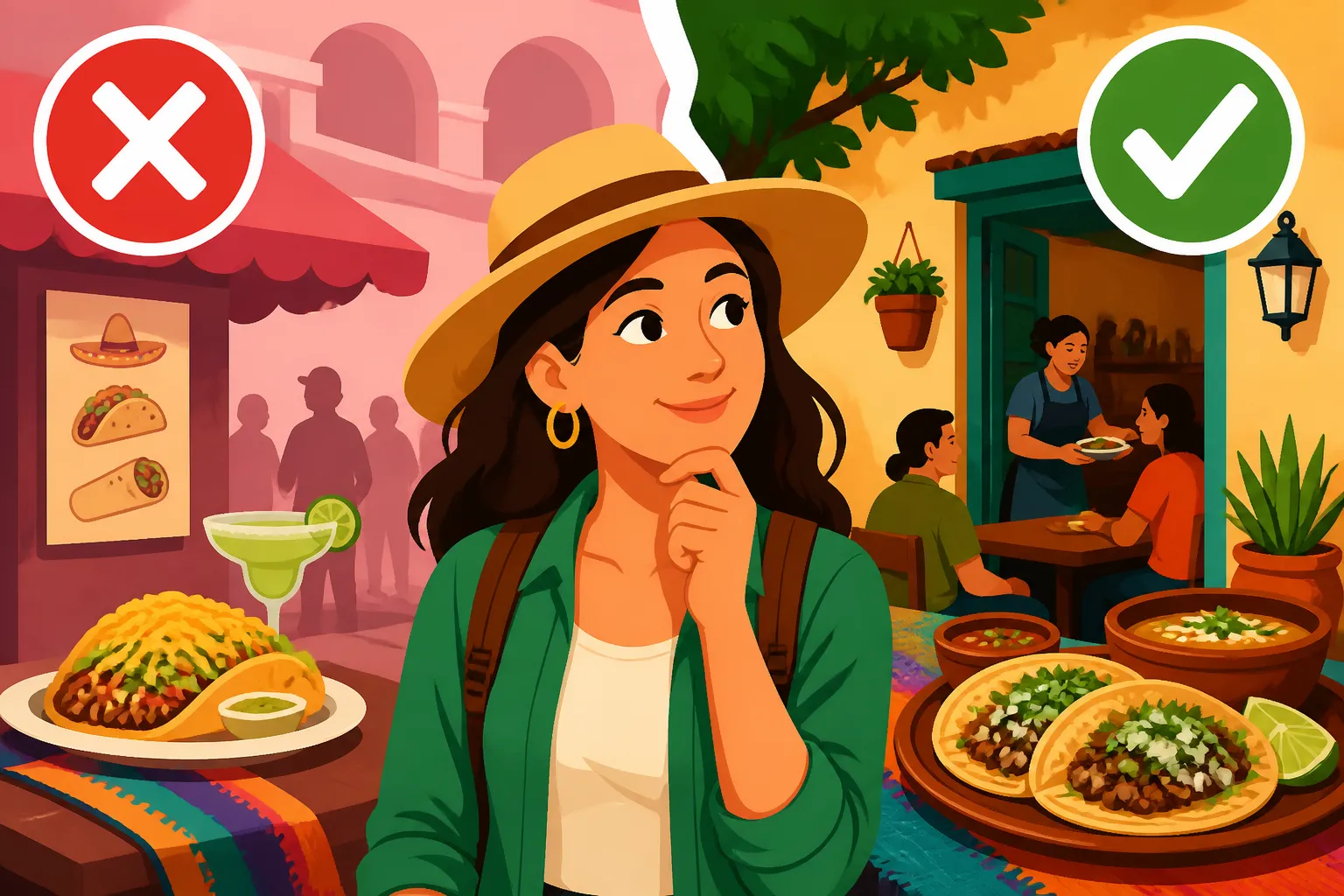
When you are walking through the historic center of a city like Mérida or the bustling streets of Playa del Carmen, the temptation to sit at the first place with a nice view is overwhelming. However, in Mexico, the quality of the food is often inversely proportional to the quality of the view. The most egregious tourist traps are designed to capture "one-time" customers—travelers who will be gone in three days and never return. Consequently, these establishments prioritize profit margins over culinary tradition, often resulting in "Tex-Mex" hybrids that lack the depth of Mexican Regional Cuisine: How Food Changes Across Mexico.
One of the most obvious red flags is the "jale." In many tourist-heavy areas, restaurants employ a person whose sole job is to stand on the sidewalk and "pull" (jalar) customers in. If a waiter is waving a laminated menu in your face, calling you "Amigo," or promising you a free tequila shot if you sit down, you are looking at a tourist trap. Authentic restaurants in Mexico are usually so busy with locals that they don't have the staff—or the need—to solicit people from the street. They rely on word-of-mouth and decades of local loyalty rather than aggressive marketing.
The menu itself tells a story. A truly authentic spot will often have a menu that is short, seasonal, or even written on a chalkboard. If you see a multi-page, laminated book with faded photos of food and translations in four different languages, proceed with caution. While some great places do offer translations, an overly polished, English-first menu is a signal that the kitchen has tailored its flavor profiles to a foreign palate, often removing the spice and complexity that define the local fare. For a deeper understanding of these nuances, you might want to read about Mexican Food Culture: Eating and Drinking as a Visitor.
The Geography of Authentic Dining
To find the real deal, you have to move away from the "Main Square" or the "Zócalo." In almost every Mexican city, the closer you are to the cathedral or the primary tourist landmark, the more likely you are to encounter inflated prices and standardized recipes. Take a three-block walk in any direction away from the primary tourist corridor. You will notice the architecture shifts, the "souvenir" shops disappear, and the restaurants start to look a bit more "rough around the edges." This is where the magic happens.
When planning your stay, using a platform like Booking.com can help you identify neighborhoods that are more residential rather than strictly commercial. Choosing an accommodation in a "Colonia" rather than a "Zona Hotelera" puts you within walking distance of the small, family-run kitchens that the locals frequent. These areas are where you will find the "cenadurías" (dinner spots) and "taquerías" that stay open late and serve the neighborhood's workers and families.
The Visual Indicators of Quality
In Mexico, we have a saying: "The uglier the chair, the better the food." This isn't a hard rule, but there is a grain of truth to it. Look for the ubiquitous plastic chairs and tables branded with the logos of Corona, Victoria, or Coca-Cola. These are often provided to small business owners by the beverage companies. A restaurant filled with these "muebles de plástico" and bright fluorescent lighting might not win an interior design award, but it is often where you will find the best "cochinita pibil" or "pozole" of your life.
Pay attention to who is eating there. If the tables are filled with office workers in business casual attire or construction workers in vests, you have found a winner. Locals are the ultimate filter for quality and price. If a place is empty at 2:00 PM—the peak of the Mexican "comida" hour—that is a major red flag. Conversely, a line of people waiting on the sidewalk for a specific "puesto" or "fonda" is the best review a restaurant can get. If you are nervous about your first few outings, booking a tour through Viator can introduce you to these hidden spots with the help of a local guide, ensuring you start your culinary journey on the right foot.
Leveraging Local Wisdom and Traditional Formats
To eat like a local, you must understand the local schedule. Authentic dining in Mexico follows a specific rhythm that is very different from the U.S. or Europe. Breakfast (desayuno) is often hearty and served from 8:00 AM to 11:00 AM. The main meal of the day, the "comida," typically happens between 2:00 PM and 4:30 PM. Many authentic restaurants, especially "fondas," will actually close by 6:00 PM because their primary business is the afternoon crowd. If you are looking for a heavy meal at 7:00 PM, you might be forced into tourist-centric spots unless you are looking for tacos.
The "Comida Corrida" is perhaps the greatest secret for anyone living or traveling in Mexico on a budget. This is a fixed-price, multi-course lunch designed for workers. It usually includes a "sopa aguada" (watery soup/consommé), a "sopa seca" (usually rice or pasta), a main dish (guisado), a carafe of "agua fresca," and a tiny dessert. You can find more details on this in our guide on What Is a Comida Corrida and How Does It Work?. These meals are the pinnacle of home-style cooking and are rarely found in the flashy restaurants of the tourist zones.
The Power of the Mercado Municipal
Every town in Mexico, from the smallest village to the sprawling neighborhoods of Mexico City, has a "Mercado Municipal." These markets are the heartbeat of the community. While the outer edges might sell clothes and electronics, the center is almost always dedicated to food. Here, you will find "cocinas económicas"—small stalls with a few stools where women cook huge pots of traditional stews.
Eating at the market is the ultimate way to ensure authenticity. The ingredients are literally sourced from the stall next door, ensuring everything is fresh. It is also an excellent place to observe Mexican Regional Cuisine: How Food Changes Across Mexico in its purest form. In a Oaxacan market, you’ll find "tlayudas" and "tejate," while in a Yucatecan market, you’ll find "salbutes" and "panuchos." Just remember to check the hygiene of the stall; a busy stall with a high turnover of customers is usually a safe bet. For more on health, see our tips on Staying Healthy in Mexico: Essential Tips for Food, Water, and Preventive Care.
Finding Regional Specialties
Mexico is not a culinary monolith. If you are in a coastal town and the restaurant is pushing "Northern-style flour tortilla burritos," you are likely in a tourist trap. Authentic restaurants focus on the strengths of their specific region. When traveling between states, using a service like Busbud to reach regional capitals like Oaxaca City or Puebla can open doors to flavors you simply cannot find in the resort towns.
Once you arrive in a new region, ask the locals for their "plato típico." Don't ask a hotel concierge, as they often have kickback agreements with certain tourist restaurants. Instead, ask a taxi driver or the person working at the local "tienda" (convenience store). Ask them, "¿Dónde está su lugar favorito para comer?" This simple question will often lead you to a backstreet gem that isn't even on Google Maps.
| Feature | Authentic Local Spot | Tourist Trap |
|---|---|---|
| Primary Language | Spanish (English may be limited) | English-first or multi-language menus |
| Solicitation | No one asks you to come in | "Hustlers" waving menus on the street |
| Seating | Functional, often plastic chairs | Curated, "Instagrammable" decor |
| Menu Style | Short, handwritten, or daily specials | Massive, laminated books with photos |
| Pricing | Clearly marked in Pesos | Often high or "Market Price" |
| Peak Hours | 2:00 PM – 4:00 PM (Comida) | 7:00 PM – 9:00 PM (Dinner) |
Navigating the Street Food Scene
For many, the most authentic food in Mexico doesn't even come from a building with four walls. Street food, or "antojitos," is a fundamental pillar of Mexican life. However, many tourists avoid it out of fear of getting sick. While caution is necessary, avoiding street food entirely means missing out on the most authentic culinary experiences available. The key is knowing how to spot a "good" stand.
First, look at the "comal" (the flat griddle). It should be hot and active. Second, check the "salsa hierarchy." A good stand will have multiple fresh salsas, onions, cilantro, and limes available for you to add yourself. Third, watch the money handling. In a well-run stand, the person touching the food is not the person touching the money. Often, they will use a plastic bag over their hand to handle cash or have a designated cashier. If you want to dive deep into this world, check out our guide on Is Street Food Safe to Eat in Mexico? and learn How to Order at a Taquería in Mexico.
The Salsa Trap and Water Safety
One mistake tourists make is assuming that "authentic" always means "burn your mouth off spicy." In reality, many Mexican dishes are flavorful but mild, with the heat added at the end via salsas. An authentic restaurant will provide the heat on the side. If a dish comes pre-smothered in a sauce that is clearly designed just to be "hot" without flavor, it might be catering to the "daredevil" tourist crowd.
Water safety is another area where travelers get tripped up. Authentic restaurants know that their local customers don't want to get sick either. They use "garrafones" (large jugs of purified water) for everything from the "agua fresca" to the ice. If you are worried, it is perfectly acceptable to ask, "¿El hielo es de garrafón?" (Is the ice from a purified jug?). Most reputable places will say yes. For more detailed advice, read Is It Safe to Drink Tap Water in Mexico? to understand how the infrastructure works.
Cultural Etiquette in Local Eateries
When you find that perfect, hole-in-the-wall spot, your behavior can change the level of service you receive. Authentic places are often family-run, and a little politeness goes a long way. Always start with a "Buenas tardes" or "Buenas noches." When you finish your meal, it is common to say "Gracias, provecho" to the people sitting at the tables near you as you leave.
Tipping is also a nuanced topic. In the big tourist traps, they might automatically add a "service charge" (which is technically illegal in Mexico). In an authentic local spot, you are expected to tip between 10% and 15%. If the service was exceptional at a small "fonda," leaving a bit extra is a great way to show appreciation for the hard work that goes into traditional cooking. You can find more on this in our guide to Tipping in Mexico (Propina): When and How Much.
Special Diets and Authenticity
Finding authentic food can be a challenge if you have dietary restrictions, but it isn't impossible. Traditional Mexican cuisine is actually quite friendly to gluten-free diets because of the reliance on corn (maíz) rather than wheat. However, "hidden" ingredients like lard (manteca) are common in authentic cooking. If you are vegetarian or have allergies, you need to be specific. Authentic places are usually happy to accommodate, but they might not have a "vegan menu" printed out. Using resources like Managing Food Allergies and Special Diets in Mexico can help you prepare the right phrases to ensure your meal is both authentic and safe.
Finally, remember that the quest for "authentic" food is really a quest for connection. The best meal I ever had in Mexico wasn't in a five-star restaurant; it was at a plastic table in a backyard in Oaxaca where a woman was hand-pressing tortillas over a wood fire. By following the locals, moving away from the Zócalo, and embracing the "ugly chairs," you aren't just getting a better meal—you are experiencing the real Mexico. Whether you arrive by a bus found on Busbud or stay in a neighborhood booked through Booking.com, the effort to find the right kitchen is always rewarded with the best flavors the country has to offer.
Important Disclaimer
The information provided in this guide is for educational and informational purposes only. While every effort has been made to ensure the accuracy of the advice regarding dining and health in Mexico, regional conditions and business practices can change. Always use your best judgment when consuming street food or visiting unfamiliar areas. We are not responsible for any illness, financial loss, or negative experiences that may occur while following the suggestions in this article. Consult with local health authorities regarding any specific medical concerns or food safety regulations during your travels.