Bringing Prescription Medications from Home: Rules and Tips for Expats
Navigating international borders with prescription drugs requires careful planning and a deep understanding of local laws. This comprehensive guide explains Mexican customs regulations, prohibited substances, required medical documentation, and how expats can safely transition to sourcing their essential medications locally.
Disclosure: This post may contain affiliate links. We may earn a commission at no extra cost to you if you make a purchase through these links. Read full disclosure.
Understanding Mexican Customs and Import Regulations
When relocating to a new country, ensuring the continuous, safe supply of your daily medications is paramount. Mexican customs authorities enforce strict regulations regarding what pharmaceuticals can cross their borders. Understanding how these agencies operate will prevent your vital health supplies from being confiscated at the airport.
The Personal Use Exemption and Quantity Limits
The Mexican customs authority, known as Aduanas, operates under a specific framework regarding imported goods. By default, international travelers and newly arriving expatriates are legally permitted to bring medications necessary for their personal health into the country. This is known as the personal use exemption. The general, unwritten rule of thumb enforced by border agents is that customs will comfortably allow up to a 90-day supply of a medication to pass through without requiring special, commercial-level importation permits.
The 90-day limit exists specifically to combat the black market resale of imported pharmaceutical drugs. For an expat moving to Mexico permanently, packing a full year’s supply of a vital blood pressure medication might seem like the most logical and secure preparation strategy. However, this heavily triggers red flags at the border. Customs agents may view anything significantly beyond a three-month supply as an attempt to import pharmaceuticals commercially. Commercial importation requires a specialized, highly regulated business license, and failing to possess one will result in the immediate confiscation of your excess medications.
This limitation profoundly impacts the timeline of your relocation strategy. Expats must utilize this initial 90-day window to secure a local doctor and establish a sustainable, domestic supply chain for their healthcare needs. Relying on continuous “border runs” to physically reset this 90-day allowance by flying back and forth to your home country is financially draining, legally risky, and ultimately unsustainable for someone holding a Mexico Temporary Resident Visa: Comprehensive Guide for Expats (2026 Update).
Declaring Medications at the Border
The physical process of entering Mexico involves navigating specific security checkpoints. When you land at a major Mexican international airport, you will first pass through the immigration desks and then proceed to the baggage claim and customs area. Here, you will encounter the country’s standard “traffic light” inspection system. Pressing a button at the exit yields either a green light, allowing you to pass through freely, or a red light, which triggers a mandatory manual inspection of all your luggage.
Honesty and transparency are your absolute best tools during this process. If you are carrying a significant volume of medication, or any highly controlled substances, it is strongly advisable to declare them on your customs form, regardless of whether you ultimately receive a red or green light. Attempting to hide prescription drugs deep within your luggage and subsequently being searched can lead to immediate confiscation, heavy administrative fines, or terrifying legal detention.
If you are pulled aside for a red-light inspection, knowing how to handle the interaction with the customs agent is vital. Stay calm, have your medical documentation readily available in a dedicated, easily accessible folder, and clearly state that the items are “medicamentos para uso personal” (medications for personal use). Having your paperwork meticulously organized demonstrates respect for their regulations and usually results in a swift, hassle-free inspection, allowing you to quickly move on to enjoying Healthcare in Mexico: Complete Guide for Expats (Public vs Private).
The Role of COFEPRIS in Regulating Drugs
To truly understand Mexican medication laws, expats must familiarize themselves with COFEPRIS (Comisión Federal para la Protección contra Riesgos Sanitarios). This federal agency serves as the Mexican equivalent of the US Food and Drug Administration (FDA) or Health Canada. COFEPRIS directly oversees the rigorous regulation, approval, clinical testing, and safe handling of all pharmaceuticals, medical devices, and holistic health products within the country.
COFEPRIS is the governing body that maintains the official, legally binding lists of prohibited and controlled substances. They dictate exactly what can be sold freely over the counter, what requires a standard doctor’s prescription, and what strictly requires a specialized, barcoded prescription from a certified specialist. When a customs agent seizes a medication at the border, they are not acting arbitrarily; they are executing the direct regulatory framework established by COFEPRIS.
Furthermore, COFEPRIS protects the Mexican public from counterfeit drugs and ensures that locally manufactured generic medications meet strict international bioequivalence standards. While their rigid border rules might seem frustrating when you are desperately trying to bring in your home prescriptions, their overarching goal is to maintain the safety and integrity of the domestic pharmaceutical market, ensuring expats receive world-class care when utilizing Pharmacies in Mexico: How to Get Medications (OTC vs Prescription).
Navigating Prohibited and Controlled Substances
The most dangerous assumption an expat can make is believing that a medication legally prescribed in their home country is automatically legal in Mexico. The Mexican government maintains a strict “zero tolerance” policy for specific chemical compounds, regardless of your personal medical history.
Banned Ingredients in Common Medications
Expats are often shocked to discover that incredibly common, over-the-counter medications sold freely in American, Canadian, or European supermarkets are strictly illegal in Mexico. The most prominent and frequently encountered example is pseudoephedrine. This chemical is a highly effective decongestant and is the primary active ingredient in popular sinus medications like Sudafed, as well as certain formulations of Vicks inhalers and NyQuil. Mexico banned pseudoephedrine entirely in 2007 due to its widespread use in the illicit manufacturing of methamphetamine.
The consequences of bringing pseudoephedrine into the country are severe, and ignorance of the law is never an accepted defense. If a customs agent finds a standard box of Sudafed tucked away in your toiletry bag, it will be confiscated immediately. Depending on the quantity and the agent’s discretion, you could face intense questioning, heavy financial penalties, or criminal charges. Expats must meticulously read the active ingredient lists of all their preferred cold, flu, and allergy remedies before packing their suitcases.
Fortunately, managing seasonal illnesses without these banned substances is entirely possible. While you cannot bring your favorite pseudoephedrine-based decongestant across the border, Mexican pharmacies are exceptionally well-stocked with completely legal, highly effective alternatives that contain phenylephrine or other COFEPRIS-approved decongestants. It is infinitely safer to leave the banned substances at home and purchase a localized equivalent upon arrival to treat your symptoms.
Rules for Narcotics and Psychotropic Drugs
Mexico places exceedingly stringent regulations on Group I, II, and III medications. These classifications include heavy narcotics, powerful opioids (such as Oxycodone, Hydrocodone, or fentanyl patches), and psychotropic drugs (including popular ADHD medications like Adderall and Ritalin, as well as anti-anxiety medications like Xanax or Valium). The government heavily restricts the movement of these substances to combat international drug trafficking and domestic prescription abuse.
Traveling internationally with these specific medications requires a highly organized, proactive approach. You must carry the absolute exact amount prescribed for your trip, ensuring it does not exceed the 90-day personal use limit. However, be aware that customs may aggressively scrutinize even a 30-day supply of strong narcotics. The medication absolutely must be accompanied by a formal, freshly signed letter from your prescribing physician detailing your specific medical necessity, the exact daily dosage, and your overarching treatment plan.
Furthermore, expats must understand that finding local refills for these specific drugs is a complex undertaking. In Mexico, prescribing these controlled medications requires a highly specialized doctor who holds a specific, closely monitored COFEPRIS permit to issue serialized, barcoded prescriptions. Expats relying on ADHD medications or heavy pain management drugs must research local specialists well before their moving date to ensure continuity of care. You can learn more about this specific logistical hurdle in Access to Mental Health Medications: How Easy Is It to Get Antidepressants?.
Transporting Medical Marijuana and CBD Products
The legal landscape surrounding cannabis and CBD products in Mexico is highly confusing, filled with contradictory laws and slow-moving legislation. While the Mexican Supreme Court has taken legal steps toward decriminalizing the recreational use of marijuana and the government has established frameworks for certain medical cannabis applications, the international border regulations remain incredibly strict, black-and-white, and largely unforgiving.
It must be stated unequivocally: bringing any raw cannabis product across the international border into Mexico is a federal crime. It absolutely does not matter if you hold a valid, state-issued medical marijuana card from California, a legal prescription from Canada, or a holistic wellness certificate from Europe. Mexican customs and military authorities do not recognize foreign marijuana prescriptions under any circumstances. Attempting to import these products can lead to immediate arrest, severe prison time, and prosecution for international drug smuggling.
CBD products present a similarly treacherous gray area. While isolated CBD oil is widely sold within Mexico at local health stores, importing foreign CBD products that contain even trace amounts of THC is highly risky and generally prohibited by border agents. To avoid catastrophic legal trouble that could instantly end your expat journey, you must leave all cannabis and hemp-derived products at home and exclusively explore the legally available options once you are safely settled inside the country.
Proper Documentation for Traveling with Medicine
Your ability to successfully navigate customs with your health supplies relies entirely on the strength of your paperwork. In the eyes of a border agent, an unlabelled pill is a suspicious chemical; a properly documented pill is a protected medical necessity.
Procuring Valid Prescriptions and Doctor Letters
The anatomy of a perfect medical document for international travel is highly specific. A simple, crumpled pharmacy cash register receipt is completely insufficient. You must carry the original, formal prescription signed by your doctor. This document must clearly state your full legal name (which must match your passport exactly), the generic chemical name of the drug, the daily dosage instructions, and the total physical quantity prescribed and dispensed.
For chronic medical conditions, rare diseases, or any controlled psychotropic substances, a supplementary “Letter of Medical Necessity” from your primary care physician is invaluable. This formal letter, printed on official hospital or clinic letterhead, should explain your exact diagnosis, clearly articulate why you require the medication to function, and explicitly state that the supply you are carrying is strictly for personal use during your relocation or temporary travel.
Expats are strongly advised to request these documents from their healthcare providers well in advance of their flight. Doctors’ offices are notoriously busy, and getting a formally drafted, signed, and stamped letter can take several days or even weeks. Keep the original physical copies in a dedicated, waterproof folder in your carry-on luggage, never your checked bags. Additionally, store high-resolution digital backup scans on your smartphone and in a secure cloud drive, a strategy similarly recommended when Bringing Children’s Medical Records: Managing Kids’ Health History Abroad.
Original Packaging and Pharmacy Labeling
One of the most common and easily preventable mistakes travelers make is repackaging their medications for convenience. Many expats prefer to use daily plastic pill organizers or consolidate multiple different medications into a single large bottle to save space in their luggage. When crossing an international border, this is a disastrous strategy that practically guarantees a secondary inspection.
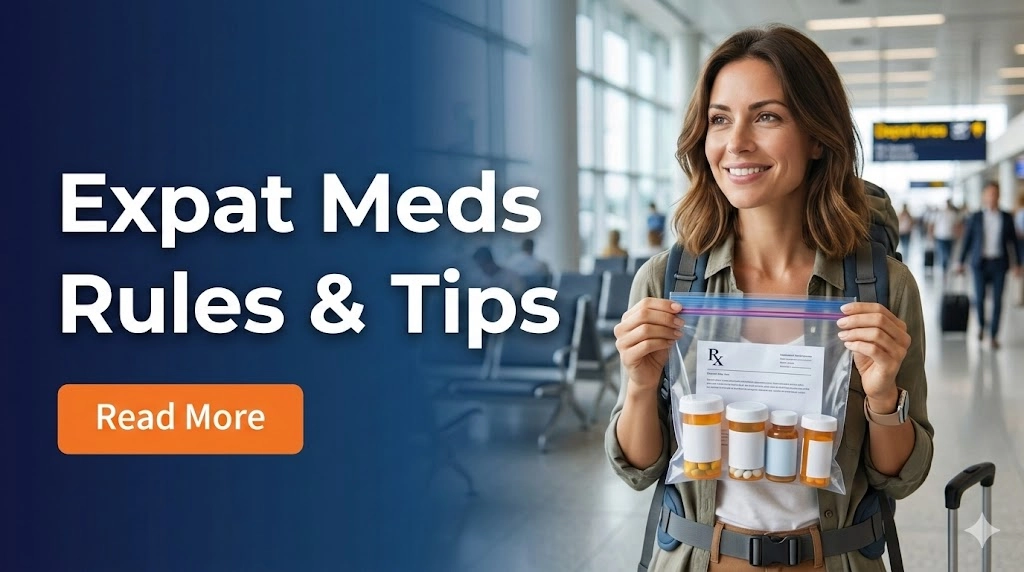
Customs agents must be able to instantly and definitively identify what a pill is, its exact chemical dosage, and who it legally belongs to. All medications must remain in their original, manufacturer-issued packaging or the official, child-proof pharmacy dispensing bottle. The printed pharmacy sticker label must be completely intact, clearly displaying the drug’s generic name, the prescribing doctor’s contact information, and the patient’s name matching their travel documents.
If an agent finds a baggie or an organizer full of mixed, unlabelled pills, they possess the absolute legal authority to confiscate the entire batch. They cannot scientifically verify if the substances are legal vitamins or illicit narcotics on the spot. The minor spatial convenience of using a pill organizer is never worth the massive risk of losing life-saving medication during an airport inspection.
Translating Your Medical Documents into Spanish
A major consideration for expats is overcoming the language barrier at customs. While border agents at massive international airports like Cancun, Los Cabos, or Mexico City frequently speak basic conversational English, relying on their English proficiency when desperately defending your legal right to carry a controlled narcotic is a massive, unnecessary gamble. Official Mexican legal and customs proceedings are ultimately conducted entirely in Spanish.
For highly routine medications, such as standard blood pressure pills or common thyroid medications, a clear English prescription is usually sufficient to pass a basic, visual inspection. However, if you are carrying psychotropic drugs, strong narcotics, or a large volume of complex medical equipment (such as dozens of syringes for insulin), having your doctor’s letter and prescription professionally translated into Spanish is highly recommended.
Utilizing a certified translator adds an undeniable layer of legitimacy to your documents. It demonstrates a profound respect for Mexican regulations and allows the customs agent to quickly and accurately verify your medical story without needing to call over a supervisor or find a bilingual colleague. This drastically speeds up your exit from the airport. For more insights on handling medical translations throughout your residency, read Do You Need to Translate Medical Records into Spanish for Mexican Doctors?.
Transitioning from Home Prescriptions to Local Sources
Once you successfully arrive in Mexico with your medications, the clock immediately starts ticking on your 90-day supply. Your highest logistical priority must be figuring out how to seamlessly replace your imported home medications with sustainable, local equivalents.
Finding Equivalent Medication Brands Locally
The exact brand name of the medication you used back in the United States, Canada, or the UK will likely not exist in Mexico, or it will be sold under a completely different commercial trademark owned by a different pharmaceutical conglomerate. Therefore, you must intimately know the active pharmaceutical ingredient—the generic chemical name—of your medication. For example, the pain reliever acetaminophen is known globally as paracetamol, and the specific brand name Tylenol might be sold locally as Tempra.
In Mexico, medications are distinctly categorized as either medicamentos de patente (expensive, brand-name originator drugs) or medicamentos genéricos (highly affordable generics). Expats should utilize local pharmacy websites or consult with a bilingual pharmacist to look up their active ingredients.
Generics in Mexico are heavily regulated by COFEPRIS to ensure absolute bioequivalence. This means they contain the exact same active ingredients, strength, and efficacy as the expensive brand names you are used to, often resulting in massive financial savings for expats living on a budget. To master this transition, reviewing Mexican vs U.S. Medication Brands: Finding Equivalent Drugs is an essential step in your healthcare planning.
Consulting a Local Physician for New Prescriptions
To legally purchase restricted medications—such as strong antibiotics, specialized inhalers, or any psychotropic substances—in Mexico, your foreign prescription is entirely useless. Mexican pharmacies are strictly prohibited by federal law from dispensing controlled substances based on a piece of paper written by an American, Canadian, or European doctor. You must obtain a localized script.
The only safe and legal solution is to schedule a comprehensive consultation with a local Mexican doctor shortly after your arrival. Bring your translated medical records, your doctor’s letter of necessity, and the physical bottles of your remaining home medication. The Mexican doctor will thoroughly evaluate your condition, verify your ongoing need for the drug, and issue a formal Mexican prescription that any local pharmacy will readily accept.
Finding a highly trusted local doctor is a crucial milestone in your expat journey. Rely on community Facebook groups, local expat forums, or international hospital directories to find bilingual specialists who deeply understand the complex nuances of transitioning foreign patients onto local treatment protocols. For guidance on locating these professionals, read Finding English-Speaking Doctors and Specialists in Mexico.
Managing Pharmacy Costs and International Insurance
Budgeting for your new local prescriptions requires understanding the financial landscape of Mexican private healthcare. While standard generic medications for cholesterol or blood pressure are incredibly cheap, imported brand-name drugs for highly complex conditions—such as specialized biologic therapies for rheumatoid arthritis or advanced oncology drugs—can sometimes be as expensive, or even more expensive, than they are in Europe or Canada.
To effectively manage these potentially crippling costs, many proactive expats rely heavily on premium international health insurance. World-class providers like Cigna Global offer comprehensive, global policies that can be customized to include coverage for outpatient prescription drugs, chronic condition management, and routine specialist consultations. Securing a policy from Cigna Global ensures that managing a severe illness remains financially sustainable while living comfortably abroad.
When paying for your day-to-day, out-of-pocket medical expenses at local clinics, highly efficient currency conversion is vital. Expats frequently use trusted multi-currency platforms like Wise to instantly transfer funds from their home country bank directly into Mexican Pesos. Using Wise allows you to avoid the steep foreign transaction fees and predatory exchange rates charged by traditional credit cards at the pharmacy counter. Furthermore, for non-prescription, holistic health needs, many expats order their preferred organic vitamins and specific nutritional supplements through iHerb, perfectly bridging the gap between local clinical care and specialized global wellness support.
Shipping Medications into the Country Safely
When their initial 90-day supply runs dangerously low, many new expats attempt to have family members mail their prescription refills from their home country via standard postal services. This is almost always a terrible, highly stressful idea.
Customs Delays and Confiscation Risks
Shipping pharmaceutical drugs across the Mexican border is not viewed as a personal errand; it is classified as a highly regulated, commercial-level importation process. If you casually mail a bottle of prescription drugs to your Mexican address without first securing a formal sanitary import permit from COFEPRIS, the package will almost certainly be flagged and intercepted by customs officials at the central processing facility.
Once intercepted, customs agents will legally seize the package. You will eventually receive a notification stating that the medical items are being held pending proper import documentation. Providing this documentation retroactively as an individual citizen without a customs broker is a bureaucratic nightmare that is nearly impossible to resolve.
This invariable leads to severe, potentially life-threatening disruptions to your medical treatment. The vital drugs will sit in a hot, un-airconditioned warehouse, rapidly degrading in quality, until they are eventually destroyed by the state or shipped back to the sender months later. The massive risk of confiscation makes standard international mailing an entirely unviable strategy. For a deeper look at alternative solutions, read What If a Medication You Need Isn’t Available in Mexico?.
Utilizing Private Couriers Versus Standard Mail
If you suffer from a highly rare condition and absolutely must ship a specialized medication that is entirely unavailable anywhere in Mexico, you cannot rely on regular government postal services (like the USPS or Royal Mail connecting to Correos de México). You must utilize specialized, premium private international couriers such as DHL, FedEx, or dedicated global medical logistics companies.
These premium private couriers maintain dedicated internal customs brokerage departments. Before you even ship the item, you must work intimately with the courier’s licensed broker to submit your doctor’s prescription, your letter of medical necessity, and a formal, lengthy application to COFEPRIS to request a one-time personal import permit. This process is intensely bureaucratic, highly expensive, and incredibly time-consuming.
Even with a top-tier private courier and a pre-approved import permit, logistical delays are incredibly common. The ultimate, crucial takeaway for expats is that importing medications should only ever be an absolute last resort for rare, specialized illnesses. For the vast majority of healthcare needs, it is infinitely safer, dramatically cheaper, and exponentially faster to transition your care to equivalent medications available within the Mexican domestic market.
Sourcing Supplements and Over the Counter Items
While shipping heavily regulated prescription drugs is an absolute nightmare, shipping non-prescription, over-the-counter wellness items is significantly easier. Many health-conscious expats maintain specific dietary regimens or holistic health routines that require specialized vitamins, whey protein powders, or herbal extracts that are difficult to find in standard local Mexican supermarkets or neighborhood farmacias.
Because these specific items are classified strictly as nutritional supplements rather than highly regulated pharmaceuticals, they face far less scrutiny at the border. However, buying from unknown, independent foreign sellers can still result in highly frustrating customs delays if the packaging looks suspicious, lacks proper commercial labeling, or vaguely resembles a prescription medication.
To guarantee a smooth, highly reliable supply of wellness products, expats heavily utilize established, trusted global retailers like iHerb. These massive platforms have optimized their shipping routes, pre-paid duties, and perfected their customs declarations specifically for the Mexican market. This ensures that your preferred specialized probiotics, organic herbal teas, and high-quality vitamins arrive safely and promptly at your front door. Combining these imported wellness products from iHerb with excellent local medical care, and managing the overarching costs through secure financial platforms like Wise, creates a perfectly balanced, entirely stress-free health strategy for your new life in Mexico.
| Medication Category | Common Examples | Legal Status at Mexican Border | Required Documentation for Entry |
| Over-the-Counter (OTC) | Ibuprofen, Antacids, basic Allergy meds (No Pseudoephedrine) | Permitted freely for personal use. | None required, but original packaging is highly recommended to avoid confusion. |
| Standard Prescriptions | Blood pressure pills, cholesterol meds, non-narcotic antibiotics | Permitted (Strictly up to a 90-day supply). | Original packaging and a physical copy of the valid home country prescription. |
| Psychotropics & Narcotics | ADHD medication, strong opioids, anti-anxiety pills (Benzodiazepines) | Highly Restricted. Subject to intense scrutiny and tight quantity limits. | Original packaging, formal prescription, and a translated Doctor’s Letter of Medical Necessity. |
| Prohibited Substances | Pseudoephedrine (Sudafed), Medical Marijuana, CBD with trace THC | Strictly Illegal. Zero tolerance policy. | None. Will be immediately confiscated and may result in severe criminal prosecution. |
References
Primary sources (official)
- COFEPRIS (Federal Commission for the Protection against Sanitary Risks): https://www.gob.mx/cofepris
Other helpful sources
- International Society of Travel Medicine (ISTM): https://www.istm.org/
- Centers for Disease Control and Prevention (CDC) – Traveling Abroad with Medicine: https://wwwnc.cdc.gov/travel/page/travel-abroad-with-medicine
Disclaimer
The information provided in this article is for educational and informational purposes only and does not constitute formal medical or legal advice. Mexican customs regulations, COFEPRIS drug classifications, and international shipping laws are subject to frequent changes without notice. Always consult directly with a qualified, licensed medical professional and contact the nearest Mexican consulate or embassy to verify the current, specific legal status of your medications before attempting to cross the international border.