Breaking the B1 Plateau: Why Grammar Study Stalls and What Speaking Fixes
Ah, the B1 plateau. If you’ve been living in Mexico for a while, perhaps a year or two, and you’ve moved past those initial "hola, cómo estás" pleasantries, you know exactly what I'm talking about. You can order food, ask for directions, and maybe even hold a simple conversation, but when it comes to expressing nuances, debating a topic, or truly connecting with locals beyond the superficial, it feels like hitting a brick wall made of unyielding Spanish grammar. This guide isn't about blaming you; it's about acknowledging this very real, very frustrating stage and showing you exactly how to push through it.
Disclosure: This post may contain affiliate links. We may earn a commission at no extra cost to you if you make a purchase through these links. Read full disclosure.
The B1 Plateau: A Familiar Frustration for Expats
When you first arrive in Mexico, every new Spanish word or phrase feels like a triumph. You quickly pick up the basics, maybe take a few group classes, and suddenly, you can navigate daily life. It’s exhilarating! But then, a subtle shift happens. The easy gains disappear, and you find yourself stuck, understanding most of what you hear but struggling to articulate anything beyond the functional. This is the notorious B1 plateau, and trust me, nearly every expat I know has bumped up against it.
What the B1 Level Really Means
The Common European Framework of Reference for Languages (CEFR) defines B1 as an "intermediate" level. At this stage, you're supposed to be an "independent user" of the language. You can understand the main points of clear standard input on familiar matters, handle most situations likely to arise while traveling in a Spanish-speaking country, and produce simple connected text on topics that are familiar or of personal interest. You can describe experiences and events, dreams, hopes, and ambitions, and briefly give reasons and explanations for opinions and plans.
Sounds pretty good, right? And it is! Reaching B1 means you've put in a significant amount of effort and overcome the initial hurdles of a completely new language. You’re not a beginner anymore, and you should be incredibly proud of that. You can successfully navigate a local market, chat with your neighbor about the weather, and order your favorite tacos without pointing. However, the reality of living in Mexico with B1 Spanish quickly reveals its limitations. You might understand the gist of a joke, but struggle to tell one. You can follow a conversation about a soccer game, but explaining the complex rules or the history of your favorite team feels impossible. This gap between comprehension and confident, nuanced expression is precisely where the plateau sets in, leaving many expats feeling like they’re treading water.
Why Traditional Grammar Study Often Fails at B1
For many of us, our language learning journey began with textbooks, grammar drills, and flashcards. These tools are incredibly effective for beginners. They provide a structured framework, help you grasp fundamental concepts, and build a foundational vocabulary. You probably spent countless hours memorizing verb conjugations, adjective agreements, and the difference between ser and estar. And for A1 and A2 levels, it worked wonders! You saw tangible progress, which motivated you to keep going.
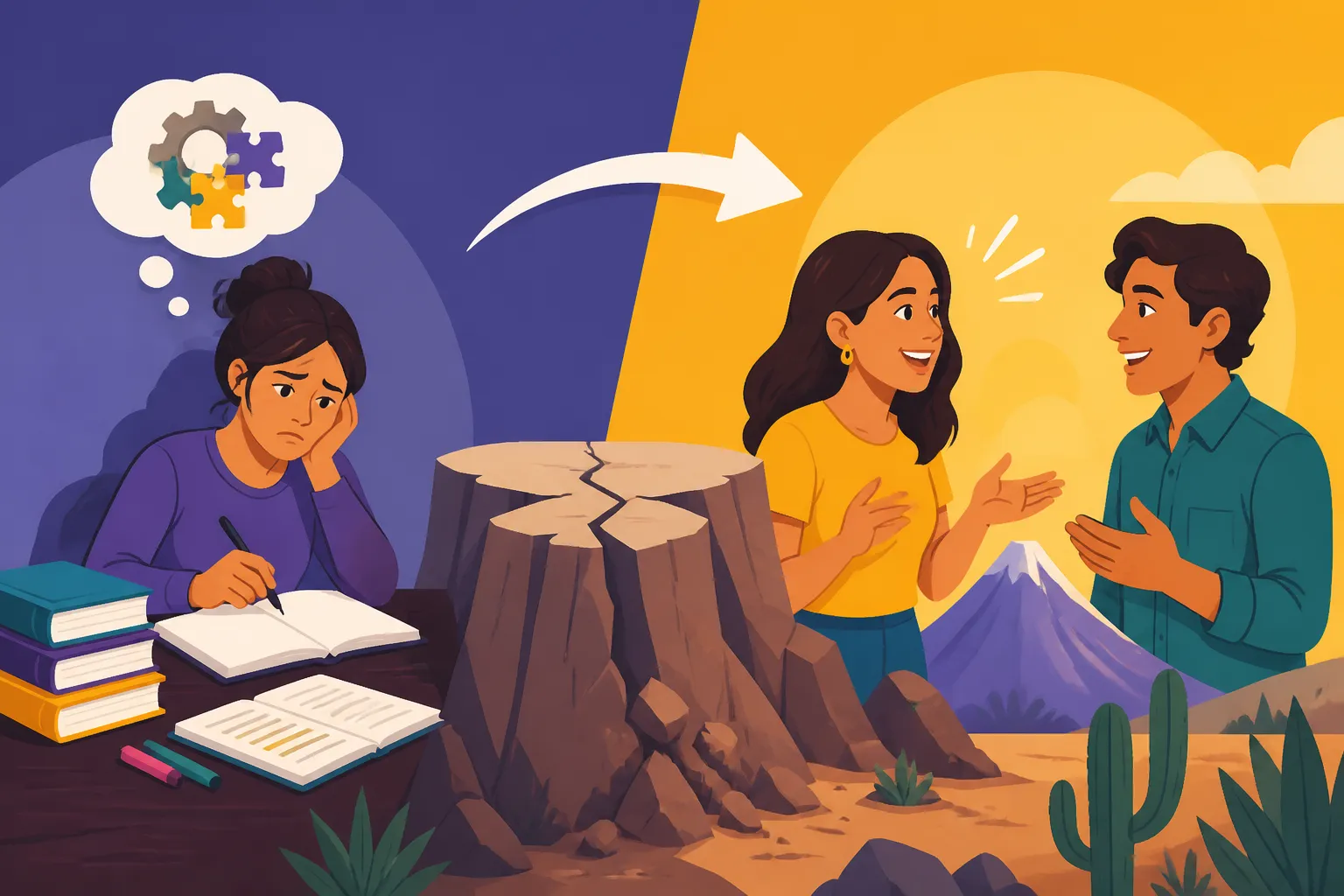
However, at the B1 level, relying solely on grammar books and apps often becomes counterproductive. You’ve likely covered most of the core grammar by now. What happens is that you start to overthink everything. You’re constructing sentences in your head, trying to recall the perfect subjunctive tense or the exact preposition, and by the time you've mentally assembled the sentence, the conversation has moved on. This leads to hesitation, self-correction, and ultimately, silence. The focus shifts from natural communication to a constant, exhausting internal grammar quiz. The well-intentioned pursuit of grammatical perfection actually hinders fluid conversation. You might know the rules, but you haven't internalized them to the point where they flow effortlessly, and simply studying more rules won't magically make them stick. It’s like trying to learn to ride a bike by reading a manual—you need to actually get on and pedal.
The Speaking Barrier: The Real Challenge Beyond B1
So, if grammar isn't the primary problem anymore, what is? For most expats stuck at B1, the real hurdle isn't a lack of knowledge, but a lack of fluid application of that knowledge. It's the speaking barrier – a potent combination of psychological blocks and insufficient practical, real-world conversational experience that prevents your Spanish from truly taking flight.
The Fear of Making Mistakes
Let’s be honest, putting yourself out there in a new language is terrifying. At the A1/A2 stage, people are generally incredibly forgiving and encouraging. They celebrate every simple sentence you manage to string together. But once you hit B1, there’s an unspoken expectation, both from yourself and sometimes from others, that you should be "better." The fear of sounding silly, of mispronouncing a word, of using the wrong verb tense, or worse, of accidentally saying something offensive, can be paralyzing.
I’ve been there. I remember trying to explain a complex issue at the immigration office (INM) and getting completely tongue-tied, feeling my face flush because I couldn't find the right words, even though I knew them somewhere in my brain. That fear often leads us to avoid situations where we might make mistakes. We opt for the English-speaking cashier, we let our Mexican friend do the talking, or we stick to short, predictable exchanges. In Mexico, where direct communication isn't always the norm and a misstep could be misinterpreted, the anxiety can be even higher. This avoidance creates a vicious cycle: less speaking leads to less practice, which in turn fuels more fear and hesitation. It’s a self-imposed prison of silence that keeps your Spanish from progressing naturally. Living in Mexico with Limited Spanish: Survival Tips for Language Barriers can attest to how pervasive this feeling is.
Lack of Consistent Practice with Native Speakers
While living in Mexico provides an immersive environment, it doesn't automatically guarantee the right kind of speaking practice. Most of our daily interactions as expats are often transactional: "A kilo of tortillas, please," "How much is this?", "Can I get the check?" These brief exchanges, while helpful for survival, don't push you to express complex ideas, narrate stories, or engage in meaningful discussions. You rarely get the chance to practice those tricky B1-level grammar points in a natural, low-pressure setting.
Finding dedicated conversational partners can also be surprisingly difficult. While many Mexicans are incredibly friendly, expecting them to patiently correct your grammar or guide you through a nuanced discussion during a casual coffee chat might be unrealistic. They might switch to English out of politeness or simply not have the time or inclination to be your personal language coach. Group classes, while offering some speaking practice, often mean limited individual attention, and you might spend more time listening to other non-native speakers than engaging with a fluent one. This lack of consistent, focused, and corrective speaking practice with native speakers is a major roadblock. You need someone who can not only speak with you but also identify your specific errors, explain why they're errors, and help you integrate the correct usage into your active vocabulary.
The Solution: Intentional, Consistent Conversational Practice
Breaking free from the B1 plateau isn't about more grammar books; it's about shifting your approach entirely. It's about prioritizing active speech and creating structured opportunities to push past your comfort zone. The key, my friend, is intentional, consistent conversational practice. This is where you transform passive knowledge into active, fluid communication.
Why Speaking is the Gateway to Fluency
Think about it: when you speak, you're not just recalling words; you're actively constructing thoughts, selecting vocabulary, applying grammar rules on the fly, and shaping sentences in real-time. This process forces your brain to retrieve and utilize information under pressure, which is entirely different from merely recognizing it in a textbook. It’s like the difference between knowing how to tie a knot by looking at diagrams and being able to quickly tie it blindfolded in a storm. The active engagement required in speaking solidifies your understanding of grammar in a way that passive study never can. When you make a mistake while speaking, and a tutor gently corrects you, that correction often sticks far better than reading about a rule in a book. It’s experiential learning at its best.
Beyond the cognitive benefits, speaking builds immense confidence. Every successful conversation, no matter how small, reinforces your ability and slowly erases that crippling fear of making mistakes. It allows you to develop your unique voice in Spanish, to express your personality, and to truly connect with the vibrant culture around you in Mexico. Fluent conversation isn't just about exchanging information; it's about building relationships, sharing experiences, and ultimately, feeling more at home. From being able to fully participate in a fiesta to having a deep conversation with a new friend, your world in Mexico expands exponentially once you break through that speaking barrier. It's the ultimate key to true integration and enjoyment of your expat life.
The Power of Personalized 1-on-1 Tutoring
While simply forcing yourself to speak more is a good start, the most effective way to move past the B1 plateau is through personalized, one-on-one tutoring with a native Spanish speaker. This isn’t just about having a conversation partner; it's about having a dedicated coach who can pinpoint your weaknesses, provide immediate, constructive feedback, and tailor lessons specifically to your needs. Unlike group classes where you might get lost in the shuffle or spend too much time listening to others, a private tutor's entire focus is on your progress.
Imagine a safe space where you can stumble, make mistakes, and ask "how do I say…?" without judgment. Your tutor can identify if you’re consistently misusing a particular verb tense, struggling with specific prepositions, or if your pronunciation is creating misunderstandings. They can then create targeted exercises, role-play scenarios relevant to your life in Mexico, and guide you through conversations that push you just beyond your current capabilities. This individualized attention is invaluable. It’s like having a personal trainer for your Spanish brain, constantly challenging you and refining your technique. This is precisely where platforms like iTalki shine, providing that vital bridge to authentic, personalized language development.
Making iTalki Your Fluency Ally in Mexico
When I first heard about online language platforms, I was skeptical. How could learning from a screen be as effective as being out there, speaking with people in the mercado? But I quickly realized that the magic of a platform like iTalki isn't about replacing real-world interactions; it's about supercharging your ability to have those interactions confidently and correctly. It provides the structured, personalized practice that casual daily chats simply can't.
How iTalki Bridges the Gap for Expats in Mexico
iTalki is, quite frankly, a game-changer for expats hitting that B1 wall. Why? Because it puts a world of native Spanish speakers, many of whom are experienced teachers, right at your fingertips. You can connect with tutors from Mexico, which means you're learning local nuances, slang, and pronunciation that generic "Spanish from Spain" courses might miss. The convenience is unbeatable: no need to commute to a language school, no fixed schedules that clash with your life. You can take a lesson from your living room in San Miguel de Allende, a coffee shop in Mexico City, or even a beachside palapa in Puerto Vallarta, as long as you have an internet connection. This flexibility is crucial for busy expat lives.
The benefits of using iTalki for an expat like you are significant:
- Affordability: Compared to in-person private tutors or traditional language schools, lessons on iTalki are often incredibly budget-friendly. You can find tutors offering sessions for a fraction of what you'd pay locally.
- Vast Selection: There are literally thousands of Spanish tutors available. You can filter by price, availability, native country, and even what they specialize in (e.g., conversational Spanish, business Spanish, exam prep). This means you can find someone who perfectly matches your learning style and goals.
- Targeted Practice: You can tell your iTalki tutor exactly what you want to work on. Struggling with the subjunctive? Want to practice ordering in a fonda? Need to prepare for a conversation with your landlord? They can tailor the lesson to your specific needs, helping you apply what you've learned in your daily life.
- Safe Learning Environment: Online 1-on-1 sessions provide a safe, non-judgmental space to make mistakes, ask questions, and experiment with new vocabulary and grammar structures without the pressure of a real-world audience. This psychological safety is paramount for overcoming the fear of speaking.
- Consistency: The ease of scheduling and the variety of tutors means you can maintain consistent practice, which is the bedrock of language acquisition. Short, frequent sessions are often more effective than infrequent, long ones.
By actively engaging with iTalki tutors, you're not just speaking; you're receiving immediate, personalized feedback on your grammar, vocabulary, pronunciation, and fluency. Your tutor can identify those specific patterns of errors that you might not even realize you're making and help you correct them effectively. This kind of targeted, consistent practice is precisely what's needed to transform your B1 knowledge into B2 fluency and beyond. How to Choose Between Online and In-Person Spanish Classes in Mexico dives deeper into balancing your learning options.
Choosing the Right Spanish Tutor on iTalki
With so many tutors available on iTalki, finding the right fit might seem daunting at first, but it’s actually one of its greatest strengths. This variety ensures you can find someone who truly connects with your learning style and specific needs as an expat in Mexico. Here’s how to navigate the options effectively:
- Filter by Native Language/Country: Since you're living in Mexico, you'll likely want to focus on Latin American Spanish, and ideally, Mexican Spanish. Use the filters to find tutors from Mexico. This ensures you're learning relevant vocabulary, expressions, and accent nuances.
- Watch Introduction Videos: Almost every tutor has a short introduction video. Pay attention to their teaching style, their energy, and how clearly they speak. Do they seem patient? Engaging? Do you feel like you could easily communicate with them?
- Read Reviews: Student reviews are gold. Look for comments that resonate with your own learning goals. Do other students praise their ability to explain complex grammar simply, or their skill in encouraging conversation? Look for feedback specifically mentioning their experience with intermediate students or those aiming for fluency.
- Consider Teacher Types: iTalki offers two main types of tutors:
- Professional Teachers: These often have formal teaching qualifications, structured lesson plans, and extensive experience. They might be a bit more expensive but can be excellent for systematic improvement.
- Community Tutors: These are native speakers who offer informal conversation practice. They might not have formal teaching credentials but are often fantastic for pure conversation practice, building confidence, and are usually more affordable. A combination of both can be very effective!
- Look for Relevant Experience: Some tutors specifically mention working with expats, travelers, or students at your level. This can be a huge advantage, as they'll already understand the common challenges and frustrations you face.
- Take Trial Lessons: This is absolutely crucial! Most tutors offer discounted trial lessons. Use these to test out different tutors, get a feel for their teaching style, and see if your personalities click. Don't be afraid to try several before committing. During your trial, explain your situation: "I'm an expat in Mexico, I'm at a B1 level, and I want to break past this plateau. I need more conversational practice and help with my fluency."
By being strategic in your selection process, you can find an iTalki tutor who becomes an invaluable ally in your journey to Spanish fluency. They can help you identify those persistent grammatical errors you make, expand your vocabulary with relevant Mexican colloquialisms, and most importantly, build your confidence to speak more freely and spontaneously, both in your virtual lessons and in your daily life in Mexico.
Beyond iTalki: Integrating Spanish into Your Daily Mexico Life
While dedicated sessions with an iTalki tutor are transformative for breaking the B1 plateau, the goal isn't just to speak Spanish well in a structured lesson. The ultimate aim is to seamlessly integrate that improved Spanish into every facet of your life here in Mexico. Your tutor gives you the tools and the confidence; now it’s up to you to put them to work in the real world.
Actively Seeking Speaking Opportunities
Once you start feeling more confident after your iTalki sessions, it's time to intentionally seek out and create real-world speaking opportunities. Don't wait for conversations to come to you; actively pursue them. This means stepping out of your comfort zone, but remember, every little interaction is practice, and you're now better equipped to handle them.
Here are some ideas for actively seeking speaking opportunities in Mexico:
- Join Local Groups and Activities: Look for hobbies or interests that involve local Mexicans. This could be a sports club, a cooking class, a dance group, a book club (if you're feeling brave!), or even volunteering. These activities naturally foster conversation around shared interests. Making Friends in Mexico: Expat Groups, Meetups, and Social Tips can give you a head start on this.
- Participate in Intercambios: Many cities in Mexico have language exchange meetups where native Spanish speakers want to practice English, and vice-versa. These can be a fantastic, low-pressure way to practice and meet new people. Just be sure to set clear expectations to ensure you get your Spanish practice in!
- Engage Beyond the Transactional: At the grocery store, pharmacy, or local tienda, try to extend the conversation beyond just buying what you need. Ask about their day, compliment their products, or comment on something local. Even a few extra sentences can make a difference. Pharmacy Spanish: Phrases to Help You Buy Medicine in Mexico is a great resource to arm yourself with useful phrases.
- Make Mexican Friends: This might sound obvious, but intentionally cultivating friendships with native Spanish speakers is arguably the best way to immerse yourself. Suggest meeting for coffee, a meal, or an activity, and commit to speaking Spanish.
- Attend Local Events: Go to fiestas, neighborhood gatherings, cultural events, and festivals. These are natural places for conversation and offer a glimpse into authentic Mexican life. Pay attention to Mexican Etiquette and Customs: Do's and Don'ts for New Expats to navigate these interactions smoothly.
The more you force yourself to use your newly honed Spanish, the more natural and automatic it will become. It's about building muscle memory for your mouth and your brain, transitioning from consciously applying grammar rules to instinctively speaking correctly. Learning Spanish in Mexico: Top Tips and Resources for Expats provides a broader view of resources that complement this approach.
Embracing Mistakes as Learning Opportunities
This is perhaps the most crucial mental shift you need to make: embrace your mistakes. For so long, the fear of making errors has held you back, but now you need to reframe them. Every mistake you make is not a failure; it’s a data point. It’s a moment of active learning. It’s proof that you are trying, and that is commendable.
Here in Mexico, people are generally incredibly patient and appreciate the effort you make to speak their language. They would much rather you stumble through a sentence in Spanish than resort to English out of fear. Often, a local will gently correct you, or you’ll notice their expression and realize you mispronounced something. These moments, which might feel embarrassing initially, are powerful learning experiences. You're likely to remember the correct usage after a real-world correction more than you would from a textbook example.
I’ve made countless comical mistakes over the years, from confusing similar-sounding words to completely butchering verb tenses. I once tried to order "a cup of milk" (una taza de leche) but accidentally asked for "a breast of milk" (un teta de leche) in a busy café. The baristas burst into laughter, explained my error good-naturedly, and now, years later, I still vividly remember the correct word. The key is to laugh with them, thank them for the correction, and then move on. Don't let a mistake derail your confidence. The sooner you accept that making mistakes is an unavoidable and even necessary part of becoming fluent, the faster you will progress. Think of it as a badge of honor – you’re putting yourself out there. When you need to express complex medical issues, for example, remember that Overcoming Language Barriers at the Doctor: Tips for Expats will become easier with practice and a relaxed attitude towards errors.
Disclaimer
This article is for general informational purposes only and does not constitute professional advice. Laws, prices and regulations vary by location and change over time. Consult a qualified professional for guidance on your specific situation.