Accessibility in Healthcare: Services for Patients with Disabilities in Mexico
Relocating to Mexico offers vibrant culture, beautiful climates, and a generally lower cost of living. However, for expats living with physical, visual, or hearing disabilities, the prospect of navigating a foreign healthcare system brings an entirely different layer of anxiety. The candid reality is that while Mexico has made significant legislative strides regarding disability rights, the physical infrastructure often lags decades behind. This guide breaks down the harsh realities of medical accessibility in Mexico, what legal rights you have, and how to strategically build a healthcare safety net that accommodates your specific physical or sensory needs.
Disclosure: This post may contain affiliate links. We may earn a commission at no extra cost to you if you make a purchase through these links. Read full disclosure.
The Legal Framework Versus the Physical Reality
To understand your rights as a disabled patient in Mexico, you must navigate the massive gap between federal legislation and local, real-world enforcement.
Mexican Disability Law
In 2011, Mexico enacted the Ley General para la Inclusión de las Personas con Discapacidad (General Law for the Inclusion of Persons with Disabilities). On paper, this is a robust legal framework that mandates equal access to public health facilities, prohibits discrimination, and outlines standards for architectural accessibility.
However, federal mandates in Mexico often take an agonizingly long time to translate into concrete infrastructure, particularly in older buildings and regional towns. The enforcement of these building codes is highly inconsistent. A newly constructed hospital in Monterrey may feature state-of-the-art ramps, wide elevators, and accessible restrooms, while a historic, 50-year-old public clinic in Oaxaca might only be accessible via a steep flight of concrete stairs.
Public Versus Private Infrastructure
This inconsistency is most glaring when comparing the public and private healthcare tiers. The public systems (such as IMSS and IMSS-Bienestar) operate in many older, legacy buildings. While they legally must provide care, the physical reality for a wheelchair user often involves navigating narrow corridors, broken elevators, and a lack of dedicated accessible parking. To understand the broader operational struggles of the public tier, reviewing Public Healthcare in Mexico: IMSS and IMSS Bienestar Explained for Expats is highly recommended.
Conversely, the elite private healthcare sector operates primarily in modern, purpose-built medical campuses. Private hospitals that cater to international standards actively compete for patients, meaning their infrastructure is vastly superior. If you require seamless physical accessibility, the private sector is not just a luxury; it is a logistical necessity.
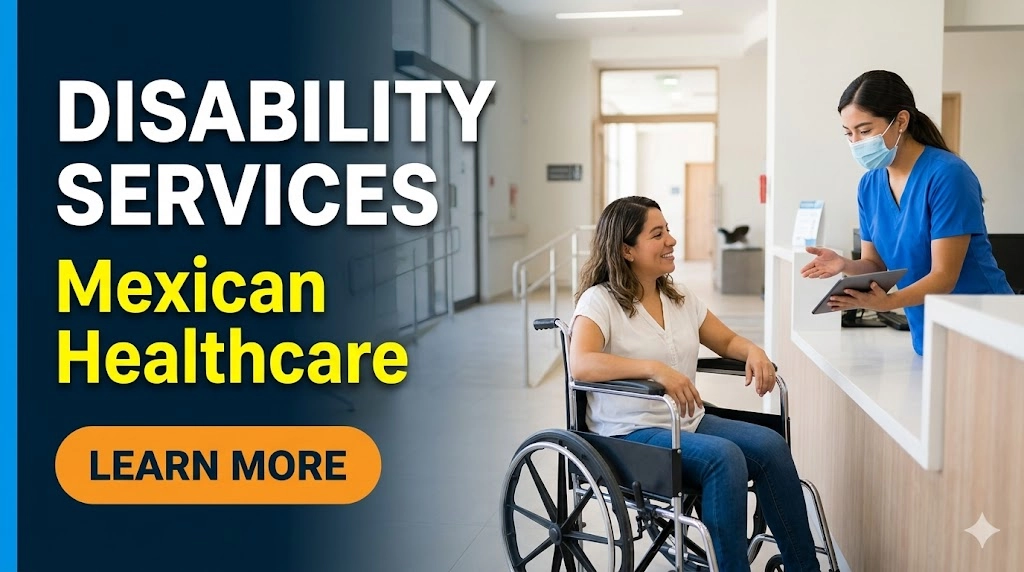
Navigating Physical and Mobility Accessibility
For patients reliant on wheelchairs, walkers, or prosthetics, getting to the doctor is often more dangerous than the medical issue itself.
The Urban Infrastructure Challenge
Mexico’s most charming towns, such as San Miguel de Allende, Guanajuato, or Puerto Vallarta’s romantic zone, are famous for their historic cobblestone streets and incredibly narrow, uneven sidewalks. Curb cuts are frequently missing, blocked by parked cars, or too steep to safely navigate.
When choosing a medical provider, you must physically map the route from your vehicle to the clinic entrance. Relying on a Google Maps pin is insufficient. You need to verify if there is a flat drop-off zone, valets who can assist with mobility devices, and whether the clinic is on the ground floor.
Choosing the Right Hospital
When vetting a hospital for a major procedure or routine care, look specifically for facilities with major international accreditations. Hospitals that have achieved the Joint Commission International (JCI) gold seal or the domestic Consejo de Salubridad General (CSG) certification are audited not just on surgical safety, but on facility safety.
These accredited hospitals are strictly required to maintain wide doorways, fully compliant ADA-style bathrooms, and emergency evacuation protocols for non-ambulatory patients. To learn how to verify these credentials before booking an appointment, consult our guide on Choosing a Good Hospital: What Accreditations to Look for in Mexico.
Accommodations for Sensory Impairments
Accessibility is not solely about ramps; communicating with medical staff is a life-or-death requirement for patients with visual or hearing impairments.
Hearing Impairments and Sign Language
Expats who are deaf or hard of hearing face a unique, critical challenge: Mexican Sign Language (Lengua de Señas Mexicana or LSM) is an entirely different language from American Sign Language (ASL) or British Sign Language (BSL). They are not mutually intelligible.
If you rely on ASL, you cannot expect a local Mexican hospital translator to understand you. Furthermore, while Mexican law mandates that public hospitals provide LSM interpreters, the reality is a severe national shortage of these professionals. In an emergency room setting, finding an interpreter on short notice is nearly impossible.
Proactive Solutions:
- Written Communication: Always keep a bilingual, printed medical dossier detailing your condition and symptoms.
- Advocacy: You must travel with a hearing companion or hire a private, bilingual medical concierge who can advocate for you verbally to the nursing staff. For broader strategies on managing doctor visits, read Overcoming Language Barriers at the Doctor: Tips for Expats.
Visual Impairments
For patients who are blind or visually impaired, navigating a bustling, chaotic Mexican hospital requires absolute reliance on a guide. Braille signage is incredibly rare outside of apex private hospitals in Mexico City. Elevators frequently lack auditory floor announcements.
When signing intake forms or surgical consent forms (consentimiento informado), you are legally required to understand what you are signing. Because Braille forms are practically nonexistent, you must ensure that a trusted advocate or a certified medical translator is present to read the complex Spanish legal and medical terminology aloud to you.
Structuring Your Healthcare Safety Net
For expats with disabilities, you cannot rely on serendipity. You must aggressively engineer your medical logistics to remove as much friction as possible.
The Role of Premium International Insurance
Because relying on the public IMSS system poses severe mobility and logistical hurdles, access to the premium private sector is vital. However, top-tier accessible private hospitals are highly expensive and demand massive upfront cash deposits during emergencies.
Securing a robust international health insurance policy from Cigna Global is the most effective way to guarantee your access to these modern facilities. With a Cigna Global policy, you are plugged directly into a network of JCI and CSG-accredited hospitals that feature pristine, globally compliant architectural accessibility. In an emergency, their 24/7 multilingual dispatchers can direct you to a facility guaranteed to accommodate your mobility devices, while coordinating direct billing so you aren’t forced to navigate complex financial paperwork at the admissions desk. To understand the financial mechanics of this protection, review Choosing Private Health Insurance: Local Mexican Plans vs International Coverage.
Bypassing Inaccessible Pharmacies for Wellness
Managing a disability often requires a strict, ongoing regimen of nutritional support and wellness maintenance. Unfortunately, accessing local commercial pharmacies (farmacias) can be a daily struggle if the neighborhood sidewalks are broken or lack curb cuts.
Instead of battling hostile urban infrastructure just to find specialized vitamins, probiotics, or anti-inflammatory supplements, savvy expats bypass the local supply chain entirely by utilizing iHerb. By ordering through iHerb, you gain access to a massive, globally sourced catalog of premium nutritional supplements, joint-support formulas, and specialized dietary items that are shipped reliably and directly to your accessible residential address in Mexico. Relying on iHerb eliminates the physical exhaustion of hunting down specific wellness products across town, allowing you to manage your baseline health from the comfort and safety of your own home. (For prescription medications, you can also learn about local delivery options in Pharmacies in Mexico: How to Get Medications (OTC vs Prescription)).
Hiring Local Caretakers (Cuidadores)
The Mexican healthcare system structurally expects that every patient has a dedicated family member acting as their cuidador (caretaker) to assist with feeding, bathroom mobility, and basic comfort, even within the hospital.
If you live alone or your partner cannot physically assist you, hiring a private, local nursing assistant is highly common and incredibly affordable in Mexico compared to North America. You can hire a certified nurse (enfermera) for home visits or to accompany you to the hospital to manage your wheelchair, translate your needs, and assist with physical transfers.
Summary of Accessibility by Facility Type
To help you manage expectations, here is a realistic breakdown of what to expect across different healthcare settings in Mexico:
| Facility Type | Physical Accessibility (Wheelchairs/Mobility) | Sensory Accommodations (Visual/Hearing) | Best Suited For |
| Public Clinics (IMSS/ISSSTE) | Poor to Moderate. Often older buildings; elevators may be unreliable. | Very Poor. Lack of ASL/LSM translators and Braille. | Patients with full mobility and severe budget constraints. |
| Local Private Clinics (Consultorios) | Varies wildly. May be on a ground floor, but lack ADA bathrooms. | Poor. Rely entirely on patient-provided advocates. | Minor ailments for ambulatory patients. |
| Top-Tier Private Hospitals (JCI Accredited) | Excellent. Ramps, wide doors, compliant ADA-style bathrooms. | Moderate. English speakers available; Braille/ASL still rare. | Expats with disabilities requiring guaranteed safe access and premium care. |
References
Primary sources (official)
- Consejo Nacional para el Desarrollo y la Inclusión de las Personas con Discapacidad (CONADIS): The federal council responsible for promoting and evaluating public policies regarding disability inclusion in Mexico. https://www.gob.mx/conadis
Other helpful sources
- World Health Organization (WHO): Global context on health equity for persons with disabilities. https://www.who.int/news-room/fact-sheets/detail/disability-and-health
Disclaimer
The information provided in this guide is for educational, logistical, and informational purposes only and does not constitute formal medical or legal advice. Architectural accessibility, elevator functionality, and the availability of sign language interpreters vary drastically by specific hospital and region in Mexico. Always physically verify the accessibility of a clinic prior to an appointment, consult with local advocacy groups regarding specific regional infrastructure, and confirm coverage for private home-care nursing directly with your health insurance provider.