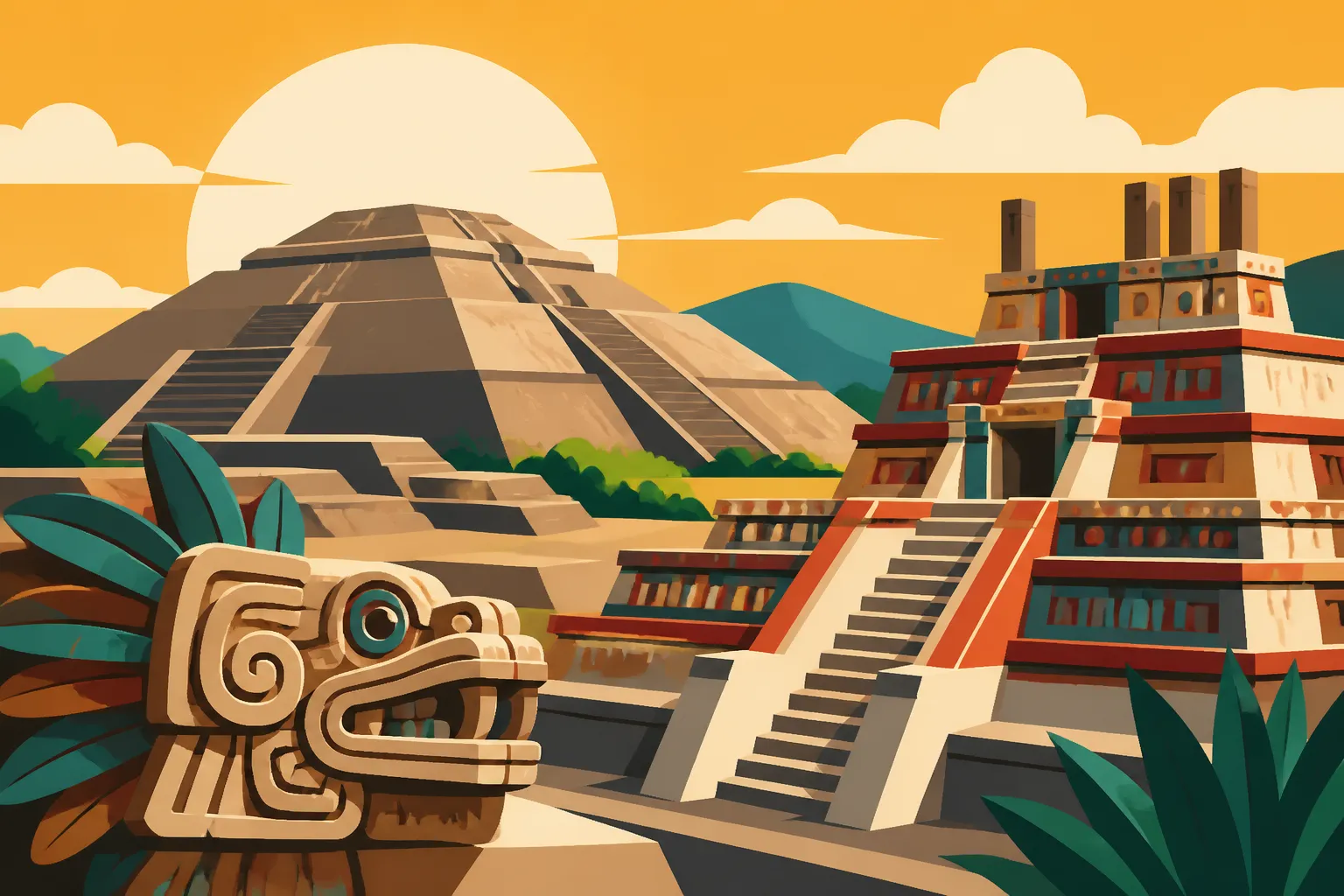
Aztec and Central Mexican Sites: Teotihuacán and Templo Mayor
Many travelers arrive in the sprawling chaos of Mexico City and feel an immediate, overwhelming sense of history layered upon history. You might stand in the middle of a colonial plaza only to realize you are literally walking on top of the ruins of a massive Aztec empire, or drive an hour north and find a city of giants that was already ancient and mysterious when the Aztecs first discovered it. This guide solves the confusion of navigating these monumental spaces, offering a veteran expat’s perspective on how to truly experience Teotihuacán and Templo Mayor without falling into the usual tourist traps.
Disclosure: This post may contain affiliate links. We may earn a commission at no extra cost to you if you make a purchase through these links. Read full disclosure.
Understanding the Legacy of Central Mexico
To appreciate what you are looking at in Central Mexico, you have to dispel the common myth that everything ancient is "Aztec." When I first moved here, I made the mistake of assuming the pyramids at Teotihuacán were built by the same people who lived in the center of what is now Mexico City. In reality, several centuries and vastly different cultures separate these sites. Teotihuacán was a multi-ethnic metropolis that flourished between 100 BCE and 550 CE, whereas the Aztec (Mexica) Empire didn't rise to power until the 1300s. Understanding this timeline is crucial because it changes how you view the architecture and the sacred geography of the region.
The Mystery of Teotihuacán the City of the Gods
Teotihuacán is perhaps the most enigmatic site in the Western Hemisphere. By the time the Aztecs stumbled upon it in the 13th century, it had been abandoned for over 600 years. They were so awestruck by the scale of the ruins that they named it the "Place where the Gods were created." As you walk through the site today, you aren't just seeing a tourist attraction; you are seeing what was once the sixth-largest city in the world, with an estimated population of over 125,000 people.
The city was meticulously planned on a grid system, which was unheard of for its time. Unlike the later Aztec sites, we don't know the names of the rulers of Teotihuacán or even what language they spoke. Exploring the site requires a shift in mindset—you have to embrace the mystery. If you want to delve deeper into the historical context before you arrive, checking out Ancient Ruins, History, and Archaeology in Mexico can provide a broader look at how this site fits into the national landscape.
The Rise of the Aztecs and Tenochtitlan
Fast forward several centuries, and the Mexica people arrived in the Valley of Mexico. According to legend, they were searching for an eagle perched on a cactus eating a snake—a prophecy that would mark the site of their new home. They found it on a swampy island in Lake Texcoco and built Tenochtitlan, one of the most sophisticated cities in human history. While Teotihuacán is a vast, open-air site in a dry valley, the Aztec heartland was a "Venice of the New World," connected by canals and causeways.
The Aztecs viewed Teotihuacán as a sacred ancestral site and adopted many of its architectural styles. However, their own religious center, the Templo Mayor, was the absolute axis mundi of their universe. It was here that they built their twin temples to Huitzilopochtli (the god of war) and Tlaloc (the god of rain). Today, the remnants of this site sit in the very heart of the modern capital. For those staying in the city, Mexico City and Mexico's Great Cities: Explorer's Guide is a fantastic resource for understanding how these ancient sites intersect with modern urban life.
Deep Dive into Teotihuacán Planning Your Visit
Teotihuacán is massive. I cannot stress this enough—if you think you can "pop over" for an hour and see it all, you are in for a shock. It is a high-altitude, sun-drenched valley where the air is thin and the distances are long. Most people start their journey from Mexico City. If you prefer a structured experience, I often recommend using Viator to find highly-rated archaeological guides who can explain the complex symbolism of the murals and carvings that the untrained eye might miss.
Navigating the Avenue of the Dead
The central artery of the city is the Avenue of the Dead (Calzada de los Muertos). It stretches for miles, though the excavated portion is about 1.5 miles long. Walking this path is a humbling experience. It was designed to create a sense of scale that makes the individual feel small and the state feel eternal. As you walk, you’ll pass through various "barrios" or neighborhoods.
Veterans of the site know that the real magic is often in the details off the main path. For instance, the Palace of Quetzalpapálotl near the Moon Pyramid contains some of the best-preserved carvings and murals in the city. You’ll see depictions of owls and mythological creatures that still retain fragments of their original red and green pigments. If you are handling your own transportation, using Busbud to secure your bus tickets from the Terminal del Norte is a smart move, as it ensures you have a seat on the earlier, cooler buses before the midday heat hits.
The Pyramid of the Sun and the Pyramid of the Moon
The Pyramid of the Sun is the third-largest pyramid in the world. It is a massive mountain of stone and earth, built over a natural cave that the ancients believed was the birthplace of the sun. In recent years, access to climb the pyramids has been restricted to help preserve the structures, but standing at the base is still a visceral experience. The Pyramid of the Moon, located at the northern end of the avenue, offers the best perspective of the city’s symmetry.
When you stand in the Plaza of the Moon, you can see how the architects aligned the pyramid with the Cerro Gordo mountain behind it. It’s a masterclass in "landscape architecture" where the man-made structure mimics the natural one. If you're wondering about the best way to get there, I’ve written extensively on How to Visit Teotihuacán From Mexico City to help you choose between the bus, Uber, or a private driver. Regardless of how you get there, bring more water than you think you need.
Transportation and Logistics Getting from CDMX to Teotihuacán
The logistics of getting to Teotihuacán can be a headache if you don't plan. The site is about 30 miles (50km) northeast of the city. Most expats use the "Autobuses Teotihuacán" line which runs from the Terminal Central del Norte. The journey takes about an hour depending on the infamous Mexico City traffic. Using Busbud can help you visualize the schedule and avoid the confusion of the busy ticket counters at the station.
Once you arrive at the site, there are five different gates. Gate 1 is near the Ciudadela (Temple of the Plumed Serpent), while Gate 3 is closest to the Pyramid of the Moon. My pro tip: have your driver drop you at Gate 1 and pick you up at Gate 3. This allows you to walk the entire Avenue of the Dead without having to double back on your tired legs. For more general advice on navigating the country's transit systems, refer to Getting Around Mexico: Buses, Flights, and Car Hire.
Templo Mayor The Sacred Heart of the Aztec World
While Teotihuacán is a day trip, Templo Mayor is an afternoon stroll from the Zócalo (the main plaza). For centuries, the exact location of the Great Temple of the Aztecs was a mystery, buried under the colonial buildings of the Spanish conquerors. It wasn't until 1978, when electrical workers accidentally hit a massive stone disc depicting the goddess Coyolxauhqui, that the site was truly rediscovered and excavated.
The Unexpected Discovery in the Zócalo
The discovery of Templo Mayor changed everything we knew about the Aztec capital. It proved that the Spanish didn't just build near the Aztec temples; they used the very stones of those temples to build the Metropolitan Cathedral. When you visit today, you see a "sunken" archaeological zone because the heavy colonial buildings have caused the soft lakebed soil to compress, while the ancient ruins remain closer to their original level.
Standing on the walkway overlooking the ruins, you can see the layers of history like rings in a tree. The Aztecs had a tradition of building a new, larger temple directly over the old one every 52 years to mark a new "century" in their calendar. There are seven major phases of construction visible. It is a fascinating, if somewhat grim, place that reflects the intense religious fervor of the Mexica. To find a place to stay within walking distance of this history, Booking.com offers several boutique hotels in the Centro Histórico that give you a front-row seat to the Zócalo's energy.
Exploring the Seven Stages of Construction
Walking through the Templo Mayor site is like a lesson in archaeology 101. Because each successive ruler wanted to outdo his predecessor, the temple grew in size and complexity. You can see the original "Phase II" temple, which is the best preserved because it was protected by the layers built on top of it. You’ll see the sacrificial stones and the chacmool figures—statues used to hold offerings—still in their original positions.
The site is also home to the "House of the Eagles," a meeting place for the elite Aztec warriors. Here, you can still see the original polychrome benches carved with processions of warriors. It is remarkably intimate compared to the vastness of Teotihuacán. To understand how these artifacts are curated and what they tell us about the Aztec mind, I recommend reading Museums of Mexico City: Anthropology and Beyond.
| Feature | Teotihuacán | Templo Mayor |
|---|---|---|
| Location | 1 hour North of CDMX | Heart of Centro Histórico |
| Primary Culture | Teotihuacano (Pre-Aztec) | Mexica (Aztec) |
| Key Attraction | Pyramid of the Sun | Coyolxauhqui Stone |
| Vibe | Vast, expansive, dusty | Urban, layered, intimate |
| Time Needed | 5-7 hours | 2-3 hours |
| Physical Effort | High (lots of walking) | Low (boardwalks/museum) |
Practical Expat Tips for a Smooth Experience
After living here for years, I’ve learned that the "how" of visiting these sites is just as important as the "where." Mexico City's altitude (7,350 feet) means you get dehydrated faster and sunburned more easily than you expect. Also, the "vendedores" (vendors) at Teotihuacán are famously persistent. You will hear the sound of hundreds of obsidian jaguar whistles—a sound that can be haunting the first time and a bit grating by the tenth.
Timing and Crowd Management
The absolute best advice I can give you is to arrive at Teotihuacán the moment the gates open at 8:00 AM. By 11:00 AM, the tour buses from the city arrive, and the heat begins to radiate off the stones. Sundays are free for Mexican residents and citizens, which means the sites are absolutely packed. If you are an expat or tourist, try to visit on a Tuesday or Wednesday.
For Templo Mayor, the museum is closed on Mondays, like most state-run museums in Mexico. If you want to avoid the crowds in the Zócalo, try to visit Templo Mayor on a weekday morning. If you're interested in other day trips that might be less crowded, check out Best Day Trips From Mexico City. Using Viator to book a "skip-the-line" tour can also save you significant time during the peak winter travel season.
Dealing with Vendors and Local Guides
At Teotihuacán, you will be approached by many people offering their services as guides. Some are officially licensed by the government (look for a photo ID card), and others are locals who have grown up in the shadow of the pyramids. Both can be good, but always agree on the price and the duration of the tour before you start walking.
When it comes to souvenirs, the obsidian "volcanic glass" is the local specialty. It’s beautiful, but remember that you have to carry whatever you buy across the entire site. If you find yourself overwhelmed by the social dynamics, Common Cultural Surprises for First-Time Visitors to Mexico can help you navigate the nuances of local interaction. And don't forget that tipping your guide is standard practice; Tipping in Mexico (Propina): When and How Much provides a good breakdown of what is expected.
Nearby Gems Beyond the Main Pyramids
Most people leave Teotihuacán after seeing the pyramids, but that’s a mistake. The surrounding town of San Juan Teotihuacán has some incredible restaurants. There is a famous restaurant called La Gruta which is located inside a massive natural cave. It’s a bit of a "tourist" spot, but having a meal underground by candlelight is an experience you won't soon forget.
Near Templo Mayor, don't miss the chance to walk a few blocks to see the murals at the Secretaría de Educación Pública or the Palacio Nacional. These murals by Diego Rivera tell the story of the very ruins you just walked through. If you're looking for a place to stay that makes these side trips easy, check Booking.com for apartments in the neighborhood of Regina or near the Alameda Central. These areas are slightly quieter than the Zócalo but still walk-able to the main sites.
Comparing the Visitor Experience Teotihuacán vs Templo Mayor
Choosing between these two sites isn't really necessary, as they offer completely different vibes. Teotihuacán is about grandeur and the feeling of a lost civilization. It is a place where you feel the weight of time and the scale of human ambition. Templo Mayor is about the collision of worlds—the literal physical intersection of the indigenous past and the Spanish colonial present.
Physicality and Accessibility
Teotihuacán requires a lot of physical stamina. You are walking on uneven stones, gravel, and dirt for several miles. While the main paths are relatively flat, the heat can be punishing. If you have mobility issues, it can be a challenge, though some areas are accessible by car if you have a private driver. Always keep safety in mind, especially in large crowds, and read Staying Safe in Mexico: Practical Tips for Travelers for general advice.
Templo Mayor, on the other hand, is much more accessible. The site uses a system of raised metal boardwalks that allow you to look down into the ruins without having to climb over them. The accompanying museum is world-class, with elevators and air conditioning, making it a much more comfortable experience for those who might struggle with the ruggedness of Teotihuacán. It’s a great option for a rainy afternoon in the city.
Integration into Modern City Life
One of the most striking things about Templo Mayor is how it is just there. You can be walking to a pharmacy or a taco stand and suddenly find yourself looking at the foundation of a 15th-century empire. It’s a reminder that Mexico City is a "Palimpsest"—a city written over and over on the same piece of land.
Teotihuacán feels like a world apart. Once you enter the gates, the modern world disappears behind the hills. It is a silent, stony testament to a people who achieved incredible things and then vanished. Both sites are essential for anyone trying to understand the soul of Mexico. If you find yourself wanting to see more "magic" towns after this, you might enjoy exploring Lesser-Known Archaeological Sites in Mexico to escape the bigger crowds and find your own hidden piece of history.
Disclaimer
This guide is intended for informational purposes only. While every effort has been made to provide accurate and up-to-date information regarding travel logistics and site accessibility as of 2026, conditions on the ground in Mexico can change rapidly. Always check official government websites for the latest entry requirements, opening hours, and safety advisories before planning your trip. The author is an expat sharing personal experiences and does not represent the official tourism board of Mexico.