How to Set Up Automatic Bill Payments in Mexico
Waking up to a silent refrigerator and a dead Wi-Fi router because a physical bill never arrived in your mailbox is a rite of passage for many newcomers. I once spent three hours in the sweltering afternoon heat at a CFE office just to get my power restored after missing a single payment. This guide will show you how to bypass those lines and set up automatic payments for every major utility in Mexico.
Disclosure: This post may contain affiliate links. We may earn a commission at no extra cost to you if you make a purchase through these links. Read full disclosure.
The Administrative Maze of Mexican Utilities
Moving to Mexico often involves a steep learning curve regarding how the "real world" functions. Back home, you might have been used to a seamless digital ecosystem where every bill was an afterthought. In Mexico, the traditional culture is still very much centered around the ventanilla (the teller window) or the local OXXO. For years, the standard practice was to wait for a paper slip to be tucked into your gate, then run to the nearest convenience store to pay it before the 2:00 PM cutoff.
However, the "I'll do it tomorrow" approach is a dangerous game when it comes to Mexican utilities. Unlike some countries where you get multiple warnings and grace periods, services like CFE (electricity) are notoriously quick to pull the plug—literally. Once that technician clips your wire or removes your meter, you are looking at a multi-day ordeal involving reconnection fees and long waits in government offices. To avoid this, understanding the digital shift in Managing Your Money in Mexico: Budgeting, Saving, and Currency Tips is essential for any long-term resident.
The shift toward automation is not just about convenience; it is about security. When you rely on automatic payments, you eliminate the risk of a lost paper bill or a missed deadline while you are traveling back home or exploring another state. Transitioning to a digital-first mindset will significantly lower your stress levels and allow you to actually enjoy the lifestyle you moved here for.
The Challenge of Physical Bill Delivery
In many Mexican colonias, mail delivery is at best "sporadic" and at worst non-existent. You might live in a beautiful condo in Playa del Carmen or a colonial home in Mérida, but that doesn't mean the mailman knows exactly where your slot is, or that the bill won't be swiped by a gust of wind. I’ve lived in three different states in Mexico, and in every single one, I’ve had at least one month where the bill simply never showed up.
If you aren't proactive, you won't even know you owe money until the service stops. This is why setting up digital alerts and automatic transfers is the only way to stay ahead of the curve. It's also worth noting that many utility companies are moving toward "paperless" initiatives, which sounds great in theory but often means they just stop sending the paper without successfully notifying you via email. By mastering the automation process, you take the power back into your own hands.
Navigating the Cash-Centric Tradition
Mexico is still a cash-heavy society in many ways, and for a long time, the infrastructure for automatic debits was clunky. You’ll still see locals queuing up at Paying Bills at OXXO: A Handy Option for Expats in Mexico because they prefer the physical receipt. For an expat, however, this is a massive time sink. The psychological shift from "paying when I see the bill" to "the system handles it" can be a bit scary at first, especially when you are dealing with government-run entities.
There is a lingering distrust of "domiciliación" (direct debit) among some long-term residents because they fear being overcharged and having no recourse. While overcharging can happen, the modern banking apps offered by Best Banks in Mexico for Expats: Comparing Fees and Services have become much more sophisticated, allowing you to set limits on how much can be withdrawn automatically.
Core Methods for Automating Your Payments
To successfully automate your life in Mexico, you need to understand the three primary digital channels: the banking app, the service provider's own app, and the direct debit (domiciliación). Each has its pros and cons, and often you will end up using a mix of all three depending on the service.
For most expats, the journey starts with How to Open a Bank Account in Mexico: Requirements and Tips. Once you have a local account, the world of SPEI (Sistema de Pagos Electrónicos Interbancarios) opens up. This is Mexico's near-instant electronic funds transfer system, and it is the backbone of most automated payments.
Using Major Mexican Banking Apps
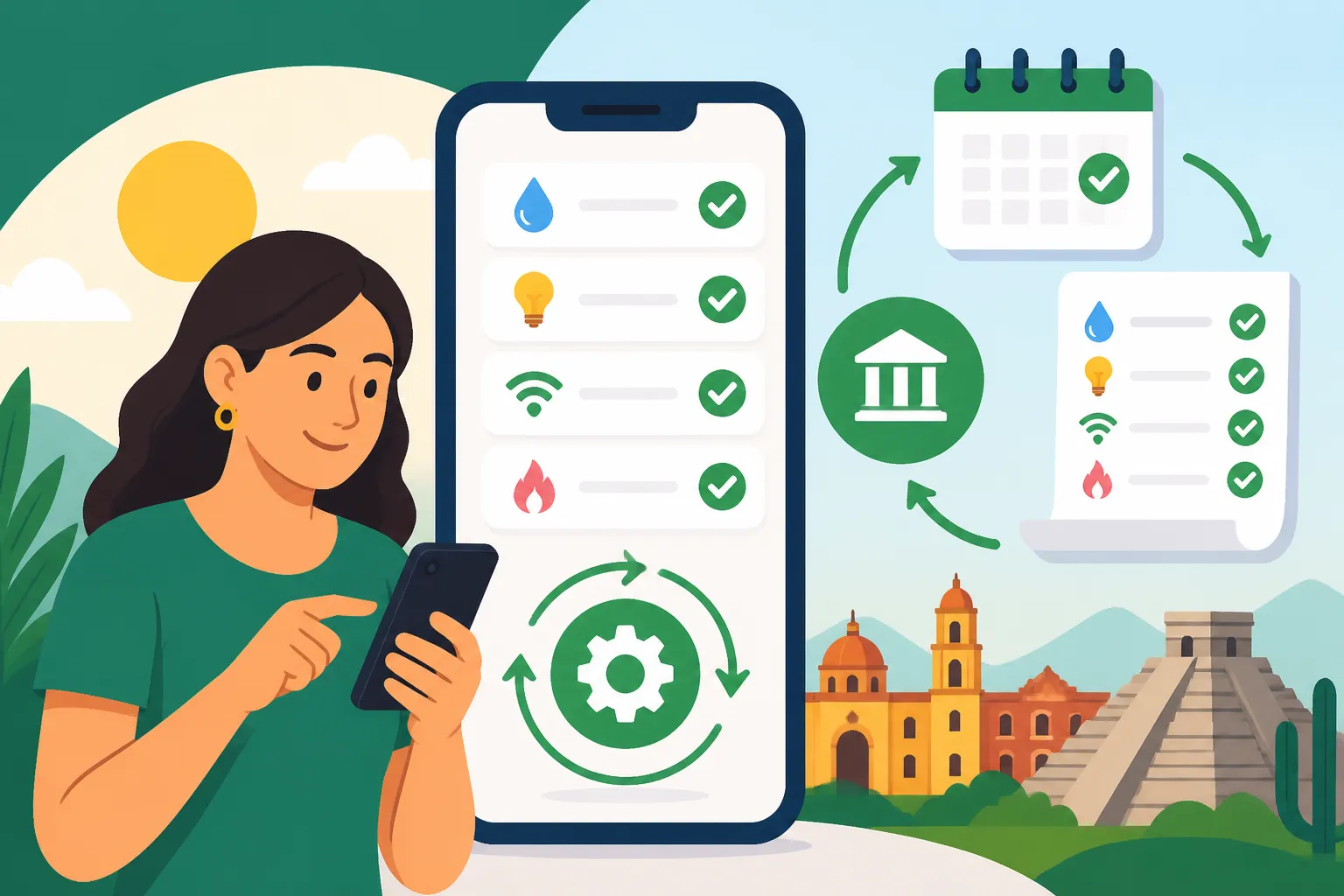
Apps from banks like BBVA, Banorte, or Santander are surprisingly robust. Most of them have a dedicated "Services" section where you can search for the company name (like CFE, Telmex, or Aguakan), enter your account number, and save it as a favorite. While some apps allow for a true "auto-pay" where they pull the balance, others allow you to set up a recurring "programed payment."
For example, if you know your water bill is usually around 300 pesos, you can program a monthly transfer. However, I always recommend using the "Search Balance" feature within the app. Every month, you log in, click your saved service, and the app fetches the current amount due from the provider's database. It’s one click to pay, which is "semi-automated" and offers a great balance of convenience and control.
Setting Up Domiciliación (Direct Debit)
"Domiciliación" is the term you will hear most often when asking about automatic payments. This is a formal agreement where you give a company permission to pull the exact amount of your bill from your debit or credit card every month. You can usually set this up through the service provider's website or by visiting their office with a "clabe interbancaria."
Understanding What Is a CLABE? Understanding Mexican Bank Account Numbers is vital here. The CLABE is an 18-digit number unique to your account, and it is what utilities use to identify where to pull the money from. When you set up a direct debit, make sure you do it at least 15 days before your next due date, as the system often takes one full billing cycle to activate. Always keep a close eye on your first automated statement to ensure it actually went through.
Utilizing Third-Party Fintech and International Tools
If you aren't yet comfortable with a local bank, or if you are managing a property from abroad, tools like Wise can be a lifesaver. You can use Wise to hold a Mexican Peso balance and send SPEI transfers directly to utility companies if you have their bank details. This is particularly useful for paying things like HOA fees or private security guards who may not be integrated into the standard "service" lists of major banks.
Furthermore, when you are moving large sums of money to cover your Cost of Living in Mexico: 2026 Comprehensive Guide, Wise offers significantly better exchange rates than traditional banks. I often use it to fund my Mexican account specifically for my "automated bill fund" so I’m not losing a chunk of change to hidden bank fees every month.
| Payment Method | Reliability | Ease of Setup | Best For |
|---|---|---|---|
| Bank App (Manual/Saved) | High | Easy | CFE, Water, Gas |
| Domiciliación (Direct Debit) | Very High | Moderate | Internet, Cell Phone |
| Service Provider App | Moderate | Easy | Telcel, Totalplay |
| Fintech (Wise/SPEI) | High | Moderate | HOA, Private Contracts |
Essential Services Walkthrough: Electricity, Water, and Web
Not all utilities are created equal in Mexico. The process for automating your electricity is vastly different from how you’ll handle your fiber-optic internet. Let’s break down the "Big Three" that every expat needs to manage.
For many of these services, you will eventually need to provide a tax ID. Knowing How to Get an RFC in Mexico will help you get official "facturas" (tax receipts), which are important if you are running a business or need to deduct expenses.
Automating Your CFE Bill
The Comisión Federal de Electricidad (CFE) is the one bill you cannot afford to ignore. The best way to automate this is through the CFE Contigo app. You link your service account number (found on any old bill) and add a credit or debit card. Within the app, there is a toggle for "Pago Recurrente."
A word of warning from personal experience: CFE’s app can be temperamental with foreign-issued credit cards. If you find your "auto-pay" failing, it is likely because your home bank is flagging the transaction as suspicious. This is where a local bank account becomes invaluable. For a deeper dive into the nuances of this specific utility, check out our guide on How to Pay Your CFE Electricity Bill in Mexico.
Managing Internet and Mobile Plans
Whether you choose Telmex, Totalplay, or Izzi, these companies are much more "tech-forward" than the water or electric companies. Most Best Internet Providers in Mexico: Expats' Top Picks for Reliability offer a discount if you set up "domiciliación." For example, Totalplay often gives a 50-peso "pronto pago" discount if you pay within the first few days of your cycle—automation ensures you never miss this.
For mobile phones, if you are on a "Plan" with Telcel or AT&T, the automatic debit is usually part of the contract. However, if you are on a "Amigo" or prepaid kit, you can use your banking app to schedule a "Recarga" (top-up) every 30 days. This keeps your data active without you having to find a pharmacy or OXXO every time your "Paquete" expires.
Water and Property Taxes (Predial)
Water is usually handled at the municipal level (like SAPA in Baja or Aguakan in Quintana Roo), meaning the digital options vary wildly. Some cities have excellent portals where you can set up a profile and pay annually. In fact, for both water and the Predial (property tax), I highly recommend paying the full year in advance during January. Most municipalities offer a 10% to 20% discount for annual payments, and it effectively "automates" the bill by removing it from your mind for the next 11 months.
Troubleshooting and Best Practices for Foreign Residents
Automation is wonderful until it isn't. The most common point of failure is a "rejected transaction." In Mexico, if a direct debit fails once, the company often cancels the automation entirely without telling you. You might think your bills are being paid, only to find out three months later that you have a massive balance and a disconnection notice.
Always set a calendar reminder for the 5th of every month to do a "quick sweep" of your banking app. Verify that the expected amounts were deducted. If you are a US citizen or resident, remember that keeping significant funds in these automated accounts might trigger reporting requirements. Consulting with a specialist like Taxes for Expats can help you understand your FBAR and FATCA obligations regarding your Mexican bank accounts.
Handling Facturas and Tax Receipts
In Mexico, a simple bank confirmation isn't always enough for official accounting. You need a factura (an XML and PDF file registered with the SAT). When you set up automatic payments, make sure you have also registered your RFC and tax address with the service provider. Most apps have a "Datos Fiscales" section. If this is set up correctly, the system will automatically email you a tax-legal receipt every time a payment is triggered.
Taxes for Expats can be particularly helpful here if you are an entrepreneur or digital nomad working from Mexico. They can advise on how to track these automated utility payments to ensure you are compliant with both Mexican and US tax laws, especially if you are claiming a home office deduction.
Dealing with Price Fluctuations
Electricity bills in Mexico can fluctuate wildly between summer and winter due to air conditioning usage. If you have set a "limit" on your direct debit through your bank, a high summer bill might exceed that limit, causing the payment to fail. I recommend setting your bank's "pago automático" limit significantly higher than your average bill to account for those 100-degree months.
Also, be aware of "estimated" readings. If the CFE meter reader couldn't access your property, they might estimate your usage based on previous months. If they estimate too low, you might have a "catch-up" bill the following month that is double the usual price. Again, a generous limit on your automation settings will prevent a service cutoff during these spikes.
The "Safety Buffer" Strategy
The golden rule for expat finances in Mexico is to always keep a "utility buffer" in your local account. I suggest keeping at least two months' worth of expenses as a stagnant balance. Between fluctuating exchange rates and occasional bank glitches, having that extra 5,000 pesos sitting in the account ensures that your Banking in Mexico: Complete Guide for Foreigners experience remains a positive one.
If you are funding this account from abroad, using Wise to schedule a monthly "push" of funds into your Mexican account is the most efficient way to manage this. You can set Wise to send a fixed amount of Pesos every month, ensuring your "bill-pay" account is always topped up regardless of how the exchange rate wiggles.
Disclaimer
The information provided in this article is for informational purposes only and does not constitute legal, financial, or tax advice. Regulations regarding utility payments, banking procedures, and tax requirements in Mexico are subject to change. Always verify current procedures with the relevant service providers or a qualified professional.