Staying Comfortable: Air Conditioning, Heating, and Utilities in Mexico
Many new expats arrive in Mexico thinking it is a perpetual tropical paradise, only to find themselves shivering on a cold tile floor in January or sweating through a humid night in July without a whisper of a breeze. I spent my first winter in a gorgeous colonial apartment in Querétaro huddled under three wool blankets because I didn't realize that central heating is almost non-existent here. This guide solves the temperature and utility puzzle, helping you navigate air conditioning, heating workarounds, and the quirks of Mexican utility systems to stay comfortable year-round.
Disclosure: This post may contain affiliate links. We may earn a commission at no extra cost to you if you make a purchase through these links. Read full disclosure.
The Reality of Temperature Control in Mexican Homes
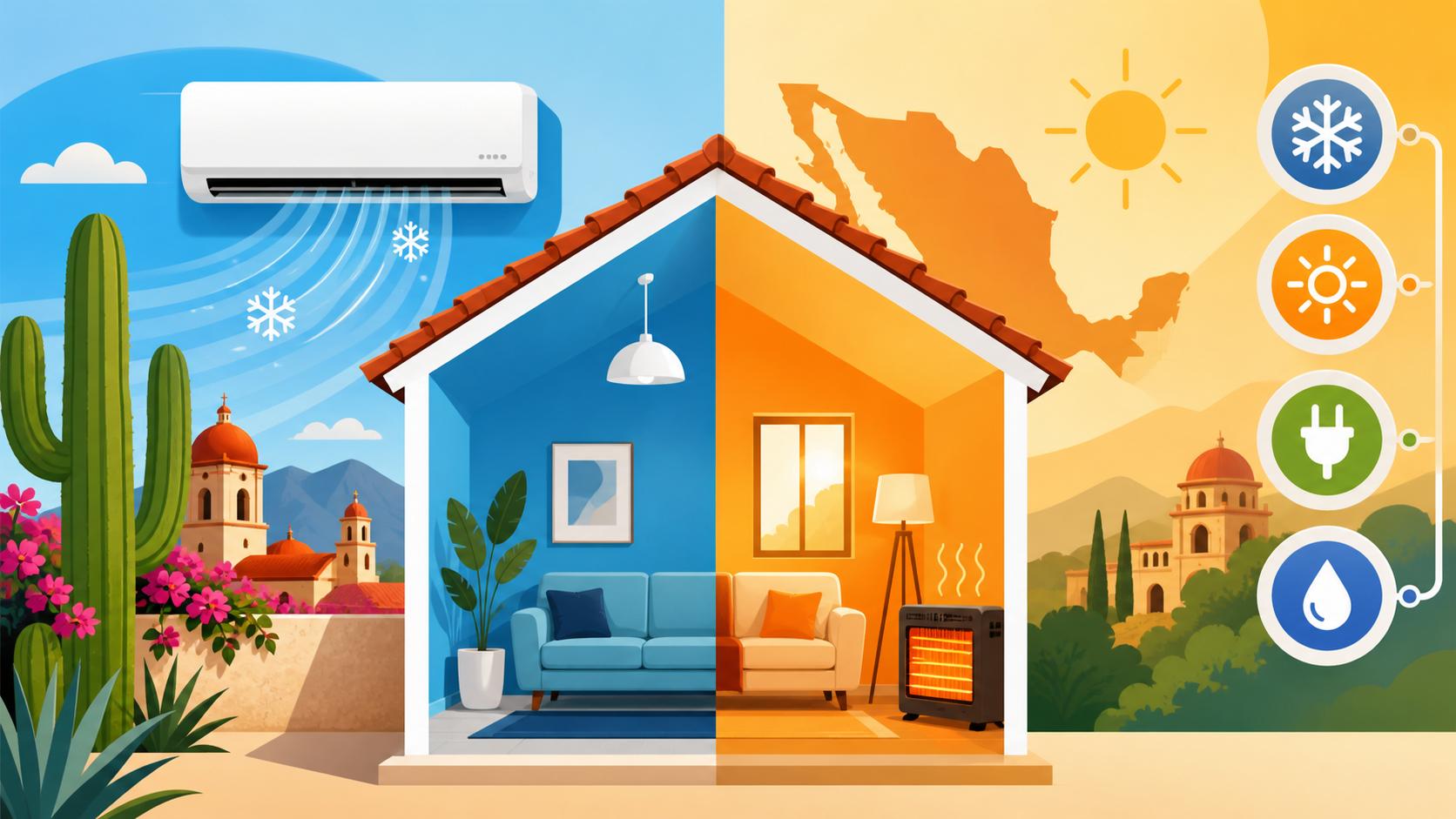
The most common mistake foreigners make when moving to Mexico is assuming that a "modern" or "luxury" home will have a built-in HVAC system similar to what you find in the United States or Canada. In reality, traditional Mexican architecture is designed to manage heat passively rather than through mechanical systems. Thick stone or brick walls and high ceilings are wonderful for keeping the interior cool during a hot afternoon in San Miguel de Allende, but they become literal iceboxes once the sun goes down in the highland winters.
Regional Differences in Climate and Infrastructure
Mexico is a massive country with wildly varying microclimates, and your utility needs will change drastically depending on where you land. If you are looking at Best Places to Live in Mexico for Expats (2027 Edition), you must consider the altitude. In highland cities like Mexico City, Guadalajara, or Oaxaca, the temperature can swing 30 degrees Fahrenheit between noon and midnight. Here, you rarely need air conditioning, but you will desperately want a heating solution for December and January.
Conversely, in coastal regions like Playa del Carmen or Puerto Vallarta, the humidity is the primary enemy. In these areas, air conditioning isn't a luxury; it’s a necessity for both comfort and preventing mold. If you are planning on Living in Puerto Vallarta: Coastal Living Guide for Expats, you need to budget for high electricity costs, as your AC units will likely run for ten months out of the year. Desert climates like Los Cabos or Hermosillo offer a mix of both extremes: scorching summer days where you need high-powered cooling and surprisingly chilly winter nights.
Thermal Mass and Construction Materials
Most homes in Mexico are built with concrete, brick, or "block." Unlike the wood-frame and drywall construction common in North America, these materials have high thermal mass. This means they absorb the ambient temperature and hold onto it. In the summer, your walls will radiate heat long after the sun sets. In the winter, once those concrete walls get cold, it takes days of sunshine to warm the interior of the house back up.
I often tell new arrivals to pay attention to the orientation of the house. A "south-facing" home in the highlands is a treasure because it collects the winter sun. However, that same orientation in a tropical beach town might make your living room unbearable. Before signing a lease, visit the property at the hottest time of day and the coolest time of night to see how the building handles the temperature naturally.
Mastering Air Conditioning and Fans in Tropical Mexico
If you find yourself in the lowlands or along the coast, your relationship with the Comision Federal de Electricidad (CFE) will be the most important one in your life. While central air is rare, "mini-split" systems are the gold standard. These are individual units mounted on the wall in each room, allowing you to cool only the spaces you are currently using.
Maximizing Mini-Split Efficiency
Mini-splits are incredibly efficient if used correctly, but they can also bankrupt you if you aren't careful. Most veteran expats keep their units set between 24°C and 26°C (75°F to 78°F). This is enough to pull the humidity out of the air and make the room comfortable without forcing the compressor to run 24/7.
Maintenance is another factor many newcomers overlook. The salt air in coastal towns is brutal on AC condensers. I’ve seen brand-new units rust out in less than three years. You should have a technician service your units and clean the filters at least twice a year. If you are Coping with Heat and Humidity: Tips for Expats in Tropical Climates, you might also consider investing in a high-quality dehumidifier. Often, if you can drop the humidity level, you can keep the AC at a higher temperature and save a fortune on your monthly bill.
Ceiling Fans and Natural Ventilation
Never underestimate the power of a good ceiling fan. In many parts of Mexico, a well-placed fan is all you need for 80% of the year. When shopping for a home, look for "ventilación cruzada" (cross-ventilation). Homes with windows on opposite sides of the room allow the evening breeze to flush out the hot air accumulated during the day.
If your rental doesn't have enough fans, you can easily find affordable standing or floor models on Amazon Mexico. I recommend the high-velocity metal fans for living areas and "silent" plastic models for bedrooms. If you are a digital nomad staying at a Selina location, you'll usually find they have optimized these airflow patterns in their coworking spaces, but always check the specific room amenities if you are sensitive to heat.
Navigating the Winter Heating Strategies for the Highlands
In the central highlands, the "winter" is short—usually from late November to February—but it is piercing. Because homes aren't insulated, the temperature inside your house will often be lower than the temperature outside. When you are Living at High Altitude: Tips for Expats in Mexico City and Highland Areas, staying comfortable requires a proactive approach to heating.
Portable Heaters and Safety
Since central heating is absent, most expats rely on portable electric or gas heaters. Electric space heaters are easy to find but can be expensive to run. I prefer oil-filled radiator heaters for bedrooms because they provide a steady, silent heat and don't dry out the air as much as ceramic fan heaters.
Gas heaters (using the same LP gas as your stove) are very effective and cheaper to operate, but they come with risks. You must ensure the room is well-ventilated to avoid carbon monoxide buildup. I personally avoid using gas heaters in bedrooms while sleeping. Instead, I suggest investing in a high-quality "calentador" for the morning hours when the house is at its coldest.
Insulation and Soft Goods
Since you can't easily add insulation to a brick wall, you have to get creative. Heavy curtains (cortinas térmicas) are a game-changer. Closing them as soon as the sun goes down helps trap whatever warmth the house gained during the day. Area rugs are also essential; walking on cold tile or marble floors in January is a quick way to feel miserable.
Another veteran tip: the electric blanket or mattress pad. Rather than trying to heat a whole drafty room with high ceilings, just heat the bed. You can find these easily on Amazon Mexico, and they use a fraction of the electricity that a space heater requires. If you are Renting a Home in Mexico: Complete Expat Guide to Leases, Deposits, and More, ask the landlord if they provide "cobijas" (heavy blankets), as traditional Mexican blankets are incredibly warm and specifically designed for this climate.
Understanding Mexican Utilities: Electricity, Gas, and Water
Managing your utilities in Mexico is a bit more hands-on than in many other countries. You aren't just paying a bill; you are often managing a supply chain. From watching your water levels to listening for the gas truck’s bell, it requires a different mindset.
Electricity and the Infamous DAC Rate
Electricity is provided by the state-owned CFE. For most residents, electricity is subsidized, meaning the rates are quite low. However, if your average consumption over a 12-month period exceeds a certain threshold, you are moved into the "DAC" (Doméstico de Alto Consumo) tier. In this tier, the subsidies vanish, and your bill can triple or quadruple overnight.
This is why monitoring your AC usage is so critical. To avoid the DAC, many expats install solar panels if they own their homes. If you are a renter, you need to be diligent about turning off lights and units when not in use. For more details on the logistics, see Home Utilities in Mexico: Setting Up Electricity, Water, Gas, and Internet.
The LP Gas Mystery: Tanks vs. Stationary
Most homes in Mexico use Liquid Petroleum (LP) gas for cooking and heating water. There are two main systems: "cilindros" (portable tanks) and "tanques estacionarios" (large stationary tanks on the roof).
- Portable Tanks: You listen for the gas truck driving through the neighborhood, often playing a specific jingle or shouting "El Gaaaaas!" You flag them down, and they swap your empty tank for a full one.
- Stationary Tanks: These are much more convenient. You call a gas company, and they bring a long hose up to your roof to fill the tank. Most stationary tanks have a gauge so you can see when you are running low.
A common "newbie" mistake is forgetting to check the gas level before a long weekend or a holiday. There is nothing quite like hopping into the shower on a cold morning in January only to realize you’ve run out of gas and the delivery trucks won't be back for two days. This is one of those Household Quirks in Mexico: Water Cisterns, Gas Tanks, and More that you eventually learn to manage with a calendar.
Water Systems: Tinacos and Aljibes
Water in Mexico doesn't usually come directly from the street into your tap with high pressure. Instead, most houses have a two-part system. There is an underground cistern (aljibe) that collects water from the city line. A pump then moves that water up to a large plastic tank on the roof called a "tinaco." Gravity then provides the pressure for your faucets and showers.
You need to occasionally check that your pump is working and that your tinaco is clean. If the city water goes out for a day or two—which happens—you are fine as long as your tanks are full. However, if you have a leak or leave a tap running, you can drain your entire reserve.
| Utility Type | Payment Frequency | Typical Management Method | Expat Tip |
|---|---|---|---|
| Electricity (CFE) | Every 2 Months | App, OXXO, or CFE Kiosk | Watch out for the DAC high-usage tier. |
| LP Gas | As Needed | Call for delivery or flag down truck | Always keep 20% in the tank as a buffer. |
| Water (Municipal) | Monthly/Bi-monthly | Local water office or online | Check your rooftop tinaco for debris yearly. |
| Internet | Monthly | Direct debit or OXXO | Use Airalo for backup data during outages. |
Practical Tips for Managing Utility Bills
Paying your bills can be an adventure in itself. While online portals are becoming more common, many expats still prefer the "boots on the ground" method to ensure their service isn't cut off.
Paying via OXXO and Apps
The OXXO convenience store is the unofficial financial hub of Mexico. You can take almost any utility bill to an OXXO, and for a small fee (usually around 10-15 pesos), they will scan the barcode and take your payment in cash. This is often more reliable than trying to use a foreign credit card on a glitchy government website. I highly recommend Paying Utility Bills in Mexico: Methods and Tips for Expats for a deeper dive into these payment workflows.
The CFE has a decent app called "CFE Contigo," which allows you to see your consumption in real-time. This is incredibly helpful for spotting leaks or identifying if a guest left an AC unit running in a spare bedroom. If you are comfortable with Spanish, Paying Bills at OXXO: A Handy Option for Expats in Mexico is a skill you should master within your first week.
Dealing with Outages and Maintenance
Infrastructure in Mexico can be fragile, especially during the rainy season. Power outages are common when the big summer storms roll through. I always keep a few portable power banks charged and have Airalo installed on my phone so I can maintain an internet connection if my home router goes down.
If you have a major utility failure, don't expect the same response times you might be used to back home. Finding a reliable "plomero" (plumber) or "electricista" is worth its weight in gold. Ask your neighbors for recommendations rather than looking in the yellow pages. Word of mouth is the only currency that matters when you need your water pump fixed on a Sunday afternoon.
Staying Connected and Productive
For digital nomads and remote workers, the "comfort" of a home also includes reliable connectivity. While fiber optic internet (Infinitum or Totalplay) is now available in most major cities, it isn't everywhere. If you are staying at a Selina or a similar coworking-focused space, they usually have redundant lines. If you are renting a private home, always ask for a speed test before you move in.
If your home internet is spotty, having a local SIM card or an eSIM like Airalo is a perfect "plan B." I've worked from beach cafes in Tulum using a hotspot when the town's power grid gave up, and it saved my professional reputation more than once. Being comfortable in Mexico means being prepared for the moments when the "modern" world takes a temporary siesta.
Summary of Seasonal Comfort Strategies
To live well in Mexico, you must learn to flow with the seasons. In the spring (the "hot dry" season), focus on keeping the sun out of your house during the day and opening everything up at night. In the summer (the "rainy" season), manage the humidity and prepare for power blips. In the winter, invest in high-quality wool socks and an electric mattress pad.
Living here is a lesson in mindfulness. You become aware of how much water is in your tank, how much gas is in your heater, and how the wind moves through your rooms. Once you master these rhythms, the administrative hurdles of Navigating Mexico's Immigration System: Visas, INM Procedures, and Regulations won't seem nearly as daunting because you'll have a comfortable, temperature-controlled sanctuary to return to at the end of the day.
Disclaimer
The information provided in this guide is for informational purposes only and is based on personal experiences and general knowledge of living in Mexico. Utility regulations, pricing tiers (such as CFE's DAC rate), and infrastructure availability can change without notice. Always verify specific requirements and costs with local service providers in your specific region. We are not responsible for any financial loss or discomfort resulting from the use of this information.