How to Choose Safe Neighborhoods to Stay in Mexico
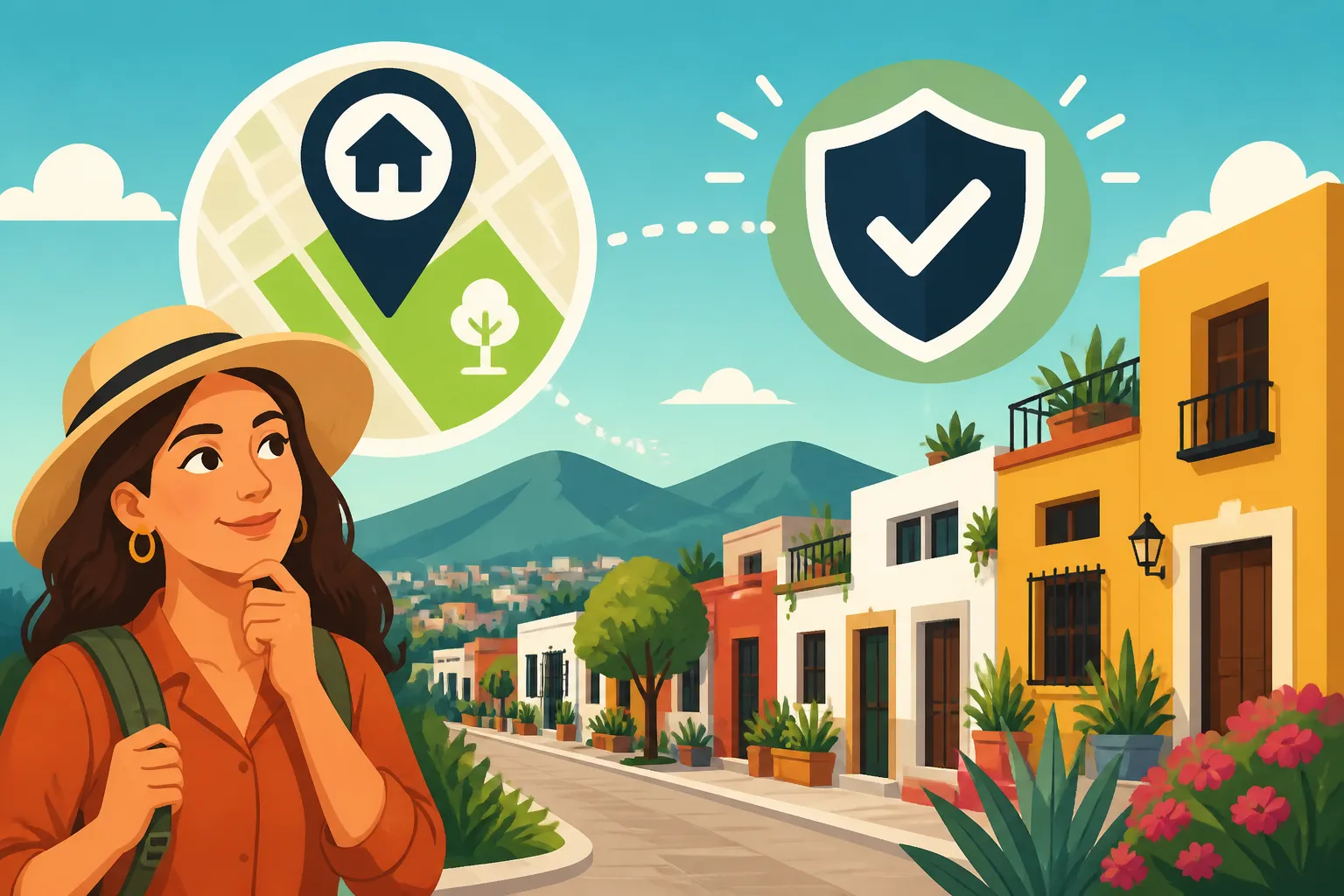
You have found a beautiful rental in Mexico at a great price, but you have no idea whether the street outside is lively and friendly or empty and uneasy after dark. This guide shows you how to research, compare and check neighborhoods across Mexico, so the place you book stays a good choice from check-in until you leave.
Disclosure: This post may contain affiliate links. We may earn a commission at no extra cost to you if you make a purchase through these links. Read full disclosure.
Why Neighborhood Choice Matters More Than City Choice in Mexico
When I first started travelling around Mexico, friends back home kept asking me the wrong question: “Is Mexico City safe?” or “Is Cancún dangerous?” After years of living here and helping visiting friends pick places to stay, I can tell you that the city is rarely the deciding factor. The colonia, the street, and sometimes even the side of the plaza you sleep on shape your experience far more than the name on your plane ticket.
That is good news. It means you have real control. You can’t change a city’s overall reputation, but you can choose a neighborhood with good lighting, foot traffic, open businesses at night, and easy, reliable transport. Choosing well is a learnable skill, not luck.
The Block-by-Block Reality
Mexican cities change character quickly. In Mexico City, the leafy, café-lined streets of Roma Norte sit right next to parts of Doctores and Obrera, where the atmosphere shifts noticeably, especially at night. Walk ten minutes and you may move from boutique bakeries to auto repair shops with shutters pulled down by early evening. Neither area is “bad” in a dramatic way. They simply suit different visitors at different hours.
The same pattern shows up in smaller cities. In Oaxaca, the historic centre and the barrio of Jalatlaco feel walkable and social. Head well beyond them and you reach residential and commercial zones that are perfectly normal for locals but have fewer streetlights, fewer people out walking, and fewer taxis passing by. For a visitor who doesn’t know the area, that combination is what raises the risk, more than any specific threat.
Here is a scenario I have seen many times. A couple books a stylish apartment that the listing says is “ten minutes from the centre.” It is, by car. On foot, the route goes along a dim avenue with closed warehouses. They arrive late from the airport, the driver can’t find the gate, and they end up standing on a dark corner with their suitcases and phones out. Nothing happens, but they spend the whole first night anxious. A slightly pricier room four blocks closer to the plaza would have avoided all of it.
Reading Official Advisories Without Panicking
Government travel advisories are a useful starting point, but you need to read them with care. The US State Department, for example, rates Mexico state by state rather than as one country. Some states carry strong warnings while the main tourist states sit at much lower levels. Other governments, such as Canada and the UK, publish their own guidance. Reading two or three side by side gives you a more balanced picture.
What these advisories do well is flag regions where organized crime, road travel or specific areas carry higher risk. What they cannot do is tell you which street in Mérida’s Centro is quiet at midnight. Treat them as the regional layer of your research, then zoom in. For a broader overview of how risk varies across the country, see Mexico Travel Safety by Region: What to Know.
One habit that helps: notice what an advisory actually restricts. Many warnings are about intercity driving at night, or about specific municipalities, not about the tourist core of a city. If an advisory says to avoid driving between towns after dark, that should shape your arrival time and transport choices, not necessarily cancel your trip.
How to Research a Neighborhood Before You Book
This is where most of the work happens, and it is worth spending an extra hour on it before you pay a deposit. I use the same routine whether I am booking a weekend in Puebla or a month in Guadalajara.
A Step-by-Step Vetting Process
Follow these steps in order. Each one filters out options so you are not comparing fifty listings at once.
- Pick two or three candidate neighborhoods for your city using trusted neighborhood guides, expat forums and recommendations from people who have actually stayed there recently.
- Open a map and mark the places you will visit most often, such as the historic centre, a coworking space, the bus terminal or the beach. Prioritize neighborhoods within an easy walk or a short ride of those points.
- Check the official travel advisory for the state, and note any specific warnings about road travel or particular municipalities.
- Search accommodation in your shortlisted neighborhoods only, using the platform’s map view rather than the default list, so you see exactly where each property sits.
- Read the most recent reviews and search within them for words like “street”, “night”, “walk”, “noise”, “taxi” and “safe”.
- Use street-level imagery to “walk” from the property to the nearest main road, convenience store and restaurant cluster.
- Message the host or hotel with specific questions about the entrance, lighting, reception hours and how guests usually arrive at night.
- Plan your arrival transport before you book, so you know exactly how you will reach the door from the airport or bus station.
When you use Booking.com, the map view and the location score in reviews are genuinely helpful for this kind of filtering. A property with a strong overall rating but repeated comments about a “sketchy walk back” is telling you something important. The location tells you more than the rating does.
Decoding Listings and Reviews
Listings are written to sell, so learn to read between the lines. “Up-and-coming area” often means mixed, with parts still rough. “Authentic local neighborhood” can mean wonderful street life, or it can mean a long walk to anything open after nine at night. “Quiet residential street” may sound perfect, but in some cities a very quiet street at night is less comfortable than a busy one, because there are fewer people around.
Pay close attention to practical details. Is there a 24-hour front desk, or a self check-in lockbox? Is the entrance on a main street or down an unlit passage? Does the building have a portero or security guard? These things matter more than a rooftop pool. For help with the terminology on Mexican listings, see Reading Mexican Hotel Listings: Room Types, Bed Sizes, and Terms Decoded.
Reviews are most valuable when they come from people like you. A solo traveller’s comment about walking home alone is more relevant to a solo traveller than a family’s comment about the breakfast. If you are travelling alone, especially as a woman, Solo Female Travel in Mexico: Booking Filters and Areas Worth Paying For covers the filters and neighborhoods worth prioritizing.
A practical trick I use: sort reviews by most recent and read at least the last fifteen or twenty. Neighborhoods change. A new bar strip can bring noise and crowds, or a road project can cut off easy taxi access. Older reviews may describe a place that no longer exists in quite the same way.
Street View and the Night Test
Street-level imagery is my favourite research tool, and it costs nothing. Drop yourself onto the street outside the property and look around. Are there working streetlights? Shops with open fronts, or walls with graffiti and closed metal shutters? Do you see restaurants, pharmacies and an OXXO convenience store within a couple of blocks? These everyday businesses keep a street populated into the evening.
Then do what I call the night test in your head. Imagine coming back at ten at night after dinner. Which route would you walk? Is there a main avenue with traffic and lights, or would you have to cut through a park or a long empty block? If the honest answer is “I would take a car even for three blocks,” that is a sign the location suits daytime travel better than nightlife.
Keep in mind that imagery can be a few years old. Use it to judge layout and lighting, and confirm current conditions through recent reviews and your host. If something looks different from what reviews describe, ask about it directly.
Neighborhood Profiles in Popular Mexican Destinations
No neighborhood is perfectly safe, and every city has areas that are fine for locals but less practical for visitors who don’t know the terrain. The profiles below reflect where travellers commonly stay comfortably, with the trade-offs I would mention to a friend.
Mexico City
For first-time visitors, Roma Norte and Condesa are the classic choices. They are walkable, full of restaurants and cafés, busy into the evening, and well served by ride-hailing apps. The trade-offs are noise in the busiest pockets, and petty theft such as phone snatching on crowded corners. Polanco is more upscale and polished, with embassies, hotels and high-end shopping, and it tends to feel calm and orderly, though it can be less lively on foot at night.
Coyoacán offers a slower, more residential feel with cobbled streets and plazas. It is lovely for families or longer stays, though it is a longer ride to some central sights. The Centro Histórico is spectacular by day and has improved a great deal, but some side streets empty out after business hours. If you stay there, choose a hotel on a well-trafficked street close to the Zócalo or the pedestrian corridors, and use cars at night rather than wandering.
Areas such as Tepito are generally best avoided by visitors, and the outer edges of neighborhoods bordering Roma, like parts of Doctores, deserve extra care at night. For a deeper look at each district, see Where to Stay in Mexico City: Roma, Condesa, Polanco, Centro, and Coyoacan.
Guadalajara, Oaxaca, and Mérida
In Guadalajara, travellers often choose Colonia Americana and the Chapultepec area for nightlife and walkability, Providencia for a calmer, more residential base, and parts of Zapopan for modern comfort. The historic centre is excellent for sightseeing by day. Tlaquepaque is charming and popular for its crafts and dining, and can be a pleasant base if you don’t mind a ride into the city.
Oaxaca City is compact. The historic centre, Jalatlaco and the area around the Santo Domingo church are popular, walkable and generally relaxed. The main thing to watch is how far you stray from the lit, populated core after dark. For specifics, see Where to Stay in Oaxaca City: Centro, Jalatlaco, and Xochimilco.
Mérida has a well-earned reputation as one of Mexico’s calmer large cities. Centro, Santa Ana, Santiago and the areas along Paseo de Montejo are favourites for visitors, with colonial houses converted into guesthouses and boutique hotels. The northern districts are more modern and car-oriented, with malls and newer housing. Where to Stay in Merida: Centro, Santa Ana, and the North breaks down which suits which kind of trip.
Cancún, Playa del Carmen, and Tulum
The Caribbean coast has a different safety pattern. The resorts and main hotel corridors are heavily geared toward visitors and well patrolled. Away from them, issues tend to cluster around nightlife, late-night bar streets, and scams aimed at tourists rather than random street crime.
In Cancún, the Hotel Zone is self-contained and convenient, while downtown offers better value and a more local feel, with some areas that are better by day. Where to Stay in Cancun: Hotel Zone vs Downtown Compared goes into the trade-offs in detail. In Playa del Carmen, staying near Fifth Avenue is popular, but rooms right on the busiest party blocks can be noisy, and those are the streets where pickpockets and pushy sellers work late at night. Playacar and the quieter northern blocks give you more calm. In Tulum, staying in town is usually more practical and walkable than an isolated beach-road property, where you depend on taxis and the stretches between hotels can be dark.
The table below summarizes the general character of these areas for a visitor deciding where to sleep.
| City | Neighborhoods Visitors Often Choose | Best For | Main Trade-Off | Night Strategy |
|---|---|---|---|---|
| Mexico City | Roma Norte, Condesa, Polanco, Coyoacán | First-timers, foodies, walkers | Petty theft on busy corners, noise in nightlife pockets | Walk main streets, use ride-hailing apps for longer trips |
| Mexico City | Centro Histórico | Sightseeing on a short trip | Side streets empty after business hours | Stay near the Zócalo or pedestrian corridors, take cars after dark |
| Guadalajara | Americana, Chapultepec, Providencia | Nightlife, longer stays | Spread-out city, more reliance on cars | Book near your evening plans |
| Oaxaca City | Centro, Jalatlaco, around Santo Domingo | Culture, food, walkable stays | Fewer lights at the edges of the core | Stay inside the historic grid |
| Mérida | Centro, Santa Ana, Santiago, Paseo de Montejo | Relaxed colonial stays | Heat and noise rather than crime | Keep to lit streets near the plazas |
| Cancún | Hotel Zone, selected downtown areas | Beach holidays, convenience | Tourist scams, nightlife incidents | Use official taxis or pre-booked transfers |
| Playa del Carmen | Near Fifth Avenue, Playacar, northern blocks | Walkable beach town life | Pickpockets and noise on party blocks | Avoid sleeping right on the busiest bar streets |
| Tulum | Town centre, well-reviewed beach properties | Beaches, ruins, cenotes | Isolated stretches between beach hotels | Arrange rides in advance from beach areas |
On-the-Ground Checks Once You Arrive
Research gets you most of the way, but your own eyes on the first evening confirm the rest. I treat my first few hours in a new neighborhood as part of the booking process. If something feels off, there is usually still time to move.
Your First Evening Walk
Arrive in daylight if you can. It is the single best piece of safety advice I give anyone heading to a new Mexican city. You see the streets as they really are, you find the entrance without fumbling, and you can do a short orientation walk before dark.
On that walk, find the nearest pharmacy, convenience store, ATM inside a bank or shopping centre, and a couple of places to eat. Notice where people gather in the evening. Families walking, couples on benches, street vendors and open shops are all good signs. Then walk back to your accommodation as the light fades and notice how it feels. Streets in Mexico often get busier in the evening rather than quieter, especially around plazas, which is reassuring.
Watch for the opposite too: blocks where every shop shutters early, poorly lit underpasses, or empty lots. You don’t need to panic about them, just route around them. For everyday habits that keep you from becoming an easy target, such as how you carry your phone and wallet, see Street Safety: Tips for Avoiding Pickpockets and Scams in Mexico.
Building and Room Security
Once inside, take a few minutes to check the basics. Does the main door lock properly and close behind you on its own? Is there a guard, a reception desk or an intercom? In apartments, check the windows at street level and any balcony doors, especially on the ground and first floors.
Keep valuables out of sight. Do not leave your laptop visible on a table by a ground-floor window, and never leave it on the seat of a parked car, even for a few minutes. Put it in the room safe, a locked suitcase or a bag stored out of view. The same goes for passports and spare cash. Carry a copy of your passport and leave the original locked away unless you need it for a specific errand.
Save key details in your phone before you go out: the full address in Spanish, the name of a nearby landmark, and your host’s or hotel’s phone number. If your phone dies or you get lost, a taxi driver can get you home with a landmark far more easily than with an apartment number. Also save the emergency line, which is 911 across Mexico; Emergency Numbers in Mexico: How to Call Police, Fire, or Ambulance explains how the system works and when to use it.
Transport and Late-Night Logistics
How you move around is part of how safe your neighborhood feels. A slightly out-of-the-way rental can work well if you have reliable transport, while a central room can feel risky if you end up hailing random cars at two in the morning.
For airport arrivals, use authorized airport taxis bought at the official booth inside the terminal, a ride-hailing app at airports where it is permitted, or a pre-booked transfer. Platforms like Viator list airport transfers and guided day trips from established operators, which helps when you land late or want a driver who already knows the route. In cities, ride-hailing apps are widely used because the trip is tracked and the driver’s details are recorded. If you prefer street taxis, choose official sitio stands. How to Stay Safe Taking Taxis in Mexico covers the details.
For intercity travel, buses are comfortable and widely used, and first-class lines run from well-organized terminals. Aim for departures that get you in before dark, because arriving at a big terminal at night and then looking for a ride is more stressful than it needs to be. Busbud lets you compare routes and departure times across bus companies, which makes it easier to pick a daytime arrival. If you plan to drive between cities, read Is It Safe to Drive at Night in Mexico? Road Safety Tips for Expats before you set your schedule. The general advice from people who live here is to drive on toll roads and finish long drives before sunset.
Finally, give yourself permission to change your mind. If the first night confirms a bad feeling, such as a broken lock, an unlit entrance or a street that clearly empties out, contact the host or hotel right away and document the problem. Booking.com and similar platforms have customer service channels for this kind of issue, and many flexible-rate bookings let you cancel future nights. Paying a little extra to move is always cheaper than spending a whole trip on edge.
Choosing a safe neighborhood in Mexico comes down to doing your homework, matching the area to how you will actually spend your days and nights, and trusting what you see when you arrive. Do those three things and you will spend your energy on tacos, plazas and sunsets instead of worrying about the walk home.
Disclaimer
This article is for general informational purposes only and does not constitute professional advice. Laws, prices and regulations vary by location and change over time. Consult a qualified professional for guidance on your specific situation.