How to Call an Ambulance in Mexico (911 and Cruz Roja)
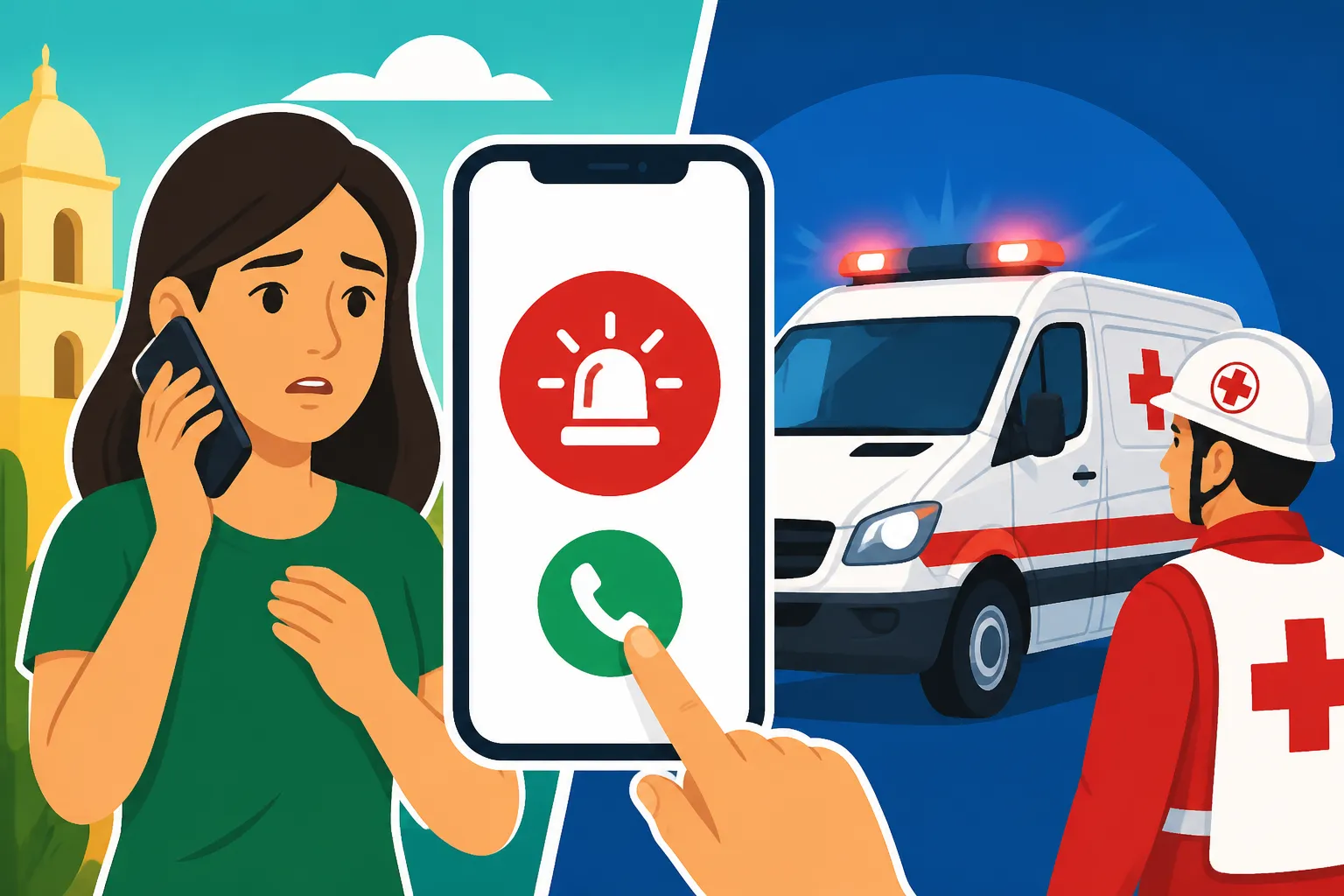
Staring at a phone during a medical crisis while your mind goes blank is a terrifying reality for many foreigners living in Mexico. I’ll never forget the sheer panic I felt during my first year in Querétaro when a neighbor collapsed and I realized I didn’t actually know if 911 worked the same way here as it does back home. This guide solves that life-threatening uncertainty by providing the exact protocols for summoning help, navigating the private versus public system, and managing the language barriers that often crop up in high-stress situations.
Disclosure: This post may contain affiliate links. We may earn a commission at no extra cost to you if you make a purchase through these links. Read full disclosure.
Understanding the Mexican Emergency Response Landscape
When you transition to life in Mexico, it is easy to assume that emergency services function as a monolithic, government-run entity. However, the reality is a patchwork of public, semi-public, and private providers that can be confusing if you haven't done your homework. In the United States or Canada, you call 911 and a centralized dispatcher sends the nearest available unit. In Mexico, while 911 is indeed the national emergency number, the response you get depends heavily on your location and the resources available at that specific moment.
The most common responder you will see on the streets is the Cruz Roja Mexicana (Mexican Red Cross). While it is a global brand, in Mexico, it operates as a private, non-profit organization that provides the bulk of the country's pre-hospital emergency care. They are often the first on the scene, but they are not technically a government agency. Beside them, you have state and municipal ambulances (often labeled Protección Civil) and a booming industry of private ambulance companies.
Knowing which one to call—and when—is the first step in Medical Emergencies in Mexico: What Expats Should Know and Prepare. If you are in a major city like Mexico City or Guadalajara, the options are plentiful, but in rural areas, the Cruz Roja might be your only lifeline. Understanding this distinction is vital because it dictates how you will be treated and, more importantly, where you will be taken once you are inside the vehicle.
The Role of 911 in Mexico
Mexico officially unified its emergency numbers into 911 a few years ago, replacing the old 066 system. When you dial 911, you reach a centralized dispatch center known as a C4 or C5 (Command, Control, Communications, and Computing Center). These centers are high-tech hubs, but they are often overwhelmed. The dispatcher’s job is to verify your emergency and then radio the appropriate agency—police, fire, or ambulance.
The biggest hurdle for expats using 911 is the language. While dispatchers in major tourist hubs like Cancún or Puerto Vallarta often speak English, you cannot bank on this in residential neighborhoods or smaller colonial towns. If you don't speak Spanish, the precious minutes spent trying to find an English-speaking operator can be agonizing. This is why many veteran expats choose to keep the direct local number for the Cruz Roja or a private hospital on their fridge instead of relying solely on the national dispatch system.
Cruz Roja vs. Private Ambulances
There is a significant difference in the level of service and the "destination" policy between the Red Cross and private companies. The Cruz Roja is a humanitarian organization. They will generally take you to the nearest public hospital or their own trauma centers. If you want to be taken to a specific private hospital where your Health Insurance in Mexico: How Expats Can Get Coverage (2027) is accepted, the Cruz Roja may or may not agree to take you there depending on the severity of your condition and their own internal protocols.
Private ambulances, on the other hand, operate like a boutique service. They are often faster because they are not juggling as many calls as the public system. Most importantly, if you call a private service, they will take you wherever you want to go, provided you can pay. For those with premium international coverage from providers like Cigna Global, using a private ambulance service is often the preferred route because it ensures you end up in a facility that matches the standards of care you are used to.
How to Call for Help: Step-by-Step Instructions
When the time comes to actually make the call, you need to be prepared for a very specific line of questioning. Unlike the highly automated systems in some Western countries, Mexican dispatchers will often ask for a lot of verification to filter out prank calls, which are unfortunately common.
First, stay as calm as possible. If you are calling 911, the first thing they will ask is "Cuál es su emergencia?" (What is your emergency?). State clearly whether you need "una ambulancia" (an ambulance), "la policía" (the police), or "los bomberos" (the fire department). Even if your Spanish is shaky, knowing these three words is essential. After you state the need for an ambulance, be prepared to give your exact location. This is where many expats struggle.
Providing Your Location Effectively
In Mexico, an address isn't just a street name and a number. To get an ambulance to your door quickly, you must provide the "Colonia" (neighborhood) and the "Entre calles" (the two cross-streets your building is between). Without the Colonia, the dispatcher might find three different streets with the same name in different parts of the city.
A pro-tip I always share with newcomers is to look for a physical landmark nearby. Is there an OXXO on the corner? A specific church? A well-known park? Mentioning these "puntos de referencia" can save lives. If you are using a mobile phone, make sure your GPS is on, but don't rely on the dispatch center being able to "ping" your location with 100% accuracy. Always be ready to describe your house—the color of the gate, the type of tree in front, or any identifying features. This level of detail is a core part of Navigating Hospitals and Clinics in Mexico: An Expat’s Guide to Medical Care because it ensures the help actually arrives at the right door.
Communicating the Medical Situation
Once the location is established, the dispatcher will ask about the patient. You should be ready to describe the symptoms simply. If someone is having a heart attack, say "ataque al corazón." If they aren't breathing, "no respira." If there is heavy bleeding, "hemorragia."
If you have a policy with SafetyWing or Cigna Global, you might also have access to a 24/7 emergency hotline provided by the insurer. In some cases, calling your insurance company first (if the situation allows for a 2-minute delay) can be helpful because they can sometimes coordinate with local private providers on your behalf. However, in a true "life or limb" emergency, call 911 or the local Cruz Roja number first, then deal with the insurance coordination once the patient is stable.
| Service Type | Phone Number | Best For | Payment/Cost |
|---|---|---|---|
| National Emergency | 911 | General emergencies, police, fire | Free (Public) |
| Cruz Roja | Local city number (e.g., 065) | Trauma, accidents, low-income | Donation-based/Low cost |
| Private Ambulance | Specific hospital/company # | Scheduled transfers, premium care | Out-of-pocket or Insurance |
| Green Angels | 078 | Roadside assistance/Medical on highways | Free service (tips expected) |
The Reality of Response Times and "The Wallet"
We need to have a frank conversation about response times. In many Mexican cities, traffic is a nightmare. Ambulances do their best, but they are often stuck in the same gridlock as everyone else. Furthermore, there is a cultural issue where drivers don't always pull over for sirens as quickly as they should. This is why Calling an Ambulance in Mexico: How Emergency Services Operate often involves a longer wait than you might expect.
Because of these potential delays, many expats living in gated communities or "fraccionamientos" pay a monthly fee to a private emergency response company. These services station ambulances near specific neighborhoods to ensure a sub-10-minute response time. If you have the budget, this is a massive piece of mind. If you are relying on 911, be prepared for a 15-to-30-minute wait depending on the city and the time of day.
Costs and Insurance Handling
Is the ambulance free? If it's a 911/Public unit or the Cruz Roja responding to an accident on the street, you generally won't be handed a bill on the spot. However, the Cruz Roja survives on donations, and it is customary (and appreciated) to make a donation later if they helped you.
Private ambulances are a different story. A ride in a private, advanced life-support (ALS) ambulance can cost anywhere from $3,000 to $10,000 MXN (roughly $150 to $500 USD), and they often require payment upfront or a guarantee of payment from your insurance. This is where having a robust plan from SafetyWing or Cigna Global becomes essential. These companies are familiar with the Mexican system and can often provide the necessary "Guarantee of Payment" (GOP) to the hospital or ambulance service so you aren't scrambling for a credit card while in the back of a moving vehicle.
The "Payment Upfront" Hurdle
It sounds harsh, but private hospitals and their associated ambulance services are businesses. I have seen cases where an ambulance will wait to leave for the hospital until they have verified that the patient has insurance or a way to pay the ER admission fee. To avoid this, always keep your insurance card and a copy of your passport in a "Go-Bag" near your front door. If you show the paramedics a Cigna Global card immediately, the "wealth-check" process usually moves much faster. You can find more details on this in Healthcare Costs in Mexico: Doctor Visits, Hospital Stays, and Surgery Expenses.
Essential Preparation: Don't Wait for the Crisis
The worst time to learn how to call an ambulance is when you actually need one. You need to do the legwork now. Start by finding the direct number for the nearest Cruz Roja station in your specific city. Save it in your phone under "Ambulancia." Next, identify the top-tier private hospital in your area—places like Hospital Ángeles, Star Médica, or ABC Hospital. Most of these high-end facilities have their own fleet of ambulances. Save their direct emergency line as "Ambulancia Privada."
You should also look into Finding English-Speaking Doctors and Specialists in Mexico before you are sick. Often, if you have a primary care doctor in Mexico, you can call them during an emergency, and they can pull strings to get a private ambulance sent to you faster than the public system could ever manage.
Create an Emergency "Cheat Sheet"
In the heat of the moment, your Spanish will fail you. Write down the following information on a card and tape it to the back of your front door or near your landline:
- Your full address, including the Colonia and cross-streets.
- A short script in Spanish: "Necesito una ambulancia en [Address]. El paciente tiene [Symptoms]."
- Your insurance policy number (SafetyWing, Cigna Global, etc.) and their international collect-call number.
- Contact info for your "In Case of Emergency" (ICE) person who speaks Spanish.
If you are incapacitated, a neighbor or a bystander can use that card to call for you.
Special Considerations for High-Risk Groups
If you are a retiree or someone managing a chronic condition, the stakes are higher. You should be aware of Senior Care in Mexico: Assisted Living and Home Care Options and how they coordinate with emergency services. Many senior-living communities have on-site paramedics, but if you live independently, you might want to consider a wearable medical alert device that works via the cellular network in Mexico.
For those with heart conditions or severe allergies, knowing the location of the nearest "Centro de Salud" versus a private "Hospital de Especialidades" is crucial. In a crisis, the ambulance driver might ask you, "A qué hospital?" (To which hospital?). If you don't have an answer, they will take you to the closest public facility, which may be overcrowded. Having a pre-selected destination ensures you get the specialized care you need immediately. This is particularly important for Managing Chronic Illness in Mexico: Access to Medication and Specialists.
Roadside Emergencies: The Green Angels
If you are traveling on Mexico’s federal highways and have a medical emergency, you have a unique resource: Los Ángeles Verdes (The Green Angels). While they are famous for fixing flat tires and delivering fuel, they are also trained in first aid and can coordinate with local ambulances. You can reach them by dialing 078. They are a government-funded service and are generally very reliable, though they only patrol during daylight hours. This is an often-overlooked part of Medical Tourism vs Expat Healthcare: Key Differences and Tips when people are driving across the border for care.
Healthcare in Mexico Disclaimer
This article is for informational purposes only and does not constitute medical or legal advice. Emergency response times and protocols in Mexico can vary significantly by state and municipality. Always consult with local authorities and your insurance provider to confirm the best emergency procedures for your specific location. In the event of a life-threatening emergency, dial 911 immediately. We recommend maintaining a comprehensive private health insurance policy to ensure access to the widest range of medical services.