How Long Does It Take to Get Mexican Residency? Timeline & Tips
If you have decided to make Mexico your new home, whether to enjoy a tranquil retirement in Lake Chapala, to work remotely from the vibrant cafes of Roma Norte, or to build a life with your Mexican spouse, you are likely feeling a mix of profound excitement and deep bureaucratic dread. This comprehensive guide will strip away the anxiety of the unknown and break down the exact week-by-week timeline of the Mexican residency process. We will cover the preparation phase, the consular wait times, the notoriously stressful Canje (Exchange) black hole inside Mexico, the factors that accelerate or delay your file, and the critical survival tips you need to protect your sanity, your passport, and your healthcare during the transition.
Disclosure: This post may contain affiliate links. We may earn a commission at no extra cost to you if you make a purchase through these links. Read full disclosure.
The Master Timeline: A 5-Phase Journey
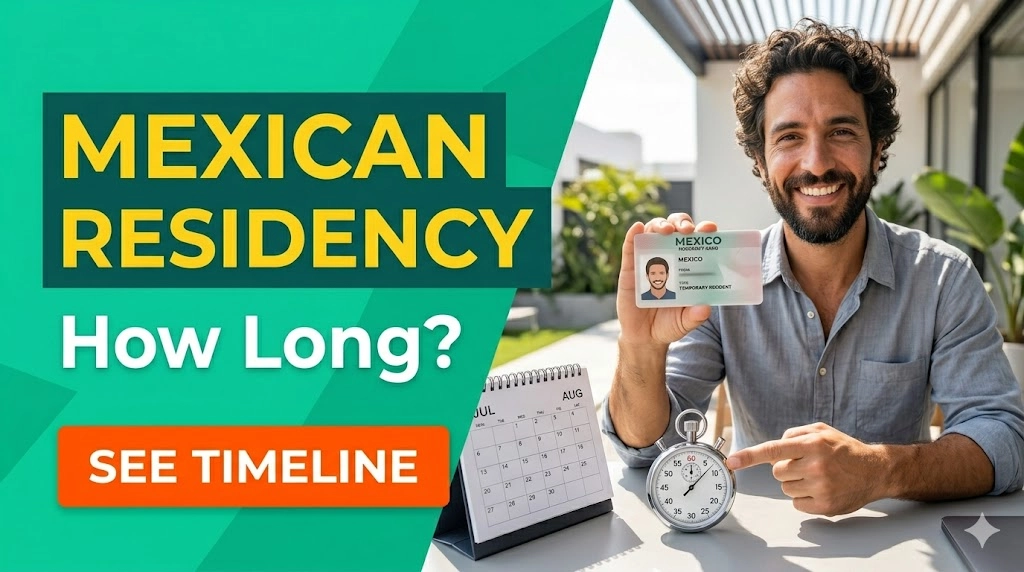
To maintain your sanity, you must stop viewing the residency application as a single event. It is a five-phase marathon. Below is the realistic 2026 timeline for a standard Residente Temporal (Temporary Resident) or Residente Permanente (Permanent Resident) application based on Economic Solvency.
(Note: If you are applying via Family Unity or Corporate Sponsorship, your timeline will have distinct variations, which we address below).
Phase 1: The Pre-Application Preparation (Weeks 1 to 4)
The clock does not start when you walk into the consulate; the clock starts the moment you decide to gather your paperwork. Mexican consulates operate with zero tolerance for missing documents, unauthenticated vital records, or improper translations.
Gathering Financials
If you are applying based on Economic Solvency, you must download your last 6 to 12 months of bank statements to prove you meet the strict 2026 UMA thresholds.
- The Time Trap: Consulates do not accept simple online screenshots. You must often request official PDF statements, print them, and potentially take them to a physical bank branch to obtain a “wet ink” signature and branch stamp from a manager. Coordinating this with your bank can take 1 to 2 weeks. To verify the exact financial numbers you need to hit, review our guide: Mexico Temporary Residency Financial Requirements (2026).
The Apostille and Translation Mandate
If you are applying for Permanent Residency as a retiree, or if you are bringing a spouse or dependent children, you must present foreign vital records (marriage certificates, birth certificates, or pension award letters).
These documents are legally meaningless to the Mexican government in their original English, French, or German formats.
- The Apostille (1-3 Weeks): You must mail your original vital records to the issuing government (e.g., your state’s Secretary of State in the US, or the Foreign, Commonwealth & Development Office in the UK) to receive an international Apostille authentication. Government processing times vary wildly.
- The Certified Translation (2-4 Days): Once apostilled, Mexican law strictly mandates that the document must be accompanied by a certified Spanish translation performed by a recognized, sworn translator (a Perito Traductor).
Your Action Step: Do not let the translation process delay your timeline. We strongly recommend utilizing RushTranslate for your entire immigration dossier. They specialize in certified, sworn translations specifically formatted for complex Mexican consular and INM standards. By sending your apostilled documents and specialized financial letters to RushTranslate the moment you receive them, you ensure your paperwork is legally flawless and ready for your interview, completely eliminating the risk of a devastating consular rejection.
Phase 2: The Consular Appointment (Weeks 4 to 12)
Once your physical folder of documents is perfectly assembled, you must secure an appointment at a Mexican consulate or embassy outside of Mexico.
The “MiConsulado” Bottleneck
You cannot simply walk into a consulate. You must book an appointment through the Secretariat of Foreign Affairs (SRE) digital portal, known as MiConsulado.
The demand to move to Mexico is at an all-time high. Major consulates in cities like Los Angeles, Chicago, London, Toronto, and Dallas are chronically backlogged.
- The Wait Time: Finding an open appointment slot can take anywhere from 2 weeks to 2 months. Many expats spend weeks logging into the portal daily just to find a cancellation.
The Day of the Interview
When your appointment day finally arrives, the actual process is remarkably fast.
- You submit your application, your RushTranslate certified documents, and your passport.
- The consular officer reviews your file and conducts a brief interview (usually 10 to 20 minutes) to confirm your intentions in Mexico.
- You pay the consular processing fee (approximately $53 USD).
Receiving the Visa Sticker
If approved, the timeline for receiving your passport back varies by consulate.
- Fast Consulates: Will print the visa sticker and hand your passport back to you on the exact same day, usually within 2 to 3 hours.
- Slower Consulates: Will require you to leave your passport and return to pick it up 2 to 5 business days later.
Critical Clarification: The sticker placed in your passport is NOT your residency card. It is a single-use entry visa valid for 180 days. You have effectively completed only half of the journey.
Phase 3: The Critical Arrival and “Canje” Initiation (Days 1 to 30 Post-Arrival)
You now have 180 days to fly to Mexico. However, the exact moment you land, a brand new, highly unforgiving countdown clock begins.
The E-Gate Danger (Day 1)
When you arrive at the Mexican airport, you must absolutely bypass the automated e-gates. If you scan your passport at an e-gate kiosk, the system will register you as a tourist, instantly and permanently voiding your hard-earned consular visa sticker.
You must wait for a human INM officer, show them the visa sticker, and explicitly state: “Vengo para el canje de mi visa” (I am coming for the exchange of my visa). Ensure they stamp your passport and write the word “Canje” on it. To fully understand this catastrophic trap, read Common Mistakes to Avoid When Applying for Mexican Residency Visas.
The 30-Day Deadline
From the date printed on that specific “Canje” entry stamp, you have exactly 30 calendar days to report to your local INM office to initiate the card exchange process.
- Tip: Do not arrive in Mexico and immediately go on a two-week vacation to a different state. Go to your destination city and start the INM process immediately.
Phase 4: The INM Processing “Black Hole” (Weeks 12 to 20)
This is the phase that breaks the spirit of many new expats. You have initiated the Canje at your local INM office. You submitted your Formato Básico, your photographs, and your passport copies. You paid the massive federal fees (ranging from $5,500 to $12,000+ MXN) at a local bank. To budget accurately for this step, review Mexico Immigration Fees and Costs: Budgeting for Your Residency.
The NUT and the Waiting Game
The INM agent will hand you a piece of paper containing your NUT (Número Único de Trámite). This is your tracking number.
From this moment on, your application is actively processing.
- The Timeline: Processing the Canje takes anywhere from 3 weeks to 8 weeks, depending entirely on how backlogged your specific INM office is. (Offices in Playa del Carmen, Tulum, and Mexico City are notoriously slow; offices in smaller cities like Querétaro or Mérida may be faster).
The Passport Lock
During this 3 to 8-week waiting period, you are legally trapped in Mexico. While the INM does not physically keep your passport, your federal immigration file is locked. If you attempt to cross an international border or board an international flight while your Canje is processing, the border database alerts the INM. Your application is instantly canceled under the legal presumption of abandonment, and your residency is destroyed.
Phase 5: Fingerprints and Card Issuance (Weeks 20 to 24)
After weeks of obsessively checking the INM tracking portal online, you will finally see the status change, or you will receive an email notifying you that your file has been approved.
- The Biometrics Appointment: You will return to the INM office. The agent will take your digital fingerprints and high-resolution facial photographs.
- The Final Wait: After providing biometrics, you will wait in the lobby (or be told to return in a few days, depending on the office’s printing capacity).
- The Card: The agent will hand you your physical, plastic Tarjeta de Residente. Your official Mexican CURP (ID number) will be printed on the front.
Congratulations. The timeline is complete. You are officially a legal resident of Mexico. To understand the immediate next steps you must take to integrate your new ID, read How to Get a CURP as a Foreigner: The Mexican ID Number Explained.
Variables That Radically Alter the Timeline
The 2-to-6-month timeline outlined above represents the standard Economic Solvency route. However, Mexican immigration is highly situational. Your specific pathway will drastically alter how long you wait.
The Fast Track: Family Unity (Vínculo Familiar)
If you are entering Mexico as a tourist and changing your status because you are married to a Mexican citizen, or because you just had a child born in Mexico, your timeline is significantly compressed.
- Why it’s faster: You completely skip Phase 1 and Phase 2. You do not need to hunt for a consulate appointment abroad or prove financial solvency.
- The Timeline: You enter as a tourist, immediately apply for a Cambio de Condición at the local INM, and wait the standard 4 to 8 weeks for INM processing. You can achieve residency in 1 to 2 months total. To explore this highly privileged route, read Permanent Residency through Family Ties: Marrying a Mexican or Having Mexican Children.
The Slow Track: Corporate Sponsorship (Lucrativa)
If you are moving to Mexico because a local company hired you, your timeline is beholden to corporate bureaucracy.
- Why it’s slower: Before you can even book a consulate appointment, your future Mexican employer must submit a petition to the INM and receive an authorization NUT. If the INM audits the company’s CIE (Employer Registry), this can delay the process by months.
- The Timeline: Expect 4 to 7 months total, factoring in the corporate petition phase before you even reach the consulate.
The Penalty Track: Regularization (Expired Visas)
If you flew to Mexico, overstayed your 180-day tourist visa, and are now attempting to fix your status (e.g., through marriage while undocumented), you are placed in the Regularization queue.
- Why it’s slower: The INM heavily scrutinizes irregular migrants. You must submit a formal confession letter (Carta bajo protesta), wait for the INM to calculate your UMA fines, pay the fines, and then wait for standard processing.
- The Timeline: Expect the INM processing phase alone to take 8 to 14 weeks. To understand how to navigate this stressful scenario, read Overstaying in Mexico: Consequences and How to Fix Your Status.
Survival Tips for the “Hurry Up and Wait” Bureaucracy
Navigating the Mexican INM requires the patience of a saint. If you try to rush the system, you will only cause yourself profound anxiety. Use these logistical tips to survive the timeline.
1. Do Not Book Non-Refundable Flights
The biggest mistake expats make is booking a non-refundable flight to Mexico before they have secured their consulate appointment. Because MiConsulado wait times are entirely unpredictable, you might not get an appointment until a week after your intended flight. Always book fully refundable fares or wait until the visa sticker is physically in your passport before booking your relocation flight.
2. The Emergency Exit: Permiso de Salida
What happens if you are trapped in Phase 4 (the INM Canje black hole), and a family member falls deathly ill in your home country, or your boss demands you fly to a conference?
You cannot simply leave. You must proactively apply for a Permiso de Salida y Regreso (Exit and Return Permit) at your local INM office.
- You submit a formal request letter, specific photographs, and pay a fee (approx. $600-$800 MXN).
- The INM issues a formal letter granting you a strict window (usually up to 60 days) to leave the country without canceling your pending residency application.
- Getting this permit takes 3 to 5 days, so you cannot apply for it on the way to the airport. For a detailed breakdown of border management, review Leaving Mexico and Re-entering: Travel Tips for Residents and Visa Holders.
3. Check the Portal Daily (But Don’t Panic)
During the INM processing phase, you can track your NUT number online. The portal is notoriously glitchy. It may stay on “Pending” for five weeks, and then suddenly update three times in one afternoon. Do not panic if the status hasn’t changed in a month; this is standard operating procedure.
Healthcare During the Gap: The Invisible Danger
We must address a critical, potentially bankrupting vulnerability that occurs directly in the middle of your residency timeline.
The Coverage Void
- Phase 1 & 2: You are in your home country, covered by your domestic health plan (e.g., US Medicare, UK NHS, Canadian provincial care).
- Phase 5: You have your residency card and your CURP, allowing you to legally integrate into the Mexican public healthcare system (IMSS) or secure local long-term private policies.
The Danger Zone is Phase 3 and Phase 4. When you fly into Mexico on your visa sticker and wait 4 to 8 weeks for your plastic card, you are in a legal gray area. Your home country insurance no longer covers you. Furthermore, because you are explicitly entering to establish residency, standard travel insurance policies will often deny major claims, citing that you are not on a temporary “trip” and are technically an un-carded resident.
The Reality of Mexican Private Hospitals
If you get into a severe traffic accident or suffer a cardiac event while waiting for your INM file to process, you will be taken to a hospital. Mexico boasts world-class private facilities (like Hospital Ángeles and Star Médica). However, they are strict for-profit entities. In a severe emergency, they will demand a massive, upfront credit card deposit (often $3,000 to $10,000 USD) before admitting you to the ER.
Attempting to survive the 2-month INM waiting period without robust medical coverage is financial suicide.
You must secure a globally portable health policy that covers you from the moment you leave your home country, through your residency transition, and permanently into your new life in Mexico. We highly recommend securing an expat-tailored policy through Cigna Global.
Their elite international plans offer direct billing networks with Mexico’s top private hospitals. This means that if a crisis strikes while your passport is locked at the INM, the private hospital coordinates the massive bills directly with Cigna Global. You do not have to drain your relocation budget or navigate complex reimbursement forms in Spanish while under duress. Securing this coverage ensures your vulnerable transition period is completely financially protected. To deeply understand how these hospital systems operate, read Healthcare in Mexico: Complete Guide for Expats Public vs Private.
Summary Checklist: Mastering the Timeline
The Mexican residency timeline is not a sprint; it is an endurance event. By anticipating the delays and preparing your documentation flawlessly, you eliminate the stress of the unknown. Use this rapid-fire checklist to track your progress:
- [ ] Month 1: Gather 6-12 months of official bank statements.
- [ ] Month 1: Send foreign vital records to RushTranslate for certified Spanish translation.
- [ ] Month 1-2: Hunt for a MiConsulado appointment and attend your interview abroad.
- [ ] Month 2-3: Enter Mexico via a human INM officer and verify the “Canje” stamp on your passport.
- [ ] Day 30 (Post-Arrival): Absolute deadline to file your Formato Básico at the local INM.
- [ ] Month 3-5: Wait out the INM processing phase. Do not leave Mexico.
- [ ] Continuous: Secure a Cigna Global international health policy so you are protected against catastrophic medical deposits during your transitional months.
Becoming a legal resident of Mexico requires abandoning the demand for instant gratification and embracing the rhythm of your new country. The bureaucracy may be slow, and the lines may be long, but the reward at the end of the timeline is the unparalleled freedom to build your life, your career, or your retirement in one of the most vibrant, culturally rich nations on earth.
References
Primary Sources (Official)
- Instituto Nacional de Migración (INM): The definitive federal portal detailing the exact procedural requirements, the mandatory 30-day window for the Canje process, and real-time tracking of your NUT number. https://www.inm.gob.mx/mpublic/publico/inm-tramites.html
- Secretaría de Relaciones Exteriores (SRE): The official government portal for booking your initial consular interview abroad, outlining the specific required documents, and detailing the 2026 UMA financial thresholds. https://www.gob.mx/sre/acciones-y-programas/visas-para-extranjeros
Other Helpful Sources
- Mexperience: A highly trusted expat portal providing simplified explanations of the consular bottlenecks, INM processing delays, and practical tips for surviving the bureaucratic waiting game. https://www.mexperience.com/lifestyle/mexico-immigration-guide/
- ExpatDen Mexico: A detailed, firsthand resource offering granular breakdowns of navigating specific INM offices, booking MiConsulado appointments, and securing gap-coverage health insurance. https://www.expatden.com/mexico/
Disclaimer
The information provided in this comprehensive guide is for educational, logistical, and informational purposes only and does not constitute formal immigration, legal, tax, or medical advice. The estimated timelines provided (e.g., 2 to 6 months) are averages based on standard processing; your specific timeline will depend entirely on the operational capacity of your chosen consulate and local INM office. Always verify the most current requirements and processing times directly with the INM or your nearest Mexican consulate. We strongly recommend consulting with a certified bilingual Mexican immigration attorney (Abogado Migratorio) to manage your application, especially if you have a complex case or need to secure an exit permit during processing.