eSIM Referral Credits and Promo Codes: How the Discounts Actually Work
Your friend texts you an eSIM referral code the night before your flight to Cancún. You paste it in, the discount looks smaller than you expected, and a week later you find “credit” sitting in your account with no idea how to spend it. This guide explains how referral credits and promo codes actually work, using Airalo as the main example, so the savings reach your Mexico data plan.
Disclosure: This post may contain affiliate links. We may earn a commission at no extra cost to you if you make a purchase through these links. Read full disclosure.
How eSIM Referral Credits Work for a Mexico Trip
My first eSIM was for a two-week trip from Mexico City down to Oaxaca. I had no idea what a referral credit was. I just knew the guy at the hostel in Roma Norte said “use my code, we both get something.” I used it, got a small discount, and moved on. Months later I opened the app before a Mérida trip and found a balance I had forgotten about. That is how most of us meet these programs: by accident, and with no real explanation.
So let’s slow down and walk through the mechanics properly.
The Two-Sided Referral Mechanic
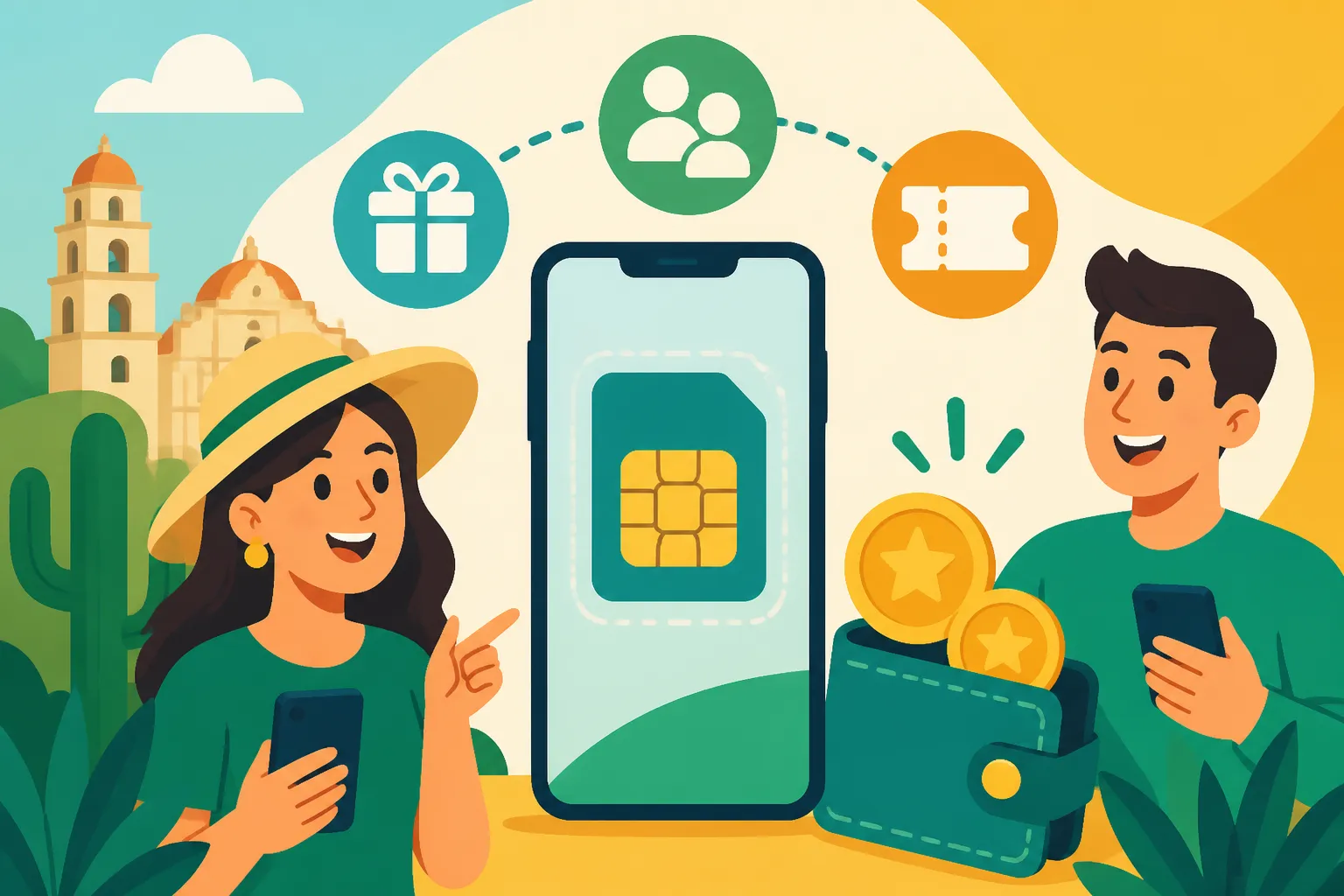
Almost every travel eSIM referral program has two sides. The new customer, the person who has never bought from that provider, gets a discount on their first purchase. The existing customer who shared the code gets a reward once that first purchase goes through.
Airalo follows this pattern. Every account has a personal referral code. When someone new uses it at checkout, they get a reduced price on their first eSIM. Once the purchase is complete, the person who shared the code receives credit in their account. Airalo calls this balance Airmoney. Neither side receives cash, and nothing is paid out to a bank account. The reward is store credit that lowers the price of future eSIMs or top-ups.
The order of events matters. The credit usually lands after the friend’s purchase is confirmed, not when they sign up. If your travel buddy creates an account in the Cancún airport arrivals hall but doesn’t buy until they reach Tulum, your reward waits until then. If they sign up with your code and then buy through a different account, or skip the code, the link is gone.
Where the Credit Lives and What It Can Buy
Referral credit sits in your account wallet inside the app. In my experience it’s easy to forget about, because nothing in the normal purchase flow forces you to look at it. You have to apply it at checkout, or at least confirm that it’s applied.
With Airalo, Airmoney can go toward a new eSIM package or a top-up on an eSIM you already have installed. That second option is the one I use most in Mexico. If I’m halfway through a month in Puerto Vallarta and my data is running low, I top up the existing eSIM instead of installing a new one, and I put my accumulated credit toward it. If you’re unsure whether to extend or start fresh, see eSIM Top-Ups in Mexico: When to Extend vs Buy a New Plan.
What credit generally can’t do:
- It can’t be withdrawn as cash.
- It can’t be moved to someone else’s account.
- It may not cover the full price of a plan, depending on the provider’s rules for that balance.
- It may have an expiry window, which providers spell out in their terms and change from time to time.
Check the credit’s conditions in the app or on the provider’s help pages before you build a trip budget around it. The current details are always there, and they change more often than you’d think.
Fine Print Worth Reading Before You Share Your Code
The part that frustrates people is the terms that decide whether a referral counts at all. Here’s what to look for in any program, Airalo’s included:
- First-purchase only. The code works for a brand-new customer. If your partner bought an eSIM from the same provider two years ago for a trip to Spain, they’re no longer “new,” and the code won’t give either of you anything.
- One account per person. Making a second account with a different email to refer yourself is exactly what these programs are built to catch. It can get rewards cancelled or the account flagged.
- Refunds reverse rewards. If the referred friend gets a refund on that first eSIM, the reward to you may be withdrawn.
- Promotions change. The size of the discount and the reward is set by the provider and adjusted over time. What your friend got last year is not necessarily what you’ll get today.
None of this is sinister, but it explains most of the “why didn’t I get my credit” moments. Read the referral section of the app’s help center once, and you’ll understand almost every outcome you run into.
Promo Codes for Mexico eSIMs: What Actually Gets Discounted
Referral codes are one kind of discount. Promo codes are a separate category, and mixing them up causes most checkout headaches. A referral code belongs to a person. A promo code belongs to a campaign.
The Types of Codes You Will Run Into
When planning a Mexico trip, you’ll see discount codes come from several places:
- First-purchase welcome codes. Shown to new customers on the provider’s site or in the app, often similar in effect to a referral discount.
- Seasonal or event promotions. Tied to busy travel periods or sale events, available for a limited window.
- Creator and influencer codes. Travel YouTubers, bloggers, and Instagram accounts often have their own codes, usually aimed at first-time buyers.
- Partner codes. Banks, airlines, card programs, and travel apps sometimes partner with eSIM providers and hand out codes to their customers.
- Win-back or retention offers. Sent by email or push notification to existing customers who haven’t bought in a while.
Airalo uses several of these. The constant across all of them is that each code has its own rules: who can use it, which plans it applies to, when it expires, and whether it can combine with anything else.
Why a Code Fails at Checkout
You’re standing in the immigration queue at Mexico City’s Benito Juárez airport, trying to buy data before you lose airport Wi-Fi, and the app says your code is invalid. It’s maddening. It’s almost always one of these reasons:
- The code is for new customers only and your email already has a purchase history.
- The code has expired, which is common with creator codes that were published once and never updated.
- The code applies only to certain regions or package types, and you picked a Mexico plan outside that scope.
- You’ve already used another code on this order, and the provider allows only one discount code per purchase.
- The code has a minimum purchase condition that your chosen package doesn’t meet.
- You typed it with an extra space, or confused a zero with a capital O.
The fix is boring but reliable: buy before you fly, on hotel or home Wi-Fi, so a failed code costs you a few minutes instead of a panicked scramble at the baggage carousel. If you’re still choosing a provider and don’t want a discount to be the deciding factor, see Buying an eSIM for Mexico: Provider Comparison and Real Cost Per GB.
Referral Credits vs Promo Codes vs Loyalty Rewards
Here’s how the main discount types compare. Providers adjust these values regularly, so check the app for what’s live when you buy.
| Discount Type | Who Gets It | When It Applies | Common Restrictions | Best Use in Mexico |
|---|---|---|---|---|
| Referral discount for the new user | First-time customer using a friend’s code | On the first eSIM purchase | New accounts only, one use per person | A first trip, such as a week in the Riviera Maya |
| Referral credit for the sharer | Existing customer who shared the code | After the friend’s purchase is confirmed | Store credit only, may expire, non-transferable | Topping up mid-trip or the next Mexico plan |
| Promo code | Anyone who meets the campaign rules | At checkout on qualifying plans | Expiry dates, plan scope, usually one per order | Bigger packages for longer stays |
| Loyalty or cashback credit | Repeat customers | Earned after each purchase, spent later | Varies by account status and provider terms | Frequent visitors and snowbirds |
The key takeaway: a referral code or promo code lowers the price of this purchase, while credits and loyalty rewards lower the price of a future one. Once you think of it that way, the system makes much more sense.
Step by Step: Using Airalo Referral Credits and Codes Before You Land in Mexico
This is the practical part. I’ve helped friends set this up in café booths in Condesa, on ADO buses to Valladolid, and over WhatsApp with people still packing in Toronto. The process is the same every time.
Before any of this, make sure your phone supports eSIM and is carrier-unlocked. A discount is worthless on a phone that can’t install the plan. See eSIM Device Compatibility: Which Phones Work in Mexico Before You Buy.
Redeeming a Friend’s Code on Your First Plan
If you’re new to Airalo and someone has shared their code with you:
- Download the Airalo app or open the website while you’re on reliable Wi-Fi at home.
- Create your account with the email you plan to keep using. Credits and purchase history are tied to it.
- Search for Mexico and browse the local packages. Compare data allowance and validity period against how long you’ll actually be in the country.
- Pick your package and go to checkout.
- Find the field for a referral or promo code and enter your friend’s code exactly as they sent it.
- Confirm the discount shows up in the order total before you pay. If it doesn’t, stop and check the reasons listed earlier.
- Complete the purchase and install the eSIM, ideally a day or two before departure, leaving it switched off until you land if the plan’s validity starts on first connection.
Step seven is where trips go wrong for reasons unrelated to discounts. Installing in advance means you aren’t scanning QR codes on a weak connection at the airport. For a full walkthrough of installation errors, see Installing an eSIM Before You Fly to Mexico: Step by Step and Common Errors.
Sharing Your Own Code With Travel Companions
Once you have an account, your own code becomes one of the easiest ways to make your next trip a little cheaper. This works especially well for group trips: a bachelorette weekend in Tulum, a family Christmas in San Miguel de Allende, a group of friends doing the Oaxaca coast.
- Open the app and find the referral or invite section in your account settings.
- Copy your personal code or share link.
- Send it to companions who have never bought from Airalo. Confirm they’re actually new, or the code won’t work for them.
- Ask them to enter it on their very first purchase, before buying anything else on that account.
- Once their purchase is confirmed, check your wallet. The credit should appear there.
A word on family trips. Every adult who buys on their own account with your code can count as a referral if they’re new. If you’re buying all the eSIMs for the family yourself on one account, that’s simply several purchases by one customer, not referrals. For the best setup for several phones, see eSIM for a Family Trip to Mexico: Cheapest Setup for Four Phones.
Please be honest with your friends. Tell them you get credit when they use your code. Most people are happy to help, and it keeps things friendly when they find out.
Spending Credit on a Mexico Top-Up
This is where credit really pays off for me. Picture this: you’re three weeks into a month in Mérida, Google Maps and WhatsApp video calls home have used up most of your data, and you still have a day trip to Uxmal and the Puuc Route ahead of you. You don’t want a new eSIM. You want more data on the one that already works.
- Open the app and go to your installed Mexico eSIM.
- Check the remaining data and validity so you know how much you need.
- Choose the top-up option and pick a package.
- At checkout, confirm that your available Airmoney is applied to the total.
- Pay any remaining balance with your card and finish the top-up.
- Check that the new data shows on the existing eSIM. There’s no need to install anything again.
If your data hasn’t run out but the connection has dropped, that’s a network or settings issue, not a top-up issue. See Losing Signal in Mexico: Troubleshooting an eSIM That Stops Working before you spend credit you don’t need to spend.
Squeezing Real Value From eSIM Discounts in Mexico
A discount only matters if the plan underneath it is right for your trip. I’ve seen friends chase a code onto a package that didn’t suit them and end up paying twice. So let’s talk about value, not just savings.
Doing the Per-GB Math Properly
The number that counts is what you actually pay per gigabyte you actually use, after the discount. To work it out:
- Estimate how much data you’ll realistically use, based on trip length and habits. Navigation, ride-hailing apps, messaging, and the occasional video call add up differently than streaming in your hotel room.
- Take the price of the package that covers that estimate.
- Subtract the referral discount, promo code, or credit you’ll apply.
- Divide by the gigabytes you’ll actually use, not the package’s headline allowance.
The fourth step is the one that matters. A big package with a nice discount can still cost more per gigabyte than a smaller, undiscounted one if half the data expires unused when you fly home. If you’re unsure how much you’ll need, see Sizing Your Mexico Data Plan: GB Estimates by Trip Length and Usage.
When a Discount Should Not Decide Your Plan
There are situations where the code is the least important part of the decision:
- You already have roaming included. Some US phone plans include Mexico usage. Compare that honestly before buying anything. See eSIM vs Your US Carrier’s Included Mexico Roaming: When It Actually Pays.
- You’re staying long enough for a local SIM. For a stay of several months, a Telcel prepaid SIM can be the better option, depending on your needs. See Travel eSIM vs a Telcel Amigo SIM: The Real Price Per GB in Mexico.
- You’re crossing borders. If the trip includes Texas or California as well as Mexico, a regional plan may suit you better than a Mexico-only package, discount or not. See North America Regional eSIM Plans: Worth It for a US-Mexico Trip.
- You need unlimited data. If you work remotely and upload large files, the plan structure matters far more than a one-time discount. See Airalo vs Holafly for Mexico: Unlimited vs Metered Data Compared.
My personal rule: pick the right plan first, then look for a code. Never the other way around.
Three Real-Life Scenarios
The first-time visitor to the Riviera Maya. Sarah is flying from Chicago for ten days between Cancún and Playa del Carmen. Her coworker shares an Airalo referral code. Sarah sizes her package to her actual use, enters the code at checkout, installs the eSIM at home, and turns it on when she lands. She saves money on her first purchase, and her coworker gets credit for the next trip. Simple and clean.
The returning snowbird. David spends winters near Lake Chapala and goes back north each spring. He’s bought several eSIMs over the years, so welcome codes no longer work for him. His value comes from accumulated credit and loyalty rewards, which he saves for the top-ups he always needs in his last few weeks. He checks his balance and the expiry terms before every trip, so nothing lapses.
The digital nomad hopping cities. Ana moves from Mexico City to Oaxaca to Puerto Escondido over two months. She shares her code in the nomad WhatsApp groups and coworking spaces she joins, being upfront that she earns credit. That credit pays for part of her mid-trip top-ups. She knows that if she stays longer, a local SIM might be the cheaper long-term choice, so she reviews her setup each month rather than staying loyal out of habit.
Before You Fly: A Quick Checklist
- Confirm your phone is unlocked and supports eSIM.
- Decide on your plan based on usage, then look for a code.
- If you’re new to Airalo, ask friends whether anyone has a referral code to share.
- Enter one code at checkout and confirm the discount before paying.
- Install the eSIM at home on stable Wi-Fi.
- Check your wallet for leftover credit before buying a top-up.
- Read the current referral and credit terms in the app, since they change.
When it’s time to buy data for your next trip to Mexico, open Airalo, check whether you have credit waiting or a friend’s code to use, and set it up before you leave home. Arriving in Cancún or Mexico City with working data and a few savings already banked is one of the small travel wins that makes the first day much easier. For a broader overview of how phone service and data work across the country, see Mobile Data and eSIMs for Travel in Mexico.
Disclaimer
This article is for general informational purposes only and does not constitute professional advice. Laws, prices and regulations vary by location and change over time. Consult a qualified professional for guidance on your specific situation.