Mexican vs U.S. Medication Brands: Finding Equivalent Drugs
Translating your daily pill bottle into Spanish at a pharmacy counter is a terrifying rite of passage for new residents. Thousands of expats find themselves entirely lost when their usual brand names don’t exist here. This guide breaks down exactly how to find medication equivalents, navigate active ingredients, and safely manage prescriptions in Mexico.
Disclosure: This post may contain affiliate links. We may earn a commission at no extra cost to you if you make a purchase through these links. Read full disclosure.
The Danger of Relying on Brand Names in Mexico
When expats arrive in Mexico, they often head straight to a local pharmacy expecting to find familiar boxes of Tylenol, Advil, Lipitor, or Zoloft. However, pharmaceutical branding is highly localized. Attempting to navigate your healthcare based strictly on the marketing names you know from back home will almost certainly lead to a dead end.
Why Your Usual Brand Doesn’t Exist Here
Drug manufacturers license different brand names for different international markets based on regional trademarks and local corporate partnerships. Even if the exact same global pharmaceutical company manufactures your daily medication, the box on a Mexican pharmacy shelf will likely feature a completely different name, a different color scheme, and different packaging.
Attempting to ask a Mexican pharmacist for a specific U.S. or Canadian brand name usually results in a blank stare. They are trained on domestic Mexican pharmacology, not foreign branding. If you are preparing for your initial move and packing your bags, you should thoroughly review Bringing Prescription Medications from Home: Rules and Tips for Expats so you have enough of your home supply to tide you over while you learn to navigate the local medical system.
The Importance of Active Pharmaceutical Ingredients (API)
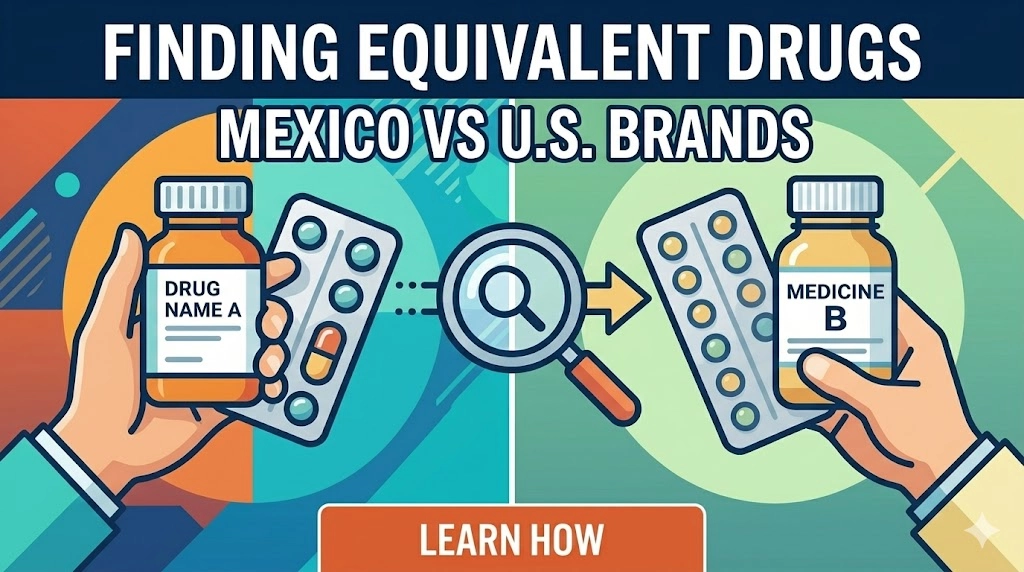
The absolute secret to successfully navigating Mexican pharmacies is abandoning brand names entirely and focusing strictly on the Active Pharmaceutical Ingredient (API). In Mexico, this is known as the sustancia activa or principio activo.
Every medication in the world is based on its underlying chemical compound. For example, the active ingredient in Tylenol is acetaminophen (which translates to paracetamol in Mexico). The active ingredient in Advil is ibuprofen (ibuprofeno). To successfully buy or refill your medication, you must read the fine print on your current prescription bottle, identify the chemical name, and translate that specific chemical into Spanish. This linguistic shift is the fundamental baseline of managing your health abroad. If you have complex health needs requiring multiple overlapping drugs, exploring Managing Chronic Illness in Mexico: Access to Medication and Specialists will help you coordinate your long-term medication strategy safely.
How to Find Your Equivalent Medication
Finding your equivalent medication is a straightforward, analytical process once you know the exact steps and understand how the Mexican pharmaceutical market categorizes its drugs.
Translating Your Prescription (Step-by-Step)
First, locate the chemical name and the exact milligram (mg), microgram (mcg), or milliliter (ml) dosage on your home prescription. Second, use a reliable medical translation tool or simply search online for the Spanish translation of that chemical.
When you look at your medication, pay close attention to the presentation. You must understand if your medication is an extended-release or delayed-release formula. In Mexico, extended-release is often denoted by the letters “LP” (Liberación Prolongada) or “PR” (Prolongada Retard) appended to the end of the brand name. Knowing these specific abbreviations will prevent you from accidentally buying an immediate-release version that could severely disrupt your treatment protocol.
When you approach the pharmacy counter—because most medications in Mexico are kept securely behind the glass—you will ask the pharmacist for the sustancia activa. For example, instead of asking for Zoloft, you would ask: “¿Tienen Sertralina de 50 miligramos?” (Do you have Sertraline 50mg?). The pharmacist will then check their internal database and present you with the available local brands that contain that exact chemical compound.
Patente vs Genérico: Understanding Mexican Drug Categories
When the pharmacist finds your medication, they will inevitably ask you a crucial question: “¿Patente o genérico?”
Medicamentos de patente are the name-brand drugs produced by the original pharmaceutical company that developed the chemical. They are the premium, most expensive option. Medicamentos genéricos are generic equivalents produced by other authorized domestic manufacturers. Mexico has a massive, thriving market for generic medications, monitored heavily by COFEPRIS (the Federal Commission for the Protection against Sanitary Risk). Generic drugs in Mexico must pass strict bioequivalence tests to ensure they are identical in quality and efficacy to the name-brand versions. Opting for the generic version will often save you 60% to 80% at the checkout counter.
However, not all pharmacies are created equal. While massive discount chains like Farmacias Similares are excellent for basic, low-level generics (like simple pain relievers or basic antibiotics), many specialists recommend sticking to patente drugs or buying premium generics from higher-tier pharmacies like Farmacias del Ahorro or Farmacias San Pablo for highly sensitive maintenance medications.
Quick Reference Table: Common U.S. to Mexican Medication Equivalents
To help you get started, here is a comparative table of some of the most common medications expats seek, mapping the U.S. brand name to the underlying active ingredient and its common Mexican equivalents.
| U.S. Brand Name | Active Ingredient (API) | Spanish API Translation | Common Mexican Brands (Patente & Genérico) |
| Tylenol | Acetaminophen | Paracetamol | Tempra, Sedalmerck, Tylenol (rare), Genéricos |
| Advil / Motrin | Ibuprofen | Ibuprofeno | Actron, Tabalon, Motrin, Genéricos |
| Lipitor | Atorvastatin | Atorvastatina | Lipitor, Vaslip, Genéricos |
| Synthroid | Levothyroxine | Levotiroxina | Eutirox, Karet, Genéricos |
| Zoloft | Sertraline | Sertralina | Altruline, Sertex, Genéricos |
| Glucophage | Metformin | Metformina | Glucophage, Dabex, Genéricos |
| Zyrtec | Cetirizine | Cetirizina | Zyrtec, Virlix, Genéricos |
| Nexium | Esomeprazole | Esomeprazol | Nexium, Nexium Mups, Genéricos |
Navigating Pharmacies and Prescription Rules
Once you know what to ask for, you must understand the legal parameters governing how drugs are sold in Mexico. The rules here differ drastically from what you are used to in the United States or Europe.
What Needs a Prescription in Mexico?
Mexico categorizes all medications into different fractions (Fracciones) that dictate exactly how they can be legally dispensed. Unlike the U.S. or Canada, where almost all daily maintenance medications require a doctor’s permission, Mexico is far more relaxed regarding routine healthcare.
Medications for blood pressure, cholesterol, diabetes, asthma, and even basic birth control generally fall into unrestricted categories. This means they are available over-the-counter. You simply walk in, ask the pharmacist for the drug by its chemical name, pay, and leave. You can read more about this surprising level of accessibility in Over-the-Counter Medications: What Can You Get in Mexico Without a Prescription?.
However, antibiotics and strong antivirals (Fraction IV), as well as controlled psychotropics, sedatives, and heavy painkillers (Fractions I, II, and III), are strictly regulated. You absolutely cannot buy these without a valid Mexican prescription. If you bring a written prescription from your doctor back home, the Mexican pharmacist will reject it entirely; foreign prescriptions hold absolutely no legal weight in Mexico.
Using Pharmacy Clinics (Consultorios)
If you discover that your required medication does legally require a prescription, you do not necessarily need to book an expensive, time-consuming hospital appointment. Major pharmacy chains typically feature a small doctor’s office physically attached to the building, known as a consultorio adyacente a farmacia.
You can walk into one of these clinics without an appointment, pay a nominal fee (usually between $3 and $5 USD), and consult with a fully licensed general practitioner. If you explain your medical history and present your old pill bottles, they will usually write you a valid Mexican prescription on the spot, which you can immediately fill at the counter next door. For a deeper understanding of how these corporate chains and their attached clinics operate, review Pharmacies in Mexico: How to Get Medications (OTC vs Prescription).
Managing Payments and Imported Supplements
When purchasing months of maintenance medications or paying for multiple specialist visits, currency exchange fees can quietly drain your budget. Using a foreign credit card at a Mexican pharmacy subjects you to terrible dynamic currency conversion rates and hidden foreign transaction penalties. Savvy expats utilize Wise to manage these medical expenses efficiently. By keeping funds in a Wise account, you can convert your home currency into Mexican Pesos at the exact mid-market exchange rate, using your Wise debit card to pay the pharmacy terminal directly without hidden banking markups.
Furthermore, while Mexican pharmacies are excellent for dispensing allopathic pharmaceuticals, they severely lack diverse, high-quality nutritional supplements, specific probiotic strains, and holistic remedies. If your health regimen requires specialized dietary support to combat medication side effects, expats consistently rely on iHerb. You can order massive global wellness brands through iHerb and have them shipped securely and directly to your Mexican residential address, bypassing the limited inventory of local health food stores entirely. You can also pay for your iHerb imported orders efficiently using your Wise card to further optimize your budget.
What to Do When Your Drug Is Unavailable
Occasionally, expats face the terrifying realization that their exact medication is completely unavailable in Mexico, regardless of whether they have a prescription or not.
Dealing with Banned or Unapproved Medications
COFEPRIS, the national health regulator, does not automatically approve every single drug that the FDA approves in the United States. The most famous example of this divergence is Adderall (amphetamine/dextroamphetamine), which is entirely illegal and unavailable in Mexico. Other highly specific ADHD medications, certain modern biologics, and highly specialized immunosuppressants might also be completely absent from the market.
Beyond severe psychiatric medications, there are other surprising differences. Many combination cold and flu medications containing pseudoephedrine are heavily restricted or entirely banned in Mexico due to their potential use in illicit drug manufacturing. You will easily find phenylephrine as a substitute, but your favorite home brand of severe sinus medication simply will not exist here. If you find yourself in a situation where your daily drug is illegal or unapproved, you must read What If a Medication You Need Isn’t Available in Mexico? to explore your legal and medical alternatives.
Seeing a Specialist for Alternatives
If your specific drug is banned or unapproved, a basic pharmacy consultorio doctor cannot help you. You must seek out a board-certified private specialist, such as a psychiatrist, endocrinologist, or neurologist, to help you safely transition to a local equivalent that is legally available. For example, while Adderall is illegal, a Mexican psychiatrist can legally prescribe Ritalin or Concerta (methylphenidate) as a viable alternative.
Navigating private specialists in Mexico is generally straightforward, as the private sector operates as a free market. You can easily book an appointment directly without needing a gatekeeper or a general practitioner’s permission. For absolute clarity on this process, review Seeing Specialists in Mexico: Do You Need a Referral or GP Recommendation?. Finding an English-speaking professional is highly recommended to ensure no critical medical nuances are lost during your medication transition, a topic covered extensively in Finding English-Speaking Doctors and Specialists in Mexico.
Leveraging International Health Insurance
Transitioning to new, highly specialized medications or undergoing extensive lab work to monitor a new drug’s efficacy can become incredibly expensive out of pocket. This is why holding a robust international health insurance policy like Cigna Global is crucial for long-term expats navigating complex health profiles.
A premium Cigna Global plan ensures you have reliable financial coverage for top-tier private specialist consultations across the country. Depending on your specific policy riders, Cigna Global may also cover the ongoing costs of your new prescription medications, shielding your retirement savings from unexpected pharmaceutical expenses. If your medication suddenly runs out and you need immediate triage advice on how to secure an emergency equivalent, exploring Running Out of Medication: Getting a Prescription Refill in Mexico will expertly guide your next immediate steps.
References
Primary sources (official)
- U.S. Embassy & Consulates in Mexico – Local Resources and Medical Assistance: https://mx.usembassy.gov/services/
Other helpful sources
- Mexico News Daily – How to find what you need in a Mexican pharmacy: https://mexiconewsdaily.com/mexico-living/how-to-find-what-you-need-in-a-mexican-pharmacy-and-not-what-you-dont/
- International Citizens Insurance – The Healthcare System in Mexico: https://www.internationalinsurance.com/countries/mexico/healthcare/
Disclaimer
The information provided in this guide is for educational and informational purposes only and does not constitute formal medical or legal advice. Mexican pharmaceutical regulations, COFEPRIS approvals, and the legal availability of specific active ingredients are subject to frequent and sudden changes. Always consult with a licensed, board-certified Mexican physician regarding your specific health condition and prescription needs, and never attempt to transport banned or controlled substances across international borders without explicit legal authorization.