Online Tutors vs a Mexican Immersion School: Cost Per Speaking Hour
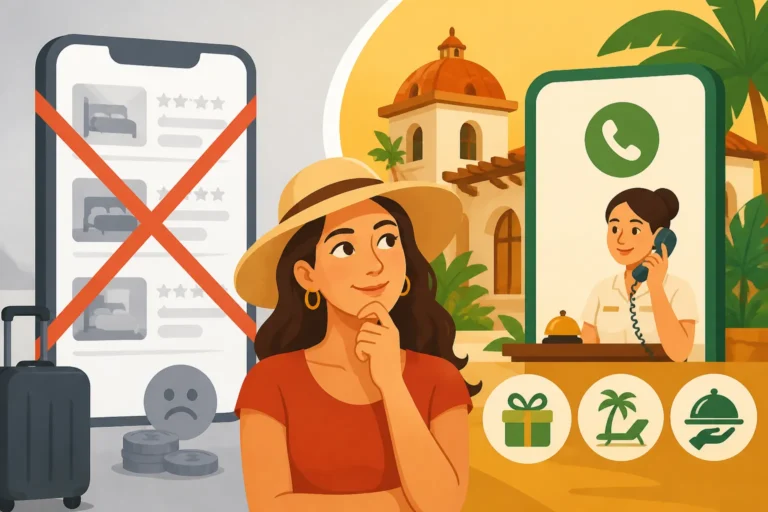
You sit through a four-hour morning class in Oaxaca, then realise you spoke Spanish for only a small share of it. Or you book a one-on-one lesson online and talk almost the whole hour. Comparing these two options by course price alone gives the wrong answer. This guide shows how to compare them by cost per speaking hour, using real October 2026 prices for online tutors and two well-known Mexican schools.
Disclosure: This post may contain affiliate links. We may earn a commission at no extra cost to you if you make a purchase through these links. Read full disclosure.
What a Speaking Hour Really Costs
Here is a story I hear all the time from friends in Mexico. Someone saves up and books two weeks at a language school in a beautiful colonial city. They come home with a notebook full of verb tables and a decent tan. Then they freeze the first time a taxi driver asks them a question at normal speed.
The school did nothing wrong. They bought instruction hours, but what they needed was speaking hours, and those are not the same thing.
Class Hours vs Speaking Hours
A class hour is the time you are scheduled to be in a room or on a video call. A speaking hour is the time your own mouth produces Spanish while someone corrects you, pushes you, and makes you reformulate. In a group class, the teacher’s explanations, other students’ turns, and written exercises all take up the clock. Your personal speaking time is only a fraction of the listed hours.
In a one-on-one lesson, the ratio flips. A good tutor talks less than you do. They prompt, listen, correct, and ask the next question. Even with a short grammar explanation, most of the hour belongs to you.
So the real comparison is not “school price per hour vs tutor price per hour.” It is the price per hour divided by the share of that hour you actually spend speaking. A cheaper class hour can turn into a more expensive speaking hour once you account for how many other people share the room.
How to Measure Your Own Speaking Time
You do not need guesswork for this. You can measure it with a phone timer and a little honesty. Here is the method I used myself when deciding how to split my budget:
- During one representative class or lesson, start a stopwatch every time you begin speaking Spanish and pause it when you stop.
- At the end, compare your total speaking minutes to the length of the session.
- Divide the price you paid for that session by your speaking minutes, then multiply by 60. That gives you your personal cost per speaking hour.
- Repeat for two or three sessions, because one quiet day in a group class or one chatty day with a tutor can skew the result.
The number you get is personal. A confident student who grabs every chance to talk will get more speaking time from a group class than a shy one. A tutor who lectures will deliver less speaking time than one who mostly asks questions. That is why measuring beats assuming.
If you want the wider picture of how online platforms structure their pricing before you run this experiment, see Learning Spanish With an Online Tutor: The Complete Platform and Cost Guide.
The Real Prices on the Table as of October 2026
Let’s put actual figures down so the comparison means something. All prices below were read on the providers’ own pages on 18 October 2026. Each price is given in the currency its source uses.
iTalki Spanish Tutor Rates in an October 2026 Snapshot
iTalki has two kinds of teacher. Professional teachers are certified or experienced instructors. Community tutors are native or fluent speakers who focus on conversation practice. iTalki sets the allowed price limits: professional teachers can charge between USD 10 and USD 120 per lesson, and community tutors between USD 5 and USD 120 per lesson.
That ceiling looks intimidating, but the snapshot below sits far beneath it. I looked at an October 2026 snapshot of the first 100 tutors in the default order of iTalki’s Spanish search page, taking each tutor’s cheapest 60-minute lesson in US dollars. The pattern was clear:
- The middle half of Spanish community tutors charged $10–16 per hour.
- The middle half of professional Spanish teachers charged roughly $18.50–30 per hour.
For context, Preply’s own page lists an average of $27 per hour for Mexico-based tutors. That lands in the same territory as an iTalki professional teacher.
There is no subscription on iTalki. You buy credits and spend them lesson by lesson, so you are never locked into a monthly fee you forget to cancel. For a fuller breakdown of how rates spread across tutor types, see iTalki Tutor Pricing for Spanish: What You Pay Per Hour by Tutor Tier.
Instituto Cultural Oaxaca Immersion Pricing
Instituto Cultural Oaxaca, usually called ICO, is a long-running school in one of Mexico’s most beloved cities for language learners. As of October 2026, its 20-hour programme costs:
- USD 250 for one week, covering 20 hours of instruction plus 4 hours of intercambio.
- USD 760 for four weeks, covering 80 hours.
- A deposit of USD 55.
Per class hour, that works out to about $12.50 for the one-week option and about $9.50 for the four-week option. The longer stay is clearly the better deal per hour. The intercambio hours deserve attention, because they are conversation exchanges with local speakers, which makes them the most speaking-dense part of the package.
UNAM CEPE Polanco in Mexico City
UNAM’s Centro de Enseñanza para Extranjeros has a campus in Polanco, Mexico City. Its 2026 calendar lists an in-person intensive format that suits people with day jobs. It runs for 8 weeks on Monday to Thursday evenings, at these prices:
- MXN 12,400 for basic levels.
- MXN 10,750 for intermediate and advanced levels.
- MXN 10,330 for the virtual option.
At basic level, the in-person course runs up to roughly 96 class hours. That works out to roughly MXN 129 or more per class hour. This is a structured, university-backed course with a strong grammar foundation and the credibility of the UNAM name. It is also a group format, which matters a great deal once you start counting speaking minutes.
Price Comparison at a Glance
| Option | Format | Published price, October 2026 | Hours included | Price per class hour | Speaking share of each hour |
|---|---|---|---|---|---|
| iTalki community tutor | One-on-one online | $10–16 per hour, middle half of snapshot | Pay per lesson | $10–16 | Very high; most of the lesson is you talking |
| iTalki professional teacher | One-on-one online | About $18.50–30 per hour, middle half of snapshot | Pay per lesson | About $18.50–30 | High; structured, but still one-on-one |
| Preply Mexico-based tutors | One-on-one online | $27 per hour average | Subscription | $27 average | High; one-on-one |
| Instituto Cultural Oaxaca, 1 week | In-person group, Oaxaca | USD 250; USD 55 deposit at registration | 20 h instruction + 4 h intercambio | About $12.50 | Shared with classmates; intercambio is speaking-heavy |
| Instituto Cultural Oaxaca, 4 weeks | In-person group, Oaxaca | USD 760; USD 55 deposit at registration | 80 h | About $9.50 | Shared with classmates |
| UNAM CEPE Polanco, basic | In-person group evenings, Mexico City | MXN 12,400 for 8 weeks | Up to about 96 h | About MXN 129+ | Shared with classmates |
| UNAM CEPE Polanco, intermediate or advanced | In-person group evenings, Mexico City | MXN 10,750 for 8 weeks | Per 2026 calendar | See calendar | Shared with classmates |
| UNAM CEPE Polanco, virtual | Online group | MXN 10,330 | Per 2026 calendar | See calendar | Shared with classmates |
Look at the “Price per class hour” column and the four-week ICO option looks hard to beat. Then look at the last column. Those class hours are shared, and one-on-one time is not. Running the stopwatch method from the first section on a group class is exactly how you turn that column into your own cost per speaking hour.
Where Each Option Wins on Speaking Time
I don’t want to pretend schools are a bad deal. I loved my time in a classroom in Mexico, and some things only happen there. But if your goal is to talk, you should know where each format actually delivers.
One-on-One Tutoring and Talking Time
With a one-on-one tutor, there is nowhere to hide, and that is the point. When I started booking iTalki lessons, my first reaction was mild panic, because every silence was mine to fill. After a few weeks, that pressure was the thing that moved me from understanding Spanish to producing it.
You also control the content completely. If you live in Guadalajara and need to argue with your landlord about a broken water heater, you can spend an entire lesson role-playing that conversation. If you work remotely and want to handle a video call with a Mexican client, you can rehearse that instead. A group class follows a syllabus built for the average student. A tutor follows you.
There is also accent choice. If you are moving to Mexico, you can filter for tutors from Mexico, or even from a specific region, so the Spanish you practise matches the Spanish you will hear at the tianguis. For more on why this matters, see Mexican vs Castilian Spanish: Choosing a Tutor for Life in Mexico.
What Immersion Gives You Outside the Classroom
Immersion’s real value often sits outside the classroom hours you paid for. In Oaxaca, you leave class and order a tlayuda at a market stall, ask directions to Santo Domingo, and chat with your homestay host over dinner. None of that is on the invoice, yet all of it is speaking practice with real stakes.
ICO’s intercambio hours formalise this. Sitting across from a local who wants to practise English while you practise Spanish is excellent, speaking-heavy time, and it is baked into the one-week package. Group classes also give you something tutoring can’t: classmates. You make friends, compare mistakes, and build the confidence that comes from seeing others struggle too.
The catch is that street practice is uneven. Some days you talk constantly. Other days you retreat to a café with English-speaking classmates because you are tired. Immersion gives you opportunity, not a guarantee. Whether you get speaking hours out of the city depends on how hard you push yourself after class.
Group Class Dynamics at a Mexican School
In a group, your speaking time depends on class size, the teacher’s style, and your classmates. One talkative student can eat up a surprising amount of a session. A quiet group can leave long stretches of teacher talk. Evening courses like UNAM CEPE Polanco’s attract working professionals who arrive tired after a day at the office, which affects energy levels in the room.
Group classes shine for structure. If you are an absolute beginner, a well-sequenced syllabus that builds tenses in a logical order is valuable. UNAM’s programme in particular gives you a recognised institutional framework, which some learners find motivating.
For learners stuck at an intermediate level, though, the group format can make things worse. When you already know the grammar and just need to use it, a syllabus that keeps explaining the grammar holds you back. If that sounds familiar, see Breaking the B1 Plateau: Why Grammar Study Stalls and What Speaking Fixes.
The Costs Around the Lesson
The lesson price is only part of what you pay. Both formats come with costs around the edges, and you should see them before you commit.
Paying for iTalki Credits
On iTalki, you buy credits first, then use them to book lessons. Payment is in US dollars. Depending on how you pay, the payment provider may charge a processing fee, and that charge comes from the provider, not from iTalki. The fee is shown on the payment page before you confirm, so you are never surprised after the fact.
Your own bank may also add a foreign exchange fee if your card is in pesos or another currency. If you hold a card that handles dollar payments without a foreign transaction charge, use it here. Otherwise, check your bank’s terms before buying a large batch of credits.
Because there is no subscription, you can buy exactly what you need. Many learners buy lesson packages from a tutor they already like once the trial goes well. To get that balance right and avoid credits sitting unused, see iTalki Packages vs Single Lessons: How to Buy Without Wasting Credits.
Deposits, Travel and Time Away for Immersion
Immersion programmes carry costs that never show up in the per-hour figure. ICO asks for a USD 55 deposit to complete registration. Then you have the cost of getting to Oaxaca, a place to sleep, and meals for every day you are there. If you live in Mexico City or Monterrey, you may also lose working days or burn vacation time.
UNAM CEPE Polanco avoids the travel problem if you already live in Mexico City, since the evening schedule fits around a job. But you are committing to Monday to Thursday evenings for eight weeks. Crossing Mexico City at rush hour to reach Polanco is a real cost in time and energy, especially if you live across town.
None of this is a reason to skip immersion. It is a reason to treat the per-hour price in the table as a floor, not a ceiling. The ICO four-week programme’s attractive per-hour rate assumes you can spend a month in Oaxaca. For many people with jobs, kids, or a lease elsewhere, that is the expensive part. If you’re scouting schools across different cities, see How to Find Spanish Immersion Schools in Mexico.
Scenarios: Choosing by Your Situation
Numbers are useful, but decisions happen in real lives. Here are three situations I see constantly among people learning Spanish for life in Mexico.
The Remote Worker in Mexico City
Picture Dana. She works for a US company from an apartment in Roma Norte and has a flexible but busy schedule. She has considered the UNAM CEPE Polanco evening intensive because the UNAM name appeals to her and the evening format fits her workday. At MXN 12,400 for the basic level, it is a serious structured option.
When Dana thinks it through honestly, the problem is consistency. Some weeks her clients want late calls, and Monday to Thursday evenings are not reliably free. She also needs to speak, because she already reads menus and signs fine. She ends up booking three iTalki lessons a week with a community tutor from Mexico City. She schedules them around her calendar, sometimes at 7 a.m. before work. Every lesson is almost entirely her talking, and she never loses an evening to the commute to Polanco.
If you’re in a similar position, see Fitting Spanish Lessons Around Work: Realistic Weekly Study Schedules.
The Pre-Move Planner Abroad
Now picture Marcus, who is still in Toronto and plans to move to Mérida. He can’t attend a school in Mexico yet. What he can do is arrive already able to hold a conversation, which makes everything from apartment viewings to setting up internet less stressful.
For Marcus, online tutoring is not just the cheaper option. It is the only way to get speaking hours before he arrives. He books trial lessons with tutors from the Yucatán and from central Mexico, settles on one of each, and alternates. The community tutor handles relaxed conversation, while the professional teacher fixes his recurring errors with the subjunctive. Once he’s in Mérida, he may add a short school course, and by then he’ll get far more out of it.
For a full plan built around this timeline, see Reaching Conversational Spanish Before You Move: A Pre-Arrival Plan.
The Sabbatical Learner Heading to Oaxaca
Finally, there’s Elena, who has a month off and has always wanted to spend it in Oaxaca. For her, the ICO four-week programme makes a lot of sense. USD 760 for 80 hours gives her a strong per-hour rate, and the city itself becomes her conversation partner.
Elena is smart about it, though. A few weeks before leaving, she books a handful of online lessons to wake up her rusty Spanish, so she doesn’t spend her first expensive week of immersion just remembering how to conjugate. After she returns home, she keeps a weekly online lesson going so the fluency she built in Oaxaca doesn’t fade. The school is the high-intensity burst, and the tutor is what holds it in place before and after.
A Step-by-Step Plan to Get the Most Speaking for Your Money
If you’ve read this far, you’ve probably noticed that the smartest answer is often both: one-on-one tutoring as the backbone, with a school stint as a booster when your life allows it. Here is how to set that up without wasting money.
Booking Trials and Picking a Tutor
iTalki lets first-time students book trial lessons at a lower price than a regular lesson. You can take up to three trials, each with a different teacher. Not every teacher offers one, and iTalki does not publish a trial length, so check each tutor’s profile.
Here’s the process I recommend:
- Decide what you need most right now: relaxed conversation, structured correction, or exam preparation.
- Filter Spanish tutors by country if you want a Mexican accent, then shortlist around six whose intro videos you can follow comfortably.
- Book three trial lessons, one each with your three favourites, spread across a single week so you can compare them while they’re fresh.
- During each trial, run the stopwatch test from earlier. Note how much of the lesson you spent speaking and how the tutor handled your mistakes.
- Pick the tutor who got you talking the most while still correcting you clearly, then book a short run of regular lessons before committing to a package.
To decide which type of teacher suits your level, see Community Tutor vs Professional Teacher on iTalki: Which for Your Level?. To walk into that first trial ready, see Your First iTalki Trial Lesson in Spanish: What to Prepare.
Combining a School Stint With Ongoing Tutoring
If you can take time out for immersion, here is how to make the two work together instead of treating them as rivals:
- Before the school, book a few weeks of online lessons focused purely on speaking, so you arrive warmed up rather than rusty.
- Choose a programme with built-in conversation time where possible. ICO’s one-week option includes 4 hours of intercambio alongside 20 hours of instruction.
- While you’re at the school, keep a short daily log of the phrases you wished you’d known in real conversations outside class.
- After the programme ends, bring that log to your online tutor and turn it into lesson material.
- Keep at least one weekly online lesson going so the progress from immersion doesn’t slip away once you’re back in your routine.
This hybrid approach gives you what each format does best. The school provides structure, classmates, and a city full of practice. The tutor provides concentrated, personal speaking time that you can book from anywhere in Mexico or abroad. If you’re weighing platforms before you start, see iTalki vs Preply for Spanish: Tutor Pool, Pricing, and Booking Compared.
My honest bottom line is this. If your goal is to speak, start by booking your iTalki trial lessons this week and running the stopwatch test. You will know within a few sessions what a speaking hour really costs you, and you can add the Oaxaca or Mexico City school experience on top when your calendar and budget allow.
Disclaimer
This article is for general informational purposes only and does not constitute professional advice. Laws, prices and regulations vary by location and change over time. Consult a qualified professional for guidance on your specific situation.