How to Prove Health Insurance for a Mexican Residency Visa
You are standing at the consulate window, your heart racing as the officer flips through your meticulously organized folder, only for them to ask for a document you didn't know existed. I remember that exact sinking feeling during my own residency interview when I realized my financial statements weren't the only thing they cared about. This guide solves the mystery of proving health insurance to secure your Mexican residency visa.
Disclosure: This post may contain affiliate links. We may earn a commission at no extra cost to you if you make a purchase through these links. Read full disclosure.
The Reality of Health Insurance Requirements for Mexican Residency
When you begin the journey toward living in Mexico, the focus is almost always on the financial solvency requirements. You spend weeks gathering bank statements and investment tallies, but then you hear a rumor or see a checklist item from a specific consulate mentioning medical coverage. The truth is that Mexico’s immigration policy is decentralized in practice. While the official law focuses heavily on your ability to support yourself, individual consulates have the discretion to ensure you won't become a burden on the Mexican public healthcare system.
In recent years, particularly as we move into 2026, more consulates in the United States, Canada, and Europe are explicitly asking for proof of private health insurance. They want to see that if you have an accident on day two of your residency, you have the means to pay for a private hospital. This is where many expats stumble because they assume their domestic insurance or a basic travel policy will suffice.
Navigating this requires understanding that you aren't just proving you have insurance; you are proving that your insurance works in Mexico. If you are just starting the paperwork, you should review the How to Apply for a Mexico Temporary Resident Visa: Step-by-Step Process to see where this requirement fits into your timeline. It is often the "hidden" hurdle that delays an otherwise perfect application.
Why Consulates Are Getting Stricter
The shift toward mandatory insurance proof stems from the increasing pressure on Mexico’s public health infrastructure. The Mexican government wants to ensure that foreign residents are utilizing the high-quality private sector rather than competing for resources in the public clinics. When I went through my renewal, the officer was very clear: they wanted to see a policy that covered "gastos médicos mayores" (major medical expenses).
Furthermore, the rise of the digital nomad has changed the landscape. Consulates now see thousands of younger applicants who might not have a traditional pension. For these applicants, showing a robust insurance policy from a provider like Cigna Global can be the deciding factor in proving long-term stability. It demonstrates that you have planned for the "what ifs" of life abroad.
Temporary vs Permanent Residency Expectations
The insurance requirement can vary depending on which visa you are chasing. For those applying for permanent residency—often retirees—the scrutiny is higher. Officers know that as we age, medical needs increase. If you are a retiree, you might find that the consulate is not just looking for insurance, but specifically for a policy that includes repatriation of remains or emergency evacuation.
For temporary residents, the requirement might be slightly more relaxed, focusing on the first year of your stay. However, don't let that fool you into bringing a weak policy. If you are looking at the Mexico Temporary Residency Financial Requirements (2026), keep in mind that your insurance cost is a vital part of your monthly budget that the consulate will implicitly evaluate.
Types of Insurance Accepted During the Visa Interview
Not all insurance policies are created equal in the eyes of a Mexican consular officer. You might have a great plan back home, but if the "Summary of Benefits" doesn't explicitly mention "Worldwide Coverage" or "Coverage in Mexico," it likely won't be accepted. I have seen people get turned away because their insurance card didn't have a Spanish translation or a clear 24/7 international emergency number.
Generally, you have three main avenues for proving coverage: international private medical insurance (IPMI), high-end travel medical insurance, or local Mexican private plans. Each has its pros and cons depending on your age, health status, and which consulate you are visiting.
International Private Medical Insurance (IPMI)
This is the gold standard for residency applications. Companies like Cigna Global provide comprehensive policies that are designed specifically for expats. What makes Cigna Global particularly effective for the visa process is their ability to issue a formal "Visa Letter" or "Certificate of Insurance." This document is usually a one-page summary that lists your name, the geographical area of coverage (which must include Mexico), and the fact that the policy meets the requirements for international residency.
Consulates love these because they are easy to verify and carry the weight of a major global brand. These plans cover everything from routine check-ups to major surgeries and chronic conditions. If you are managing a long-term health issue, you should check our guide on Managing Chronic Illness in Mexico: Access to Medication and Specialists to see how an international plan integrates with local care.
Travel Medical Insurance for the Canje Process
If you are on a tighter budget or are transitioning into Mexico as a digital nomad, you might look at travel medical insurance. Providers like SafetyWing are very popular in the expat community because they offer flexible, subscription-based coverage. SafetyWing is often accepted by consulates for temporary residency because it provides solid emergency medical coverage and includes those all-important evacuation benefits.
However, a word of caution: some consulates might reject "travel" insurance if it looks too much like a vacation policy. If you use SafetyWing, ensure you download the specific proof of insurance document that highlights the medical benefits rather than the trip cancellation aspects. This is especially useful during The Canje Process: Exchanging Your Visa for a Resident Card, where you need to maintain coverage while your official plastic ID is being processed in-country.
Local Mexican Private Insurance
You can also purchase a plan from a Mexican provider like GNP or AXA Mexico before your interview. This can be a bit of a "chicken and egg" situation because some local insurers require a residency card to issue a policy. However, specialized brokers can often help you secure a plan with just your passport. Bringing a policy from a well-known Mexican company is a surefire way to pass the interview because the officer will recognize the brand immediately. You can learn more about these options in our breakdown of Private Health Insurance in Mexico: GNP, AXA, and Major Insurers.
Comparison of Insurance Options for Visa Approval
| Insurance Type | Best For | Consulate Acceptance Rate | Typical Visa Documentation Provided |
|---|---|---|---|
| International (IPMI) | Retirees and Families | Very High | Formal Visa Letter / Certificate of Insurance |
| Travel Medical | Digital Nomads / Temporary | Moderate | Policy Summary / Coverage Certificate |
| Local Mexican Plan | Long-term Residents | High | Mexican Policy Contract (Carátula) |
| Home Country Plan | Short-term stays only | Low | Benefit Booklet (Requires proof of global rider) |
Essential Documentation: What the Consulate Actually Wants to See
The most common mistake I see is an expat handing over a plastic insurance card and a 50-page policy booklet. The consular officer does not want to read your policy. They want a specific, concise proof of coverage. In my experience, if the document isn't in their hands within ten seconds, the tension in the room goes up.
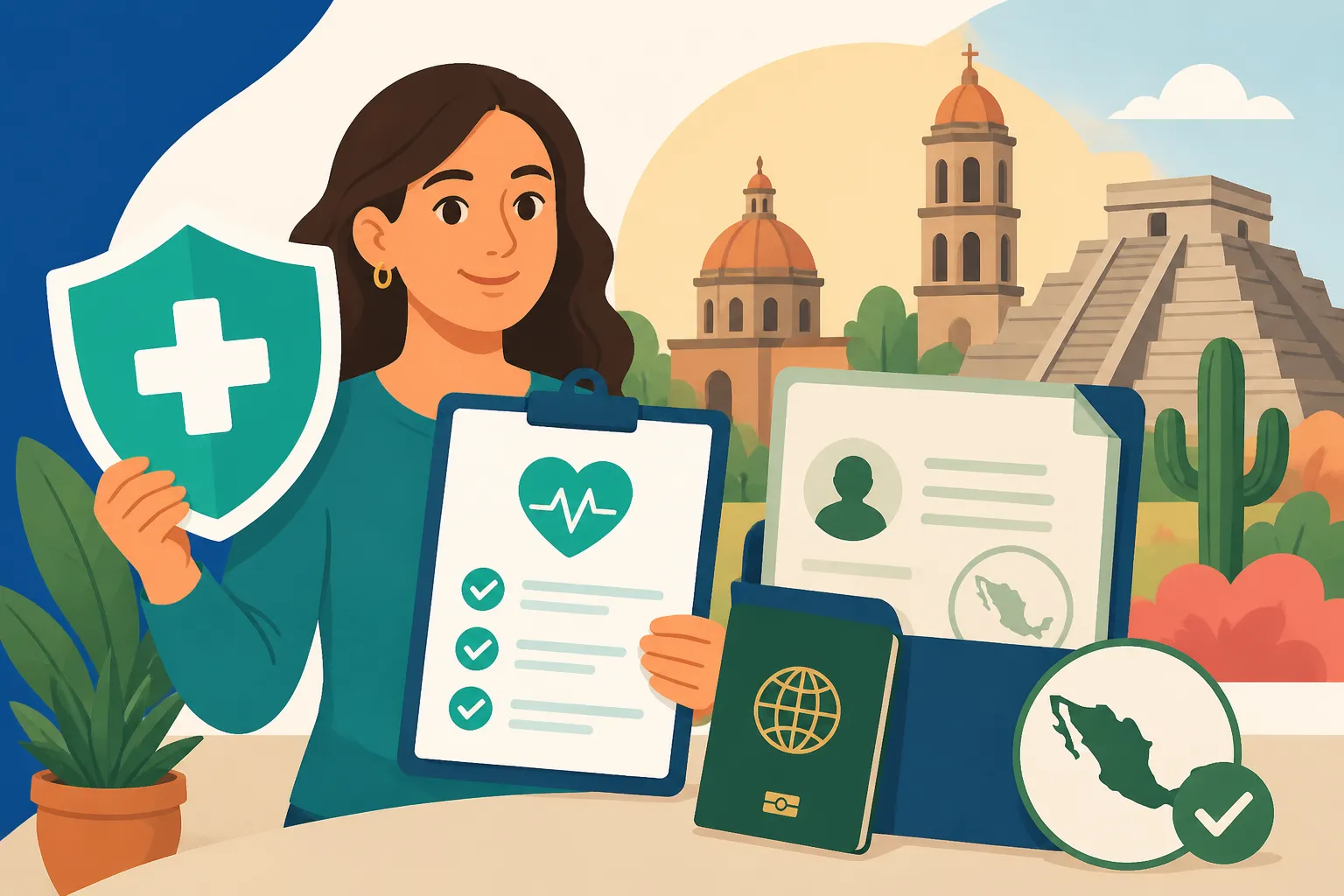
To avoid this, you need to prepare a "Visa Pack" specifically for your health coverage. This should be separate from your financial documents. You are looking to provide a clear bridge between your insurance provider and the laws of Mexico.
The Summary of Benefits Letter
You should contact your provider—whether it's SafetyWing, Cigna Global, or another firm—and ask for a "Letter for Mexican Residency." This letter should be on company letterhead and must include:
- Your full name (matching your passport exactly).
- The policy number and validity dates.
- A statement that the policy provides coverage within the territory of Mexico.
- The maximum limit of coverage (usually, a higher limit is better for residency).
- Confirmation that the plan covers emergency hospitalization and surgery.
If your provider cannot give you this letter, you might have a hard time at the consulate. I always recommend having this letter translated into Spanish by a certified translator. Even if the consulate is in an English-speaking country, the immigration officers in Mexico who eventually receive your file may require it.
Proof of Payment
Believe it or not, showing you have a policy isn't always enough. Some cynical (or perhaps just thorough) officers want to see that the policy is actually active. Bringing a receipt of payment or a bank statement showing the premium being deducted can save you a "return visit" to the consulate. This is especially true for subscription models like SafetyWing, where the officer might want to see that your next month is already accounted for.
If you are a US citizen, you should also be prepared to explain why your domestic coverage is insufficient. Many officers are aware that Medicare does not work abroad, and they will specifically look to see if you have addressed this gap. For more details on this specific hurdle, read our article on Does Medicare Cover You in Mexico? A Guide for U.S. Retirees.
Real-World Scenarios and Troubleshooting
The "ideal" application rarely happens without a hitch. I've heard stories from the expat community in San Miguel de Allende where one person was approved with a simple travel policy, while another at the same consulate was told they needed a $0-deductible international plan. The subjectivity of the process is the most frustrating part of moving to Mexico.
Dealing with Pre-Existing Conditions
If you have a pre-existing condition, getting a policy that satisfies the consulate can be tricky. Some international plans might exclude your condition, which could lead a sharp-eyed officer to question your "solvency" regarding health costs. In this case, Cigna Global is often a good choice because they offer medical underwriting that can sometimes include conditions for an extra premium, providing you with a "clean" certificate for the consulate.
If you cannot find a plan that covers a specific condition, you may need to supplement your application with a letter from your doctor stating that you are stable and have the financial means to cover your own medical costs. This is where your financial solvency proof and your health insurance proof overlap. You can find more advice on this in our guide to Health Insurance in Mexico: How Expats Can Get Coverage (2027).
What to Do if You Are Rejected
If the officer tells you your insurance isn't sufficient, don't panic. Usually, they will give you a list of what they want to see changed. Common requests include "higher coverage limits" or "no deductible." If this happens, you can often call your provider (like SafetyWing or Cigna Global) and upgrade your plan over the phone, get a new letter emailed to you, and return to the consulate the next day.
It is also worth checking if you are applying at the "right" consulate. Some are known for being much more difficult regarding health insurance than others. You might find better luck looking into Consulate vs In-Country: Two Ways to Apply for Mexican Residency to see if a different strategy fits your specific situation.
Maintaining Your Coverage Post-Visa
Getting the visa is just the first step. Once you are in Mexico and have completed your "Canje" to get your residency card, you need to decide if you want to keep your international plan or switch to something else. Many expats choose to eventually enroll in the public system as a backup while keeping a private plan for major issues.
Enrolling in the public system (IMSS) as a foreigner is a process in itself and is generally not used for the initial visa application because it requires you to already have your residency card. However, it is a great long-term strategy for staying healthy. You can find the steps for this in our Public Healthcare in Mexico: IMSS and IMSS Bienestar Explained for Expats guide.
Ultimately, proving health insurance is about peace of mind—both for the Mexican government and for you. Living in a new country is an adventure, but a medical emergency shouldn't be the thing that ends it. By preparing your documentation correctly and choosing a reputable provider, you can walk into that consulate with the confidence that you are fully covered for your new life in Mexico.
Disclaimer
This guide is provided for informational purposes only and does not constitute legal, financial, or medical advice. Immigration requirements for Mexico are subject to frequent changes and may vary significantly between different consulates and port-of-entry offices. Always verify the latest requirements with the official website of the Mexican Secretariat of Foreign Affairs (SRE) or your local Mexican consulate before submitting any applications. The mention of specific insurance providers does not imply a legal guarantee of visa approval.