Are Taxis Safe in Mexico? Using Cabs vs Ride-share Apps
Getting stranded at a chaotic Mexico City bus terminal at 2 AM with three oversized suitcases and a dying phone battery is a special kind of stress that every expat eventually faces. I still remember my first week in Guadalajara, standing on a dark corner and wondering if the beat-up car flashing its lights at me was a legitimate shortcut home or a massive mistake. This guide solves the "transportation anxiety" by providing a deep, realistic look at safety protocols, regional nuances, and the ongoing battle between traditional cabs and ride-share technology.
Disclosure: This post may contain affiliate links. We may earn a commission at no extra cost to you if you make a purchase through these links. Read full disclosure.
The Traditional Taxi System and Safety Realities
Navigating the world of Mexican taxis requires understanding that not all cabs are created equal. The "taxi culture" here is deeply ingrained in daily life, but it comes with a set of unwritten rules that locals know by heart and newcomers often learn the hard way. When you step out of your door in a new city, the sheer number of different colored cars can be overwhelming. The reality is that your safety depends heavily on how you hail the car, rather than just the car itself.
Street Taxis vs Sitio Taxis
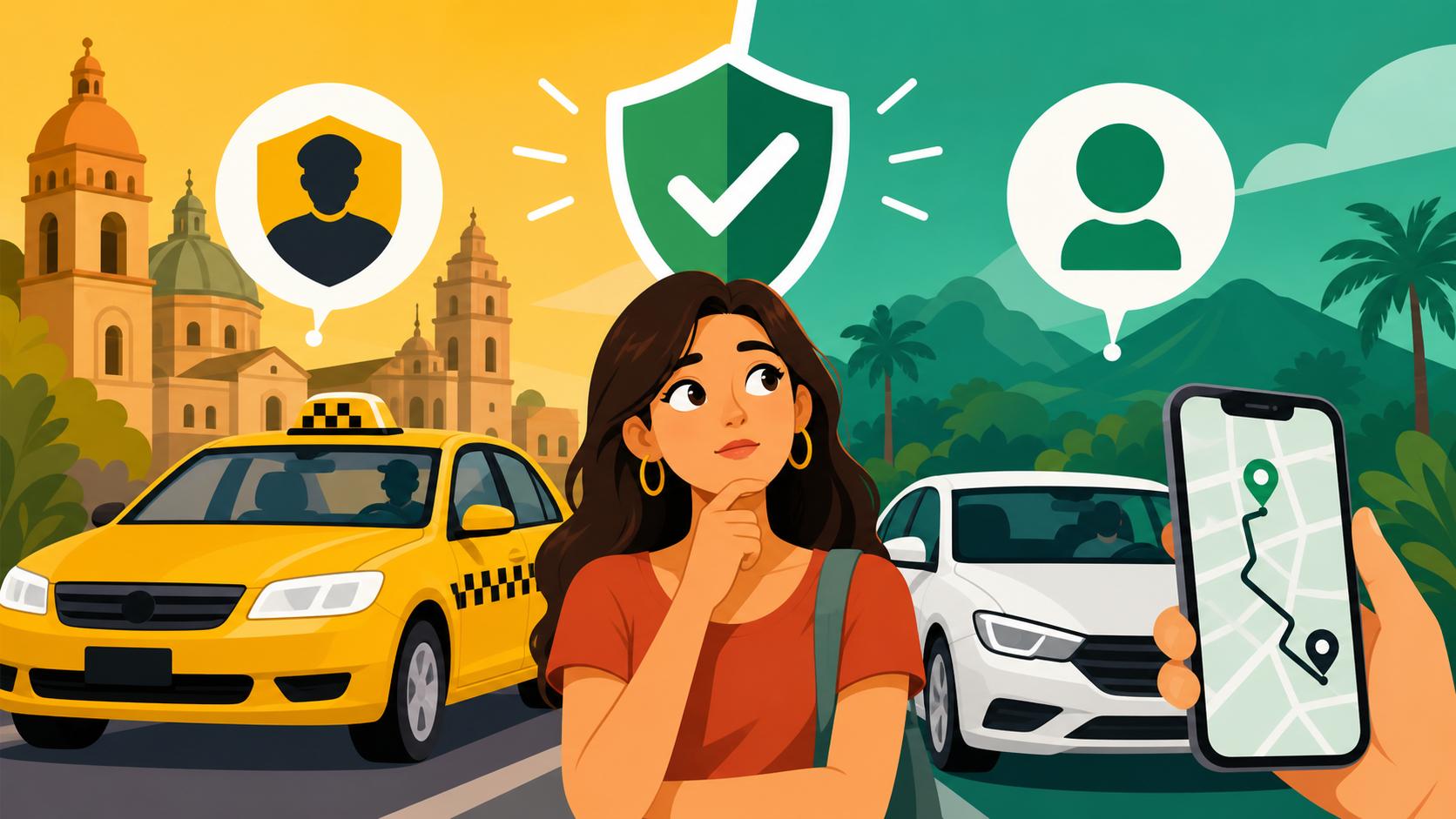
In most major Mexican cities, you will see two primary types of traditional cabs: the "Libre" (street) taxi and the "Sitio" (station) taxi. I’ve learned over the years that the difference between these two is often the difference between a stressful ride and a seamless one. A street taxi is any cab you hail by waving your hand on the sidewalk. While many are perfectly fine, they carry the highest risk for tourists and expats. These are the vehicles most commonly associated with overcharging or, in worse-case scenarios, "secuestro express" (short-term robberies). Because there is no central dispatcher tracking these drivers, there is very little accountability if something goes wrong.
On the other hand, a "Sitio" is a designated taxi stand, often located near malls, hospitals, or major intersections. These drivers belong to a specific union or association and are dispatched from a physical base. When you use a Sitio, the dispatcher often logs the cab number and the destination. If you are staying at a hub like Selina, the front desk usually has a specific Sitio they trust. I always recommend keeping the WhatsApp number of a local Sitio in your contacts. It provides a level of traceability that street hailing simply cannot match. For more on general security, check out Safety in Mexico: What Expats Need to Know About Staying Safe.
Regional Safety Variations
Safety isn't a monolith in Mexico; it changes drastically depending on whether you are in the heart of the capital or a sleepy beach town. In Mexico City, for example, the pink and white taxis are iconic, but even locals are cautious about using them late at night. The city is so massive that tracking rogue drivers is a logistical nightmare. Conversely, in smaller expat havens like San Miguel de Allende or Mérida, the taxi community is tight-knit. Everyone knows everyone, and the risk of a serious safety incident is significantly lower.
However, even in safe cities, the "gringo tax" is a very real thing. Without a meter—or a driver willing to turn it on—you are at the mercy of whatever price the driver decides to quote. This is why many expats living in the capital prefer the structure of apps. If you are curious about life in the big city, my guide on Living in Mexico City: An Expat's Guide to Neighborhoods and Lifestyle goes into more detail about navigating the specific transit quirks of each "colonia."
Identifying Red Flags and Official Markings
Learning to spot a legitimate taxi is a vital skill. Every official taxi in Mexico must have a "tarjetón" (a large identification card) displayed prominently, usually in the front passenger-side window. This card features the driver’s photo, name, and the vehicle’s license plate number. If you get into a cab and that card is missing, obscured, or doesn't match the person behind the wheel, thank them and get out immediately. I have personally stepped out of cabs several times because the driver looked nothing like his ID card; it’s not being rude, it’s being smart.
Another tip is to check the license plates. Official taxis have plates that start with a specific letter or have a unique color scheme (often starting with 'A' or 'B' in Mexico City). If you see a car with private plates acting as a taxi, it is an "unregistered" cab and should be avoided at all costs. To keep your phone ready for photos of plates or GPS tracking, I suggest ordering a high-capacity power bank from Amazon Mexico before you arrive. Nothing makes you more vulnerable than a dead phone in the back of an unknown vehicle.
The Rise of Ride Share Apps for Expats
The introduction of ride-sharing apps has revolutionized life for the international community in Mexico. For many of us, the ability to see a driver’s name, plate number, and the estimated fare before ever opening a car door was a game-changer. It removed the language barrier and the awkwardness of haggling over five pesos in broken Spanish. However, the landscape is more complex than just "Uber is better."
Comparing Uber DiDi and Cabify
Uber was the first to arrive and remains the most popular among expats, but it is no longer the only player. DiDi, a Chinese company, has made massive inroads across Mexico by offering lower prices and aggressive promotions. In many cities, DiDi actually has more drivers on the road than Uber, which means shorter wait times. Cabify is a third option, often marketed as a "premium" service with higher-quality vehicles and more vetted drivers.
I personally keep all three apps on my phone. There are times when Uber has a "surge" price that triples the fare, while DiDi remains at the standard rate. If you are moving here long-term, you should definitely check out the specific guide on Using Uber and Ride-Sharing Apps: A Guide for Expats in Mexico to understand which app dominates your specific city. One critical piece of advice: make sure your phone has a reliable data connection. I always use Airalo to get a local eSIM as soon as I land so I don't have to rely on spotty airport Wi-Fi to book my first ride home.
Why Digital Nomads Favor Apps
For the digital nomad crowd, particularly those staying at Selina locations in places like Oaxaca or Playa del Carmen, apps are the gold standard for one primary reason: the GPS trail. Being able to share your real-time location with a friend or partner via the app provides a massive psychological safety net. Most apps now also have a built-in emergency button that connects you directly to local authorities.
Furthermore, the cashless nature of apps is a huge benefit. You don't have to worry about whether the driver has change for a 500-peso bill—a common "scam" where drivers claim to have no change to force a higher tip. If you’re still getting used to the local money, Tip Culture: How Much to Tip for Services (From Maids to Waiters) will help you navigate when a little extra cash is actually appropriate.
Connectivity Challenges and Solutions
The biggest weakness of ride-share apps in Mexico is the "no signal" trap. If you are in a remote neighborhood or a basement bar, you might not be able to summon a ride. This is where having a backup plan is essential. Some areas have restricted Uber from operating, particularly near airports and certain hotel zones. If you can't get a signal, you are forced back into the world of traditional taxis.
To avoid being stranded, I recommend downloading "offline maps" on Google Maps for your city. Also, ensure your phone is unlocked before you move. You can find more technical help on this in the post Will Your Foreign Phone Work in Mexico? Using SIM Cards and Unlocked Phones. Having a working Airalo data plan is the best way to ensure you can always "see" where your driver is, even if the car's own GPS is lagging.
| Feature | Street Taxi (Libre) | Sitio Taxi | Ride-Share Apps (Uber/DiDi) |
|---|---|---|---|
| Safety Rating | Low | Medium-High | High |
| Price | Negotiable (often higher for expats) | Fixed by Zone | Algorithm-based (Transparent) |
| Accountability | None | Local Dispatcher | Digital Trail & Support |
| Availability | High (Everywhere) | Specific Hubs | High (Major Cities) |
| Language | Spanish Required | Spanish Helpful | Not Required (App handles it) |
| Payment | Cash Only | Cash Only | Credit Card / Digital |
Navigating the Taxi vs App Conflict
If you’ve spent any time reading the news in Mexico, you’ve likely seen reports of friction between taxi unions and ride-share drivers. This isn't just a business rivalry; it’s a deeply political and sometimes physical conflict that can impact your travel plans. Understanding where these "hot zones" are will save you from getting caught in the middle of a protest or a confrontation.
The Situation in Cancún and the Riviera Maya
The most famous example of this conflict is in Quintana Roo. The taxi union in Cancún is incredibly powerful and has fought tooth and nail to keep Uber out of the hotel zone and the airport. For years, there were reports of taxi drivers harassing Uber drivers or even blocking roads. While the legal situation has improved, the tension remains. If you are at a Selina in Cancún, the staff will likely tell you to walk a block or two away from the main taxi stand before calling an Uber to avoid "provoking" the local drivers.
In these tourist corridors, taxis often charge exorbitant rates—sometimes $50 USD for a ten-minute ride. If you are on a budget, this can be infuriating.
Airport Logistics and Restrictions
Federal zones, which include all international airports in Mexico, have strict rules about who can pick up passengers. Generally, only "Authorized Taxis" (expensive, pre-paid vouchers) can pick you up directly at the curb. Uber and DiDi are often forced to pick up passengers outside the airport gates or at a specific "hidden" location.
I’ve spent many hours wandering around the Mexico City airport trying to find the "secret" Uber pickup spot. My advice? If you have a lot of luggage or it's your first time, just pay for the authorized airport taxi. It’s safer and easier. Once you are settled in your apartment, you can switch to apps for your daily commute. If you ever find yourself in a medical bind during these transits, Emergency Numbers in Mexico: How to Call Police, Fire, or Ambulance is a page you should have bookmarked.
How to De-escalate and Stay Neutral
As an expat, the best policy is to stay neutral. Never get involved in an argument between a taxi driver and an app driver. If a taxi driver approaches you while you are waiting for an Uber, simply say, "Mi amigo viene por mí" (My friend is coming for me). This usually ends the conversation without conflict.
Also, it’s a common courtesy in Mexico to sit in the front seat of an Uber if you are in a "sensitive" area. This makes it look like you are just a friend of the driver rather than a paying customer, which helps the driver avoid harassment from taxi syndicates. It’s a small gesture that goes a long way in keeping everyone safe.
Essential Safety Protocols for Every Journey
Regardless of whether you choose a taxi or an app, there are certain "veteran expat" habits you should adopt to ensure every journey ends safely at your front door. These are the things I do every single time, whether I’m in a sleepy village or the middle of Monterrey.
Sharing Your Ride Status
The single most important thing you can do is share your trip. In Uber and DiDi, there is a "Share My Trip" button. I send my link to my spouse or a close friend every time I get in a car after dark. If you are using a Sitio taxi, take a photo of the license plate and the driver’s ID and send it to someone. If the driver asks why you are taking a photo, just smile and say, "Safety protocol for my family." A legitimate driver will never have an issue with this.
I also recommend staying off your phone for the first few minutes of the ride. Watch the route. Does it match the GPS? I’ve had drivers try to take "shortcuts" that were actually just ways to run up the meter or take me into unfamiliar territory. If you have your own data through Airalo, you can follow along on your own map to ensure they aren't taking the long way. If you are driving yourself, you might find the tips in Is It Safe to Drive at Night in Mexico? Road Safety Tips for Expats useful for understanding the general road risks.
The "No Cash" Rule and Emergency Prep
Whenever possible, avoid showing large amounts of cash. If you must use a taxi, have small bills ready. If a ride costs 85 pesos, don't pull out a 500-peso bill. This marks you as a high-value target. I always keep a "decoy" wallet with a few hundred pesos and some expired cards, just in case. You can find high-quality slim wallets and hidden money belts on Amazon Mexico that are perfect for expat life.
Also, trust your gut. If you open the door and the car smells like alcohol, the driver is acting erratic, or the interior is falling apart, do not get in. It is always better to wait another ten minutes for a different car than to spend thirty minutes in an unsafe situation. If you do ever run into trouble, having a good insurance policy is vital; read Healthcare in Mexico: Complete Guide for Expats (Public vs Private) to understand your coverage options.
Language and Communication Tips
You don't need to be fluent in Spanish to use transport, but a few key phrases go a long way. Knowing how to say "Siga el GPS, por favor" (Follow the GPS, please) or "Aquí está bien" (Here is fine) can prevent a lot of confusion. Most drivers are hardworking people trying to earn a living, and showing a little bit of effort in their language usually results in better service.
If you are using an app, the chat feature usually has an auto-translate function, which is a lifesaver. But remember, the driver is driving! Don't expect them to read long paragraphs of instructions while navigating Mexican traffic. Keep it simple: "Estoy en la esquina" (I am on the corner). For more on managing your first month in the country, my guide Settling in Mexico: Step-by-Step Guide to Your First 30 Days as an Expat covers the basics of getting your phone and transport set up.
Disclaimer
This article is for informational purposes only. While I have lived in Mexico for many years and share these tips based on personal experience and current 2026 data, safety conditions can change rapidly. Always follow local advice, stay aware of your surroundings, and consult official embassy travel advisories for the most up-to-date security information. Use of third-party apps and services is at your own risk.