What to Do If You’re Pulled Over by Police in Mexico
Seeing those flashing red and blue lights in your rearview mirror while driving through a Mexican coastal town or a busy city boulevard is enough to make any expat’s heart skip a beat. I remember my first time being pulled over in Playa del Carmen; my hands were shaking so hard I could barely find my registration, and I was terrified of doing the wrong thing. This guide provides a clear, step-by-step protocol for navigating a traffic stop in Mexico so you can stay calm, protect your rights, and handle the situation like a seasoned local.
Disclosure: This post may contain affiliate links. We may earn a commission at no extra cost to you if you make a purchase through these links. Read full disclosure.
Understanding the Different Types of Police in Mexico
The first thing you’ll notice when Living in Mexico: Cultural and Practical Guide for New Expats is that "the police" aren't a single entity. Depending on where you are—a highway, a residential neighborhood, or a tourist zone—the officer at your window could belong to one of several different branches. Knowing who is pulling you over is the first step in understanding the jurisdiction and the likely reason for the stop.
Policia de Transito (Traffic Police)
These are the officers you will encounter most frequently. They are typically responsible for enforcing local traffic laws, such as speeding, illegal turns, or expired plates. In many cities, their uniforms are distinct from the regular municipal police, often featuring neon vests or white hats. Their primary tool is the "infracción" (traffic ticket). It is important to note that in places like Mexico City, only specifically authorized transit officers are allowed to issue tickets; others may stop you but must call a transit officer to process the fine.
Policia Municipal and Estatal (Municipal and State Police)
The Municipal Police handle local crime and order, while the State Police (Policia Estatal) have a broader reach within the state borders. While their primary focus isn't always traffic, they can and will pull you over if they suspect a crime or if you are committing a blatant safety violation. If you are stopped by them, the tone is often more formal. You might encounter them frequently if you are staying at a Digital Nomad Life in Mexico: Remote Work Living Guide hub like Selina, as these locations are often in central areas with a high police presence.
Guardia Nacional (National Guard)
The Guardia Nacional replaced the old Federal Police and is now responsible for federal highways and "zones of federal jurisdiction." If you are driving between cities or on the "cuota" (toll) roads, these are the officers who will monitor your speed. They are heavily armed and often travel in large pickup trucks. A stop by the Guardia Nacional is a serious matter and requires the utmost respect and cooperation.
The Immediate Protocol: What to Do When You See the Lights
When those lights go on, your immediate actions set the tone for the entire interaction. Mexican police officers, like those anywhere else, are looking for signs of cooperation or "actitud" (attitude). Being proactive and calm can often turn a potential ticket into a simple warning.
Finding a Safe Place to Pull Over
As soon as you see the signal, use your turn indicator to show you’ve seen them. Slow down gradually and find a well-lit, public area if possible. In Mexico, it is generally acceptable to drive a short distance to a safe spot, such as a gas station or a busy storefront, as long as you are clearly signaling your intent to stop. If you are in a remote area, pull as far off the shoulder as possible to avoid traffic.
The First Sixty Seconds of the Interaction
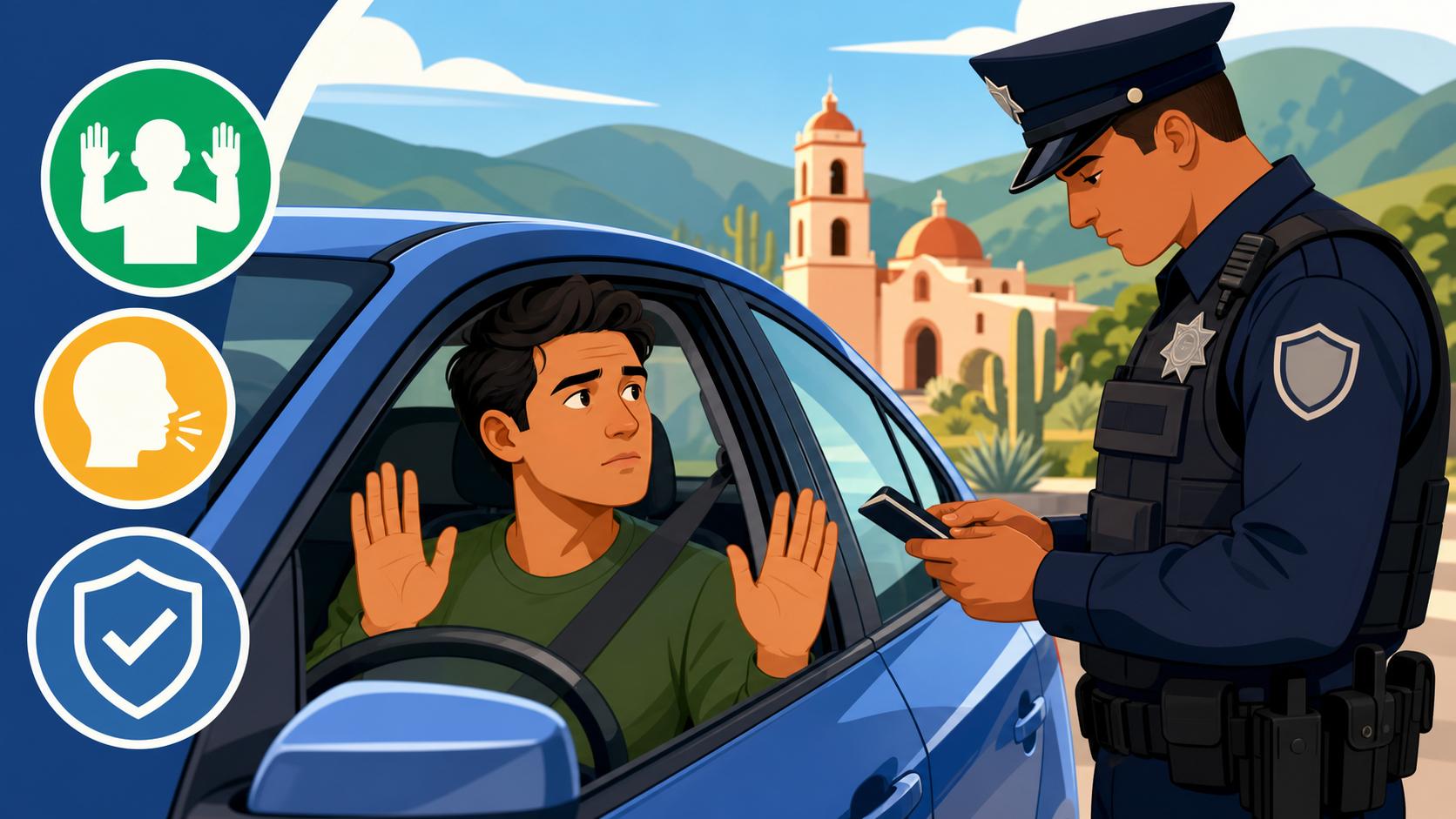
Once stopped, turn off your engine and roll down your window—all the way, not just a crack. Keep your hands on the steering wheel where they are visible. If it is night, turn on your interior dome light. Wait for the officer to approach you; never get out of the vehicle unless specifically instructed to do so. In Mexico, getting out of the car unprompted is often viewed as an aggressive or suspicious move.
Communication and Language Barriers
If your Spanish is limited, don't panic. Many officers in tourist-heavy areas like Puerto Vallarta or Cancún speak a bit of English. However, even a small effort in Spanish goes a long way. Phrases like "Buenas tardes, oficial" (Good afternoon, officer) and "Dígame, ¿cuál es el problema?" (Tell me, what is the problem?) show respect. If you find yourself struggling to communicate, having a reliable data plan from Airalo allows you to quickly use translation apps or look up specific legal terms on the fly.
The Documentation Phase: What You Must Carry
When the officer asks for your "papeles" (papers), they are looking for three specific items. Failure to produce any of these is an automatic valid reason for a fine and, in some cases, having your vehicle towed or your license plate confiscated.
Driver’s License and Residency Status
You must have a valid driver’s license. Most states in Mexico allow you to drive with a valid foreign license as long as your immigration status is legal. However, if you have residency, many states eventually require you to obtain a local Mexican license. Always carry your residency card (Temporary or Permanent) alongside your license. If you are still in the process of moving, ensure your foreign documents are up to date and easily accessible.
Vehicle Registration and Insurance
The "tarjeta de circulación" (registration card) is a small plastic card or paper that must stay in the car. The officer will check this against your plates. Equally important is your proof of insurance. Foreign insurance policies are generally not recognized for civil liability in Mexico. You must have a Mexican policy. For more on this, see Car Insurance in Mexico: Understanding Coverage and Costs. I personally keep all these documents in a bright yellow folder in the glove box so I’m not fumbling around when under pressure.
The Use of Dashcams and Technology
In recent years, many expats have started using dashcams to record interactions. This is legal in Mexico and can be a huge help if you encounter a "mordida" (bribe) attempt. You can easily find high-quality dashcams on Amazon Mexico that are shipped locally. Just be discreet; pointing a camera directly in an officer's face can escalate the situation. Having a camera visible on the dashboard is often enough of a deterrent for unethical behavior.
| Document Type | Spanish Name | Why It's Required |
|---|---|---|
| Driver's License | Licencia de Conducir | Proves you are qualified to operate the vehicle. |
| Registration Card | Tarjeta de Circulación | Links the vehicle to the owner and proves it's legal. |
| Proof of Insurance | Póliza de Seguro | Required by law for civil liability coverage. |
| Residency Card | Tarjeta de Residencia | Proves your legal stay in the country (if applicable). |
Dealing with the Mordida (The Bribe)
We have to talk about the elephant in the room: the "mordida" or "little bite." While the Mexican government has made significant strides in reducing corruption, you may still encounter an officer who suggests an "informal" way to settle the matter on the spot.
Identifying a Shakedown
A common tactic is for an officer to tell you that the fine is very expensive (e.g., $5,000 pesos) and that they will have to take your license to the station, which is far away and closed until Monday. They might then wait for you to offer a "solution." This is a classic setup designed to make you feel that paying a smaller amount in cash is the easier option. They may use phrases like "¿Cómo podemos arreglar esto?" (How can we fix this?) or "Para el refresco" (For a soda).
How to Say No Firmly but Politely
The best way to handle this is to insist on the official ticket. Say, "Deme la infracción, por favor" (Give me the ticket, please). Tell them you prefer to pay at the "comandancia" (police station) so you can get a receipt. Often, when an officer realizes you know the law and aren't afraid of the official process, they will simply let you off with a warning because writing the actual paperwork is time-consuming and doesn't benefit them personally.
Your Rights Regarding Property
In many Mexican states, it is legal for an officer to remove your license plate or keep your driver's license as "garantía" (collateral) for a traffic fine. This sounds terrifying to foreigners, but it is standard practice. You get your items back when you pay the fine at the municipal office. Never hand over your actual passport unless you are being detained for a serious crime; a photocopy or a digital version on your phone is usually sufficient for a traffic stop.
How to Legally Pay a Traffic Fine
If you do receive an official ticket, the process for paying it is actually quite straightforward, and there is a significant incentive to do it quickly. Understanding this can help you stay within the bounds of Safety in Mexico: What Expats Need to Know About Staying Safe.
The Early Payment Discount
Most municipalities in Mexico offer a 50% discount if you pay your fine within the first five to fifteen days. This is why a "huge" fine often ends up being quite affordable—sometimes as little as $400 or $800 pesos ($20-$40 USD) for minor infractions. This discount is designed to encourage people to use the official system rather than paying bribes.
Where to Pay
You usually pay traffic fines at the "Tesorería" (Treasury) or the "Juzgado Cívico" (Civic Court). In larger cities, you can sometimes pay at a local OXXO convenience store or online using the folio number on your ticket. If the officer took your license plate or driver's license, you must go to the specific office listed on the back of the ticket to pay and retrieve your property. Be sure to check Driving Restrictions (Hoy No Circula) in Mexico City: What Expats Need to Know if you are in the capital, as violations there involve different impound lots.
Practical Tips for Avoiding Traffic Stops
The best way to handle a police stop is to not get pulled over in the first place. Many expats are targeted not because of their nationality, but because of common vehicle "red flags" that signal a lack of local knowledge.
Vehicle Maintenance and Compliance
Make sure all your lights (headlights, tail lights, and brake lights) are working. A burnt-out bulb is the #1 excuse for a "visual inspection" stop. Also, be very careful with window tint. Many states have strict laws about how dark your front windows can be. If you bought a car with dark tint, consider having it removed or lightened. If you are frequently moving between cities and staying at Selina locations, your car is your lifeline—keep it in top shape to avoid being a target.
Driving Habits and Common Triggers
Avoid using your cell phone while driving; this is a major focus for traffic police now. Always wear your seatbelt, and ensure your passengers do too. Be particularly mindful of "Alto" (Stop) signs. In Mexico, you are expected to come to a complete, 3-second stop. A "rolling stop" is a favorite for officers waiting at corners. Also, keep your plates clean and visible. If you have foreign plates, ensure your Tip (Temporary Import Permit) is valid and displayed on your windshield if required.
What to Do in an Escalated Situation
Rarely, a stop can become tense or the officer may act inappropriately. In these moments, your smartphone is your best tool.
Recording the Interaction
If you feel you are being harassed or if an officer is demanding a bribe aggressively, you have the right to record the interaction. In Mexico City, the "Sugerencias y Denuncias" (Suggestions and Complaints) line or the "Mi Policia" app allows you to report badge numbers in real-time. If you have a reliable data connection, you can even stream the interaction to a friend.
Seeking Assistance
If you are being detained or if the situation feels unsafe, ask to speak to a supervisor ("Quiero hablar con su jefe/comandante"). You can also call the "Angeles Verdes" (Green Angels) at 078 if you are on a highway and believe the stop is fraudulent. They are a government-funded roadside assistance group that often helps tourists and expats navigate issues with authorities.
Summary Checklist for a Traffic Stop
- Stay inside the vehicle with your hands visible on the wheel.
- Be polite and use basic Spanish greetings.
- Provide your documents (License, Registration, Insurance) when asked.
- Request the official ticket if a bribe is suggested.
- Check for the early payment discount at the local treasury office.
- Report any misconduct via official municipal apps or hotlines.
Disclaimer
This guide is for informational purposes only and does not constitute legal advice. Laws and police protocols in Mexico vary significantly by state and municipality. While we strive to provide accurate and up-to-date information for 2026, always consult with a qualified Mexican attorney or your local consulate for specific legal concerns. Driving in a foreign country carries inherent risks; please prioritize your personal safety and comply with all local regulations.