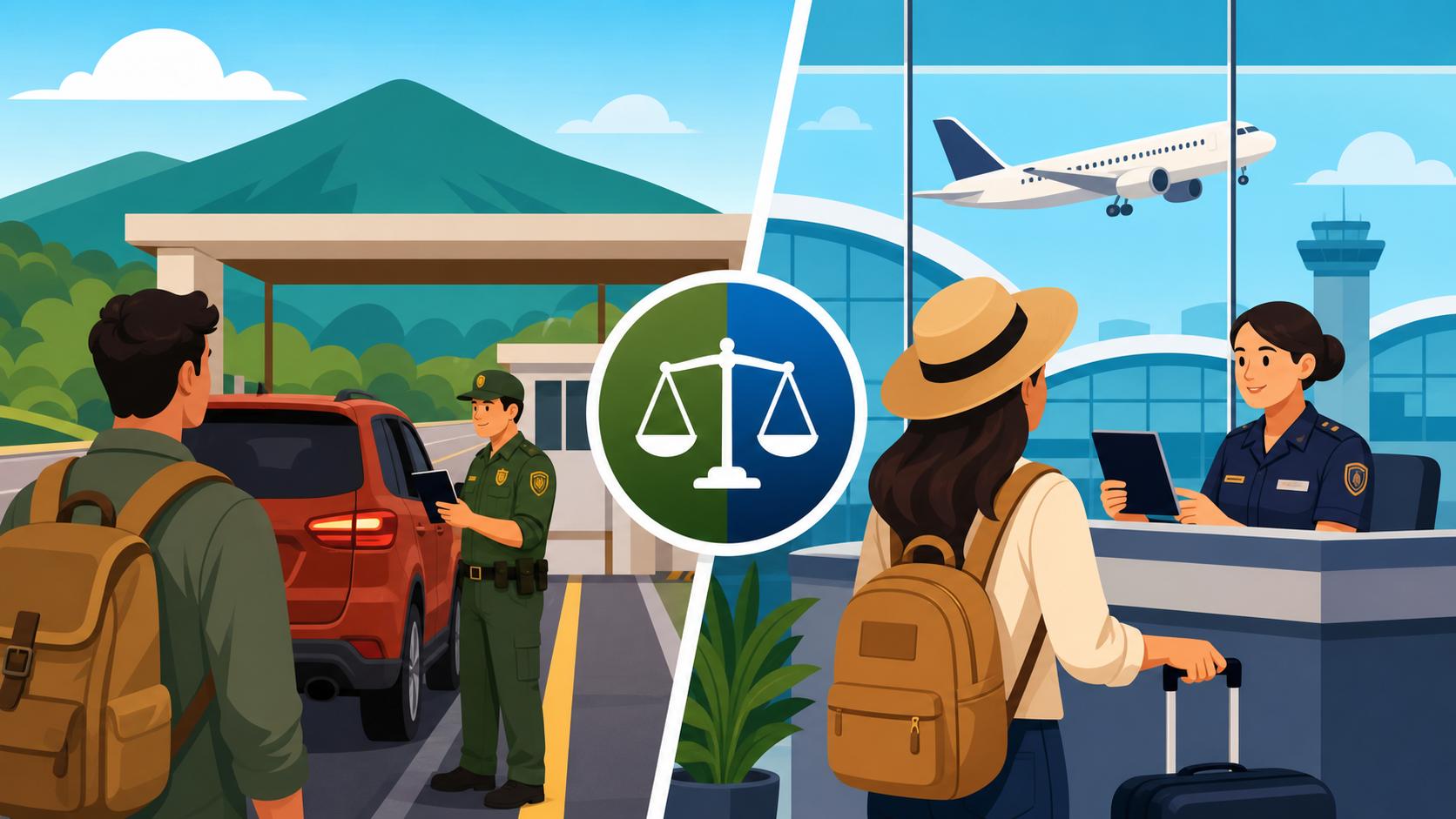
Crossing into Mexico by Land vs Air: How Entry Procedures Differ for Expats
Entering Mexico can feel like a straightforward formality until you find yourself staring at a confused immigration officer who just gave you seven days on your permit instead of 180. I remember the panic of my first land crossing at Nuevo Laredo, realizing I had forgotten to print my bank statements and had no way to prove my solvency to the skeptical agent behind the glass. This guide clarifies exactly how entry procedures differ between land and air to help you avoid these stressful administrative traps.
Disclosure: This post may contain affiliate links. We may earn a commission at no extra cost to you if you make a purchase through these links. Read full disclosure.
Navigating the Air Arrival Experience: Speed vs. Scrutiny
Flying into Mexico is generally the preferred route for most expats, primarily because it feels more like a standardized international transit experience. If you are arriving at major hubs like Benito Juárez International (AICM) in Mexico City, Cancún International (CUN), or Guadalajara (GDL), you are stepping into a system that has been heavily modernized over the last few years. The goal here is efficiency, but that doesn't mean you should let your guard down regarding your paperwork.
The Shift to Digital Immigration Records
For years, the paper Forma Migratoria Múltiple (FMM) was the bane of every expat's existence. You had to fill it out on the plane, keep the tiny stub safe for months, and pay a fine if you lost it. Today, major airports have largely phased out the paper FMM in favor of a digital system. When you land, the immigration officer (INM) simply scans your passport and stamps it. In many cases, they will write the number of days you are allowed to stay directly on the stamp.
It is vital to check this number before walking away. I’ve seen fellow expats assume they were getting 180 days, only to find out the officer gave them 30 because they didn't have a return flight booked. If you are coming for a long-term stay, have your Mexico Tourist Card (FMM) Explained: Entry Requirements for 2026 details ready to show the officer why you need the full six months. If you are entering to finalize a residency visa, you must ensure the officer marks your entry as "Canje" (exchange) and not as a tourist, otherwise, you may have to leave the country and start over.
Customs and the Random Inspection System
Once you clear immigration and grab your bags, you face the SAT (Tax Administration Service) or Aduana. Mexico uses a "Semaforo" (traffic light) system. You press a button, and if the light is green, you walk through. If it’s red, your bags are searched. While this feels like a game of chance, the rules for what you can bring are strict. Electronics are a common sticking point; bringing two laptops can sometimes trigger an import tax if the officer deems one to be for resale.
For those moving significant personal items or professional equipment, having a Duty-Free Import of Household Goods: Using Menaje de Casa with Your Visa can save you thousands of dollars in duties. At the airport, space is limited, so you are unlikely to be carrying a full household of furniture, but items like high-end cameras or specialized tools might require documentation. I always recommend having a digital folder with your How to Translate Documents for Your Mexican Visa Application (Certified Translations) ready, especially if you used a service like RushTranslate to ensure your invoices and inventory lists are legally recognized in Spanish.
Ground Transportation and Immediate Needs
Exiting a Mexican airport can be a sensory overload. From the "official" taxi stands to the surge pricing of Uber, the transition to your new home starts the moment you step outside. It is worth noting that in many airports like Cancún, Uber is still in a legal grey area, and taking one might involve walking to a specific zone outside the airport perimeter. If you are feeling overwhelmed, remember that Staying Healthy in Mexico: Essential Tips for Food, Water, and Preventive Care starts with that first bottle of water you buy at the terminal—never drink the tap water in the airport bathrooms.
The Land Border Reality: Permits, Pedestrians, and Paperwork
Crossing the border by land—whether at San Ysidro, Nogales, or El Paso/Juarez—is a fundamentally different beast. Unlike the airport, where the "entry fee" is usually baked into your ticket price, the land border requires you to be proactive about every single step. If you just drive across the "nothing to declare" lane without stopping at the INM office, you are technically in the country illegally.
The Mandatory Stop at Banjercito
If you are driving a foreign-plated vehicle, the most important acronym in your life is TIP (Temporary Import Permit). You cannot get this at an airport. You must stop at a Banjercito office, usually located just past the initial customs check at the border. You will need to pay a deposit (often between $200 and $400 USD depending on the year of the vehicle) which is refunded when you take the car out of Mexico.
The paperwork required here is extensive. You need your passport, your residency visa (if applicable), and the vehicle title. If your documents are not in Spanish, some border agents may be sticklers and demand a professional translation. This is where having Requirements for Renewing Temporary Residency After Four Years (2026 Rules) knowledge is helpful, as your TIP is usually tied to the expiration date of your residency. If your car isn't properly documented, it could be confiscated at a highway checkpoint further south.
Immigration Scrutiny for Pedestrians and Drivers
When you walk or drive across, you must find the INM office to get your passport stamped. Unlike the high-volume flow of airports, land border agents often have more time to ask questions. They might ask where exactly you are staying, what you do for a living, and how much money you have. I always carry a printed folder with my Health Insurance in Mexico: How Expats Can Get Coverage (2027) details, such as a policy from Cigna Global, to show I won't be a burden on the public healthcare system if something goes wrong.
Land crossings also mean you are responsible for paying the DNR (Derecho de No Residente) fee yourself if you are staying longer than seven days. This is roughly $700 MXN. At the airport, this is hidden in your airfare. At the border, you often have to go to a nearby bank, pay the fee, and bring the receipt back to the officer. It is a tedious "tramite" that catches many newcomers off guard. Make sure you understand Mexico Immigration Terminology 101: FMM, CURP, RFC and Other Essentials before you reach the front of the line.
Bringing Pets and Household Goods by Land
Many expats choose the land route specifically because they are moving with pets or a "Menaje de Casa." While the rules for pets have relaxed—U.S. and Canadian pets generally don't need a formal health certificate anymore—you still have to go through a SENASICA inspection. The inspector will look for ticks, sores, or signs of illness.
If you are hauling a trailer full of your life's belongings, the Aduana process is much more involved than at an airport. You will be diverted to a commercial or "heavy" inspection lane. This is where your Customs Tips for New Residents: What You Can Bring When Moving to Mexico guide becomes your bible. If your inventory isn't meticulously organized, the officers may unpack every single box on the side of the road. It is a grueling process that requires patience, a bit of Spanish, and ideally, a pre-stamped inventory from a Mexican consulate.
Comparing the Costs and Practicalities
To help you decide which route is best for your specific situation, I've put together a comparison of the typical experiences you'll face.
| Feature | Air Entry (AICM / CUN / GDL) | Land Entry (Laredo / Nogales / Tijuana) |
|---|---|---|
| Entry Fee (DNR) | Included in the airline ticket. | Paid out-of-pocket at a bank or INM office. |
| FMM Format | Almost exclusively digital/scanned. | Often still requires a paper form or online pre-print. |
| Vehicle Import | Not applicable. | Requires TIP and a refundable deposit. |
| Customs Check | Random red/green light system. | Usually a mandatory inspection for loaded vehicles. |
| Scrutiny Level | Low to moderate; focused on return flights. | Moderate to high; focused on financial solvency. |
| Pet Inspection | Fast-tracked at the airport terminal. | Requires a stop at the SENASICA booth. |
| Documentation | Passport and flight info are usually enough. | Title, registration, and printed bank statements are key. |
Strategic Advice for a Smooth Transition
If you are moving to Mexico to start a new life, the "best" way to enter depends entirely on what you are bringing with you. For digital nomads with nothing but a backpack and a laptop, flying is a no-brainer. It is faster, the Healthcare in Mexico City: Top Hospitals and Clinics for Expats are nearby if you land feeling ill, and you avoid the "Wild West" feel of some border towns.
However, if you are a retiree settling in Lake Chapala or San Miguel de Allende, you likely want your own car. In this case, the land entry is a rite of passage. My advice is to never cross at night. Border cities can be complicated to navigate after dark, and the Banjercito offices often have limited hours. Aim to cross at 8:00 AM so you have the entire day to clear customs, get your TIP, and drive at least four or five hours away from the border zone into the safer interior.
Regardless of your entry point, having a solid plan for your first 48 hours is essential. You’ll want to ensure your Staying Healthy in Mexico: Essential Tips for Food, Water, and Preventive Care is a priority, especially as your body adjusts to new microbes. Additionally, ensure you have international health coverage like Cigna Global active the moment you cross, as travel insurance often has gaps when you transition into "resident" status.
If you are entering on a pre-approved residency visa from a consulate, the land border can be trickier. Some smaller crossings might not be as familiar with the "Canje" process as the officers at the Mexico City airport. If the officer looks confused by your visa sticker, politely insist that they process you as a resident-to-be. Use your Surviving the INM Office: Tips for a Smooth Visa Processing Day strategies: stay calm, be polite, and have all your originals and copies organized in a clear folder.
Final Thoughts on the Journey
The difference between land and air entry isn't just about the mode of transport; it’s about the level of responsibility you take for your own legal status. Flying offers a safety net of standardized procedures, while driving requires you to be your own immigration lawyer and customs broker. I have done both, and while I love the convenience of a three-hour flight, there is something deeply rewarding about the "Great Mexican Road Trip" that starts at the border.
Whichever you choose, make sure you have your Mexico's Visa and Residency Options fully researched so you aren't guessing at the window. Mexico is a beautiful, welcoming country, but its bureaucracy rewards the prepared and punishes the "we'll just figure it out when we get there" crowd. Take the time to get your How to Get a CURP as a Foreigner: The Mexican ID Number Explained information ready for after you arrive, and your transition will be much more about the tacos and less about the paperwork.
Disclaimer
This guide is provided for informational purposes only and does not constitute legal, financial, or immigration advice. Mexican immigration laws and border procedures are subject to frequent changes. Always verify current requirements with the official website of the Instituto Nacional de Migración (INM) or your nearest Mexican consulate before traveling.