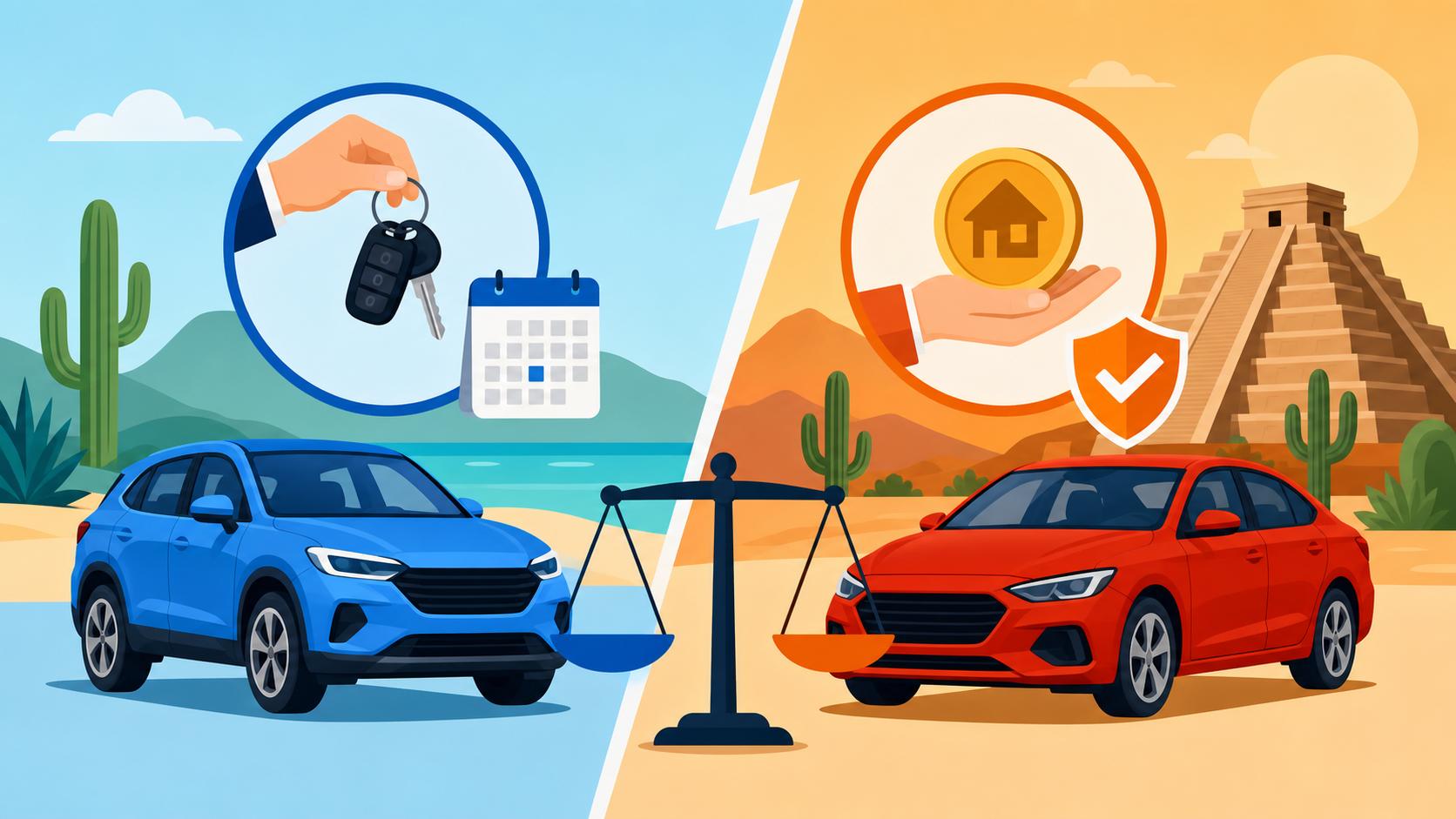
Long-Term Car Rental vs Buying: Which Is More Cost-Effective in Mexico?
Picture this: you’ve just signed a year-long lease in Mérida or Guadalajara. Every agency quote for a monthly car rental makes your stomach drop, and buying a used car feels like a bureaucratic maze in a language you’re still learning. This guide compares long-term rental and ownership in Mexico, cost by cost and scenario by scenario, so you can pick the option that suits your stay.
Disclosure: This post may contain affiliate links. We may earn a commission at no extra cost to you if you make a purchase through these links. Read full disclosure.
What Long-Term Car Rental in Mexico Really Looks Like
The first time I tried to rent a car for more than a few weeks in Mexico, I assumed I’d get a big discount for committing. I got a modest one, along with a contract several pages longer than I expected and a credit card hold that tied up a good chunk of my available limit for the whole period. Before you can compare renting with buying, you need to know what “long-term rental” means here. It covers several different products.
Monthly Rentals From Agencies Versus Formal Leasing
Most expats who say they “rent long-term” use a monthly rental from a standard agency, often at an airport location in Cancún, Mexico City, or Puerto Vallarta. You get a weekly or monthly rate that drops as the rental gets longer, but you’re still a rental customer. The car may have to come back for servicing, you may be swapped into a different vehicle, and the price can change at renewal, especially in high season.
The second product is formal leasing, called arrendamiento. It’s aimed mainly at businesses and Mexican residents with a credit history and an RFC. Leasing contracts usually run for years rather than months. They often require proof of income, and some end with an option to buy the car. A newly arrived expat on a tourist permit will usually find these closed off. A temporary or permanent resident with Mexican banking history may qualify.
The third product sits in between: local independent rental outfits and subscription-style services in bigger cities. They advertise all-in monthly pricing. Some are excellent. Others are a few cars and a WhatsApp number. Read the contract line by line and confirm what happens if the car breaks down on a highway between towns.
What Is Bundled Into the Rental Price and What Is Not
The headline monthly rate rarely matches what you pay. Mexican law requires third-party liability cover for vehicles on the road, and rental agencies sell this cover separately from the low rate you see on international booking sites. Collision and theft cover come on top, usually with a deductible, and the counter staff will offer upgrades to reduce that deductible. If you have ever felt ambushed at a Mexican rental desk, you’re not alone. Our walkthrough on How to Rent a Car in Mexico Without Overpaying for Insurance explains which coverages are mandatory and which are optional extras.
What rental does include is real value: routine maintenance, tyres when they wear out, registration, and in most cases roadside help. You never deal with the state vehicle registry, you never queue for an emissions check, and you never pay the annual state fees. For someone who doesn’t want to learn a new bureaucracy, that matters a lot.
What it usually excludes: mileage over any agreed cap, cleaning fees, tolls, fuel, traffic fines, and damage the agency classes as negligence, such as underbody damage from a tope (speed bump) taken too fast. Ask about mileage policy directly. Some long-term deals are unlimited, and others are not.
Who Long-Term Rental Actually Suits
Rental tends to suit people with a defined, short window. That includes snowbirds wintering on the Pacific coast, remote workers testing a city before signing a longer lease, and anyone waiting on residency paperwork. It also suits people who need a car for part of the year only. One couple I know in Lake Chapala rents for the two or three months each year when their grandchildren visit and goes car-free the rest of the time. For the broader question of whether you need wheels at all, see Do You Need a Car in Mexico? Pros and Cons of Living Car-Free.
The True Cost of Buying and Owning a Car in Mexico
Buying looks cheaper on paper because you pay once and the car is yours. Ownership in Mexico, though, comes with recurring costs that many newcomers underestimate. Paperwork adds friction too, especially for foreigners.
Buying New, Seminuevo, or Privately
You have three main paths. New cars from dealerships come with warranties and clean paperwork, but they lose value fastest in the first years. Seminuevos are certified pre-owned cars from dealers or larger used-car platforms. They cost more than private sales but usually come with verified documents and some kind of guarantee. Private sales, through Facebook Marketplace, expat groups, or neighbours, can be the cheapest. They also carry the most risk.
The danger in a private sale is the paperwork. Check that the factura, the original invoice, is in the seller’s name or properly endorsed through each previous owner. Confirm the car isn’t reported stolen in the public vehicle registry, REPUVE. Confirm there are no unpaid fines or outstanding state fees, because those can follow the vehicle. I once walked away from a lovely Jetta in Querétaro because the seller had a photocopy of the factura and a “cousin who has the original.” Trust that instinct.
Payment is its own hurdle. Many sellers want a bank transfer in pesos, and dealers may want proof of where the money came from on larger amounts. If your savings sit in dollars, euros, or pounds abroad, a service like Wise can convert and deliver pesos to a Mexican CLABE. That is often cheaper than a traditional international wire. Compare the quote on the day, though, because exchange spreads move. If you were hoping to finance instead, read Can Foreigners Get a Car Loan in Mexico? before you assume a dealer loan is an option.
Registration, Plates, and Who Can Own a Car
Registering a car in your name with Mexican plates generally means showing official ID and proof of address. Many state transit offices expect a residency card rather than a tourist permit. Requirements differ by state and sometimes by office, so call ahead or visit with a Mexican friend who knows the routine. Some foreigners on tourist status register a car through a Mexican partner or trusted friend. Be aware that legally, the car then belongs to that person.
Foreign-plated cars are a separate world, governed by temporary import permits and residency rules. If you are weighing driving your own car down from the US or Canada, start with Bringing Your Car vs Buying in Mexico: Pros and Cons for Expats. If you are considering legalising a foreign car permanently, see Importing a Car to Mexico: Permits, Nationalisation, and Whether It’s Worth It.
You’ll also need a valid licence. A foreign licence works for visitors in many situations. Residents often find a Mexican licence simpler for insurance, traffic stops, and peace of mind, and Exchanging a Foreign Driver’s License for a Mexican License explains how that process works.
Tenencia, Refrendo, Verificación, and Other Recurring Costs
Once the car is yours, the state starts sending bills. Tenencia is an annual state tax on owning a motor vehicle. Its amount is usually linked to the car’s value and age. It is not universal: several states have abolished it, and others waive or subsidise it if you meet conditions such as paying your other vehicle fees on time or owning a car below a value threshold. The rules depend entirely on the state where the car is registered, so check your state finance office’s page before you budget.
Separate from tenencia, most states charge an annual registration or control fee, often called refrendo or control vehicular. It is due early in the year, and late payment brings surcharges. In Mexico City and the State of Mexico you also deal with verificación, the periodic mandatory emissions test. Your result is tied to Hoy No Circula, the programme that restricts which days certain cars may drive. Newer, cleaner cars get more freedom. Older ones can be barred from driving on set days. If you live in or near the capital, read Driving Restrictions (Hoy No Circula) in Mexico City: What Expats Need to Know before you buy an older car. A bargain sedan that can’t leave the garage one day a week is not a bargain.
Insurance is the other big recurring item. Liability cover is the legal minimum. Comprehensive cover, called amplia, adds theft and collision, and most owners in cities want it. Premiums depend heavily on the car model, your postcode, and your driving history. Some models are notorious theft targets, and insurers price that in. For a fuller breakdown, see Car Insurance in Mexico: Understanding Coverage and Costs. The practical steps of getting a policy are in How to Get Car Insurance in Mexico.
Then add maintenance, tyres, fuel, parking (a pensión, or monthly parking lot, is common in city centres without garages), tolls, and the occasional repair. Mechanics are generally affordable. Parts for some imported brands can take time to arrive, and some models are much easier to service in smaller towns than others.
Depreciation, Resale, and the Exit Problem
One cost hides until you leave: selling the car. Used cars in Mexico often hold their value reasonably well, particularly popular models like the Nissan Versa or Volkswagen Vento, because the used market is active and new cars are relatively expensive locally. That works in your favour. What works against you is timing. If you have to sell in a hurry because your flight home is in two weeks, buyers sense it. Our guide on Selling Your Car or Furniture When Leaving Mexico: Getting a Good Deal covers how to avoid the fire-sale discount.
Opportunity cost matters too. Money tied up in a car isn’t sitting in savings or investments. Some long-stay expats keep the cash they would have spent on a car in an investment account and rent instead. Interactive Brokers is one platform foreigners in Mexico commonly mention for this, though whether it suits you depends on your residency and tax situation. Others buy outright to protect against currency swings and rental price rises. Neither choice is automatically right.
Long-Term Rental vs Buying: Side-by-Side Comparison
The comparison below avoids specific prices on purpose. Rates differ hugely between Cancún in high season and Monterrey in a quiet month, and they change over time. Focus on who pays for what, and how predictable each cost is.
| Factor | Long-Term Rental | Buying and Owning |
|---|---|---|
| Upfront cash | Low, plus a credit card hold for the deposit | High, the full purchase price or a down payment |
| Monthly cost predictability | Fairly predictable, but rates can rise at renewal or in high season | Lumpy, with annual state fees, insurance renewal and surprise repairs |
| Mandatory liability insurance | Bought from the agency, often the biggest add-on | Bought by you, shopped around between insurers |
| Tenencia and refrendo | Paid by the agency, built into the rate | Paid by you, rules depend on the registration state |
| Emissions verificación | Handled by the agency | Your responsibility where it applies |
| Maintenance and tyres | Usually included | Fully your cost |
| Paperwork for foreigners | Passport, licence, and credit card | ID, proof of address, often residency, factura checks |
| Flexibility | High, return or swap the car | Low, selling takes time and effort |
| Resale value | None, you never own anything | Can recover a meaningful share of what you paid |
| Crossing into the US | Often prohibited by rental contracts | Possible with the right plates, papers, and insurance |
| Best fit | Stays of a few months, trial periods, seasonal residents | Multi-year residents with residency and a stable address |
Scenario One: The Six-Month Snowbird in Puerto Vallarta
Linda arrives every November and leaves every April. Buying would mean storing the car through the rainy months, keeping insurance and state fees current while she isn’t driving, and trusting someone to start it now and then. Renting means paying high-season rates, which hurts, but nothing happens when she’s gone. For her, renting nearly always wins, unless she commits to the town for many years and has a reliable person to look after the car.
Scenario Two: The Remote Worker on a Two-Year Plan in Querétaro
Marco has temporary residency, a Mexican bank account, and a lease. He drives daily, with weekend trips to San Miguel de Allende and the Sierra Gorda. Over two years, the rental insurance add-ons alone would add up fast. A reliable seminuevo, insured independently and sold when he leaves, would almost certainly cost him less in total. That’s especially true if he buys a popular model that resells easily. For him, buying usually wins, provided he budgets for the annual state fees and an exit sale.
Scenario Three: The Family Still Waiting on Residency
The Okafors just landed in Mexico City with two kids and a residency appointment months away. They can’t easily register a car, they don’t know which colonia they’ll settle in, and Hoy No Circula complicates things in the capital. A short rental commitment of one to three months buys them time to learn the city and finish their paperwork. After that they can decide whether owning a car, using ride-hailing, or a mix of both suits them. Renting as a bridge, then deciding, is often the smartest option for families in transition.
How to Decide Which Option Is More Cost-Effective for You
The honest answer is that cost-effectiveness depends on four things: how long you’ll stay, your immigration status, how much you’ll drive, and how much hassle you’re willing to absorb. Work through these steps with real quotes in hand rather than guesses.
A Step-by-Step Cost Comparison You Can Do in an Afternoon
- Define your realistic timeline. Don’t say “maybe forever.” Decide on a firm minimum, such as six months, one year, or three years.
- Get at least three written long-term rental quotes. Include the mandatory liability cover, collision and theft cover, and any deductible-reduction options you would actually choose. Ask each agency about mileage caps and renewal pricing.
- Pick two or three specific used models you’d consider buying. Look up typical asking prices for them in your city on local listing sites.
- Request insurance quotes for those exact models at your postcode from more than one insurer or broker.
- Check your state finance office’s page to see whether tenencia applies, how much refrendo costs, and whether verificación is required where you live.
- Estimate maintenance, tyres, parking, and a contingency fund for repairs. Older cars need a bigger cushion.
- Estimate the resale value at the end of your timeline. Ask a local mechanic or dealer which models hold their value in your area.
- Add up the total cost of ownership: purchase price plus all recurring costs, minus the estimated resale value. Compare that figure with the total rental cost over the same period.
- Factor in non-financial costs, such as time spent on paperwork, stress, and the risk of a difficult sale when you leave.
- Make the decision, and set a calendar reminder to revisit it if your plans change.
Red Flags and Common Mistakes to Avoid
The biggest mistake I see is comparing a rental’s online headline rate with a car’s sticker price. Both numbers mislead. The rental leaves out compulsory insurance, and the sticker price leaves out years of state fees, insurance, and upkeep. Compare full totals only.
The second mistake is buying a car you can’t legally register in your own name, then discovering you can’t insure it properly or sell it cleanly. If you’re on a tourist permit, find out what your local transit office actually requires before you hand over any money.
The third mistake is ignoring road realities. If you’ll be driving long distances between cities, tolls are a real budget item. Toll roads are also generally safer and faster than free roads. Our guide on Driving in Mexico: Toll Roads (Cuotas) vs Free Roads (Libres) explains the trade-offs. Rural driving also means more wear on tyres and suspension, which affects both rental damage disputes and ownership repair costs.
Finally, don’t underestimate the hidden extras of daily life. Parking, car washes, tips for the attendants who guard cars in parking lots, and the occasional fine all add up quietly, as Hidden Costs of Living in Mexico: Expenses Expats Often Overlook makes clear.
The Bottom Line From Someone Who Has Done Both
I rented for my first four months in Mexico, and it was the right call. I didn’t know my neighbourhood, my Spanish was shaky, and I had no residency card yet. Once I settled, got my paperwork in order, and knew I’d be staying for years, buying a modest, popular used car saved me money and gave me freedom. When I eventually sold it, I recovered a decent portion of what I paid.
If you’re staying for less than about a year, or you aren’t sure, rent first. If you have residency, a stable address, and a multi-year horizon, buying is usually cheaper overall. Choose a car that’s easy to insure, easy to service, and easy to resell, and keep a running budget for the costs that arrive once a year.
Disclaimer
This article is for general informational purposes only and does not constitute professional advice. Laws, prices and regulations vary by location and change over time. Consult a qualified professional for guidance on your specific situation.