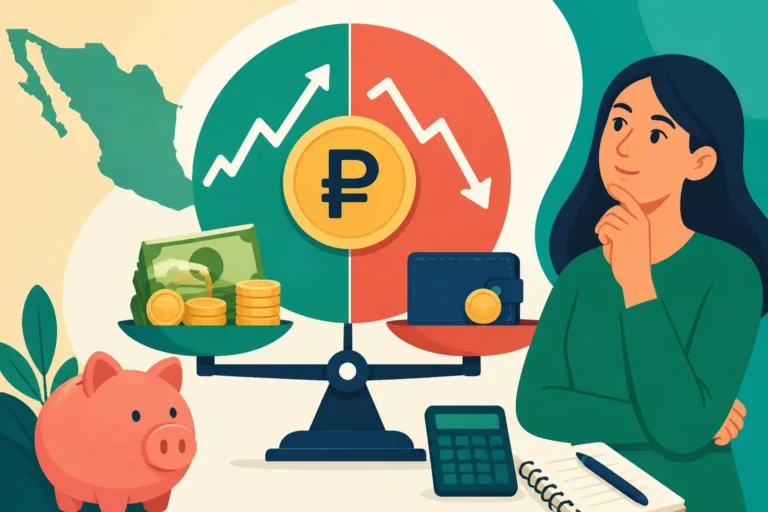
Are Mexican Banks Safe? Understanding Deposit Insurance IPAB
Staring at a wire transfer screen with my finger hovering over the mouse, I was absolutely terrified to send my life savings to an unfamiliar Mexican account. Will I ever see this money again? I’ve felt that exact paralyzing anxiety. This guide breaks down exactly how safe Mexican banks are and explains how government deposit insurance protects your hard-earned cash.
Disclosure: This post may contain affiliate links. We may earn a commission at no extra cost to you if you make a purchase through these links. Read full disclosure.
The Reality of the Mexican Banking System
The Ghost of the Peso Crisis
When you first announce to your family back home that you are moving your entire financial life south of the border, someone will inevitably bring up the 1994 peso crisis. They will recount absolute horror stories of local people losing everything overnight, runaway inflation, and banks abruptly shuttering their doors with no warning. It is completely natural to feel a deep sense of trepidation when considering placing your capital into a foreign system that carries a historically volatile reputation. I remember having that exact same knot in my stomach during my first month navigating the local infrastructure.
However, the reality of modern Mexican banking is radically different from the wild west days of the 1990s. That devastating historical collapse forced the Mexican government to radically overhaul its oversight mechanisms, resulting in a complete restructuring of their banking laws. The resulting regulatory environment is arguably stricter in its capitalization and liquidity requirements than many Western nations today. The National Banking and Securities Commission now enforces rigorous stress tests to ensure institutions can survive sudden economic shocks without ever risking depositor funds.
For expats who have just navigated the grueling bureaucracy to secure their Mexico Temporary Resident Visa: Comprehensive Guide for Expats 2026 Update and are looking to integrate safely into the local economy, this stringent oversight is a massive comfort. It means that your daily operational funds are held in highly resilient, closely monitored institutions. The days of widespread, unregulated commercial bank failures in Mexico are effectively over, replaced by a highly digitized, rigorously audited financial ecosystem that holds its own on the global stage.
Commercial Banks Versus Microfinance
When analyzing the absolute safety of your deposits, you must strictly differentiate between systemic commercial banks and smaller microfinance institutions. The Mexican financial landscape is dominated by a handful of massive, multinational banking conglomerates. Institutions like BBVA, Santander, Banorte, Citibanamex, and Scotiabank hold the vast majority of the nation’s deposits. These banks are considered functionally too big to fail by the government and operate with massive capital buffers. If you open a checking account at one of these giants, your money is functionally as secure as it would be in a major US or European tier-one bank.
Conversely, Mexico also features smaller financial cooperatives known as SOFIPOs. These alternative institutions have become incredibly popular in expat circles because they frequently offer staggering interest rates on savings accounts, sometimes exceeding 15 percent annually. It is very easy to get greedy when you are trying to stretch your Cost of Living in Mexico: 2026 Comprehensive Guide budget, but you must profoundly understand the underlying risk.
SOFIPOs carry significantly higher operational risk and operate under an entirely different, much lower tier of government deposit insurance. While a major bank covers you up to hundreds of thousands of dollars, a SOFIPO only guarantees your deposits up to a fraction of that amount. Before you blindly chase high yields to fund your coastal retirement or supplement your Digital Nomad Life in Mexico: Remote Work Living Guide lifestyle, you must strictly evaluate whether the institution holding your cash is a fully licensed commercial bank or a smaller cooperative with limited legal protection.
How IPAB Deposit Insurance Protects Your Money
Decoding the UDI Limit
In the United States, bank deposits are protected by the FDIC. In Mexico, the equivalent government safety net is the Instituto para la Proteccion del Ahorro Bancario, universally referred to as IPAB. IPAB is a decentralized agency of the federal government designed specifically to guarantee bank deposits and resolve failing banks without triggering a systemic financial panic.
If a fully licensed commercial bank in Mexico goes bankrupt, IPAB automatically steps in to reimburse the depositors. This insurance is completely free and automatic. You do not need to fill out forms, pay hidden premiums, or explicitly sign up for it when you open your checking or savings account. Understanding this implicit protection is a core pillar of navigating your new life, as outlined deeply in our broader Banking in Mexico: Complete Guide for Foreigners.
However, the most confusing aspect of Mexican deposit insurance for foreigners is how the coverage limit is actually calculated. IPAB does not insure a flat peso amount like the FDIC does with dollars. Instead, it insures up to 400,000 UDIs per person, per banking institution.
A UDI is an investment unit created by the central bank that is directly pegged to domestic inflation. Because the UDI value rises daily to match the national inflation rate, your IPAB coverage limit actually grows over time, protecting your purchasing power from currency devaluation. In 2026, 400,000 UDIs translates to approximately 3.5 million Mexican Pesos. Depending on the daily exchange rate, this roughly equates to between $175,000 and $185,000 USD of absolute, government-backed protection.
Strategic Account Diversification
If you are moving to Mexico and bringing a substantial amount of liquid cash—perhaps from selling a home back north or cashing out a business—you must be highly strategic about where you park that capital. Because the IPAB guarantee applies per person, per bank, you can easily multiply your federal protection simply by diversifying your accounts across different institutions.
For example, if you hold 3 million pesos in a BBVA checking account and another 3 million pesos in a Santander savings account, both balances are one hundred percent insured by the federal government. If you exceed the 400,000 UDI limit within a single institution, any amount over that limit is technically uninsured and at risk during a catastrophic bank failure.
Furthermore, because the insurance is applied strictly per person, married expat couples opening a joint account at a commercial bank effectively double their protection to 800,000 UDIs on that specific account. For expats navigating the complex local real estate market to secure a home, keeping your massive down payment secure is paramount. This strategy gives you absolute peace of mind when executing the massive transactions discussed in Renting a Home in Mexico: Complete Expat Guide to Leases, Deposits, and More. Never hold all your liquid net worth in a single Mexican banking institution if it exceeds the federal threshold.
| Protection Feature | United States FDIC | Mexican IPAB |
|---|---|---|
| Protecting Government Agency | Federal Deposit Insurance Corporation | Instituto para la Proteccion del Ahorro Bancario |
| Maximum Coverage Limit | $250,000 USD | 400,000 UDIs |
| Approximate 2026 Value | $250,000 USD | ~$175,000 to $185,000 USD |
| Insured Account Types | Checking, Savings, CDs | Checking, Savings, Payroll, Term Deposits |
| Limit Applied Per Bank | Yes | Yes |
Managing Your Expat Finances Across Borders
Bridging the Gap for Daily Expenses
Even with robust IPAB protection and highly capitalized commercial banks, seasoned expats rarely keep their entire net worth in a local Mexican bank account. The most intelligent, stress-free financial strategy is to maintain a localized checking account strictly for day-to-day operational expenses, such as groceries, dining, and utility bills, while keeping the bulk of your capital safely tucked away in your home country.
To bridge this geographic gap efficiently without bleeding money on wire fees, you need a low-friction transfer mechanism. Relying on legacy banks to wire money across the border exposes you to terrible exchange rates and exorbitant hidden fees that quietly erode your wealth. Instead, savvy expats use Wise to move capital precisely when they need it. When you need to clear your monthly rent or pay local contractors, you can log into Wise and send the exact peso amount directly into your landlord’s Mexican CLABE account.
Wise guarantees the mid-market exchange rate, saving you hundreds of dollars a month compared to a traditional bank wire. By executing smaller, targeted transfers through Wise, you completely eliminate the need to hoard massive, potentially uninsured cash balances in a foreign country. Integrating Wise into your monthly routine seamlessly solves the immense friction detailed in How Do Expats Typically Pay Rent in Mexico? Cash vs Bank Transfers, allowing you to operate locally like a native without over-committing your assets to the local system. Using Wise keeps your finances agile, predictable, and fundamentally secure.
Securing Your Investment Portfolios
While IPAB brilliantly protects your liquid cash deposits in commercial banks, it does absolutely nothing to protect stock market investments, mutual funds, ETFs, or retirement portfolios. Moving your heavy investment capital into the Mexican brokerage system often subjects you to highly complex local taxation and regulatory hurdles, compounding the administrative stress outlined heavily in Taxes in Mexico for Expats: A Complete Guide to Income Tax and More.
Many new expats panic when they enthusiastically update their residential address to Mexico, only to find that their traditional US brokerages instantly freeze their accounts due to strict international compliance laws. You are suddenly locked out of trading just because you moved. To maintain absolute security over your nest egg while living abroad, you should utilize an expat-friendly, globally accessible brokerage. Leaving your core investments in Interactive Brokers ensures your capital remains anchored under strict global financial regulations, far outside the Mexican banking system.
I rely heavily on Interactive Brokers to manage my long-term wealth because it legally accepts Mexican residential addresses without restricting your trading abilities or freezing your hard-earned assets. It provides a bulletproof financial perimeter, ensuring my retirement funds are secure regardless of any localized economic turbulence in Latin America. Furthermore, because Interactive Brokers allows you to hold and trade multiple global currencies in a single unified account, you entirely avoid forced currency conversion penalties when drawing down your portfolio. Managing your wealth with a borderless platform like Interactive Brokers perfectly complements the flexible lifestyle you moved here for, allowing you to travel and live with absolute confidence. Combining the daily agility of Wise with the long-term stability of Interactive Brokers creates the ultimate financial architecture, fully aligning with the peace of mind we prioritize in Safety in Mexico: What Expats Need to Know About Staying Safe.
References
Primary sources (official)
- Instituto para la Proteccion al Ahorro Bancario: The official federal agency portal detailing the list of insured commercial banks, the scope of coverage, and the exact UDI limits for depositors. https://www.gob.mx/ipab
- Banco de Mexico: The central bank of Mexico where expats can verify the daily published value of the UDI to calculate their exact real-time deposit insurance limits in pesos. https://www.banxico.org.mx/
Other helpful sources
- S&P Global Ratings on Mexican Financial Institutions: Official credit rating analysis affirming the stability of Mexican banks, their robust capitalization, and the overall resilience of the Mexican banking sector in recent years. https://www.spglobal.com/ratings/en/regulatory/article/-/view/type/HTML/id/3561957
Disclaimer
The information provided in this article is for educational and informational purposes only and does not constitute official financial, legal, or investment advice. Mexican banking laws, regulatory frameworks, and IPAB deposit insurance coverage limits are strictly enforced and subject to structural changes by the federal government. Furthermore, alternative financial institutions such as SOFIPOs carry significantly lower government protection limits and inherently higher risk profiles than fully licensed commercial banks. Always conduct extensive due diligence and consult with a licensed cross-border financial advisor or fiduciary before transferring large sums of capital internationally, opening foreign bank accounts, or making binding investment decisions while living abroad.