Can You Buy Antibiotics Without a Prescription in Mexico?
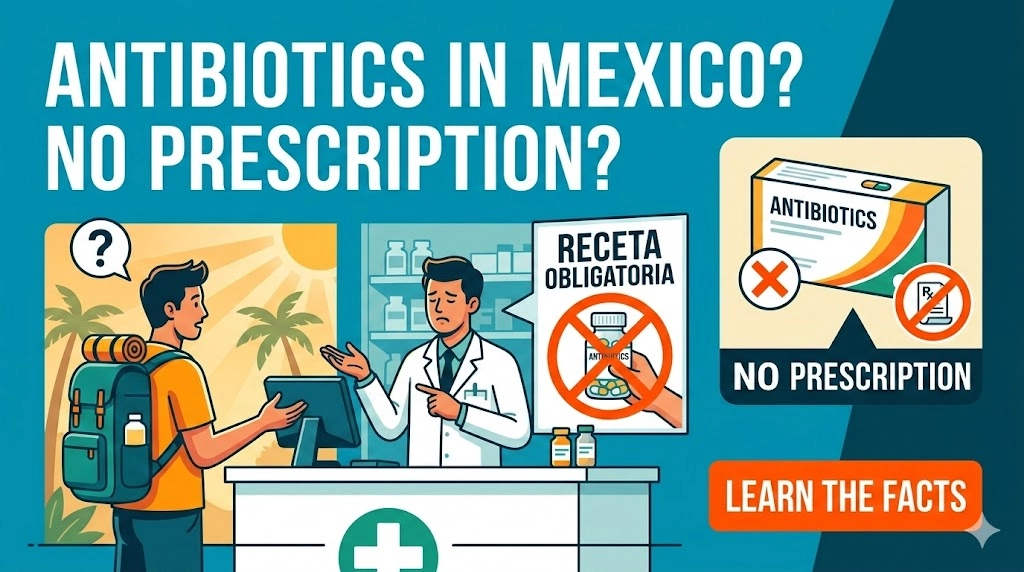
If you are wondering whether you can purchase antibiotics over the counter in Mexico, the strict legal answer is no. Since 2010, Mexican pharmacies require a valid doctor’s prescription for all oral and injectable antibiotics to combat widespread antibiotic resistance.
Disclosure: This post may contain affiliate links. We may earn a commission at no extra cost to you if you make a purchase through these links. Read full disclosure.
The Legal Reality of Buying Antibiotics in Mexico
The 2010 Antibiotic Law and Health Regulations
For many decades, Mexico was known as a destination where both locals and tourists could walk into any pharmacy and purchase powerful antibiotics over the counter without a doctor’s intervention. This practice led to a deeply ingrained culture of self-medication. However, during the 2009 H1N1 influenza pandemic, the Mexican Ministry of Health identified that rampant self-medication with antibiotics—which are entirely ineffective against viral infections like the flu—was leading to delayed medical diagnoses and severe complications. Consequently, in August 2010, the Mexican government strictly enforced a new federal law prohibiting the sale of systemic antibiotics without a prescription.
Today, COFEPRIS (the Federal Commission for the Protection against Sanitary Risk) heavily regulates the distribution of these medications. When you hand a prescription for an antibiotic to a pharmacist in Mexico, they are legally required to retain the prescription (or stamp and log it if it includes multiple refills) and record the prescribing doctor’s professional registration number (cédula profesional). Pharmacies face massive fines and the potential loss of their business licenses if they are caught selling these drugs without proper authorization.
This regulatory shift aligns Mexico with global health standards aimed at preventing antimicrobial resistance (AMR). For expats and tourists, this means you must entirely abandon the outdated assumption that you can easily self-treat a severe sinus infection or strep throat just by chatting with a pharmacy clerk. Understanding these federal regulations is a core component of navigating Healthcare in Mexico: Complete Guide for Expats (Public vs Private).
Exceptions to the Rule
While the 2010 legislation cast a wide net over systemic antibiotics—meaning those taken orally via pills or liquids, as well as injectable antibiotics—there are a few nuanced exceptions that expats should understand. The law primarily targets medications that affect the entire body. Therefore, certain localized, topical antibiotics are often exempt from the prescription requirement.
For instance, if you suffer a minor scrape or insect bite and need an over-the-counter triple antibiotic ointment (similar to Neosporin in the United States or Canada), you can generally purchase this at a Mexican pharmacy without seeing a doctor. Similarly, some specific antibiotic eye drops for mild conjunctivitis, antibiotic ear drops, and certain vaginal antibiotic suppositories may be available over the counter, depending on the exact formulation and the specific pharmacy’s internal policies.
However, if your condition requires Amoxicillin, Ciprofloxacin, Azithromycin, or any other oral antibiotic, there is no legal loophole. You must consult a licensed medical professional. If you are unsure whether the medication you need falls under the restricted list, you can refer to our detailed breakdown on Pharmacies in Mexico: How to Get Medications (OTC vs Prescription) to better understand what is freely accessible on the shelves versus what is strictly guarded behind the pharmacy counter.
How to Get an Antibiotic Prescription Quickly
Utilizing Pharmacy Clinics
Because the 2010 law drastically changed how Mexicans accessed basic healthcare, the private market quickly adapted by introducing “Consultorios Adyacentes a Farmacias” (CAF), which translates to clinics adjacent to pharmacies. Today, almost every major pharmacy chain in Mexico—such as Farmacias Similares, Farmacias del Ahorro, and Farmacias Benavides—has a small, walk-in medical clinic attached to the building. These pharmacy clinics are the absolute fastest and most cost-effective way to obtain a prescription for a minor, straightforward illness. You simply walk in, put your name on a clipboard, and wait your turn to see a general practitioner. The consultation fee is astonishingly low, typically ranging from 45 to 80 Mexican Pesos (roughly $2.50 to $4.50 USD). The doctor will perform a basic physical exam, diagnose your issue, and if an antibiotic is medically necessary, they will write you a prescription on the spot. You can then walk next door into the pharmacy to purchase the medication.
While these clinics are incredibly convenient for common ailments like Traveler’s Diarrhea (Montezuma’s Revenge): Prevention and Treatment, it is important to note that the doctors working in these consultorios rarely speak English. If your Spanish is limited, bringing a bilingual friend or using a translation app on your smartphone is highly recommended. For more complex health issues, these walk-in clinics are not suitable, and you should seek out more specialized care.
Telemedicine and Virtual Consultations
In recent years, especially following the global push toward digital healthcare, telemedicine has become a highly popular alternative for tourists and digital nomads in Mexico. If you are feeling too unwell to leave your hotel room or apartment, several online platforms connect you with licensed Mexican doctors via video chat. Services like Doctorsa and other local telehealth apps allow you to consult with a physician in English. After discussing your symptoms—such as a persistent fever, ear pain, or a urinary tract infection—the doctor can issue an electronic prescription (e-Rx) directly to your smartphone. You can then take this digital prescription to a local pharmacy, or in many major cities, have the medication delivered directly to your door through delivery apps like Rappi.
Telemedicine consultations are generally more expensive than pharmacy walk-in clinics, often costing between $20 and $40 USD, but they offer the massive advantage of English-language support and immediate convenience. When paying for digital medical services or arranging delivery, using a borderless financial tool like Wise ensures that your international debit card won’t be blocked for foreign transactions, allowing you to pay for your healthcare seamlessly.
Visiting Private Hospitals and English-Speaking Doctors
If your symptoms are severe, or if you have underlying health conditions that require careful monitoring, skipping the pharmacy clinic and visiting a private hospital or an established private practice is the safest route. Mexico boasts world-class private healthcare facilities, particularly in expat hubs like Mexico City, Guadalajara, Puerto Vallarta, and Mérida.
At a private hospital, you can easily arrange an appointment with a specialist or visit the emergency room for urgent care. The standard of care is exceptional, and the likelihood of finding a fully bilingual doctor is very high. You can review our specific tips on Finding English-Speaking Doctors and Specialists in Mexico to locate reputable providers in your area. A consultation with a private specialist will typically cost between $40 and $80 USD.
For expats who hold comprehensive global health coverage through providers like Cigna Global, visiting a top-tier private hospital ensures that you receive the highest standard of diagnostic testing before an antibiotic is prescribed. Utilizing a premium policy like Cigna Global gives you access to a vast network of vetted, English-speaking professionals, taking the stress out of navigating a foreign medical system when you are feeling vulnerable.
| Care Option | Typical Cost (Consultation) | English Spoken? | Best For | Wait Time |
| Pharmacy Clinic (CAF) | $2.50 – $4.50 USD | Rarely | Minor infections, simple prescriptions | 10 – 45 minutes (Walk-in) |
| Telemedicine App | $20 – $40 USD | Often (Depends on service) | Convenience, minor ailments, refills | 10 – 30 minutes (Virtual) |
| Private Doctor / Clinic | $40 – $80 USD | Very Likely | Complex issues, chronic conditions | Scheduled appointment |
| Hotel Doctor (House Call) | $100 – $150+ USD | Usually | Tourists unable to leave their room | 1 – 2 hours |
Navigating Mexican Pharmacies and Medication Costs
Identifying Reliable Pharmacy Chains
Once you have your prescription in hand, you need to know where to fill it. Mexico has a vast landscape of pharmacies ranging from massive national chains to small, independent neighborhood apothecaries. Expats should generally stick to the large, reputable corporate chains such as Farmacias del Ahorro, Farmacias Guadalajara, Farmacias San Pablo, and Farmacias Benavides. These large retailers have strict quality control measures, ensuring that the antibiotics you purchase are properly stored, unexpired, and authentic.
When you purchase your medication, you will often be asked if you prefer the “patente” (name-brand) or the “genérico” (generic) version. Generic antibiotics in Mexico are highly regulated by the government and are required to prove bioequivalence to their name-brand counterparts. Opting for the generic version can save you up to 80% on the cost of the medication without sacrificing any efficacy.
It is also worth noting that many large grocery store chains, such as Walmart, Chedraui, and H-E-B, have massive in-house pharmacies. These are excellent options for expats, as you can pick up your prescription while doing your weekly shopping. For a deeper dive into managing your health budget, check out our guide on Healthcare Costs in Mexico: Doctor Visits, Hospital Stays, and Surgery Expenses.
Managing Out-of-Pocket Expenses and Insurance
One of the pleasant surprises for expats in Mexico is the sheer affordability of medications. Even without insurance, a full course of a generic antibiotic like Amoxicillin or Ciprofloxacin will rarely cost more than $10 to $15 USD. Because the out-of-pocket costs for basic medications are so low, most expats do not bother submitting pharmacy receipts to their insurance companies for minor illnesses.
However, if your bacterial infection leads to a more serious complication requiring intravenous antibiotics or a brief hospital stay, the financial dynamic changes immediately. In these scenarios, having a robust international health plan like Cigna Global is crucial to protect your savings from unexpected hospitalization fees.
Furthermore, Mexican private hospitals universally require upfront deposits for emergency admissions. Having an agile financial setup is vital. Keeping emergency funds in an international account like Wise allows you to instantly convert your home currency to Mexican Pesos at the mid-market rate and pay hospital or pharmacy bills using a reliable physical card, avoiding exorbitant bank fees and currency markups.
Preventing Illness and Bringing Medications from Home
Rules for Crossing the Border with Prescriptions
If you are currently taking a prescribed antibiotic from your home country and plan to travel to Mexico, you must follow specific customs regulations. You are legally allowed to bring personal medications into Mexico, but the quantity must match the duration of your stay, and the medication must remain in its original, clearly labeled pharmacy packaging.
Most importantly, you must carry the original doctor’s prescription or a formal doctor’s note detailing why you require the medication. This is strictly enforced at customs checkpoints. If you attempt to cross the border with a zip-lock bag full of loose pills, customs agents have the authority to confiscate them. We cover these legalities extensively in our article regarding Bringing Prescription Medications from Home: Rules and Tips for Expats.
If you run out of a long-term prescription while in Mexico, you cannot simply present your U.S. or Canadian prescription bottle to a Mexican pharmacist for a refill. Foreign prescriptions are not legally valid in Mexico. You will need to book an appointment with a local Mexican doctor, show them your foreign prescription, and have them write a localized Mexican prescription for the equivalent medication.
Proactive Health Measures for Expats
The absolute best way to handle antibiotic regulations in Mexico is to avoid needing them in the first place. The transition to a new climate, different altitudes, and new culinary environments can temporarily weaken an expat’s immune system. Being proactive about your baseline health is essential. Familiarizing yourself with local environmental factors by reading Is Tap Water Safe to Drink in Mexico? is a great first step in avoiding waterborne bacterial infections.
Many expats supplement their diets to bolster their immune systems against common tropical bugs. Utilizing a global shipping platform like iHerb is a highly effective strategy for expats living in Mexico. Through iHerb, you can easily import high-quality probiotics, Vitamin C, Zinc, and specialized immune-support supplements that might be difficult to find or overly expensive in local Mexican health food stores.
Maintaining a robust wellness routine, practicing strict food and water hygiene, and understanding the logistics of the local medical system are all critical steps in ensuring a safe and vibrant life abroad. Before making your move, we highly recommend reviewing our comprehensive checklist on Medical Emergencies in Mexico: What Expats Should Know and Prepare to ensure you are fully equipped for any health scenario.
References
Primary sources (official)
- U.S. Embassy & Consulates in Mexico – Bringing Items into Mexico / U.S.: https://mx.usembassy.gov/bringing-items-into-mexico-u-s/
Other helpful sources
- National Center for Biotechnology Information (NCBI) – Impact of Over-the-Counter Restrictions on Antibiotic Consumption in Brazil and Mexico: https://pmc.ncbi.nlm.nih.gov/articles/PMC3797702/
- OLIVARES – Product regulation and liability in Mexico (COFEPRIS guidelines): https://www.olivares.mx/product-regulation-and-liability-in-mexico/
Disclaimer
The information provided in this article is for educational and informational purposes only and does not constitute medical or legal advice. Mexican pharmaceutical laws and COFEPRIS regulations are strictly enforced and subject to change. Always consult with a licensed healthcare professional in Mexico for medical diagnoses, treatment plans, and proper prescriptions. Never attempt to self-medicate or purchase regulated medications through unofficial channels.