Family Unity Visa: Bringing Your Spouse and Kids to Mexico
I will never forget the overwhelming anxiety of standing in a Mexican immigration office, clutching a folder full of my children’s birth certificates, terrified that a single bureaucratic error could legally separate my family across international borders. Relocating to Mexico solo is a massive administrative hurdle; relocating with a spouse and children is a full-scale logistical war. This comprehensive guide decodes the exact requirements, financial thresholds, and bureaucratic realities of bringing your spouse, children, or parents to live with you permanently south of the border.
Disclosure: This post may contain affiliate links. We may earn a commission at no extra cost to you if you make a purchase through these links. Read full disclosure.
1. Understanding the Family Unity Visa (Vínculo Familiar)
The Philosophy of Mexican Family Law
To successfully navigate Mexican immigration, you must understand the cultural philosophy that underpins it. The Mexican Constitution fiercely protects the integrity of the family unit. The government fundamentally believes that families should not be separated by arbitrary borders or overly punitive immigration restrictions.
Because of this deeply ingrained cultural mandate, the Vínculo Familiar pathway bypasses many of the most brutal hurdles associated with standard economic residency. If one member of your family successfully secures legal residency or citizenship, that individual acts as a legal anchor. They can cast a protective net over their immediate dependents, pulling them into the formalized Mexican registry without forcing each individual dependent to prove massive, independent wealth.
Who Exactly Qualifies as a Dependent?
The definition of “family” under Mexican immigration law is specific, yet relatively broad compared to many Western nations. If you are the primary applicant (the “anchor” resident), you can legally sponsor:
- Your legally married spouse.
- Your common-law partner (Concubina / Concubinario): Mexico legally recognizes common-law marriages, provided you can present official, state-issued documentation from your home country proving you have lived together continuously for a specified period (usually two to five years, depending on the jurisdiction), or if you share a biological child.
- Your minor children: Any biological or legally adopted child under the age of 18.
- Your adult children (with severe caveats): Children over 18 can only be sponsored if they are completely economically dependent on you and are actively enrolled in higher education, or if they possess a certified legal disability that renders them incapable of independent support.
- Your parents: You can sponsor your biological or legally adoptive parents, provided you can prove they are economically dependent on you, though this pathway is most easily utilized if the anchor is a Permanent Resident or Mexican Citizen.
The Geography of the Application: A Massive Expat Advantage
The single most powerful feature of the Family Unity Visa is the geographic location of the application process.
For standard expats applying for residency based on remote income or savings, the law strictly mandates that the process must begin outside of Mexico at a foreign consulate. You cannot arrive as a tourist and “switch” your status to a resident from within the country.
The Vínculo Familiar pathway offers a massive, legal exception to this rule. Under Article 43 of the Mexican Migration Law, if you enter Mexico on a standard 180-day tourist permit (Visitante), but you are legally married to an existing Mexican Resident (Temporary or Permanent) or a Mexican Citizen, you are legally permitted to change your status from within Mexico.
This means your spouse and children can fly to Mexico with you on standard tourist stamps, move into your new apartment, and then apply for their residency cards directly at your local Instituto Nacional de Migración (INM) office. They do not have to fly back to London, Toronto, or Chicago to sit through a grueling consular interview. This geographical flexibility saves families thousands of dollars in international airfare and prevents months of agonizing cross-border separation.

2. The Three Tiers of Family Sponsorship
The exact process, the financial requirements, and the duration of the visa your family receives depend entirely on the legal status of the “anchor” family member.
Tier 1: Sponsoring as a Temporary Resident
If you (the primary applicant) recently secured your Residente Temporal card based on your remote digital nomad income or liquid savings, your dependents will also receive Residente Temporal status.
Their residency is legally tethered to yours. If your card is valid for one year, their cards will be valid for one year. When you renew your card annually, you must simultaneously renew theirs. Furthermore, if your Temporary Residency does not include working rights (which is standard for economic solvency visas), your spouse’s dependent visa will also explicitly prohibit them from seeking remunerated local employment in Mexico. They can work remotely for offshore companies, but they cannot legally take a job at a Mexican corporation without applying for a separate work permit.
For a comprehensive breakdown of the initial primary applicant process, review our guide on Mexico Temporary Resident Visa: Comprehensive Guide for Expats (2026 Update).
Tier 2: Sponsoring as a Permanent Resident
If you hold a Residente Permanente card (often acquired via the retiree pathway or after four years of temporary progression), your sponsorship power increases dramatically.
When a Permanent Resident sponsors a spouse, the spouse does not automatically receive Permanent Residency. Instead, the spouse is granted Temporary Residency for two years. After those two years of continuous marriage and residency, the spouse automatically upgrades to Permanent Resident status.
However, if a Permanent Resident sponsors their minor children or their parents, those dependents are immediately granted Permanent Residency right out of the gate. This means they receive cards that never expire, freeing them entirely from the annual INM renewal bureaucracy.
Tier 3: The Birthright Cheat Code (Mexican Citizens)
The absolute most powerful immigration pathway in the country is triggered by birth. Mexico operates on Jus Soli (right of the soil). If you and your expat spouse give birth to a child on Mexican soil, that baby is instantly, legally recognized as a Mexican Citizen.
Because the Mexican Constitution fiercely protects the parents of Mexican citizens, the expat mother and father can immediately apply for Permanent Residency based on their new Mexican baby. This completely bypasses all standard financial solvency requirements, UMA income thresholds, and the standard four-year temporary waiting periods. Furthermore, the expat grandparents of that Mexican baby are also instantly eligible for Permanent Residency.
Having a child in Mexico essentially grants your entire generational family line immediate, permanent legal access to the country. It is a profound, life-altering legal shortcut that many young expat families intentionally utilize.
3. Financial Solvency for Dependents in 2026
If you are applying for your initial residency at a consulate and bringing your family with you at the exact same time, you must prove that you can financially support them. The Mexican government demands assurance that your family will not end up relying on the subsidized public safety net.
The UMA Multiplier for Families
As discussed in our broader immigration guides, Mexican visa financial thresholds are pegged to the UMA (Unidad de Medida y Actualización), an economic index that increases every year to match inflation.
In 2026, the baseline requirement for a single Temporary Resident requires proving roughly $4,500 to $5,200 USD in post-tax monthly income. However, if you are bringing dependents, you must add an additional financial buffer for each family member (spouse, child, etc.).
Typically, consulates demand an additional 100 days of the minimum wage or UMA per dependent. In 2026 mathematical terms, this means you must prove an additional $700 to $850 USD in monthly income for every single dependent you attach to your application.
- Example: A husband, wife, and two children applying together via income.
- Primary Applicant: ~$5,000/month
- Spouse: +$800/month
- Child 1: +$800/month
- Child 2: +$800/month
- Total Target Household Income Required: ~$7,400 USD / month.
If you are applying via the liquid savings pathway, you must add an additional lump sum of roughly $7,500 to $9,000 USD to your required baseline savings balance for every dependent.
The Financial Waiver for Inland Applications
Here is the massive tactical secret that saves many expat families: if you utilize the Article 43 geographic loophole—meaning the primary applicant secures their residency first, enters Mexico, and then the spouse and children fly to Mexico as tourists to apply via Cambio de Condición at the local INM office—the massive UMA financial solvency thresholds are frequently waived or drastically reduced.
Because you are applying strictly based on the constitutional right to family unity from within the country, the local INM delegates focus primarily on verifying the authenticity of your marriage and birth certificates, rather than auditing your foreign bank accounts. This strategy requires immense logistical coordination, but it is a massive relief for families operating on tighter monthly budgets. We outline how to budget for these initial relocation costs in Cost of Living in Mexico: 2026 Comprehensive Guide.
4. The Nightmare of Apostilles and Translations
Whether you apply at a foreign consulate or inside Mexico at the INM, the absolute most critical, highly scrutinized aspect of your Family Unity application is your civil registry documentation. You must legally prove these people are your family.
The Cult of the Apostille
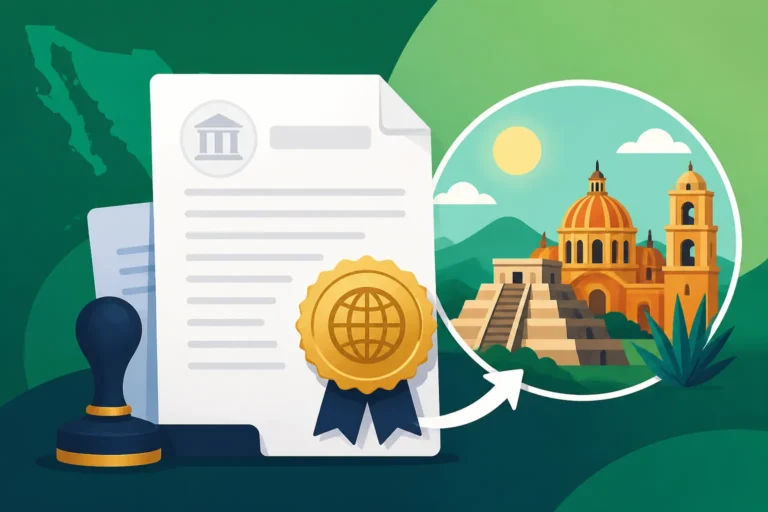
You cannot simply hand a Canadian marriage certificate or a US birth certificate to a Mexican immigration officer. Foreign government documents hold absolutely zero legal validity in Mexico until they are formally authenticated through a process called an Apostille (if your home country is a member of the Hague Apostille Convention) or Legalization.
You must contact the specific state or provincial government office where you were married and where your children were born, and request official, freshly issued copies of your marriage licenses and long-form birth certificates. You must then pay that specific state government to affix a formal Apostille stamp to the back of the document. Getting an Apostille can take weeks or months depending on the efficiency of your home country’s bureaucracy; you must start this process long before you book your flights.
The Absolute Necessity of Certified Translations
Once you secure your beautifully apostilled foreign marriage and birth certificates, you face the final, non-negotiable hurdle. The Mexican government operates strictly and exclusively in Spanish. If you hand an apostilled British birth certificate to an INM agent in English, it will be instantly rejected, your appointment will be canceled, and you will be sent to the back of a months-long waiting list.
Every single foreign document you submit must be officially translated into Spanish. You cannot translate these documents yourself, and you cannot use automated internet translations. They must be translated by a certified professional whose stamp is legally recognized by governmental authorities.
This is where leveraging a premium, certified translation service like RushTranslate becomes your ultimate administrative shield. Academic, legal, and civil documents are dense and highly formalized. A single mistranslated legal term on a marriage certificate can trigger a bureaucratic denial that tears your family’s timeline apart. By submitting your apostilled family documents to RushTranslate, you receive legally certified, flawlessly accurate Spanish translations back within 24 hours. Because RushTranslate explicitly guarantees acceptance by global immigration authorities, including the notoriously strict Mexican INM, you eliminate the risk of rejection, ensuring your family’s file processes smoothly on the very first try.
5. The Application Process: Step-by-Step Inside Mexico
Assuming the primary applicant already holds a Mexican residency card, here is the exact logistical roadmap to regularize your spouse and children from within Mexico.
Step 1: Arrive as Tourists
Your spouse and children book flights to Mexico. When they arrive at the airport, they enter as standard tourists. They must secure the digital or physical FMM (Forma Migratoria Múltiple) granting them tourist status. Ensure the agent stamps their passport properly.
Step 2: Prepare the INM Binder
You must assemble a flawless document portfolio. The Mexican bureaucracy demands perfection. For a spousal application, your binder must include:
- The primary applicant’s valid Mexican residency card (original and pristine copies of front and back).
- The spouse’s original passport, entry stamp, and tourist FMM (and copies).
- The freshly Apostilled marriage certificate.
- The certified Spanish translation of the marriage certificate (executed via RushTranslate).
- The official INM Formato Básico application form requesting the Cambio de Condición por Vínculo Familiar.
- A formal, signed letter (written entirely in Spanish) from the primary applicant requesting that their spouse be granted residency based on family unity.
- Receipts proving the payment of the government application fees.
Step 3: Endure the Waiting Room
You must secure an appointment at your local INM delegación. You and your family will spend hours sitting in sterile, chaotic waiting rooms. The officials processing your file are under no obligation to speak English. If you do not understand their instructions, they will simply tell you to step aside.
Patience, profound humility, and a polite demeanor are your only weapons here. You will hand over your impeccably organized binder. The agent will scrutinize every signature. If approved to move forward, you will wait while the background checks are initiated. We discuss how to properly navigate this specific cultural deference in Mexican Etiquette and Customs: Do’s and Don’ts for New Expats.
Step 4: The Legal Limbo
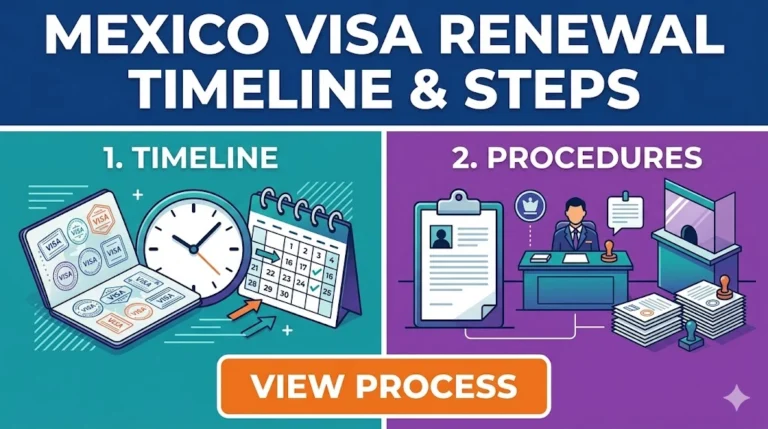
After you submit your paperwork, the INM can take anywhere from four weeks to four months to issue a final resolution. During this time, your family exists in a highly vulnerable legal limbo.
The restrictions during this waiting period are absolute. Your spouse and children are absolutely forbidden from leaving the country. If your spouse attempts to cross the border and fly home for a business trip or a wedding while their Vínculo Familiar application is pending, their application is instantly abandoned, and all government fees are forfeited. They are physically trapped inside Mexico until the plastic card is in their hand. If an absolute life-or-death emergency requires travel, you must apply for a highly restricted Permiso de Salida y Regreso (Exit and Return Permit), which takes days to secure.
6. Protecting Your Family: Healthcare and Logistics
Moving a family across borders is not just an immigration challenge; it is a profound physical and logistical risk. You must secure the environment your children are moving into.
The Illusion of Free Public Healthcare
Many expat families assume that once they secure residency, they can rely on the Mexican public healthcare system (IMSS) for their children’s medical needs. This is a catastrophic miscalculation.
While the public system is available to residents, it is chronically underfunded, heavily overburdened, and plagued by severe medication shortages. If your child spikes a 104-degree fever in the middle of the night, taking them to a crowded public IMSS clinic means sitting in a waiting room for eight hours surrounded by contagious illnesses, only to be handed basic paracetamol. You do not want your children navigating this system during an emergency.
Securing Elite International Coverage
As an expat parent, your children’s health is your absolute highest priority. You must utilize the private healthcare sector in Mexico, which in major hubs like CDMX, Guadalajara, and Monterrey, is world-class. However, private pediatric wings and neonatal intensive care units operate strictly as businesses. If you arrive at a private emergency room, they will demand massive, exorbitant upfront credit card deposits before admitting your child to the trauma ward.
Relying on a borderless, premium family policy from Cigna Global guarantees that your spouse and children are protected from the moment their flight lands. Because Cigna Global is an international provider, your coverage is not contingent upon waiting for the INM to finalize your residency cards. If a medical crisis strikes while your family is stuck in the months-long immigration limbo, your Cigna Global policy ensures your children are immediately admitted to top-tier private hospitals without you being extorted for massive cash deposits. It provides the absolute peace of mind required to sleep at night in a foreign country. We detail the terrifying reality of out-of-pocket costs in Healthcare Costs in Mexico: Doctor Visits, Hospital Stays, and Surgery Expenses.
School Enrollment and the SEP
If you are moving with school-aged children, securing their residency card is just the first bureaucratic hurdle. To enroll your children in a high-quality private international school, you must navigate the Secretaría de Educación Pública (SEP).
Mexican schools require formal, translated academic records to place your children in the correct grade. You must secure apostilled copies of your children’s report cards and transcripts from their home country. Once again, these documents must be officially translated into Spanish. Submitting these complex academic histories to RushTranslate ensures that the highly specific educational terminology is converted accurately, allowing the SEP to validate their prior education (revalidación de estudios) so your kids can start their new school year without administrative delays.
7. Housing, Banking, and Normalizing Daily Life
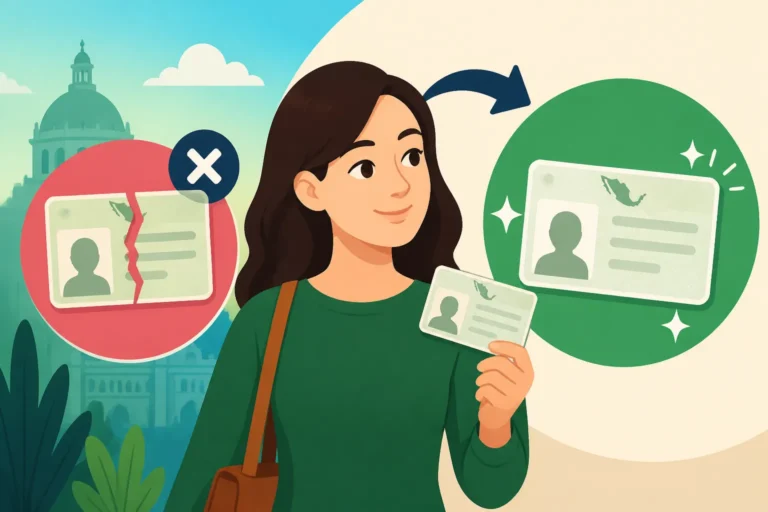
The day you are finally called back to the INM office to pick up the physical plastic residency cards for your spouse and children is a day of profound relief. The legal threat of separation is permanently extinguished.
Establishing the Financial Base
With residency cards in hand for the entire family, you can fully normalize your daily life. The spouse can now legally secure their own RFC (Tax ID) from the government.
More importantly, your spouse can now walk into a local Mexican bank and open their own domestic bank account. This provides your family with financial redundancy. You no longer have to rely on a single international travel card to feed a family of four. Having localized banking allows both partners to pay rent, setup localized utility apps, and manage daily household expenses securely via the instantaneous SPEI digital network. We break down the exact steps to unlock this network in Banking in Mexico: Complete Guide for Foreigners.
Securing a Long Term Family Home
Attempting to rent a four-bedroom family home on a tourist visa exposes you to predatory landlords who demand massive, untraceable cash deposits and offer zero legal tenant protections.
Armed with a portfolio of legal residency cards, your family proves immense stability to high-end real estate agencies. You can legally secure a standard twelve-month lease in a secure, family-friendly gated community (coto). You can initiate a Póliza Jurídica (legal eviction policy) to satisfy the landlord, drastically reducing your upfront move-in costs.
Because you will likely be leasing a bare concrete shell—as unfurnished homes in Mexico often lack even ovens or closets—you must then orchestrate the outfitting of the home. Families seamlessly bypass local delivery friction by routing all their heavy appliances, memory-foam mattresses, and children’s furniture directly to their new legal address via local e-commerce channels. For a full breakdown of these massive hidden costs, review Renting a Home in Mexico: Complete Expat Guide to Leases, Deposits, and More.
| Application Geography | Financial Requirement | Processing Time | Travel Restrictions |
| At Foreign Consulate | Massive UMA Multipliers required | 1-2 Weeks | None (Until travel to MX) |
| Inside Mexico (INM) | Often waived or heavily reduced | 1-4 Months | Cannot leave Mexico |
Conclusion: The Ultimate Reward
Relocating your entire family to Mexico is an agonizing marathon of paperwork, translation services, waiting rooms, and logistical stress. The bureaucracy will absolutely push you to your breaking point.
But when the dust settles, the reward is unparalleled. By successfully navigating the Vínculo Familiar pathway, you gift your family legal, unhindered access to one of the most vibrant, culturally rich, and beautiful countries on earth. You trade the rigid, hyper-scheduled anxiety of the Anglosphere for a culture that genuinely prioritizes family dinners, weekend fiestas, and communal warmth. Securing those plastic cards is the final barrier between you and the beautiful, chaotic, deeply fulfilling reality of your new Mexican life.
References
Primary sources (official)
- Secretaría de Relaciones Exteriores (SRE): The federal ministry overseeing all Mexican Consulates abroad, defining the initial visa requirements and family sponsorship UMA financial solvency thresholds. https://www.gob.mx/sre
Other helpful sources
- RushTranslate: Premier certified translation service ensuring your apostilled foreign birth certificates, marriage licenses, and children’s academic transcripts are flawlessly translated and accepted by Mexican immigration authorities and the SEP. https://rushtranslate.com/
- Cigna Global: Comprehensive international health insurance provider, offering borderless family policies that protect expat spouses and children from massive private hospital bills while they navigate the months-long immigration waiting periods. https://www.cignaglobal.com/
Disclaimer
The information provided in this article is for educational and informational purposes only and does not constitute official legal, immigration, medical, or tax advice. Mexican immigration laws, the specific eligibility criteria for the Visa por Vínculo Familiar, UMA-based financial solvency thresholds, and INM administrative procedures are highly complex, strictly enforced, and subject to rapid, unannounced changes at the federal level. Always conduct extensive due diligence, verify current apostille and translation requirements directly with your local INM office, and consult with a licensed, bilingual Mexican immigration attorney (abogado migratorio) before uprooting your family or submitting formal residency applications.