Puerto Vallarta vs Cancun: Comparing Expat Life in Two Beach Cities
Sweating through my shirt in a cramped immigration office, I desperately wished I had researched my destination better before signing a 12-month lease. Arriving in Mexico, many expats blindly assume every beach town offers the exact same tropical paradise, only to be crushed by infrastructure failures or severe culture shock. This guide directly compares the physical, financial, and cultural realities of Puerto Vallarta versus Cancun to help you choose the right coastal home.
Disclosure: This post may contain affiliate links. We may earn a commission at no extra cost to you if you make a purchase through these links. Read full disclosure.
The Vibe and Initial Culture Shock
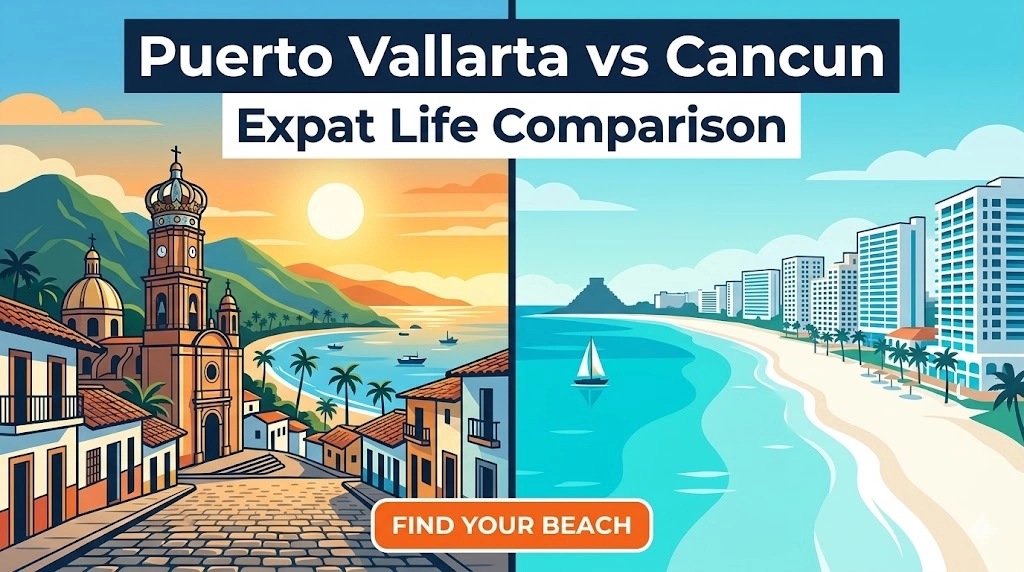
When you cross the border, the sensory overload is immediate. However, the exact flavor of that culture shock differs drastically between the romantic, historic energy of the Pacific and the heavily engineered, glossier pulse of the Caribbean.
The Pacific Charm of Puerto Vallarta
Puerto Vallarta (PV) sits on the Pacific coast, nestled tightly between the massive Bay of Banderas and the lush Sierra Madre mountains. Unlike many Mexican resort cities that were entirely manufactured for tourism, Puerto Vallarta began as a humble, authentic fishing village. This history is physically baked into the city’s infrastructure. You will find yourself walking down steep, uneven cobblestone streets, passing centuries-old churches, and eating at family-run taco stands that have occupied the exact same corner for generations.
The culture shock in PV is softer because it feels like a “real” Mexican town that simply happens to be famous. However, the terrain is physically demanding. If you have mobility issues, navigating the steep, romantic hills of the Romantic Zone or Conchas Chinas in the mid-day heat is an absolute nightmare. The charm of the cobblestones quickly fades when you twist an ankle walking to the grocery store.
Furthermore, Puerto Vallarta has an incredibly entrenched, massive expat community. It is famously welcoming and boasts one of the most robust, highly organized LGBTQ+ communities in Latin America. While this makes finding English-speaking friends remarkably easy, it also creates an “expat bubble” that can isolate you from deeper Mexican cultural immersion if you never intentionally leave the tourist zones.
The Caribbean Gloss of Cancun
Cancun, located on the northeastern edge of the Yucatan Peninsula, is a completely different beast. It was quite literally conjured out of the jungle by the Mexican government in the 1970s strictly as a master-planned tourist destination. The city is violently split into two distinct realities: the Hotel Zone (Zona Hotelera) and Downtown (El Centro).
The Hotel Zone is a 14-mile strip of pristine white sand, blindingly turquoise Caribbean water, and massive, all-inclusive mega-resorts. The culture shock here is minimal because it is designed to feel exactly like Miami or Las Vegas, but with a Mexican flavor. English is spoken everywhere, US dollars are widely accepted, and the infrastructure caters entirely to short-term, high-spending vacationers.
Living in Cancun as an expat usually means settling in El Centro or the developing residential suburbs to the south, far away from the resort strip. Downtown Cancun is an authentic, chaotic, working-class Mexican city. It lacks the historic, colonial charm of Puerto Vallarta completely. The streets are built on a grid, the architecture is modern and utilitarian, and the traffic is brutally aggressive. If you choose Cancun, you must accept that the breathtaking beaches you see on postcards are an expensive Uber ride away from your actual residential neighborhood.
Cost of Living: Which Paradise is Cheaper?
Mexico is no longer the dirt-cheap, budget paradise it was ten years ago. The massive influx of foreign capital, combined with a historically strong peso, has aggressively shifted the financial realities of both cities.
Housing and “Gringo Taxes”
The economic reality of living in a Mexican beach town is heavily dictated by global tourism. Both Puerto Vallarta and Cancun are aggressively priced to extract maximum capital from short-term vacationers carrying US Dollars or Canadian Dollars. As a full-time resident, you are constantly fighting the “Gringo Tax”—the inflated pricing applied to everything from real estate to a simple lunch at a beachfront restaurant.
In Puerto Vallarta, rents in the highly desirable Romantic Zone or Marina Vallarta have skyrocketed, driven by a massive influx of remote workers. A modern, furnished two-bedroom condo near the beach can easily demand $2,000 to $3,500 USD per month. To find affordability, expats are being pushed further inland to neighborhoods like Versalles or Fluvial, where a comfortable apartment might cost $1,000 to $1,500 USD.
Cancun offers a similar dynamic, but the split is more severe. Renting anything inside the Hotel Zone is financially ruinous for a standard expat budget. However, because downtown Cancun is so massive and sprawling, you can find highly affordable, secure residential housing slightly further out. Suburbs and gated communities in the southern part of the city offer large, modern homes for a fraction of PV’s prices. To legally manage the income you are spending and understand your tax liabilities in these cities, read Taxes in Mexico for Expats: A Complete Guide to Income Tax and More.
Groceries, Dining, and Daily Expenses
When it comes to daily living expenses, both cities offer a sliding scale based on your willingness to integrate. If you insist on buying imported American brands, dining at upscale fusion restaurants, and drinking at high-end hotel bars, your monthly budget in either city will quickly mirror that of Los Angeles or London.
However, if you adapt your lifestyle to the local economy, both locations offer incredible value. Puerto Vallarta holds a slight culinary edge in terms of authentic, accessible street food deeply integrated into the main walkable neighborhoods. You can easily eat a filling lunch of fresh ceviche or fish tacos for under $5 USD.
Cancun has massive, modern supermarkets that stock an incredible array of imported goods, catering to the international demographic. While eating out in the Hotel Zone is exorbitant, downtown Cancun boasts incredible, affordable Yucatecan cuisine. Ultimately, the cost of living is a tie; your specific neighborhood and lifestyle inflation will determine your baseline.
Infrastructure, Climate, and Connectivity
The romantic aesthetics of beachfront living often mask the brutal reality of developing infrastructure. Your daily comfort and your ability to earn a living are directly tied to the physical grid of your chosen zip code.
Battling the Humidity and Hurricane Seasons
Many expats envision sitting on a sun-drenched patio, sipping a margarita while a gentle ocean breeze keeps them perfectly cool. The reality of coastal Mexico, particularly from May through October, is a relentless, suffocating humidity that fundamentally alters how you live. The heat index can easily push past 100°F (38°C), and the air is so thick with moisture that stepping outside feels like walking into a wet towel.
In Puerto Vallarta, the Sierra Madre mountains trap the humidity over the bay during the summer, creating a greenhouse effect. The summer rainy season brings spectacular evening thunderstorms, but the constant moisture breeds black mold rapidly if your home is not perfectly ventilated.
Cancun is equally hot and humid, but it faces a significantly more severe threat: hurricane season. Sitting directly on the Caribbean Sea, the Yucatan Peninsula is a prime target for massive, catastrophic storms. If you move to Cancun, you must have a formalized evacuation plan, storm shutters, and emergency supplies ready at a moment’s notice. The anxiety of hurricane season from August to October is a massive psychological weight that Puerto Vallarta (which is geographically shielded by the bay) largely avoids.
Digital Nomads: Internet Reliability and Workspaces
For digital nomads and remote professionals, the beach town aesthetic often violently clashes with the harsh reality of telecommunications infrastructure. Both Puerto Vallarta and Cancun have modernized aggressively, but they present different infrastructural challenges.
In the central, developed neighborhoods of both cities, high-speed fiber-optic internet from major providers is the absolute standard. You can secure residential speeds of 200 to 500 Mbps, making heavy video editing and simultaneous Zoom calls completely effortless. However, the coastal power grid managed by the national provider (CFE) is notoriously fragile. A minor tropical storm can knock out the power for an entire neighborhood. You must absolutely invest in an Uninterruptible Power Supply (UPS) battery backup for your modem. To dive deeper into the overarching tech strategies required to thrive here, read Digital Nomads in Mexico: Remote Work Guide.
To survive these outages and find immediate community, veteran nomads rely heavily on dedicated co-working hubs. Booking a private room or a co-living suite at a Selina location in either Cancun or Puerto Vallarta is a strategic masterclass. Selina provides commercial-grade, redundant internet and backup generators. When the neighborhood power grid collapses, the Selina co-working space stays illuminated and connected, instantly surrounding you with other remote professionals rather than leaving you isolated and panicked in a dark apartment.
Bypassing the Local Supply Chain
Whether you choose the Pacific or the Caribbean, living on the coast means waging a perpetual, expensive war against salt air and corrosion. Screws in your laptop, the hinges on your front door, and the exposed coils on your refrigerator are all highly vulnerable. You must constantly wipe down surfaces and accept that appliances in beach towns have a significantly shorter lifespan.
When you need to replace these items or simply buy specialized tech gear, finding high-quality inventory in local Mexican hardware stores or big-box stores is an exercise in pure frustration. To bypass this chaotic local retail supply chain, savvy expats digitize their household setup by relying exclusively on Amazon Mexico.
Instead of fighting traffic and language barriers to find a specific ergonomic desk chair, professional-grade dehumidifiers, or replacement tech peripherals, you can order them directly through the localized Amazon Mexico platform. Because it operates within the country’s domestic logistics network, your items arrive quickly and reliably at your front door, completely bypassing the nightmarish delays of international customs.
Real Estate: Renting vs. Buying
Securing a safe, comfortable basecamp is your first priority, but the Mexican real estate market operates on a completely different set of rules than you might be used to.
The Nightmare of Unfurnished Mexican Rentals
When you sign a long-term lease in either city, you must understand the brutal reality of the Mexican rental market. When you sign a lease for an unfurnished apartment (sin amueblar), you are essentially renting a bare concrete box.
Unfurnished in Mexico means absolutely no appliances. There will be no refrigerator, no stove, no washing machine, and often no built-in closets or light fixtures. You are entirely responsible for outfitting the functional interior of the home from scratch. Doing this in your first week by fighting the infamous traffic to visit local stores is a spirit-breaking endeavor.
This is another reason why Amazon Mexico is an absolute lifesaver during your first month. You can order high-quality “mattresses in a box,” microwaves, and specialized cookware delivered directly to your empty echo chamber, allowing you to rapidly transform it into a comfortable home without the retail trauma. To navigate getting the lights and water turned on in these empty units, study Setting Up Utilities in Mexico: Electricity, Water, and Internet.
Navigating the Aval and Leases
In both Puerto Vallarta and Cancun, you will face the strict Aval requirement. Mexican landlords almost universally demand a local co-signer who owns debt-free property in the exact same city to guarantee your lease against squatters.
As a new arrival, bypassing this usually requires paying for a specialized legal eviction policy (Póliza Jurídica) or offering multiple months of rent upfront in cash. Furthermore, if you decide you want to buy property rather than rent, both Cancun and Puerto Vallarta are located inside the “Restricted Zone” (within 50km of the coast). Foreigners cannot hold direct title to residential land here; you must purchase property through a bank trust known as a Fideicomiso. To deeply understand these massive legal hurdles and closing costs, you must carefully study Real Estate in Mexico: Renting vs Buying for Expats.
Healthcare Access and Medical Tourism
Your physical health and ongoing medical maintenance are paramount. Both cities offer exceptional, world-class private healthcare, but navigating the system requires specific strategies.
Top-Tier Private Hospitals
For retirees, the proximity and quality of medical care is often the single most critical factor in choosing a destination. Both Cancun and Puerto Vallarta are massive medical tourism destinations. They feature pristine, JCI-accredited hospitals staffed by bilingual doctors who cater specifically to North Americans flying down for cheaper surgeries, dental work, and cosmetic procedures.
In Cancun, elite hospitals offer world-class care that rivals North American standards. In Puerto Vallarta, premium facilities provide equally spectacular services. If you live in these cities and suffer a severe cardiac event or require complex orthopedic surgery, you are minutes away from life-saving intervention.
However, you cannot rely on the Mexican public healthcare system (IMSS) for complex, catastrophic care. The public system is chronically underfunded, heavily backlogged, and operates exclusively in Spanish. To understand the massive divide in quality between the public and private tiers, review Healthcare in Mexico: Complete Guide for Expats Public vs Private.
Finding English-Speaking Doctors and Pharmacies
For routine care, such as a severe sinus infection or a tropical stomach bug, both cities are incredibly easy to navigate. You can walk into small clinics attached to major commercial pharmacies and see a licensed general practitioner for less than $4 USD, receiving your basic prescription on the spot.
However, if you require highly specialized care or ongoing maintenance medications for chronic conditions, the language barrier becomes a serious factor. To learn how to locate vetted, bilingual professionals before an emergency strikes, utilize the strategies detailed in Finding English-Speaking Doctors and Specialists in Mexico. For the strict laws regarding importing your medications and understanding local equivalents, consult Pharmacies in Mexico: How to Get Medications OTC vs Prescription.
Relying entirely on out-of-pocket cash for catastrophic medical events in these premium private hospitals is financial suicide. They will mercilessly demand a massive credit card deposit upfront before admitting you to the ER. You must secure robust international health coverage to guarantee you have VIP access to these elite hospitals without draining your life savings. To compare how these policies operate and why local domestic plans often fall short, consult Choosing Private Health Insurance: Local Mexican Plans vs International Coverage.
Expat Community and Social Integration
The soul of a city is found in its culture and the ease with which you can build a meaningful community. This is where the two coastal hubs truly diverge.
Puerto Vallarta’s Established Enclaves
Puerto Vallarta boasts an incredibly dense, highly organized expat community. If you want to arrive and immediately plug into a network of English speakers, PV is unmatched. The city is famous for its massive, vibrant LGBTQ+ community, which centers around the Romantic Zone and offers incredible inclusion.
The social scene in PV is highly active, revolving around beach clubs, charity galas, sunset cruises, and a massive restaurant culture. However, this intense concentration is a double-edged sword. Living in the “Vallarta Bubble” can feel highly insular. You can easily spend your entire life in PV speaking only English and eating at Americanized sports bars, completely isolated from authentic Mexican culture.
Cancun’s Transient Hubs vs. Hidden Pockets
Cancun’s expat community feels drastically different. Because the city is so sprawling and the Hotel Zone is dominated by short-term tourists, the full-time expat community is much more decentralized. You will not find a single, walkable “gringo neighborhood” like the Romantic Zone in PV.
Instead, expats in Cancun tend to congregate in gated communities in the south, or they integrate much more deeply into middle-class Mexican neighborhoods in the center. The social scene here requires more effort to cultivate. However, Cancun offers unparalleled access to the rest of the Riviera Maya. You are only an hour away from Playa del Carmen, Tulum, and the stunning cenotes of the Yucatan peninsula.
If you are arriving in either city to scout neighborhoods, you need a transitional strategy that prevents immediate isolation. Utilizing a Selina location as your basecamp (available in both Cancun and the Riviera Maya) provides that instant community. You can walk downstairs and network with other expats who can offer boots-on-the-ground advice about which local neighborhoods are actually safe and which ones flood during the rainy season.
The Final Verdict: Which City Fits Your Timeline?
Ultimately, no city in Mexico is perfect. Deciding between the Pacific and the Caribbean requires an honest assessment of your tolerance for specific environmental and logistical friction.
Try Before You Buy and Cellular Connectivity
The most dangerous, financially devastating mistake you can make is selling your home and signing a blind 12-month lease in either city based purely on internet research. You must employ a strict “try-before-you-buy” strategy.
Rent a short-term apartment in both locations during their worst respective seasons. Go to Cancun in September to see if you can handle the hurricane anxiety and the stifling humidity. Go to Puerto Vallarta in August to see if the steep, sweaty cobblestone hills break your spirit.
While you are executing these test runs and navigating unfamiliar streets, you must localize your cellular data the absolute second your plane lands. Relying on your home country’s “free roaming” plan is a highly dangerous gamble, as major carriers frequently throttle data speeds to an unusable crawl. By downloading a localized eSIM profile through Airalo before you even cross the border, you ensure your phone stays connected to Mexico’s strongest network. Having a dedicated Airalo data package is the ultimate digital safety blanket, ensuring you can summon an Uber, translate a menu, or check GPS maps without being stranded outside a remote airport.
Visas and Immigration Realities
While you are exploring these regions, you must ensure your administrative standing is flawless. You cannot legally rent a long-term home, buy a car, or open a bank account on a tourist visa. The Mexican government has cracked down aggressively on border runs, and immigration agents frequently hand out restricted 15-day or 30-day tourist stamps rather than the standard 180 days.
To live in either Cancun or Puerto Vallarta long-term, you must secure a Temporary or Permanent Resident Visa based on economic solvency at a Mexican consulate in your home country before you permanently move. To ensure your paperwork is flawless and you survive the initial bureaucratic gauntlet, strictly follow the steps outlined in How to Apply for Temporary Residency in Mexico: Step-by-Step.
Both cities offer a spectacular, sun-drenched lifestyle, but they cater to entirely different nervous systems. Whether you choose the cobblestone charm and deep expat roots of Puerto Vallarta or the modern infrastructure and Caribbean gloss of Cancun, meticulous preparation is your greatest asset. Secure your digital connectivity, manage your visa paperwork, build your medical safety net, and allow Mexico to offer you the most extraordinary chapter of your life. If you are ready to start planning the financial reality of this massive move, your absolute first stop must be Mexico Immigration Fees and Costs: Budgeting for Your Residency.
References
Primary sources (official)
- Puerto Vallarta Tourism Board: The official tourism portal offering insights into local attractions, events, safety protocols, and essential neighborhood overviews for Puerto Vallarta. https://visitpuertovallarta.com/
- Turismo Cancún: The official municipal tourism site for Cancun, providing official event calendars, Blue Flag beach certifications, and local activity guidelines. https://www.turismocancun.mx/en
Other helpful sources
- Travel.State.Gov: The consistently updated U.S. State Department advisory providing granular, state-by-state safety profiles crucial for expats choosing a location. https://travel.state.gov/en/international-travel/travel-advisories/mexico.html
- ExpatDen: A comprehensive, firsthand expat resource breaking down the true cost of living, healthcare logistics, and cultural transitions required for both the Pacific and Caribbean coasts. https://www.expatden.com/mexico/
Disclaimer
The information provided in this comprehensive guide is for educational, logistical, and informational purposes only and does not constitute formal immigration, legal, real estate, or financial advice. The cost of living, rental market prices, and public transit conditions in Puerto Vallarta and Cancun are highly volatile and subject to rapid economic shifts and intense gentrification. Always consult with a certified bilingual Mexican attorney or a registered immigration facilitator before signing long-term leases or executing financial transfers, and thoroughly verify your international health insurance coverage before relocating.