Grocery Shopping in Mexico: Supermarkets vs Local Markets
Navigating a bustling Mexican street market for the first time induces profound sensory overload and genuine panic. The language barrier, unfamiliar cuts of meat, and fear of foodborne illness are intensely real hurdles. This guide decodes Mexican supermarkets, local markets, and hygiene protocols so you can shop safely and confidently.
Disclosure: This post may contain affiliate links. We may earn a commission at no extra cost to you if you make a purchase through these links. Read full disclosure.
The Corporate Comfort of Mexican Supermarkets
When you first arrive south of the border, your immediate instinct will likely be to seek out the familiar, sterile aisles of a large corporate supermarket. Fortunately, the retail grocery infrastructure in Mexico is incredibly robust, highly modernized, and segmented to cater to wildly different income brackets.
High End Grocers and Familiar Brands
If you are craving imported American peanut butter, specific European cheeses, or artisanal gluten-free products, you must head to the premium tier of Mexican supermarkets. Brands like City Market, Fresko, La Comer, and Chedraui Selecto operate at a standard that rivals or exceeds premium grocers like Whole Foods in the United States.
Walking into a City Market in neighborhoods like Polanco in Mexico City or Puerta de Hierro in Guadalajara is a luxurious experience. You will find pristine gelato bars, massive walk-in wine cellars, dry-aged beef counters, and aisles dedicated entirely to imported international goods. However, this comfort comes at a steep premium. Purchasing imported North American or European brands will cost you significantly more than it did back home due to import taxes and luxury markups.
If you attempt to do your weekly bulk shopping entirely at these high-end establishments, you will obliterate your relocation budget. They are best utilized as specialty stops for specific cravings or high-quality imported wines, while relying on local markets for your fresh produce. We explore the financial impact of these shopping habits in our Cost of Living in Mexico City: Detailed Expat Budget Guide.
Budget Chains and Bulk Buying
For your standard, day-to-day pantry staples, cleaning supplies, and paper goods, the mid-tier and budget supermarkets are where you will spend the majority of your time. Walmart has a massive, dominant footprint across Mexico, operating standard Supercenters that look virtually identical to their North American counterparts.
Beyond Walmart, you will become intimately familiar with domestic chains like Soriana, Mega Soriana, and Bodega Aurrera (which is actually a budget subsidiary of Walmart). Bodega Aurrera is easily identified by its mascot, “Mamá Lucha” (a cartoon female wrestler), and is geared toward working-class neighborhoods. It offers rock-bottom prices on bulk staples like rice, beans, cooking oil, and basic household items.
While the produce sections in these budget chains are expansive, the quality and freshness often pale in comparison to what you will find at a local street market. The vegetables may sit in refrigerated trucks for days before hitting the shelves, losing flavor and vitality. Most seasoned expats eventually transition to buying their boxed and canned goods at Walmart or Soriana, but purchase their meat and vegetables strictly from local vendors.
The Etiquette of Supermarket Tipping
One of the most jarring cultural adjustments at a Mexican supermarket occurs at the checkout register. At the end of the conveyor belt, you will almost always find a “bagger” packing your groceries. These individuals are usually either teenagers or elderly adults.
These baggers, colloquially known as cerillos (matches), are generally not salaried employees of the supermarket. They rely entirely on the voluntary tips (propinas) of the customers whose groceries they pack. It is a deeply ingrained cultural expectation that you hand them a cash tip when they finish bagging your items.
The standard tip ranges from 5 to 15 Mexican pesos, depending on how many bags they packed and whether they helped you push the cart to your car. If you pay for your massive grocery haul with a credit card and simply walk away without handing the elderly bagger a coin, you will be viewed as exceptionally rude and stingy. You must always ensure you have a pocket full of small peso coins before stepping into a Mexican supermarket. We cover these essential daily social transactions heavily in Mexican Etiquette and Customs: Do’s and Don’ts for New Expats.
Embracing the Chaos of the Tianguis and Local Markets
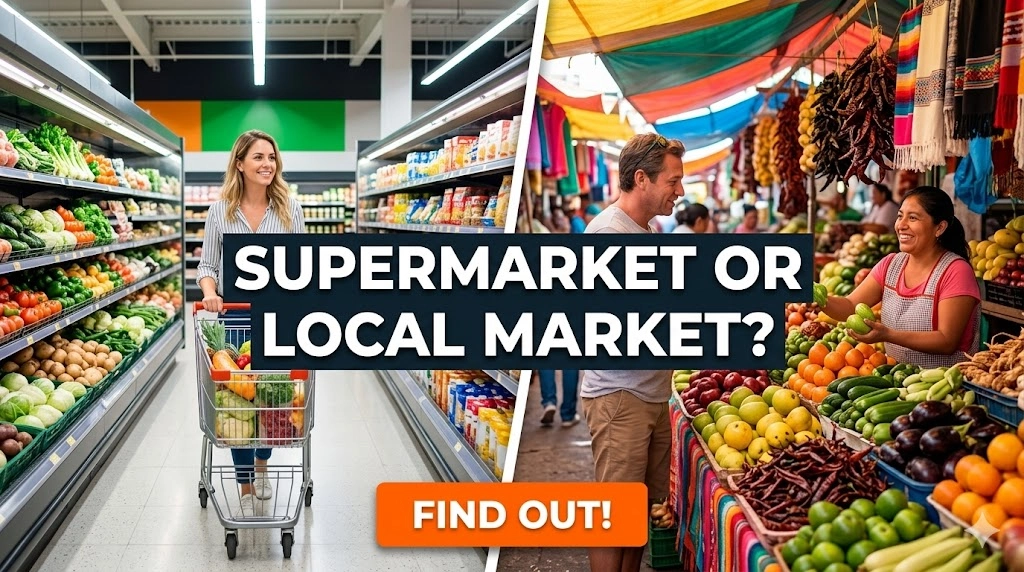
To truly integrate into Mexican society, dramatically lower your food budget, and eat the most flavorful produce of your life, you must eventually abandon the corporate supermarkets and step into the vibrant, chaotic world of the local market.
Understanding the Tianguis Culture
The tianguis is a spectacular, pre-Hispanic tradition that forms the absolute backbone of the Mexican food supply chain. A tianguis is a massive, open-air street market that pops up in specific neighborhoods on specific days of the week. Entire city blocks are closed to vehicular traffic as hundreds of vendors set up brightly colored tarps (usually pink or yellow) and wooden tables.
Navigating a tianguis for the first time is pure sensory overload. You will hear vendors screaming out their prices, smell fresh carnitas boiling in massive copper pots, and be forced to squeeze through incredibly dense crowds of local families. Here, you will find mountains of fresh, locally grown avocados, mangoes, tomatoes, and chiles at prices that are often 50% to 70% lower than at a corporate supermarket.
Because the tianguis moves daily, you must ask your neighbors or local friends which day the market sets up on your specific street. You bring your own reusable cloth bags, pull a rolling cart, and buy produce that was likely pulled from the ground just 24 hours prior.
Fixed Mercado Publico Locations
Unlike the transient tianguis, every Mexican municipality also features a permanent Mercado Público (Public Market). These are massive, fixed concrete structures located in the center of town, operating seven days a week. Famous examples include Mercado San Juan in Mexico City or Mercado Lucas de Gálvez in Mérida.
Inside the mercado, the stalls (puestos) are heavily categorized. There will be an entire aisle dedicated exclusively to butchers, another dedicated to fresh flowers, another for massive sacks of dried chiles and spices, and an entire section of fondas (small, family-run food counters) serving cheap, delicious, home-cooked daily meals (comida corrida).
Building a relationship with specific vendors inside your local mercado is a rite of passage. Once you find a “marchante” (vendor) whose produce you love, you return to them every week. They will eventually learn your preferences, throw in extra pieces of fruit for free (el pilón), and treat you like family. This organic community integration is impossible to replicate in a Walmart, a dynamic we explore in Gated Communities vs Traditional Neighborhoods: Choosing a Home in Mexico.
Haggling Cash and Communication
A common misconception among foreigners is that you must aggressively haggle over the price of a kilo of tomatoes at a local market. While haggling (regateo) is common when buying artisan crafts, clothing, or furniture in Mexico, it is generally frowned upon when buying basic food staples from a working-class farmer. The prices are already incredibly low; demanding a 10-peso discount on a bag of onions is viewed as insulting.
You must execute these transactions entirely in physical cash. Very few market vendors accept credit cards, and trying to hand a vendor a massive 500-peso bill for a 30-peso purchase early in the morning will be met with intense frustration, as they will not have enough change. You must break your large bills at a convenience store beforehand and bring small denominations.
Furthermore, you must communicate in Spanish. Pointing and grunting will only get you so far. You need to know how to ask for a half-kilo (medio kilo), ask for the price (¿A cómo está?), and execute polite greetings. The language barrier here is real, but vendors are incredibly patient with expats who make a genuine effort. To accelerate your market vocabulary, review the strategies in Learning Spanish in Mexico: Top Tips and Resources for Expats.
Specialty Stores and the Carniceria Experience
Beyond the large markets, Mexican neighborhoods are dotted with hyper-specialized micro-businesses. Rather than buying everything under one roof, you will often find yourself visiting three different shops to complete your weekly grocery run.
The Local Butcher Shop
Buying meat in Mexico requires a massive recalibration of your culinary expectations. If you walk into a local carnicería (butcher shop), you will not see pre-packaged, perfectly square steaks sitting on styrofoam trays wrapped in plastic.
Instead, you will see massive primal cuts of beef and pork hanging from metal hooks in the open air. The butcher will pull down a slab of meat and custom-cut it to your exact specifications on a massive wooden block. Mexican cuts of beef differ entirely from North American cuts. They generally cut the meat much thinner, designed for rapid grilling or tacos (such as bistec or arrachera), rather than thick, slow-roasting steaks.
Furthermore, the concept of USDA grading (Select, Choice, Prime) does not exist in the standard Mexican market. The beef is often leaner, grass-fed, and slightly tougher because it lacks the heavy marbling of American grain-fed cattle. If you specifically want a thick-cut, heavily marbled Ribeye for a weekend barbecue, you will likely need to visit a high-end specialty butcher or a premium supermarket like City Market.
Panaderias and Tortillerias
Carbohydrates are the lifeblood of Mexican cuisine, and they are acquired fresh, daily. You do not buy a plastic bag of tortillas that sits on a supermarket shelf for two weeks. You walk to the neighborhood tortillería.
At the tortillería, massive industrial machines churn out hundreds of hot, fresh corn tortillas every minute. You simply walk up to the counter, state how many kilos or half-kilos you want, and the worker wraps them in paper. It is a deeply ingrained cultural tradition to bring your own cloth napkin (servilleta) to the counter; the worker will wrap the piping hot tortillas directly in your cloth to keep them warm on your walk home.
Similarly, for sweet bread (pan dulce) and breakfast pastries, you visit the local panadería. You grab a metal tray and a pair of tongs at the entrance, wander the aisles selecting your conchas and cuernitos, and bring the tray to the counter to be counted and bagged. It is an affordable, daily ritual that roots you in the rhythm of the neighborhood.
Convenience Stores The OXXO Monopoly
You cannot discuss the Mexican retail landscape without mentioning OXXO. With tens of thousands of locations across the country, OXXO is a convenience store empire that dwarfs 7-Eleven. There is seemingly an OXXO on every single corner of every major city.
While you should not attempt to do your weekly grocery shopping at an OXXO, it is your ultimate logistical lifeline. You go to OXXO to buy emergency toilet paper at 11:00 PM, grab a quick bag of ice, or buy a cold Coca-Cola. More importantly, OXXO operates as a shadow banking system. You will frequently visit the cashier to pay your electricity bill, deposit cash into local bank accounts, and top up your phone data. We discuss the vital nature of this payment infrastructure in Paying Utility Bills in Mexico: Methods and Tips for Expats.
Food Safety Hygiene and Water Protocols
The most pervasive fear among new expats is contracting a severe gastrointestinal illness, universally referred to as “Montezuma’s Revenge.” While the fear is valid, food poisoning is almost entirely preventable if you adhere to strict, non-negotiable hygiene protocols inside your own kitchen.
Washing Produce with Microdyn
When you buy fresh produce from a tianguis or a local market, it was likely grown in soil treated with fertilizers or agricultural runoff that your foreign stomach bacteria is not equipped to handle. You cannot simply rinse an apple under the tap and eat it.
Every single piece of fruit or vegetable that you plan to eat raw (including items where you peel the skin, like avocados or melons) must be chemically disinfected. The national standard for this is a product called Microdyn (or Bacdin), a colloidal silver solution available at every supermarket checkout aisle.
You fill a large bowl with purified drinking water, add the required number of Microdyn drops (usually one drop per liter), submerge your produce, and let it soak for exactly 15 minutes. This process eradicates the harmful bacteria and parasites. If you skip this step because you are tired or in a rush, you will inevitably end up bedridden. Managing the medical fallout of skipping this protocol is a harsh reality detailed in Safety in Mexico: What Expats Need to Know About Staying Safe.
Meat and Dairy Storage Realities
You must also adjust how you handle dairy and eggs. In Mexico, commercial milk is frequently ultra-pasteurized (UHT) and sold in tetra-pack boxes that sit on warm, unrefrigerated supermarket shelves for months. It is perfectly safe to drink and only requires refrigeration after the seal is broken.
Similarly, eggs in Mexico are generally not washed with harsh chemicals before reaching the market. Because their natural protective cuticle remains intact, eggs are not refrigerated in supermarkets, and you do not need to refrigerate them in your home kitchen.
When purchasing meat from a local carnicería, be aware of the “cold chain.” Meat hanging in an open-air market may not be heavily refrigerated. You should make the butcher your absolute last stop on your market run, and you must transport the meat home and cook or freeze it immediately.
The Garrafon System for Drinking Water
This rule is absolute and unforgiving: Never, under any circumstances, drink the tap water in Mexico. The municipal water lines are heavily mineralized, frequently contaminated by aging infrastructure, and completely unpotable.
Your entire cooking and drinking routine will revolve around the garrafón (a heavy, 20-liter plastic jug of purified water). You must use garrafón water to make your coffee, boil your pasta, cook your rice, and wash your vegetables. You brush your teeth with tap water, but you spit it out.
Managing the physical logistics of these heavy jugs is a daily chore. You must either flag down a delivery truck on the street or carry them from the corner store. To alleviate this heavy lifting in an empty apartment, immediately order a bottom-loading electronic water dispenser from Amazon Mexico. Having a proper dispenser delivered to your door ensures you have a constant, safe hydration station without straining your back.
Bridging the Gap with E commerce and Delivery
For digital nomads on tight deadlines or expats feeling overwhelmed by the language barrier of the local markets, Mexico offers an incredibly advanced, frictionless delivery infrastructure.
Supermarket Delivery Apps
If you are sick, exhausted, or simply do not want to fight traffic, you can have your entire corporate supermarket run delivered to your door in under two hours.
Applications like Rappi, Uber Eats, and Walmart’s proprietary app offer seamless delivery from stores like Chedraui, La Comer, and Soriana. You browse the aisles digitally, a personal shopper picks your items, and a motorcycle delivery driver drops them at your gate.
While this is incredibly convenient, the apps frequently suffer from out-of-stock items, and the personal shoppers will text or call you in rapid Spanish to ask about substitutions. If your home internet is unstable, this coordination fails. Ensuring you have an active Airalo eSIM guarantees that your phone stays connected to the cellular network, allowing you to instantly translate the delivery driver’s messages on WhatsApp and guide them to your hidden apartment complex.
Stocking Your Pantry via Amazon Mexico
When you first relocate, you will inevitably crave highly specific comfort foods or require specialized dietary items (like premium vegan protein powders, specific organic supplements, or high-end coffee equipment) that simply do not exist in standard Mexican supermarkets.
Instead of paying massive import markups at a boutique grocer in Polanco, savvy expats leverage Amazon Mexico. The platform acts as a critical bridge for imported goods. You can order massive bulk packs of essential household items, specialized pet foods, and international pantry staples, often with free delivery via Amazon Prime. Utilizing Amazon Mexico allows you to maintain the dietary comforts of your home country without continuously hunting through unfamiliar local stores.
Managing Deliveries as a New Expat
Coordinating delivery drivers when you do not fully understand the layout of your new neighborhood is a guaranteed source of friction. Drivers will get lost, call you for directions, and demand you come down to the street to meet them.
This is exactly why veteran expats execute a strategic “soft landing.” Instead of renting a hard-to-find apartment on a chaotic public street on day one, book your first month at a globally recognized, premium coliving space like Selina. By basing yourself at a Selina property, you secure a highly visible, professionally managed address with a 24/7 reception desk.
You can safely order your groceries via Rappi or your imported pantry goods via Amazon, and the front desk staff at Selina will seamlessly accept the deliveries on your behalf. This insulated, low-stress environment allows you to gradually explore the intense, beautiful chaos of the local tianguis at your own pace, ensuring your transition into Mexican culinary life is a joy rather than a panic-inducing chore.
| Feature | Corporate Supermarket (Chedraui, Walmart) | Local Market (Tianguis / Mercado) |
| Price Point | Medium to High (Import markups) | Very Low (Direct from farmers) |
| Produce Quality | Average (Refrigerated transit) | Exceptional (Freshly harvested) |
| Payment Method | Credit Cards, Apple Pay | Strictly Physical Cash |
| Language Barrier | Low (Self-checkout available) | High (Requires verbal negotiation) |
| Atmosphere | Sterile, predictable, air-conditioned | Loud, chaotic, culturally immersive |
References
Primary sources (official)
- Procuraduría Federal del Consumidor (PROFECO): The federal consumer protection agency, providing national price monitoring for basic grocery staples (Canasta Básica) and regulating supermarket practices. https://www.gob.mx/profeco
- Secretaría de Salud: The Mexican Ministry of Health, offering official guidelines on food safety, water purification standards, and market hygiene. https://www.gob.mx/salud
Other helpful sources
- Airalo: Global eSIM provider ensuring expats maintain unbreakable cellular connectivity to translate vendor interactions and coordinate grocery deliveries in real time. https://www.airalo.com/
- Amazon Mexico: Essential e-commerce platform for sourcing imported pantry staples, high-quality water dispensers, and bulk Microdyn without retail markups. https://www.amazon.com.mx/
Disclaimer
The information provided in this article is for educational and informational purposes only and does not constitute official medical, dietary, or financial advice. Food safety protocols (such as using Microdyn) and water purification standards are strictly necessary to prevent severe gastrointestinal illness; individual biological tolerances vary greatly. The availability, pricing, and specific days of operation for local tianguis and public markets change drastically by municipality and neighborhood. Always carry physical cash in small denominations when shopping at informal markets, adhere strictly to basic sanitation practices, and consult certified medical professionals regarding prolonged foodborne illness. Ensure that any e-commerce platforms or services mentioned meet your specific logistical requirements.