Mexican Holidays and Festivals: What Expats Should Know
I will never forget marching down to the bank on a random Monday in November to pay my rent, only to find the steel shutters pulled down and the streets eerily empty. Assuming the Mexican calendar aligns with your home country is a guaranteed recipe for logistical nightmares. This guide decodes the chaotic, beautiful rhythm of Mexican holidays and festivals so you can plan your life, avoid bureaucratic dead ends, and actually enjoy the celebrations.
Disclosure: This post may contain affiliate links. We may earn a commission at no extra cost to you if you make a purchase through these links. Read full disclosure.
The Reality of the Mexican Calendar and Bank Holidays
Navigating the official calendar in Mexico requires unlearning the standardized corporate rhythms of the United States or Northern Europe. The country operates on a dual system of federally mandated statutory holidays and widely observed cultural or religious days that, while technically unofficial, still bring commerce to a grinding halt.
Understanding Dias Feriados
In Mexico, official statutory holidays are known as días feriados or días festivos oficiales. These are mandated by the federal labor law. On these days, banks, government offices, schools, and most formal corporate businesses are legally required to close. If an employee is forced to work on a día feriado, the employer must pay them triple their standard daily wage.
The major official holidays include New Year’s Day, Constitution Day in early February, Benito Juárez’s Birthday in mid-March, Labor Day on May 1st, Independence Day on September 16th, Revolution Day in late November, and Christmas Day. However, the exact dates for some of these holidays shift. To minimize midweek disruptions, the Mexican government frequently moves the observance of historical holidays to the nearest Monday.
For a new expat trying to finalize residency paperwork or open a local bank account, missing these dates is a massive headache. You might schedule an appointment weeks in advance, only to arrive and find a printed piece of paper taped to the glass door announcing a holiday closure. You must proactively sync your digital calendar with the official Mexican federal calendar the moment you arrive.
The Puente Phenomenon
The most defining characteristic of the Mexican work calendar is the puente. Translating literally to “bridge,” a puente occurs when an official holiday falls on a Tuesday or a Thursday. Rather than working for one awkward day in the middle of a holiday block, the entire country collectively bridges the gap, taking the Monday or Friday off to create a massive four-day weekend.
When a puente is declared, whether officially by the government or unofficially by local schools and businesses, the major cities rapidly empty out as middle-class locals flood the highways heading for the coasts or nearby Pueblos Mágicos. If you live in a coastal hub, you will experience a sudden, overwhelming influx of domestic tourism, accompanied by spiked restaurant prices and gridlocked traffic.
For digital nomads, the puente is a double-edged sword. It offers a fantastic excuse to log off and explore the country. However, if you have a looming deadline and your laptop charger breaks, you will find that major electronics repair shops and specialized vendors are closed for four consecutive days. Managing your remote work schedule around these massive domestic migration patterns is an essential skill we cover deeply in Digital Nomads in Mexico: Remote Work Guide.
Bureaucratic Shutdowns and Planning
The most brutal reality of Mexican holidays is how they affect government bureaucracies. The Mexican government does not operate on a skeleton crew during major holiday seasons; entire departments simply shut down completely.
This is most prevalent during the last two weeks of December and the first week of January, a period where the immigration office (INM) and the federal tax authority (SAT) virtually freeze. If your temporary residency visa is set to expire on December 28th, you cannot wait until December 20th to begin the renewal process. The offices will be closed, the online portals will be unmonitored, and you will fall out of legal status simply because you failed to respect the holiday shutdown.
You must audit your legal and financial deadlines six months in advance. If you owe annual taxes, or if you need to renew a lease that requires a notary’s stamp, you must complete the process well before a major holiday block begins. We detail the painful reality of dealing with the SAT schedule in our guide on Taxes in Mexico for Expats: A Complete Guide to Income Tax and More.
Surviving and Embracing the Noise of Local Fiestas
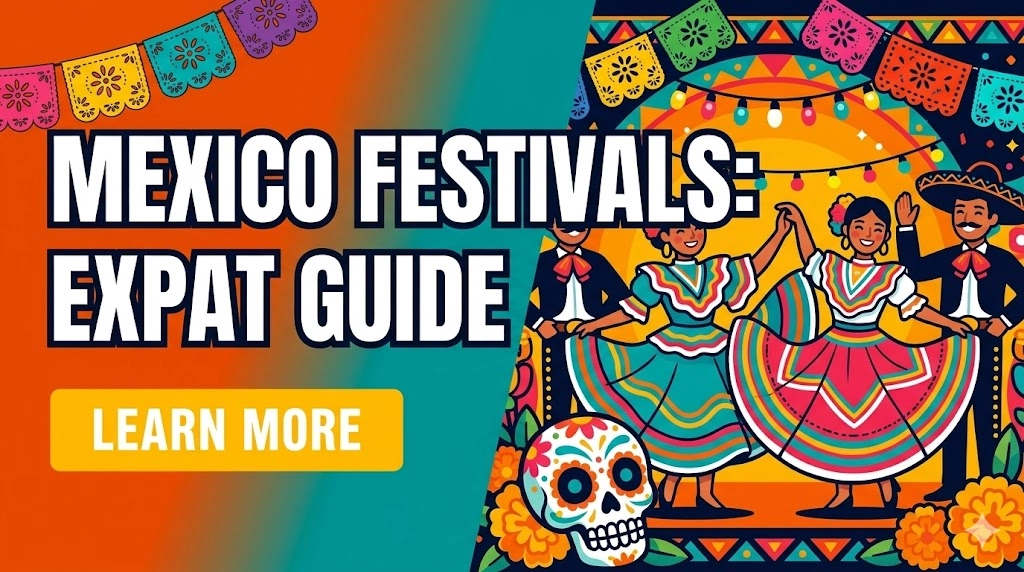
While national holidays shut down banks, the hyper-local neighborhood festivals will rattle your windows and test your sanity. Every single town, municipality, and neighborhood in Mexico has a patron saint, and the celebration of that saint is an explosive, multi-day affair.
Patron Saint Days and Cohetes
If you move into a traditional Mexican neighborhood, you will inevitably experience your first fiesta patronal. You will be jolted awake at 5:00 AM by a series of deafening explosions that sound like military artillery striking your roof. You will likely dive out of bed in a panic.
These explosions are cohetes (heavy aerial fireworks). In Mexican religious tradition, setting off cohetes at dawn is designed to wake up the patron saint and announce the beginning of the festival. This will be followed closely by a roving brass marching band playing loudly through the streets at 6:00 AM.
You absolutely cannot call the police to file a noise complaint. The police will not intervene; they are likely participating in the festival. As a foreigner, marching outside in your pajamas to yell at the locals for waking you up is the fastest way to become deeply despised by your new community. You must invest in heavy-duty earplugs, accept that you will lose some sleep, and recognize that this beautiful, chaotic noise is the heartbeat of your host country. Understanding this dynamic is a core pillar of Living in Mexico: Cultural and Practical Guide for New Expats.
Neighborhood Blockades and Traffic
During a local fiesta, the concept of a public street ceases to exist. Neighborhood committees will literally block off entire intersections with ropes, parked cars, or massive rented tents (carpas).
These blocked streets become the staging ground for carnival rides, dozens of food stalls selling tamales and churros, and massive stages for live Norteño or Cumbia bands. If your house is located inside the blockade zone, you will not be able to pull your car into your own garage for three days. You will have to park several blocks away and walk through the carnival to get to your front door.
Furthermore, you must be prepared for the peregrinaciones (pilgrimages). Massive crowds of people will march down major arterial roads, entirely shutting down traffic, carrying statues of saints adorned with flowers. If you are trying to get to the airport and you get stuck behind a three-mile pilgrimage, you will miss your flight. Always monitor local Facebook groups for your neighborhood to stay informed about upcoming street closures.
The Etiquette of Joining the Celebration
The greatest mistake an expat can make during a local festival is hiding inside their house, glaring out the window in frustration. The festival is happening literally on your doorstep; you must go outside and participate.
Mexican communities are incredibly welcoming to foreigners who show genuine interest in their traditions. Walk outside, buy a cup of atole or a plate of tacos al pastor from the neighborhood vendors, and watch the traditional dancers. If a neighbor invites you to sit at their table under the street tent, accept the invitation instantly.
You do not need to speak perfect Spanish to participate. Simply smiling, eating the food, and nodding along to the music signals profound respect for their culture. Participating in these local fiestas is the fastest, most organic way to transition from an outsider to a recognized, accepted member of the community. We discuss the nuances of this integration in Mexican Etiquette and Customs: Do’s and Don’ts for New Expats.
The Massive National Celebrations You Must Prepare For
Beyond the local neighborhood fiestas, Mexico hosts several massive national celebrations that fundamentally alter the rhythm of daily life across the entire country. You must prepare for these events logistically and culturally.
Independence Day and El Grito
Contrary to popular belief in the United States, Cinco de Mayo is a minor, regional holiday in Mexico. The true national celebration is Independence Day, which takes place on September 15th and 16th.
The celebration begins on the night of the 15th with El Grito de Dolores. In every city across the republic, massive crowds gather in the central plaza (zocalo). At 11:00 PM, the mayor or the president steps onto a balcony, rings a historical bell, and leads the crowd in screaming “¡Viva México!” followed by a massive fireworks display. The energy is electric, intensely patriotic, and involves heavy consumption of tequila and traditional dishes like chiles en nogada.
On the 16th, the country shuts down for massive military and civic parades. If you live anywhere near a central plaza, your neighborhood will be impassable for 48 hours. The noise will be constant. If you work remotely, you must inform your foreign clients that you will be offline, as the internet infrastructure in central zones often crashes due to the sheer volume of people uploading videos to social media.
Dia de los Muertos Logistics
The Day of the Dead, observed on November 1st and 2nd, is arguably the most visually stunning and emotionally profound holiday in Mexico. It is not “Mexican Halloween”; it is a deeply spiritual time when families believe the veil between the living and the dead is lifted, allowing deceased loved ones to visit.
Families construct elaborate ofrendas (altars) in their homes, covered in bright orange marigolds (cempasúchil), sugar skulls, candles, and the favorite foods of the deceased. The logistical reality for expats is that the local markets become absolute madhouses in the final days of October. Prices for flowers skyrocket, and the traffic around local cemeteries (panteones) becomes gridlocked as entire families essentially camp out on the gravesites overnight.
If you wish to build your own ofrenda to honor your ancestors—a practice highly encouraged and respected by locals—you can source the delicate paper decorations (papel picado) and traditional items locally. However, finding specific structural tiers or safe, battery-operated candles is often easier through Amazon Mexico. Utilizing Amazon Mexico allows you to have your base altar supplies delivered directly to your door, letting you focus your energy on braving the local markets solely for the fresh flowers and pan de muerto.
The Guadalupe Reyes Marathon
In Mexico, the holiday season is not a week; it is a marathon of endurance known culturally as the Guadalupe-Reyes. This period stretches from December 12th (the Day of the Virgin of Guadalupe) through January 6th (Three Kings Day, or Día de los Reyes).
For nearly a month, the country operates at half-speed professionally and double-speed socially. You will be invited to countless posadas—traditional neighborhood Christmas parties involving piñatas, hot fruit punch (ponche), and copious amounts of food. Work emails will go unanswered, construction projects will be abandoned mid-sentence, and your local gym will be empty.
You must surrender to this marathon. Do not expect to launch a new business initiative or execute a major home renovation in late December. Embrace the endless socializing. However, remember that the nights in the central highlands get bitterly cold during this season. Traditional concrete Mexican homes have zero insulation. Ordering heavy thermal blankets and portable space heaters via Amazon Mexico in early November is a crucial survival tactic to ensure your holiday season is cozy rather than freezing.
| Holiday / Festival | Dates | Bureaucratic Impact | Cultural Vibe |
| Independence Day | Sept 15 – 16 | Complete shutdown on the 16th. | Patriotic, loud, massive crowds, fireworks. |
| Dia de los Muertos | Nov 1 – 2 | Minor closures; schools often close. | Spiritual, visually stunning, heavy market traffic. |
| Guadalupe-Reyes | Dec 12 – Jan 6 | Massive rolling shutdowns; SAT/INM freeze. | Endless parties (posadas), zero professional productivity. |
| Semana Santa | March / April | Total shutdown Thursday/Friday. | Extreme domestic travel, packed beaches, price gouging. |
Navigating Expat Hotspots During High Season
If you choose to live in a highly desirable coastal destination or a famous colonial town, holidays bring an entirely different set of challenges. You are no longer just dealing with local celebrations; you are dealing with the crushing weight of domestic and international tourism.
Semana Santa Chaos on the Coasts
Semana Santa (Holy Week), which leads up to Easter, is the single most intense domestic travel week of the year in Mexico. Middle-class and working-class families from the interior cities flee to the beaches en masse.
If you live in Puerto Vallarta, Playa del Carmen, Tulum, or Mazatlán, Semana Santa transforms your town into an absolute madhouse. The beaches become a sea of umbrellas, cooler boxes, and booming Bluetooth speakers. Grocery store shelves are stripped bare of beer, ice, and basic staples. Traffic on the coastal highways comes to a complete, agonizing standstill. Furthermore, local landlords and short-term rental platforms triple their prices, resulting in severe price gouging.
If you are an expat living on the coast, you must prepare for Semana Santa like a hurricane. You stock your refrigerator a week in advance, you avoid the main highways, and you accept that the tranquil beach you usually enjoy on Tuesday mornings is gone for the next fourteen days. We break down the specific regional impacts of these tourism surges in Best Places to Live in Mexico for Expats (2027 Edition).
Finding Sanctuary During Peak Holidays
For many remote workers and older expats, the chaos of Semana Santa or the massive crowds of Independence Day in a major plaza is simply too overwhelming to handle. The smartest strategy is to evacuate the hotspots entirely.
When the beaches flood with millions of tourists during Semana Santa, seasoned expats flee to the quiet, empty interior cities, or they utilize the sanctuary of a secure coliving environment. Booking a room or a private desk at a Selina property during these chaotic holiday spikes is a phenomenal tactical move.
By retreating to a Selina basecamp, whether hidden in the mountains of Oaxaca or in a quieter district of Mexico City, you bypass the localized madness. You secure a guaranteed, quiet workspace with enterprise-grade Wi-Fi, allowing you to maintain your remote income while the rest of the country is gridlocked in holiday traffic. It provides an insulated, professionally managed safe haven when your primary city becomes unlivable.
Digital Preparedness During Overcrowded Festivals
A hidden danger of massive Mexican festivals is the catastrophic failure of digital infrastructure. When 100,000 people cram into a city plaza for an Independence Day parade or a Day of the Dead procession, the local cell phone towers are instantly overwhelmed.
If you are relying on a cheap, low-tier local mobile plan, your data will drop to zero. You will not be able to order an Uber to escape the crowd, you cannot load Google Maps to find your way out of the blocked streets, and you cannot WhatsApp your friends to coordinate a meeting point.
To survive these massive crowd surges, you must maintain a premium digital safety net. Smart expats ensure their phones are equipped with an Airalo eSIM. By utilizing an Airalo data pack, your phone can seamlessly hop between the strongest available 5G networks, bypassing the localized congestion that crushes single-carrier SIM cards. Having unbreakable mobile data during a massive festival ensures you never get stranded in an unfamiliar neighborhood when the physical infrastructure collapses. We detail the mechanics of securing this connectivity in Internet and Mobile Phone Plans in Mexico: Staying Connected as an Expat.
Practical Tips for Holiday Hospitality and Gifting
Living in Mexico long-term means you must adopt the local customs of generosity and hospitality during the holiday seasons. Failing to observe these financial and social obligations will quickly mark you as a stingy, disrespectful foreigner.
Tipping Service Workers During the Holidays
The most important financial obligation you must understand is the Aguinaldo. Under Mexican labor law, every formal employee is entitled to an Aguinaldo (a Christmas bonus) equivalent to at least 15 days of their standard salary, which must be paid by December 20th.
While this is a corporate law, the cultural expectation extends heavily into the informal sector and domestic help. If you employ a maid (empleada doméstica), a gardener, or a regular handyman, you are absolutely expected to pay them a cash Aguinaldo. If they only work for you one day a week, you calculate a pro-rated bonus.
Furthermore, during December, you must tip the people who facilitate your daily life. It is customary to hand physical cash to the sanitation workers who collect your trash, the velador (night watchman) who patrols your street, and the delivery driver who drops off your drinking water. Keeping a stack of 100 and 200 peso bills near your front door during December is mandatory. If you fail to tip these workers during the holidays, you will notice a severe drop in the quality of service you receive the following year.
Sourcing Authentic Ingredients and Decorations
Navigating the culinary traditions of Mexican holidays is a joy, but sourcing the items requires localized knowledge. On January 6th (Three Kings Day), you must buy a Rosca de Reyes, a massive oval sweet bread. Hidden inside the bread are tiny plastic baby Jesus figurines. If you cut a slice and find a figurine, you are culturally obligated to host a party and buy tamales for everyone on February 2nd (Día de la Candelaria).
Do not buy your Rosca de Reyes or your Pan de Muerto from massive corporate supermarkets like Walmart. The quality is terrible. You must find a local, independent panadería (bakery) and stand in line with the locals.
If you want to decorate your house for the posadas or for Christmas, navigating the crowded, chaotic local markets can be overwhelming for a new expat with limited Spanish. You can alleviate this friction by using Amazon Mexico to bulk-order your string lights, artificial trees, or high-quality outdoor decorations. Relying on Amazon Mexico guarantees your items arrive safely without you having to haul massive boxes on a crowded local bus, allowing you to focus your energy on participating in the neighborhood parties rather than stressing over logistical shopping.
Balancing Expat Traditions with Mexican Customs
Finally, moving to Mexico does not mean you have to abandon your own cultural holidays; you simply have to adapt them.
If you want to host a massive American Thanksgiving or a Canadian Thanksgiving, you will face logistical hurdles. Turkeys (pavos) are not standard year-round inventory in local Mexican supermarkets, and finding fresh cranberries or canned pumpkin puree can turn into a city-wide scavenger hunt. You must pre-order turkeys from specialized butchers weeks in advance or rely on premium, high-end grocers like City Market or Fresko, which heavily cater to the expat demographic and stock imported holiday goods at a premium markup.
The most beautiful outcome is blending the traditions. Host a Thanksgiving dinner, but invite your Mexican neighbors and incorporate local dishes like mole or roasted poblano peppers into the spread. By respecting the massive, chaotic beauty of the Mexican calendar while sharing your own traditions, you stop being a temporary visitor and become a fully integrated, beloved member of your new community.
References
Primary sources (official)
- Secretaría de Turismo (SECTUR): The federal tourism board, offering detailed calendars of regional cultural festivals, Pueblos Mágicos events, and domestic travel advisories during high seasons. https://www.gob.mx/sectur
Other helpful sources
- Airalo: Global eSIM provider ensuring expats maintain robust, unthrottled mobile data during massive, overcrowded national festivals when local networks crash. https://www.airalo.com/
- Amazon Mexico: Essential e-commerce platform for rapidly sourcing heavy winter thermal gear, holiday decorations, and specific cooking supplies reliably. https://www.amazon.com.mx/
Disclaimer
The information provided in this article is for educational and informational purposes only and does not constitute official legal, labor, or immigration advice. Mexican statutory holidays (días feriados) and the specific dates of puentes are subject to annual modifications by the federal government and the Secretariat of Public Education (SEP). Bureaucratic closures, especially at the SAT and INM during the December holiday period, are highly volatile and can result in severe legal penalties if visa deadlines are missed. Always verify official government calendars, consult with a certified bilingual accountant regarding Aguinaldo labor obligations for domestic staff, and confirm operating hours directly with local branches.