Home Utilities in Mexico: Setting Up Electricity, Water, Gas, and Internet
I will never forget standing in my shower in Mexico City, covered in soap, when the hot water abruptly turned ice cold and the faucet sputtered to a complete halt. I had unknowingly run out of both rooftop water and domestic gas on the exact same morning. Moving to Mexico means unlearning the invisible, automated utility infrastructure of your home country and actively managing your basic survival resources. This guide breaks down exactly how to secure, manage, and troubleshoot your electricity, water, gas, and internet without losing your sanity.
Disclosure: This post may contain affiliate links. We may earn a commission at no extra cost to you if you make a purchase through these links. Read full disclosure.
1. The CFE Monopoly Conquering Your Electricity Bill
In the United States or Canada, you might have the luxury of choosing between competing energy providers, comparing rates, and selecting green energy plans. In Mexico, you have exactly one option for your residential electricity: the Comisión Federal de Electricidad, universally known as CFE. Understanding how this monolithic state-owned entity operates is the first step to avoiding massive financial shocks.
Understanding Your CFE Contract and Meter
When you move into a Mexican rental property, the CFE electricity contract will almost certainly remain in your landlord’s name. It is highly unusual, and often bureaucratically impossible, for a temporary foreign renter to transfer the primary utility deed into their own name without proving property ownership. You are simply responsible for paying the bill that arrives every two months (bi-monthly billing is the national standard).
To pay accurately, you must understand your meter (medidor). Older Mexican homes still feature analog meters with a spinning metal disc and complex clock dials, while modernized neighborhoods feature digital smart meters. CFE employees walk from house to house physically reading these meters. If your meter is located behind a locked gate or inside your property wall, you are legally required to grant the CFE worker access, or you must tape a photograph of your meter reading to your front door on the scheduled reading date. If CFE cannot read your meter, they will estimate your usage based on historical data, which frequently results in frustrating overcharges that are agonizing to dispute.
If you are leasing an apartment, it is your responsibility to photograph the meter on the exact day you receive your keys. You do not want to be held financially responsible for the previous tenant’s unpaid usage. We explore how to negotiate these baseline liabilities with your landlord in our comprehensive guide on Renting a Home in Mexico: Complete Expat Guide to Leases, Deposits, and More.
The DAC Trap Why Your Summer Bill Skyrocketed
The most terrifying acronym in Mexican real estate is DAC, which stands for Tarifa Doméstica de Alto Consumo (High Consumption Domestic Rate). CFE electricity is heavily subsidized by the Mexican government for standard residential users. As long as you keep your consumption within the “basic” or “intermediate” tiers, your bi-monthly bill will be astonishingly cheap—often between $15 and $30 USD.
However, if you move to a coastal city like Playa del Carmen or a desert hub like Monterrey and run your mini-split air conditioning units 24/7, you will cross the consumption threshold. The moment your rolling average pushes you into the DAC tier, you instantly lose all government subsidies. You are not just charged a higher rate for the excess electricity; you are charged a massive, unsubsidized premium for every single kilowatt-hour you consume.
Falling into the DAC trap can cause a $30 bi-monthly bill to instantaneously explode into a $300 or $400 USD nightmare. To avoid this, seasoned expats treat air conditioning as a tactical resource, cooling only the bedroom at night and relying on ceiling fans and cross-breezes during the day. Tracking your AC usage is a mandatory element of your budgeting, a reality we break down extensively in our Cost of Living in Mexico City: Detailed Expat Budget Guide.
How to Actually Pay Your CFE Bill
When your paper CFE bill (recibo) is slipped under your door or wedged into your gate, you have a very short window to pay it—usually about ten days before they dispatch a technician to physically cut the wires to your house.
For decades, the standard method of paying CFE was taking the paper bill to a local OXXO convenience store, handing the cashier physical pesos, and paying a nominal 15-peso commission fee. This is still the most reliable method if you only have foreign credit cards, as OXXO is ubiquitous. Alternatively, you can take the bill to an automated CFE kiosk (CFEmático) located outside their main offices, which scan the barcode and accept cash or local cards.
Attempting to pay your CFE bill online via their official mobile app (CFE Contigo) is a frequent source of expat rage. The payment gateway utilizes strict, localized 3D Secure fraud prevention algorithms that routinely and aggressively reject foreign Visa and Mastercard credit cards. To smoothly pay your utilities online from your smartphone, you absolutely must establish a local financial footprint, a strategy we detail completely in Banking in Mexico: Complete Guide for Foreigners.
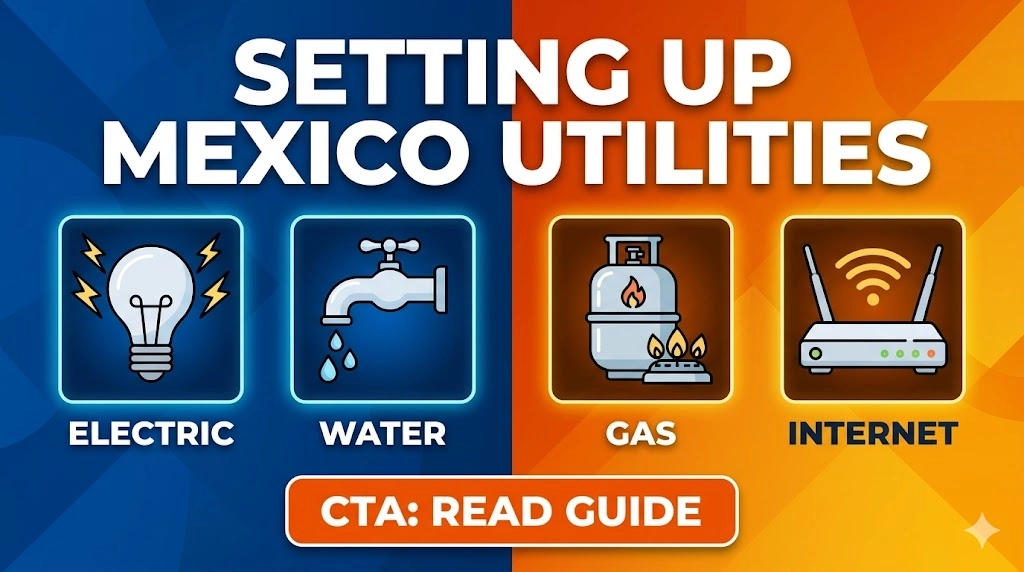
2. The Mexican Water Crisis Cisterns Tinacos and Pipas
If electricity is a monopoly, water in Mexico is a localized crisis. You must entirely abandon the assumption that turning on the tap guarantees a limitless, highly pressurized stream of water. In vast regions of the country, municipal water infrastructure is critically overtaxed.
Municipal Water vs Trucked Delivery
In many highly desirable expat hubs—particularly in Oaxaca, San Miguel de Allende, and Los Cabos—municipal water (agua potable) does not flow through the city pipes continuously. Neighborhoods are placed on strict rationing schedules (tandeos). The city might only pump water to your specific street on Tuesdays and Fridays for a three-hour window.
If your home’s internal storage tanks run dry before the city pumps water again, you have only one option: you must purchase water from the private sector. You have to call a pipa (a massive private water truck). The pipa driver will park on your street, run a massive industrial hose over your wall, and manually fill your underground tank. During the dry season (March through May), the demand for pipas skyrockets, and the price gouging can be intense. Securing a reliable pipero (truck driver) via WhatsApp is a mandatory survival skill.
The Anatomy of a Mexican Home Water System
Because municipal water delivery is intermittent, every functional Mexican home operates as its own independent water storage facility. You must intimately understand the anatomy of this system to prevent catastrophic dry spells.
- The Cisterna: This is a massive underground concrete or plastic reservoir built beneath your patio or garage. When the city pumps water, it flows here first. A standard cisterna holds between 2,500 and 10,000 liters.
- The Water Pump (Bomba): An electric pump pulls the water from your underground cisterna and pushes it up to your roof.
- The Tinaco: This is the iconic black plastic tank sitting on virtually every roof in Mexico. It holds roughly 1,100 liters of water. Gravity pulls the water down from the tinaco into your showers and faucets.
If your electricity goes out, your pump cannot move water from the cisterna to the tinaco. Once the tinaco is empty, you have no water pressure, even if you have 5,000 liters sitting underground. Before signing any lease, you must physically inspect the size of the cisterna and the condition of the pump. We highlight these specific infrastructural checks in Furnished vs Unfurnished Rentals in Mexico: What to Expect and Cost Differences.
Drinking Water The Garrafón Economy
Under absolutely no circumstances should you ever drink the tap water in Mexico. The municipal water is highly mineralized, frequently contaminated during transit through aging pipes, and is not potable. Even local Mexican families do not drink tap water.
Your entire hydration and cooking routine will revolve around the garrafón (a 20-liter heavy plastic jug of purified water). You purchase your first empty garrafón from an OXXO, a local abarrotes (corner store), or a water delivery truck. From then on, you exchange your empty jug for a sealed, full one. A refill typically costs between 40 and 60 pesos (roughly $2 to $3 USD).
Many expats choose to pay a premium to have companies like Bonafont, Epura, or Ciel deliver garrafones directly to their door weekly, sparing them the physical labor of hauling 40-pound jugs up flights of stairs. If you purchase an unfurnished home, buying a high-quality water dispenser should be your very first purchase on a platform like Amazon Mexico to ensure you have immediate access to clean drinking water while you unpack.
3. Cooking and Heating The Reality of Domestic Gas
Unlike modern subdivisions in the US or Europe, centralized, piped natural gas infrastructure is exceedingly rare in Mexico, largely confined to hyper-modern luxury high-rises in cities like Monterrey or CDMX. For the vast majority of expats, domestic gas—used for your stove, your oven, and your hot water heater (boiler)—is delivered by truck.
Tanque Estacionario vs Cilindros
When you tour a potential rental property, you must look up at the roof and look in the utility patio to determine what kind of gas infrastructure you are inheriting.
The preferred system is a Tanque Estacionario (stationary tank). This is a massive, submarine-shaped metal tank permanently bolted to the roof of your house or apartment building. It holds hundreds of liters of liquid petroleum gas (LP gas). It is safer, requires fewer refills, and features an analog gauge so you can physically climb onto the roof and check your fuel levels.
The alternative system utilizes Cilindros (portable gas cylinders), typically holding 20 or 30 kilograms of gas. These heavy metal tanks sit in your utility patio, connected directly to your boiler or kitchen via copper piping. The danger of cylinders is that they do not have gauges. You only know you are out of gas when your stove refuses to light or your shower suddenly turns freezing cold. Prudent expats who rely on cylinders always keep a backup tank on the property so they can quickly swap the connection when the primary tank dies.
How to Order and Monitor Your Gas
Gas delivery in Mexico is a vibrant, loud, and uniquely cultural experience. Gas trucks prowl the neighborhoods daily, blasting a customized, heavily distorted jingle from a loudspeaker, or featuring a driver screaming “GAAAAAS” at the top of their lungs.
If you use cylinders, you literally run out of your house when you hear the truck, flag them down, and the workers will carry a full cylinder into your patio and haul away the empty one. If you have a tanque estacionario, you hail a different type of truck (a pipa de gas). They will park on the street, drag a massive pressurized hose up the side of your building to your roof, and fill the tank.
Today, most established expats bypass the chaotic street-hailing method and simply order their gas via WhatsApp. You message your preferred local company (e.g., Gas Express Nieto, Zeta Gas), drop a GPS pin of your location, specify how many liters you want, and they dispatch a truck. You generally pay the driver directly in cash, though some modern trucks now carry mobile card readers. Always monitor your usage; running out of gas during a rare winter cold snap in the colonial highlands is miserable.
Safety Protocols and Leak Prevention
Because LP gas is heavier than air, a leak inside an enclosed Mexican kitchen or utility patio can be catastrophic. Mexican building codes regarding gas lines are notoriously lax compared to North American standards.
When you move into a new property, it is highly recommended to mix dish soap and water and rub it over the connections between the gas tank and the copper piping. If you see bubbles forming, you have a slow gas leak and must immediately call a local plumber (plomero) to re-seal the fittings with Teflon tape. To secure ultimate peace of mind, experienced expats immediately order a plug-in explosive gas detector from Amazon Mexico and install it low to the ground near their stove and indoor boiler.
4. Fiber Optic Internet Staying Connected and Productive
For digital nomads and remote workers, reliable internet is not a luxury; it is professional oxygen. The good news is that Mexico’s telecommunications infrastructure has modernized aggressively. If you live in a major city or an established expat hub, you have access to blazing-fast, highly affordable fiber-optic internet.
Telmex Totalplay and Izzi Choosing a Provider
The broadband market is dominated by three major players, and the “best” option depends entirely on your specific street’s wiring infrastructure.
- Telmex (Infinitum): Owned by Carlos Slim, Telmex is the historic national monopoly. They have the widest coverage map in the country. While their legacy copper-wire ADSL service is notoriously slow, their modern Fibra Óptica network is phenomenal, frequently delivering symmetrical gigabit speeds.
- Totalplay: A newer, aggressive competitor that operates exclusively on a 100% fiber-optic network. Totalplay is widely considered by the expat community to offer the most reliable uptime, the lowest latency (perfect for video conferencing), and the fastest customer service response times via their mobile app.
- Izzi: A major provider that often bundles cable television and internet. They utilize a mix of coaxial cable and fiber optics. While reliable in many luxury condo buildings, they generally suffer from slower upload speeds compared to Totalplay.
When choosing a property, you must ask the landlord which providers actually have “ports” available on the street pole outside the building. Just because Telmex services the neighborhood does not mean there is physical space on the pole to run a new line to your apartment. We discuss the critical nature of verifying this infrastructure in Digital Nomads in Mexico: Remote Work Guide.
The Installation Bureaucracy
Setting up a new internet contract is a test of your bureaucratic endurance. You must physically visit the provider’s office, pull a numbered ticket, and wait. You will need your passport, your residency card, and the sacred comprobante de domicilio (proof of address, usually a CFE electricity bill).
If you are renting and only have a tourist visa, Totalplay and Izzi will often refuse to open an account in your name. Telmex is sometimes more lenient but will require a massive upfront cash deposit. Furthermore, once you sign the contract, you enter the agonizing waiting period. Installation can take anywhere from 48 hours to three weeks, depending on the availability of local technicians and equipment.
Bridging the Connectivity Gap on Day One
You cannot put your remote job on hold for two weeks while waiting for the Telmex technician to arrive. You need absolute, ironclad connectivity from the second you unlock the door to your new apartment.
This is why veteran expats establish a digital safety net immediately. Before your move-in date, you must ensure your smartphone has a robust, high-capacity data plan capable of acting as a secure mobile hotspot for your laptop. By downloading an eSIM from Airalo, you instantly tap into the local Telcel or AT&T 5G network.
Using an Airalo data pack allows you to seamlessly tether your laptop, take your Zoom calls, and WhatsApp the internet technicians without relying on public cafe Wi-Fi. This day-one connectivity ensures you remain professionally viable while navigating the chaotic local installation logistics. We explore the broader strategies of mobile communication in Internet and Mobile Phone Plans in Mexico: Staying Connected as an Expat.
5. Trash Collection and Municipal Services
Waste management in Mexico operates on a highly localized, deeply cultural system that varies wildly from municipality to municipality. You will rarely find massive, automated plastic bins sitting neatly on the curb like in a North American suburb.
The Bell and the Trash Truck Protocol
In most traditional Mexican neighborhoods, trash collection (recolección de basura) is an interactive event. You do not leave your trash bags on the curb overnight, as the omnipresent street dogs (perros callejeros) will tear them to shreds before sunrise, leaving your garbage scattered across the block.
Instead, you must wait for the trash truck. As the truck slowly enters your neighborhood, one of the sanitation workers will violently and continuously ring a heavy brass handbell. When you hear the bell, you literally run out of your house carrying your trash bags and hand them directly to the workers on the back of the truck. If you are not home when the bell rings, you miss the collection.
Recycling Realities in Mexico
Formal, municipal recycling programs are virtually non-existent in Mexico outside of hyper-wealthy, progressive enclaves. You will not receive a blue bin for your plastics and cardboard.
However, informal recycling is a massive, highly efficient micro-economy. You will frequently hear the recorded voice of the fierro viejo truck cruising the streets, buying scrap metal and old appliances. Furthermore, local independent recyclers (pepenadores) walk the streets sorting through garbage for valuable aluminum cans and PET plastics. To assist them, many expats separate their clean plastics and cardboard into a distinct, clear bag and hand it separately to the sanitation workers, who sort and sell it for supplemental income.
Tipping Your Sanitation Workers
Sanitation workers in Mexico are frequently underpaid, and in some municipalities, they are not officially salaried employees at all, relying entirely on tips. It is a deep cultural expectation that you tip (dar propina) the workers when you hand them your trash. Handing them 10 or 20 pesos every time they take your bags is not just polite; it guarantees that they will wait an extra ten seconds for you when you are sprinting down the stairs with your garbage.
6. Managing Utilities as a Renter vs Owner
The legal liability and bureaucratic hurdles of managing utilities shift dramatically depending on whether you own the property or are simply signing a 12-month lease.
Whose Name is on the Bill?
If you purchase a home in Mexico, you must endure the agonizing process of visiting every single utility office—CFE, the municipal water authority (e.g., SAPAL, SIAPA), and Telmex—to legally transfer the deeds into your name, providing your new property title and your official tax ID (RFC).
If you are a renter, you almost never transfer the electricity or water bills into your name. Because outstanding utility debts remain attached to the physical property rather than the individual in Mexico, landlords fiercely guard the accounts. You will simply receive the bills bearing your landlord’s name and be expected to pay them on time. The only utility a renter typically initiates in their own name is the fiber-optic internet.
Transferring Utilities and Prorating Costs
When you move into a rental, you must demand a baseline reading of the electricity meter, the water meter (if applicable), and a visual inspection of the stationary gas tank on your very first day.
You do not want to inherit a massive, unpaid CFE bill from the previous tenant who ran their AC on the DAC tier for two months before fleeing. Photograph all meters and explicitly write the starting numbers into the annex of your lease contract. If you are moving in mid-billing cycle, you and the landlord must manually calculate and prorate the previous month’s usage.
The Comprobante de Domicilio Paradox
This dynamic creates a frustrating paradox for new expats. To open a Mexican bank account, buy a car, or secure residency, the government requires a Comprobante de Domicilio (Proof of Address). The only universally accepted proof is a recent CFE electricity bill.
But if you are renting, the CFE bill is in your landlord’s name, not yours. Fortunately, Mexican banks and immigration officials understand this reality. They will generally accept a CFE bill in your landlord’s name, provided the address matches your application exactly, and you can occasionally produce a formalized lease agreement to bridge the gap.
If navigating this bureaucratic paradox feels entirely overwhelming during your first month, the smartest strategic move is to execute a “soft landing.” By booking your initial 30 days at a turnkey coliving space like Selina, you bypass the entire utility nightmare. Staying at a Selina basecamp means your electricity, high-speed internet, and purified water are fully managed and included in your nightly rate. You avoid the stress of chasing gas trucks and tracking meter readings, giving you the mental bandwidth to safely scout permanent neighborhoods and understand the local infrastructure before signing a binding contract.
7. Troubleshooting and Emergency Utility Protocols
Mexico’s infrastructure is incredibly resilient, but it is routinely battered by intense tropical storms, massive earthquakes, and chronic underfunding. You will experience utility outages. Your survival and comfort depend entirely on your proactive preparation.
What to Do When the Power Grid Fails
Blackouts (apagones) are a standard feature of Mexican life. During the summer rainy season, spectacular lightning storms will frequently knock out neighborhood transformers, leaving you in the dark for anywhere from ten minutes to twelve hours.
You must protect your expensive electronics. A sudden power surge when the grid re-engages will instantly fry your laptop motherboard or your smart TV. The moment you move in, you must purchase heavy-duty surge protectors (reguladores de voltaje) for every expensive appliance. Furthermore, if you work remotely, you must buy an Uninterruptible Power Supply (UPS) battery backup for your internet router. You can easily source high-capacity UPS units and surge protectors via Amazon Mexico and have them delivered directly to your door before the rainy season begins. A UPS ensures that even if the neighborhood goes dark, your router stays powered, allowing you to finish your Zoom call and save your work.
Handling Sudden Water Shortages
If you wake up and the shower tap is dry, you must follow a strict diagnostic protocol.
- Check the Tinaco: Climb to the roof. Is the tank empty? If yes, the problem is supply. If it is full but you have no water, your internal plumbing is clogged.
- Check the Cisterna: Look underground. Is the massive reservoir empty? If yes, the municipal supply has failed, and you must immediately WhatsApp your local pipa driver to order a water truck.
- Check the Pump: If the cisterna is full but the tinaco is empty, your electric water pump has failed, or a breaker has tripped. You must call a local plumber (plomero) to repair the motor.
Never let your cisterna drop below 25% capacity. If you wait until it is bone dry to call a water truck, you risk burning out your electric pump by forcing it to suck air.
Essential Backup Gear for Your Home
To live comfortably in Mexico, your home must be equipped like a mild survival bunker. You are the final line of defense against infrastructural failure.
Every expat home must possess:
- Multiple heavy-duty, rechargeable LED emergency lanterns.
- A butane camping stove (so you can boil water and cook if you run out of domestic LP gas).
- A minimum of three full, sealed 20-liter garrafones of purified drinking water in reserve at all times.
- A digital multimeter to test wall outlets for proper grounding (many older Mexican homes are ungrounded, creating massive shock hazards for modern appliances).
By understanding the mechanics of the CFE monopoly, embracing the logistical reality of water trucks, and fortifying your home with strategic backups, you transform the intimidating chaos of Mexican utilities into a manageable, highly predictable routine. You stop surviving the infrastructure and start mastering the incredible lifestyle Mexico offers.
References
Primary sources (official)
- Procuraduría Federal del Consumidor (PROFECO): The federal consumer protection agency, offering guidelines on utility disputes, authorized LP gas pricing, and telecommunications rights. https://www.gob.mx/profeco
Other helpful sources
- Airalo: Global eSIM provider ensuring immediate, reliable mobile data access to manage utility deliveries and WhatsApp communication before home internet is installed. https://www.airalo.com/
- Amazon Mexico: Essential e-commerce lifeline for rapidly sourcing heavy-duty surge protectors, UPS battery backups, and gas leak detectors. https://www.amazon.com.mx/
Disclaimer
The information provided in this article is for educational and informational purposes only and does not constitute financial, legal, or professional infrastructural advice. Utility pricing, CFE subsidy thresholds, municipal water delivery schedules, and telecommunications coverage vary drastically by state, municipality, and specific neighborhood. Attempting to repair electrical panels, water pumps, or LP gas connections carries severe risks of injury or death; always hire licensed, local Mexican technicians (electricistas and plomeros) for infrastructural repairs. Ensure that any services, platforms, or e-commerce strategies mentioned meet your specific individual requirements and legal residency status.