Living in Mexico: Cultural and Practical Guide for New Expats
Moving to Mexico is the ultimate romanticized dream for hundreds of thousands of North Americans and Europeans. You picture yourself sipping mezcal on a sun-drenched terrace, typing away on your laptop, and seamlessly absorbing the vibrant local culture. But transitioning from a two-week resort tourist to a permanent, boots-on-the-ground resident requires a massive psychological and practical recalibration. This comprehensive, brutally honest 2026 guide is designed to strip away the digital nomad myths and provide you with the essential cultural survival toolkit. From decoding the true meaning of Mexican time to surviving the infamous bureaucratic trámites, here is the unvarnished guide to actually living, adapting, and thriving in Mexico.
Disclosure: This post may contain affiliate links. We may earn a commission at no extra cost to you if you make a purchase through these links. Read full disclosure.
1. The Soft Landing: Do Not Rush the Move
The most common and devastating mistake new expats make is attempting to conquer Mexico in a single weekend. They fly into Mexico City or Guadalajara on a Friday, expecting to view five apartments, sign a 12-month lease, set up their internet, and start their new remote job by Monday morning. This hyper-aggressive North American timeline will completely break you in Latin America.
Basecamping and Community
When you first arrive, you must grant yourself the gift of a “soft landing.” Do not immediately lock yourself into a year-long lease in a neighborhood you do not genuinely understand.
Instead, seasoned expats and remote workers start by booking temporary, reliable accommodation for their first month. Utilizing a globally recognized co-living and co-working hub like Selina is the ultimate strategic move. Staying at a Selina property in locations like Oaxaca, Tulum, or CDMX instantly solves your most pressing immediate needs. You receive a secure room, enterprise-grade Wi-Fi (which is absolutely critical while you organize your life), and immediate integration into a community of fellow expats and bilingual locals.
This built-in network provides invaluable, boots-on-the-ground intelligence. They will tell you which neighborhoods flood during the rainy season, which local Facebook groups are best for finding long-term rentals, and which local street food stands to avoid. By establishing a frictionless basecamp, you give yourself the physical and mental space to absorb the culture shock and make strategic, long-term decisions. We outline how to budget for this transitional phase in our Cost of Living in Mexico: 2026 Comprehensive Guide.
2. Connectivity is Oxygen: The WhatsApp Rule
If you take only one piece of practical advice from this guide, let it be this: In Mexico, email is dead. Everything runs on WhatsApp.
In the US or Canada, you might email a real estate agent, submit a web form to book a dentist appointment, or call a customer service hotline. In Mexico, whether you are communicating with a landlord, ordering a pizza, sending architectural blueprints to a contractor, or chatting with the immigration attorney handling your residency, it is all executed via WhatsApp. If you do not have an active WhatsApp account tied to a functional mobile data connection, you functionally do not exist in the Mexican economy.
Securing Day-One Connectivity
Because your entire relocation logistics depend on immediate communication, you cannot afford to land at the airport without a working smartphone. Attempting to navigate the chaotic arrivals terminal of Cancún or Mexico City while searching for a physical Telcel kiosk to buy a local SIM card is a recipe for immense stress.
To eliminate this friction, smart expats download a digital eSIM from Airalo before their flight even takes off. With an Airalo Mexico data pack installed, your phone instantly connects to the local Mexican cellular network (usually Telcel or AT&T) the exact second your plane’s wheels touch the tarmac. You can immediately WhatsApp your Selina host, order a secure Uber to bypass the predatory airport taxi mafias, and navigate your new city via Google Maps. Day-one connectivity is your greatest tactical advantage. We explore long-term local cell contracts deeply in Internet and Mobile Phone Plans in Mexico: Staying Connected as an Expat.
3. The Cultural Mindset Shift: Time, Tact, and Noise
To survive in Mexico, you must undergo a fundamental rewiring of your social expectations.
The Fluidity of Time (La Hora Mexicana)
In Northern Europe and North America, time is a rigid, linear commodity. If a meeting is at 2:00 PM, arriving at 2:05 PM requires an apology. In Mexico, time is fluid, circular, and heavily subordinate to interpersonal relationships.
You will quickly encounter the concept of “Ahorita.” Literally translated, it means “right now” or “in a little bit.” Culturally, ahorita can mean in five minutes, in five hours, tomorrow, or absolutely never. If a repairman says he will be there ahorita, you must learn to detach from your rigid schedule.
Similarly, if you are invited to a Mexican social gathering or party that “starts” at 8:00 PM, arriving at 8:00 PM is considered almost rude. You will likely catch the host still in their bathrobe. You are expected to arrive at 9:00 PM or 9:30 PM. Learning to surrender to La Hora Mexicana (Mexican Time) is the first step toward inner peace as an expat.
Politeness Over Directness (El Tacto)
Mexican culture is deeply rooted in politeness, warmth, and avoiding direct confrontation. While Americans value blunt efficiency (“Give it to me straight”), Mexicans value tacto (tact).
Because it is considered incredibly rude to say a flat “No” to someone’s face, you will often receive a soft “Maybe,” a “Let me check on that,” or an “I will call you tomorrow” when the actual answer is a definitive “No.”
- If you ask a shopkeeper if they carry a specific item, and they don’t, they might send you to a non-existent store down the street rather than disappoint you with a “No.”
- If a landlord does not want to rent to you, they won’t reject you directly; they simply will stop replying to your WhatsApp messages.
You must learn to read between the lines. Do not mistake this indirectness for malicious dishonesty; it is a profound cultural desire to maintain social harmony and save face for both parties.
The Symphony of Chaos (Embracing the Noise)
Mexico is loud. It is not just occasionally loud; it is structurally, unapologetically loud. If you are seeking absolute, pin-drop silence, you will struggle outside of highly insulated, hyper-wealthy gated communities.
When you live in a standard Mexican neighborhood, your daily soundtrack will include:
- El Gasero: The propane gas truck driving slowly down your street, blasting a catchy jingle or a man screaming “GAAAAAAS” through a megaphone at 7:30 AM.
- El Fierro Viejo: The iconic, hauntingly recorded voice of a young girl blaring from a pickup truck, asking to buy scrap metal, old washing machines, and mattresses.
- Cohetes (Fireworks): Mexico uses explosive, incredibly loud fireworks to celebrate everything from the local patron saint’s day to a random Tuesday afternoon. They sound like military artillery, and they will happen frequently.
- Street Dogs and Roosters: Stray dogs barking through the night and roosters crowing at 4:00 AM are a standard feature of both urban and rural life.
You cannot fight the noise. You cannot call the police to file a noise complaint because your neighbors are throwing a massive quinceañera with a live banda that rattles your windows until 4:00 AM. You must invest in high-quality earplugs, learn to laugh at the chaos, and accept that the vibrant noise is the pulse of the country.
4. The “Naked House” and Domestic Logistics
When you finally navigate the complex rental market and secure the keys to your new apartment, you will encounter the “naked house” phenomenon.
What “Unfurnished” Actually Means
In the US or Canada, an unfurnished apartment still comes with a refrigerator, an oven, built-in closets, light fixtures, and a hot water heater. In Mexico, an unfurnished (sin muebles) apartment is frequently a literal concrete shell.
It is culturally standard for Mexican tenants to take absolutely everything with them when they move. You may unlock the door to find bare wires hanging from the ceiling where light fixtures used to be, empty alcoves where closets should be, and a kitchen completely devoid of appliances.
The Logistics of Outfitting Your Home
If you do not own a pickup truck, outfitting a naked apartment in Mexico is an exhausting logistical nightmare. Navigating massive local department stores (like Liverpool or Coppel) in broken Spanish and attempting to organize independent freight delivery for a heavy refrigerator and a mattress can consume your first two weeks in the country.
To bypass this massive friction, seasoned expats heavily leverage Amazon Mexico. Amazon’s logistics and supply chain network across Mexico is phenomenal. You can order premium mattresses in a box, microwaves, smart TVs, ceiling fans, power tools, and essential furniture directly to your new Mexican address, often with free two-day delivery via Amazon Prime. Utilizing Amazon Mexico allows you to rapidly build out the baseline comforts of your bare-bones apartment entirely from your smartphone, bypassing the stress of local freight logistics. We break down the specific legal hurdles of securing these empty apartments in Renting a Home in Mexico: Complete Expat Guide to Leases, Deposits, and More.
The Reality of Mexican Plumbing and Water
You must fundamentally change how you interact with water in Mexico.
- Do Not Drink the Tap Water: Municipal water in Mexico is not potable. Even locals do not drink it. You must rely on 20-liter purified water jugs (garrafones) delivered to your home weekly, or install a high-end reverse osmosis system under your sink. You use tap water for showering and washing dishes, but you brush your teeth with purified water.
- The Trash Can Next to the Toilet: Mexican plumbing infrastructure is old, and the pipes are significantly narrower than in North America. In 90% of homes, restaurants, and public facilities, you absolutely cannot flush toilet paper. You must place used toilet paper in the small trash bin located next to the toilet. Attempting to flush paper will result in a catastrophic and highly embarrassing blockage.
- The Tinaco and the Cisterna: Water pressure relies on gravity. Your home will have an underground cistern (cisterna) that catches municipal water, and a pump that pushes it to a tank on your roof (tinaco). When the municipal water shuts off (which happens frequently), you survive on the water stored in your tanks. Conserving water is a daily Mexican reality.
5. Navigating Mexican Bureaucracy: The Zen of “Trámites”
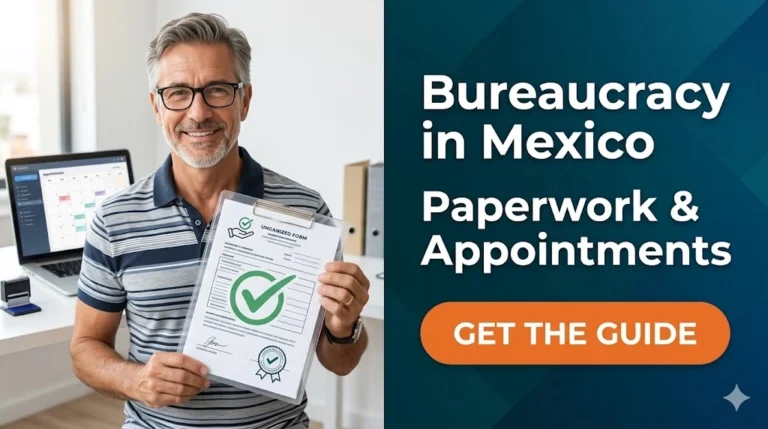
Dealing with Mexican government offices, banks, and utility companies requires a level of patience that borders on spiritual enlightenment. The Mexican word for an official procedure or paperwork process is a trámite. Your life as a new expat will be consumed by trámites.
The Cult of the Photocopy (La Copia)
Mexico runs on physical paper. You cannot simply pull up a PDF on your iPhone and show it to a bank teller. If you are going to the immigration office (INM) to process your residency, or the SAT office to get your tax ID (RFC), you must bring original documents and multiple pristine photocopies of every single page.
If you are missing a photocopy, you will be turned away and told to go to the local papelería (stationery shop) to make copies. Always carry a folder containing physical copies of your passport, your residency card, and your most recent utility bill.
The Sacred “Comprobante de Domicilio”
To do anything official in Mexico—open a bank account, buy a car, sign up for a gym—you must prove where you live by providing a Comprobante de Domicilio (Proof of Address).
This is almost exclusively satisfied by providing a recent CFE (electricity) or Telmex (internet) bill. Crucially, the bill does not necessarily have to be in your name; it is widely accepted that renters will provide a utility bill bearing their landlord’s name. However, the address on the bill must match your application exactly, and the bill usually cannot be older than two or three months. Guard your physical utility bills with your life.
“Falta un Sello” (It Needs a Stamp)
Bureaucracy in Mexico is highly decentralized and depends heavily on the mood of the specific clerk assisting you that day. You can follow the instructions on the official government website perfectly, arrive at the office, and be told that the rules changed yesterday, or that your document falta un sello (is missing a stamp) from a different department across town.
Do not get angry. Do not raise your voice. Raising your voice at a Mexican bureaucrat is the fastest way to ensure your paperwork is permanently “lost.” Smile, apologize for the confusion, ask them politely for guidance on how to fix the issue, and embrace the fact that completing a trámite often takes three separate trips. We detail exactly how to survive the banking version of this bureaucracy in Banking in Mexico: Complete Guide for Foreigners.
6. Safety in Mexico: Nuance Over Headlines
If you tell your family you are moving to Mexico, they will inevitably panic, citing sensationalized news headlines about cartel violence. The reality of safety in Mexico requires deep nuance, situational awareness, and street smarts.
The Two Mexicos
There is a massive distinction between the localized cartel conflicts fighting over trafficking routes in border states or specific hot zones (like parts of Michoacán or Zacatecas) and the daily life of an expat living in Mérida, Oaxaca, or the Roma Norte neighborhood of CDMX.
Cartels are generally multi-billion-dollar international logistics organizations. They are not interested in kidnapping a mid-level digital nomad from Canada. Violence is overwhelmingly targeted between rival organizations or against domestic authorities. As an expat, you are largely insulated from this specific type of violence, provided you do not involve yourself in purchasing illegal narcotics.
Crimes of Opportunity and Situational Awareness
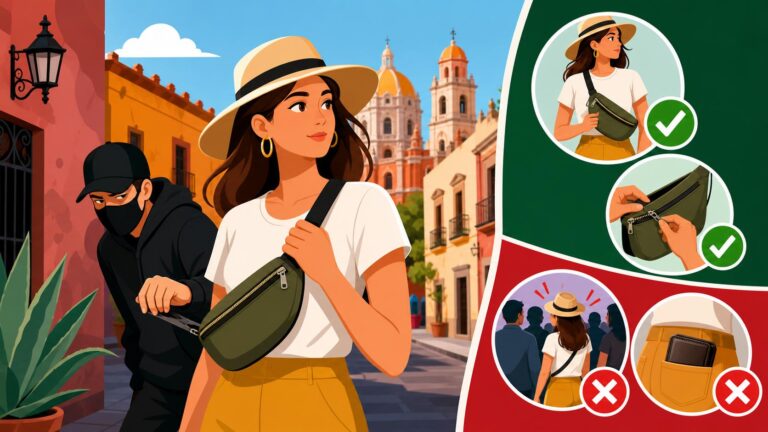
Your primary concern in Mexico is not the cartel; it is crimes of opportunity. Pickpocketing, phone snatching, and home burglaries are real threats in major urban centers. To stay safe, you must exercise basic, urban street smarts:
- Do not flash wealth. Leave the Rolex and the massive diamond rings in your home country. Do not walk down a dark street at night holding a $1,200 iPhone out in the open. Blend in.
- Use trusted transit. Do not hail random green or pink street taxis off the street, especially at night. Always use ride-sharing apps like Uber or DiDi, where the driver is tracked and the route is logged via GPS.
- Never drive the highways at night. If you own a car, plan your inter-city road trips exclusively during daylight hours. The risk of encountering hazards, unlit broken-down vehicles, or isolated roadblocks increases exponentially after dark. Stick to the paid toll roads (cuotas) rather than the free roads (libres), as they are heavily patrolled and much better maintained.
7. The Financial and Healthcare Reality Check
The Dual-Economy: Cash is Still King
While high-end restaurants in Guadalajara and supermarkets in Monterrey accept contactless Apple Pay, Mexico fundamentally operates on a massive informal cash economy.
You must carry physical Mexican Pesos every single day. You need coins to tip the voluntary grocery store baggers, small bills to buy fresh produce at the tianguis (open-air market), and cash to pay the street vendors for your evening tacos. Attempting to live entirely off a foreign travel credit card will isolate you from the authentic, local economy.
Furthermore, you must proactively manage your currency risk. If you are earning in dollars but spending in pesos, a sudden shift in the exchange rate can destroy your budget. Expats must learn to utilize modern financial tools to move money securely without paying exorbitant retail bank fees.
The Medical Safety Net
The public healthcare system in Mexico (IMSS) is heavily overburdened and generally not recommended for expats. However, the private healthcare system is world-class and significantly more affordable than in the United States.
For a minor stomach bug, you do not go to a hospital. You go to a Farmacia con Consultorio (a pharmacy with an attached doctor’s office, like Farmacias Similares or Farmacias del Ahorro). You pay roughly $3 to $5 USD for a basic consultation, the doctor writes you a prescription, and you buy the medication right next door. It is incredibly efficient.
However, for catastrophic emergencies—a severe car accident or a complex surgery—you absolutely must have international health insurance. Private Mexican hospitals demand massive upfront cash deposits before they will admit you to the trauma ward. Do not rely entirely on paying cash for major medical events. We break down the exact costs of local insurance policies and hospital stays in Healthcare Costs in Mexico: Doctor Visits, Hospital Stays, and Surgery Expenses.
Conclusion: Surrendering to the Experience
Living in Mexico is not about perfectly replicating your North American or European life with better weather and cheaper tacos. If you try to force Mexico to conform to your expectations of hyper-efficiency, rigid schedules, and sterile bureaucracy, the country will chew you up and spit you out.
To truly thrive here, you must practice the art of surrender. You must learn to laugh when the water goes out for a day, smile warmly at the bureaucrat who tells you that you need one more photocopy, and appreciate the fact that a two-hour lunch with friends on a Tuesday is far more culturally important than hitting a rigid deadline.
By executing a soft landing with Selina, maintaining ironclad digital connectivity with Airalo, heavily leveraging Amazon Mexico to bypass logistical nightmares, and embracing the chaotic, beautiful noise of the streets, you transition from a frustrated foreigner into a deeply integrated, highly fulfilled local resident.
References
Primary sources (official)
- Secretaría de Relaciones Exteriores (SRE): Official guidelines for foreign nationals, consular services, and the initial visa application processes at Mexican embassies abroad. https://www.gob.mx/sre
Other helpful sources
- Airalo: Global eSIM provider for securing immediate mobile connectivity and WhatsApp access in Mexico, crucial for navigating the digital landscape. https://www.airalo.com/
- Amazon Mexico: Essential e-commerce platform for expats needing rapid delivery of home furnishings, appliances, and daily essentials. https://www.amazon.com.mx/
Disclaimer
The information provided in this article is for educational and informational purposes only and does not constitute financial, investment, legal, or immigration advice. Mexican immigration laws, localized bureaucratic procedures, and safety conditions are highly variable by state and subject to rapid change. The cultural integration strategies and practical tips described are general guidelines, and individual experiences will vary significantly based on your specific location and personal circumstances. Always consult with certified bilingual immigration attorneys, tax professionals, and verified relocation specialists before making significant international moves or signing legally binding contracts. Ensure that any services or platforms mentioned meet your specific individual requirements and legal residency status.