Cost of Living in Puerto Vallarta: Budgeting for Beach Life
Puerto Vallarta is no longer a sleepy, bargain-basement fishing village. It is a booming, highly internationalized metropolis with a massive real estate market, a surging remote-worker population, and a heavy influx of foreign capital. While it absolutely remains more affordable than coastal cities in California, Florida, or British Columbia, the “gringo tax” and the premium for beachfront living are very real. This comprehensive guide cuts through the noise, breaking down exactly what expats can expect to spend across every category. From navigating the fiercely competitive housing market in the Zona Romántica to managing the infamous “sweat tax” of summer electricity bills, here is the factual, unvarnished truth about the cost of living in Puerto Vallarta today.
Disclosure: This post may contain affiliate links. We may earn a commission at no extra cost to you if you make a purchase through these links. Read full disclosure.
Housing and Real Estate: The Geography of Your Budget
The single largest line item in your Puerto Vallarta budget is rent, and your monthly housing cost is entirely dictated by your proximity to the ocean and the specific neighborhood you choose. The city is highly segmented, offering everything from hyper-luxury resorts to working-class residential blocks.
The Premium Zones: Zona Romántica, Conchas Chinas, and Marina Vallarta
If you desire a North American standard of luxury wrapped in a highly walkable, tourist-friendly environment, the Zona Romántica (Old Town) is the undisputed epicenter of the expat, digital nomad, and LGBTQ+ communities. The demand here is staggering. In 2026, renting a modern, furnished one-bedroom apartment in a building with a rooftop pool in the Zona Romántica routinely averages around $1,400 to $1,800 USD per month. For a two-bedroom unit, prices easily scale from $2,100 to $3,500+ USD.
Just south of the center, Conchas Chinas—often referred to as the “Beverly Hills of Puerto Vallarta”—offers sweeping cliffside views of the bay. Condos and villas here are heavily geared toward luxury retirees, with rents typically starting at $2,500 USD and rocketing upwards. To the north, Marina Vallarta provides a quiet, manicured, yacht-club lifestyle heavily favored by golfers and families, with two-bedroom rents mirroring the $2,000 to $4,000 USD range.
The Smart Expat Strategy: Versalles and 5 de Diciembre
To reclaim your budget without sacrificing safety, amazing food, or beach access, savvy expats have pushed into transitional neighborhoods. Versalles has rapidly become the culinary capital of Puerto Vallarta. It lacks the direct beachfront of the Zona Romántica, but it makes up for it with phenomenal cafes, lower noise levels, and authentic Mexican charm. A beautiful, modern two-bedroom apartment here typically rents for $1,000 to $1,500 USD per month.
5 de Diciembre, located just north of Centro, offers incredible hillside ocean views and immediate walkability to the Malecón. Because of the steep cobblestone hills, rents here are naturally suppressed. You can find a charming, traditional one-to-two-bedroom Mexican apartment here for roughly $800 to $1,200 USD per month. By simply expanding your search radius by a few miles from the primary tourist zones, you slash your housing budget by up to 40% while deeply improving your cultural immersion.
The Bureaucracy of Leasing
Securing a 12-month lease in Puerto Vallarta involves navigating a strict bureaucratic gauntlet. Landlords here aggressively protect themselves against transient tenants and squatters. You will generally be asked to provide a fiador (a guarantor who owns debt-free property in the state of Jalisco). Since most new expats lack a local fiador, you will usually be required to pay for an estudio socioeconómico or póliza jurídica—a legal background check and contract fee that costs roughly 30% to 50% of one month’s rent.
Furthermore, you are generally expected to provide the first month’s rent and a security deposit equal to one month’s rent upfront. When you need to transfer several thousand dollars to secure a lease, relying on a traditional US or Canadian retail bank will subject you to brutal exchange rate markups. To guarantee the money arrives instantly and without hidden margin fees, savvy expats use Wise. By loading your home currency into Wise, you secure the true mid-market exchange rate and can execute a local SPEI transfer directly to the landlord or property manager. We explore this localized leasing process deeply in Renting a Home in Mexico: Complete Expat Guide to Leases, Deposits, and More.
Buying Property and the Fideicomiso
For those looking to transition from renting to owning, Puerto Vallarta offers strong gross rental yields (typically between 5% and 8% annually for short-term rentals). However, because the city sits directly on the coast, foreigners are constitutionally prohibited from holding the direct deed.
You must utilize a bank trust system known as a fideicomiso. Setting up this trust requires an initial fee of roughly $2,000 to $3,000 USD, plus an annual maintenance fee of $500 to $1,000 USD paid to the Mexican trustee bank. For massive real estate transactions—such as wiring $300,000 USD to a notary’s escrow account—executing your capital transfer through an institutional platform like Interactive Brokers allows you to convert massive sums into pesos at exact spot-market rates, saving you a small fortune compared to standard retail bank wire spreads. We demystify this specific property framework in Buying Property in Mexico: The Fideicomiso Explained.
Utilities, Internet, and the Summer Climate Tax
The CFE Grid and the Brutal Summer AC Trap
The climate in Puerto Vallarta dictates a massive portion of your monthly budget. From November to April, the weather is absolute perfection—sunny, dry, and breezy in the 70s and 80s (Fahrenheit). During these winter months, you will rarely need to turn on your air conditioning.
However, from June through October, the heat and humidity become intensely oppressive. Surviving the summer requires running your mini-split air conditioning units almost constantly. Electricity is provided by the state-owned CFE (Comisión Federal de Electricidad) and is billed bi-monthly. The CFE utilizes a strict, tiered subsidy system (Tarifa 1B for the Puerto Vallarta region).
If your AC usage is moderate, your bi-monthly bill might be $40 to $80 USD. However, if your usage pushes you into the high-consumption tier—known as DAC (Tarifa Doméstica de Alto Consumo)—your government subsidies vanish instantly. Once in the DAC tier, you are charged a massive premium for every kilowatt-hour. It is incredibly common for expats who run their AC 24/7 to receive summer electricity bills ranging from $150 to $300+ USD. Managing your climate control effectively is an absolute necessity to prevent utility bills from consuming your disposable income.
Water and Domestic Gas
Municipal water piped to your home in Puerto Vallarta is very cheap—usually under $15 USD a month (and frequently included in your condo’s HOA fees). However, it is not potable. You must budget for the regular delivery of purified 20-liter water jugs (garrafones), which cost about $2.00 to $3.00 USD each.
Domestic gas, used for cooking and heating your shower water, is usually delivered by truck to a stationary tank on your roof. Depending on how frequently you cook, a gas refill will run roughly $20 to $35 USD per month.
Telecommunications and Connectivity
Puerto Vallarta has evolved into a premier remote work destination precisely because its telecommunications infrastructure has scaled to meet demand. Providers like Telmex (Infinitum) and Izzi offer reliable, high-speed fiber-optic internet. A premium connection (100 to 300 Mbps) capable of supporting heavy video conferencing typically costs between $30 and $60 USD per month. You can review the nuances of securing these utility contracts as a foreigner in Internet and Mobile Phone Plans in Mexico: Staying Connected as an Expat.
For cellular service, prepaid plans are the local standard. A robust Telcel package offering unlimited domestic calls, unlimited social media, and sufficient gigabytes for daily use costs roughly $15 to $20 USD per month.
Food and Dining: From Street Tacos to Fine Dining
The Supermarket Landscape
Your grocery budget in Puerto Vallarta is highly elastic and depends entirely on your consumption habits. Because the city caters to a massive North American demographic, local corporate supermarkets stock almost everything you would find back home.
Massive stores like La Comer (especially the upscale City Market format), Costco, Walmart, and Soriana offer imported craft beers, premium cuts of beef, European cheeses, and specialized gluten-free products. If you shop exclusively at these high-end supermarkets and maintain a strict North American diet, your grocery bill will equal or exceed US and Canadian prices—easily $400 to $600 USD a month for a couple.
The Neighborhood Markets
To live economically, you must shift your shopping habits toward local agricultural rhythms. The best places for fresh produce are the traditional indoor markets, such as the Mercado Emiliano Zapata in the Romantic Zone, or the various tianguis (open-air markets) throughout the city.
By supplementing your supermarket runs with trips to local fruterías, fishmongers, and butchers, a couple can eat exceptionally well for $250 to $350 USD a month. Avocados, limes, tomatoes, and fresh seafood purchased locally cost literal pennies on the dollar compared to supermarket prices.
The Dining Spectrum
Puerto Vallarta is one of the premier culinary destinations in Mexico, meaning dining out requires financial discipline because the options are endless.
If you dine along the Malecón or in the heart of the Zona Romántica, prices quickly rise to international standards. A dinner for two with craft cocktails or wine at a high-end seafood or fusion restaurant will effortlessly exceed $80 to $150 USD.
However, true value lies just a few streets inland. You can buy phenomenal tacos al pastor or fresh ceviche tostadas from street carts for $1 to $3 USD each. Neighborhood fondas offer comidas corridas (fixed-price, three-course lunches) for roughly $5 to $8 USD. Mid-range, authentic restaurants in Versalles or Fluvial offer beautiful, sit-down meals for two for $30 to $50 USD.
To manage these restaurant bills effortlessly without accumulating 3% foreign transaction fees on your legacy credit cards, smart expats use localized digital funding strategies. You can read exactly how to optimize your spending apps in Using Credit and Debit Cards in Mexico: What Expats Need to Know.
Navigating the Bay: Transportation Economics
The Walkable Center and Public Buses
If you live in Centro, 5 de Diciembre, or the Zona Romántica, you can largely avoid transportation costs entirely. The core of Puerto Vallarta is highly walkable, though the cobblestone streets and steep hills provide a daily workout.
For regional travel across the bay, the local bus system is incredibly robust and cheap. A standard bus ride within the city limits costs 10 MXN (roughly $0.50 USD). Buses to outer towns like Bucerías or Sayulita are slightly more but remain an absolute bargain. While the buses lack air conditioning and can be a bumpy ride, they are the lifeblood of the local economy.
Taxis and Ride-Sharing
When walking isn’t an option, ride-sharing apps like Uber and InDrive are ubiquitous, safe, and relatively affordable. A 15-minute Uber ride across town typically costs between $4 and $8 USD, though prices surge dramatically during torrential summer rainstorms or peak rush hour.
Local yellow taxis are also plentiful. Unlike Ubers, they are not metered; they operate on a zoned fare system. You must establish the price with the driver before getting in the vehicle. Even if you take an Uber or taxi twice a day, your monthly transportation budget will be vastly lower than the carrying cost of a personal vehicle.
The Reality of Car Ownership
If you live in the deep suburbs, or if you want the ultimate freedom to explore the Riviera Nayarit coastline at your leisure, owning a car is an excellent luxury. However, purchasing a vehicle locally involves high upfront costs. Used cars in Mexico hold their value exceptionally well, and local auto loan interest rates are punitive (often exceeding 14%).
Buying a car in cash is highly recommended. Factoring in the vehicle cost, mandatory full-coverage auto insurance (which is cheap compared to the US, usually around $300-$500 annually), and the inevitable suspension damage from massive cobblestones, owning a car will drain several hundred dollars from your budget every month.
Healthcare in a Coastal Hub
World-Class Private Hospitals
Puerto Vallarta is a major destination for medical tourism. The city is home to modern, internationally accredited private hospitals such as Hospital Joya, CMQ, and San Javier. The quality of care, diagnostic imaging, and surgical expertise available here caters to the highest global standards.
Routine medical care is highly accessible and remarkably affordable. Booking an appointment with a top-tier, English-speaking specialist generally costs between $40 and $60 USD out-of-pocket. Dental work, ranging from routine cleanings to complex aesthetic implants, is consistently 60% to 80% cheaper than North American prices. Many younger expats simply pay cash for their daily medical needs.
The Absolute Necessity of Global Insurance
While routine care is cheap, relying entirely on a cash-only strategy for catastrophic emergencies is incredibly dangerous. A severe accident, a complex emergency surgery, or a major illness requiring ICU admission can easily result in bills exceeding $40,000 to $100,000 USD. Mexican private hospitals operate strictly as businesses; they demand massive upfront cash deposits or credit card holds before they will even admit you to a trauma room.
You must budget for a premium international health insurance policy. For a healthy adult, a robust global policy typically costs between $150 and $300 USD per month. This premium acts as your ultimate financial shield, ensuring you are treated in top-tier facilities without liquidating your retirement savings. We break down these exact insurance mechanics and facility costs in Healthcare Costs in Mexico: Doctor Visits, Hospital Stays, and Surgery Expenses.
Managing Cross-Border Finances and Wealth
The Invisible Tax of Retail Banking
The most devastating mistake new expats make in Puerto Vallarta is treating their finances exactly as they did back in the US, Canada, or Europe. When you move to Mexico, you must regularly convert your home currency to pesos to fund your daily life. If you rely on traditional retail banks to wire your rent or use their debit cards at local ATMs, you are being robbed blindly by hidden currency conversion markups and flat out-of-network withdrawal fees.
Traditional banks bake massive profit margins into their exchange rates, often skimming 3% to 5% off your money before it ever reaches Mexico. Over a single year, this invisible “expat tax” can cost you thousands of dollars in lost purchasing power.
To permanently escape this trap, the savvy expat community routes their monthly living expenses through Wise. By funneling your home currency through Wise, you guarantee the true mid-market exchange rate. Wise bypasses the sluggish SWIFT banking network, depositing your pesos instantly into your local Mexican bank account via the domestic SPEI system. It is the ultimate tool for stretching your monthly budget.
Protecting Your Global Assets
While you must manage your daily liquidity in pesos, keeping your life savings, proceeds from a home sale, or massive corporate salary localized in a Mexican retail bank is incredibly dangerous. The Mexican peso is an emerging market currency subject to intense geopolitical volatility. Your true wealth—your retirement accounts, emergency funds, and investment portfolios—must remain insulated from local economic shocks in hard currency.
Furthermore, many mainstream North American brokerages will forcefully restrict or close your investment accounts if they discover you have established a permanent foreign address in Mexico due to strict compliance laws. Being forced to liquidate your retirement portfolio simply because you relocated is a devastating financial hit.
To prevent a catastrophic compliance freeze, proactive expats migrate their assets to Interactive Brokers. Because Interactive Brokers caters explicitly to an international clientele, you can legally maintain your global investment portfolio using your Puerto Vallarta residential address. This ensures your wealth continues compounding securely in the global market, safely insulated from Mexican inflation. We explore these advanced strategies deeply in Banking in Mexico: Complete Guide for Foreigners.
Tax Implications for Digital Nomads and Retirees
If you make your home in Mexico, the Mexican tax authority (SAT) can consider you a tax resident, meaning you are obligated to declare your worldwide income.
Many remote workers assume that because their employer is abroad and their salary is deposited into a foreign bank account, Mexico has no right to tax them. This is entirely incorrect and highly dangerous in the modern era of automated global banking data exchanges (like CRS and FATCA). You must utilize Double Taxation Agreements to ensure you don’t pay taxes twice on the same dollar. We untangle these dual-country obligations comprehensively in Taxes in Mexico for Expats: A Complete Guide to Income Tax and More.
Three Realistic Puerto Vallarta Budgets
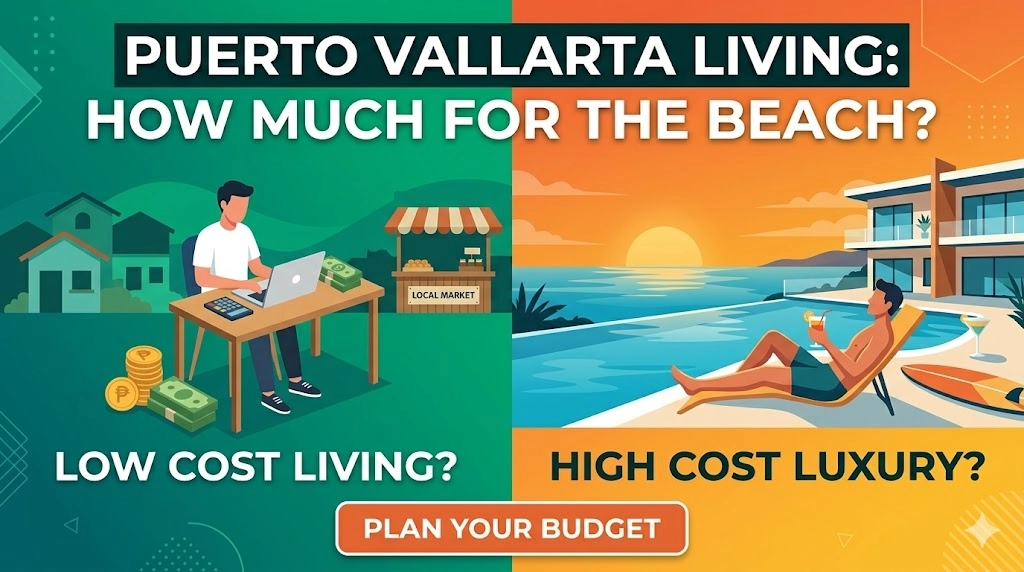
To contextualize the data, here are three realistic monthly budget profiles for a single expat living in Puerto Vallarta.
Profile 1: The “Lean Local” (Pitillal / Outskirts of Fluvial)
This expat avoids the prestige zones entirely, cooks at home using local markets, relies heavily on public buses, meticulously manages their AC usage, and integrates into the local working-class economy.
- Rent (Unfurnished 1BR/2BR apartment inland): $600 USD
- Utilities, Water, Gas & Internet (Strict AC management): $70 USD
- Groceries (Local markets & basic staples): $250 USD
- Dining Out (Street tacos, local fondas): $120 USD
- Transportation (Buses & occasional Uber): $40 USD
- Healthcare (Basic Expat Insurance & Cash Clinics): $120 USD
- Entertainment/Misc: $150 USD
- Estimated Monthly Total: $1,350 USD
Profile 2: The “Comfortable Remote Worker” (Versalles / 5 de Diciembre)
This is the standard digital nomad or comfortable expat budget. They rent a modern apartment close to the action, enjoy high-speed fiber-optic internet, utilize a hybrid grocery strategy, take Ubers frequently, and enjoy the city’s vibrant dining and cafe scene.
- Rent (Furnished 1BR/2BR near the beach/cafes): $1,300 USD
- Utilities & Internet (Moderate AC use + Housekeeper 1x week): $150 USD
- Groceries (La Comer, Walmart, some imported goods): $350 USD
- Dining Out & Nightlife: $400 USD
- Transportation (Uber/DiDi exclusively): $150 USD
- Healthcare (Premium Global Insurance): $200 USD
- Entertainment/Gym/Misc: $250 USD
- Estimated Monthly Total: $2,800 USD
Profile 3: The “Luxury Coastal Retiree” (Zona Romántica / Marina Vallarta)
This expat expects a premium lifestyle with zero compromises. They rent a luxury ocean-view condo or a marina-front villa, dine at high-end restaurants, shop at premium imported supermarkets, and demand the highest tier of global financial and medical security.
- Rent (Luxury Condo with Amenities/Ocean View): $3,000 USD
- Utilities, Internet, & Domestic Staff (High AC, Maid 2x week): $400 USD
- Groceries (City Market/Premium Imported Goods): $600 USD
- Dining Out (Fine Dining/Steakhouses/Beach Clubs): $800 USD
- Transportation (Renting/Owning a Car + Insurance/Gas): $350 USD
- Healthcare (Top-Tier Global Insurance): $350 USD
- Entertainment & Wealth Management: $600 USD
- Estimated Monthly Total: $6,100+ USD
| Expense Category | Lean Local | Comfortable Remote | Luxury Retiree |
| Housing Target | Pitillal, Las Juntas | Versalles, 5 de Dic. | Zona Romántica, Marina |
| Dining Strategy | Fondas, Street Food | Trendy Cafes, Mid-range | Fine Dining, Beach Clubs |
| Transit Focus | Local Bus, Walking | Uber, DiDi | Personal Car, Uber Black |
| Wealth Mgmt | Cash/ATM Focus | Standard Banking | Interactive Brokers Global Mgmt |
| Transfer Tool | Wise | Wise | Interactive Brokers / Wise |
Conclusion: Designing Your Life on the Bay
Puerto Vallarta offers an incredibly vibrant, safe, and culturally profound lifestyle. It boasts the infrastructure and medical facilities of a modern metropolis, surrounded by sweeping jungle mountains and the tranquil waters of the Pacific. It is not the absolute cheapest place to live in Mexico, but it arguably offers one of the best balances of safety, culinary excellence, and expatriate community in the entire country.
If you attempt to blindly replicate your North American lifestyle here—running your AC constantly, shopping exclusively for imported goods in the Zona Romántica, and ignoring local financial realities—your budget will escalate rapidly. By choosing your neighborhood strategically, embracing the local agricultural markets, optimizing your daily currency conversions with platforms like Wise, and protecting your massive long-term wealth securely through Interactive Brokers, you can unlock an exceptional, sustainable quality of life on the Bahía de Banderas.
References
Primary sources (official)
- Banco de México (Banxico): Official central bank portal for verifying daily mid-market exchange rates, historical inflation data, and monetary policy affecting the peso. https://www.banxico.org.mx/
Other helpful sources
- Numbeo – Puerto Vallarta: Crowd-sourced, highly detailed real-time cost of living tracking for Puerto Vallarta, allowing direct comparisons to your home city. https://www.numbeo.com/cost-of-living/in/Puerto-Vallarta
- Updates on infrastructure, public transportation routes, and city developments. https://visitpuertovallarta.com/
Disclaimer
The information provided in this article is for educational and informational purposes only and does not constitute financial, investment, legal, or tax advice. Macroeconomic conditions, inflation rates, real estate markets in gentrified zones, and currency exchange rates are highly volatile and subject to rapid change. The budgets presented are estimates, and individual lifestyle choices will heavily dictate actual monthly expenditures. Always consult with a certified cross-border financial planner and a qualified tax professional before relocating, restructuring your assets, or making significant financial decisions. Ensure that any financial platforms or services mentioned meet your specific individual legal residency and compliance requirements.