Understanding the Residente Temporal: Lucrativa vs No Lucrativa (With/Without Work)
The Mexican immigration system strictly categorizes foreigners based on their economic footprint inside the country. Your entire legal standing hinges on a single, uncompromising binary: Lucrativa vs. No Lucrativa (Lucrative vs. Non-Lucrative). This comprehensive guide is your roadmap to understanding the Mexican Temporary Resident visa. We will break down exactly what each category means, the distinct application pathways, the stringent UMA financial thresholds, the notorious “E-Gate Trap,” and how to seamlessly secure your local tax IDs and healthcare so you can thrive south of the border.
Disclosure: This post may contain affiliate links. We may earn a commission at no extra cost to you if you make a purchase through these links. Read full disclosure.
1. The Bedrock Rule: Following the Money
Before you fill out a single visa application or translate a bank statement, you must understand how the Mexican government legally defines “work.”
The INM does not care that you are physically typing on a laptop while sitting in a café in Condesa. They care exclusively about where the money originates and who your clients are.
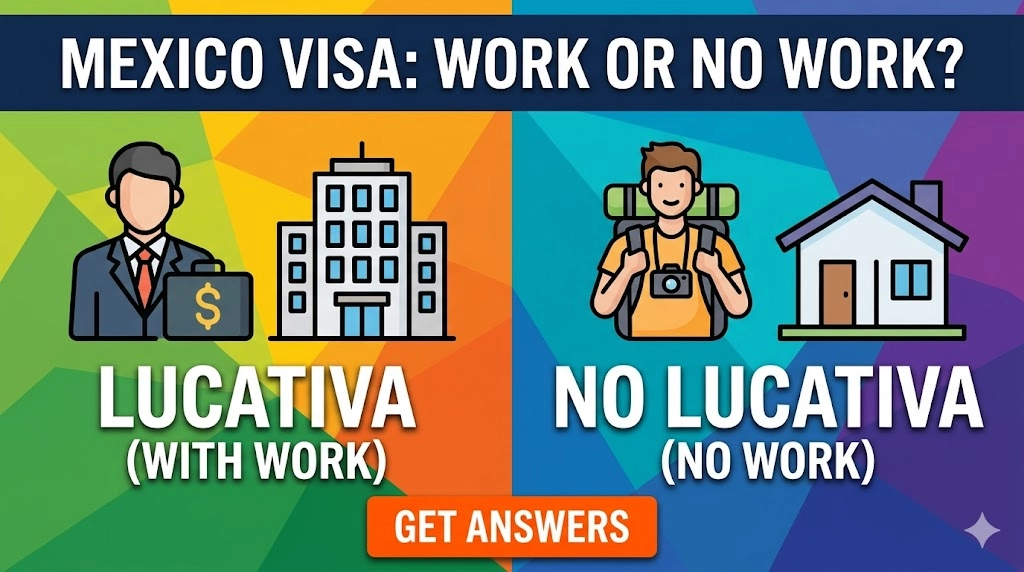
The “No Lucrativa” Classification (Non-Lucrative)
If your income is generated entirely outside of Mexico, you fall into the Non-Lucrative category.
- You are a retiree living off a pension from Canada.
- You are a software developer working remotely for a tech company in Seattle, and your salary is deposited into a US Chase bank account.
- You are a day trader managing your own portfolio in the UK.In all these scenarios, you are not taking a job from a Mexican citizen, nor are you pulling Mexican Pesos out of the local economy. You are bringing foreign capital into Mexico. The government welcomes this and classifies you as a resident engaging in non-lucrative activities.
The “Lucrativa” Classification (Lucrative)
If you intend to earn Mexican Pesos or provide services to entities within Mexican territory, you fall into the Lucrative category.
- You sign a formal employment contract with a Mexican corporation in Guadalajara.
- You open a brick-and-mortar bakery in San Miguel de Allende.
- You work as a freelance consultant and invoice local Mexican businesses.In these scenarios, you are formally entering the Mexican labor pool. You are competing with locals and extracting wealth from the local economy. To do this legally, you must obtain explicit Permission to Work (Permiso para realizar actividades remuneradas).
2. Residente Temporal NO LUCRATIVA (The Solvency Route)
For the vast majority of expats—including digital nomads, retirees, and snowbirds—the Residente Temporal No Lucrativa is the standard visa. It grants you the legal right to live in Mexico for up to four years, but it expressly forbids you from earning money from Mexican sources.
The Application Process: Starting Abroad
You cannot apply for a Non-Lucrative visa from within Mexico if you are currently on a tourist stamp (with the rare exception of Family Unity). You must initiate this process at a Mexican consulate outside of Mexico—usually in your home country.
Proving Economic Solvency (The 2026 UMA Metrics)
Because you are not allowed to work locally, the Mexican government demands absolute proof that you can support yourself without becoming a burden on the state. You must prove “Economic Solvency.”
In 2026, consulates calculate these thresholds using the UMA (Unidad de Medida y Actualización), which is officially set at $117.31 MXN daily. You must meet one of two strict financial criteria:
- Monthly Income (400 Days of UMA): You must prove a consistent, foreign-sourced monthly income hitting your bank account for the last 6 consecutive months.
- The Math: 400 x $117.31 = **$46,924 MXN per month**.
- The USD Estimate: Approximately $2,600 to $2,800 USD per month after taxes.
- Liquid Savings (20,000 Days of UMA): If you do not have a steady monthly income, you must show an average monthly balance over the last 12 consecutive months.
- The Math: 20,000 x $117.31 = **$2,346,200 MXN**.
- The USD Estimate: Approximately $135,000 to $145,000 USD.
If you meet these thresholds, the consular officer will place a pre-approved visa sticker in your passport. You then fly to Mexico to complete the Canje (Exchange) process to get your physical residency card. To optimize your lifestyle as a non-lucrative resident, review our Digital Nomads in Mexico: Remote Work Guide.
3. Residente Temporal LUCRATIVA (The Corporate Sponsorship Route)
If you are moving to Mexico because a local company offered you a job, your pathway is entirely different. You will apply for a Residente Temporal con Permiso para Trabajar (Temporary Resident with Permission to Work).
You do not need to prove Economic Solvency. Your job offer and your Mexican salary replace the need to show massive foreign bank accounts. However, you cannot initiate this visa yourself; your employer must do the heavy lifting.
The Employer’s CIE Registry
Before any Mexican company can legally hire a foreigner, the company must be heavily vetted by the federal government. They must hold an active Constancia de Inscripción del Empleador (CIE). This proves they pay their corporate taxes and are legally authorized to sponsor foreign visas.
The NUT Authorization Process
- The Petition: Your prospective employer submits your formal offer letter and your passport copy to their local INM office in Mexico, justifying why they are hiring you over a local candidate.
- The NUT: If the INM approves the corporate request, they generate an Authorization Letter containing a NUT (Número Único de Trámite).
- The Consulate: Your employer emails you the NUT letter. Only then do you book an appointment at a Mexican consulate in your home country. You present the NUT, your professional credentials, and your passport.
- The Visa Sticker: The consulate verifies the NUT in the federal database, issues your visa sticker, and you fly to Mexico to finalize the process.
When you receive your physical plastic card, the back of the card will explicitly state that you have permission to perform lucrative activities, legally tying you to your specific sponsoring employer.
4. The Hybrid Route: The Independent Work Permit
What happens if you arrive in Mexico as a “No Lucrativa” remote worker, but after six months, you decide you want to open a local coffee shop or start a freelance consulting business targeting Mexican clients?
You do not have a corporate sponsor, but you want to transition into the “Lucrativa” category. You must apply for a Permiso de Trabajo Independiente (Independent Work Permit).
The In-Country Transition
Because you already hold a valid Temporary Resident card, you do not need to leave the country. You can apply to upgrade your status directly at your local INM office.
The Business Plan Dossier
To secure an independent work permit, you must submit a formal, physical dossier to the INM that includes:
- The Petition Letter: A detailed letter (signed in blue ink) explaining exactly what your independent lucrative activity will be, your target market, and why your business benefits the local Mexican economy.
- Proof of Qualifications: You must prove you are qualified to perform the work. If you are opening an accounting firm, you must present your accounting degrees.
- SAT Registration: You must prove you are registered with the Mexican Tax Authority (SAT) and are ready to pay local taxes.
If approved, you surrender your old residency card, and the INM prints you a new one with the coveted “Permiso de Trabajo” notation on the back.
5. The Translation and Authentication Gauntlet
Whether you are applying for a Non-Lucrative visa at a consulate using your US bank statements, applying for a Corporate Lucrative visa using your Canadian engineering degree, or transitioning to an Independent Work permit, you will collide with the Mexican authentication mandate.
The Reality of Foreign Documents
A foreign bank statement, university diploma, or marriage certificate is legally meaningless to the Mexican government in its original form.
- The Apostille: Any official vital record or university degree must be internationally authenticated via an Apostille from the issuing government. (Note: Bank statements generally do not require an apostille, but they often require a “wet signature” from your branch manager).
- The Certified Translation: Once authenticated, Mexican immigration law strictly mandates that any foreign document must be accompanied by a certified Spanish translation.
You cannot use Google Translate. You cannot ask your bilingual real estate agent to translate your documents. The Mexican government explicitly requires translations performed by a recognized, sworn translator embedded within the Mexican legal system (a Perito Traductor).
We strongly recommend utilizing RushTranslate for your entire immigration and professional dossier. They specialize in certified, sworn translations specifically formatted for complex Mexican INM, corporate, and financial cases. By sending your apostilled degrees, vital records, and bank statements to RushTranslate prior to your consular interview or INM submission, you ensure your paperwork is legally flawless and universally accepted. Do not risk a visa rejection over a translation technicality.
6. The Tax Reality: The Inescapable RFC
In the past, expats on a Non-Lucrative visa operated entirely in the shadows. They lived in Mexico, worked remotely, and never interacted with the Mexican Tax Authority (SAT).
The era of the untracked expat is completely dead.
The RFC Mandate for BOTH Categories
Regardless of whether you hold a Lucrativa or No Lucrativa visa, you are legally required to possess an RFC (Registro Federal de Contribuyentes). This is the Mexican equivalent of a Tax ID or Social Security Number.
Without an RFC, you are paralyzed in the modern Mexican economy. You cannot open a local bank account, legally purchase a vehicle, or sign a post-paid fiber-optic internet contract.
- The Lucrativa Tax Reality: If you have a corporate work permit, your employer absolutely requires your RFC to process your payroll and withhold your income tax (ISR). If you are an independent freelancer, you must use your RFC to issue electronic invoices (CFDIs) and pay your monthly taxes, often utilizing the highly favorable RESICO (Simplified Trust Regime) which taxes gross income at incredibly low rates (1% to 2.5%).
- The No Lucrativa Tax Reality: If you are a remote worker or retiree, you must still register with the SAT and obtain an RFC “without fiscal obligations” (Sin Obligaciones Fiscales). This proves to the government that while you live in Mexico, you do not owe local taxes on Mexican-sourced income.
- The 183-Day Rule: Be hyper-aware that if you spend more than 183 days a year physically present in Mexico, the SAT considers you a tax resident, regardless of your visa type. You may be required to declare your global remote income, though double-taxation treaties usually protect you.
To navigate this highly complex financial landscape, thoroughly review Taxes in Mexico for Expats: A Complete Guide to Income Tax and More.
7. Healthcare: Protecting Your Mexican Dream
The type of visa you hold dictates your automatic access to the Mexican healthcare system. However, relying solely on visa-based healthcare is a dangerous logistical gamble.
The Public System (IMSS)
- Lucrativa (Corporate): The moment a Mexican company formally hires you, they are legally obligated to register you with the Instituto Mexicano del Seguro Social (IMSS). A portion of your paycheck funds this, granting you free access to public hospitals and clinics.
- No Lucrativa (or Independent): Because you do not have a corporate employer, you are not automatically enrolled in IMSS. However, as a legal resident, you possess the right to voluntarily buy into the IMSS system for a small annual fee.
The Critical Need for Elite Private Insurance
While having IMSS access is an excellent baseline safety net, the reality of utilizing the public system is complex. IMSS hospitals are chronically overcrowded, severely underfunded, and operate almost entirely in Spanish. Waiting for a specialist appointment or non-emergency surgery can take agonizing months.
If you suffer a severe medical crisis—a cardiac event, a major traffic accident, or complex oncology needs—you will almost certainly want to utilize Mexico’s elite private hospital networks (such as Hospital Ángeles, Star Médica, or Hospital San Javier).
However, private Mexican hospitals operate strictly for-profit. In an emergency, they will mercilessly demand a massive, upfront credit card deposit (often ranging from $3,000 to $10,000 USD) before they will even admit you to the emergency room or begin stabilization. US Medicare and Canadian provincial health plans do not cover you in Mexico.
Attempting to self-insure against catastrophic trauma in a foreign country is financial suicide. You must secure robust international health coverage to guarantee VIP access to private facilities. We highly recommend securing an expat-tailored policy through Cigna Global. Their international plans offer direct billing networks with Mexico’s top private hospitals. This means the hospital coordinates the massive bills directly with Cigna Global, completely bypassing the need for you to drain your checking account or navigate complex reimbursement forms in Spanish while under duress. Securing this coverage ensures your life in Mexico is physically and financially protected from day one.
8. The “Canje” Process: Turning Visas into Plastic
Whether you secured a No Lucrativa visa through your savings or a Lucrativa visa through corporate sponsorship, your experience at the Mexican consulate abroad ends the same way: with a visa sticker in your passport.
This sticker is not your residency card. It is a single-use entry permit valid for 180 days.
The E-Gate Trap
When you fly to Mexico to start your new life, do not use the automated e-gates at the airport. The digital e-gates are programmed strictly for tourists. If you scan your passport at a kiosk, you will be registered as a tourist, and your hard-earned residency visa sticker will be instantly and permanently voided. You will have to fly back to your home country to start over.
You must wait in line for a human immigration officer. Hand them your passport open to the visa sticker and explicitly state: “Vengo para el canje de mi visa.” (I am coming for the exchange of my visa). Ensure they stamp your passport and write “Canje” on it.
The 30-Day Window
From the exact date stamped in your passport, you have a strict, unforgiving 30-day window to initiate the Canje (Exchange) process at your local INM office.
You will submit your digital Formato Básico, provide specific tamaño infantil photographs (white background, no glasses), and pay the federal residency fees. Once processed—which can take 2 to 6 weeks, during which you cannot leave the country—you will provide digital fingerprints and receive your physical plastic Tarjeta de Residente Temporal. To properly budget for these rising federal expenses, read Mexico Immigration Fees and Costs: Budgeting for Your Residency.
9. The Ultimate Goal: Transitioning to Permanent Residency
Regardless of whether your card says “Permiso de Trabajo” on the back or not, both the Lucrativa and No Lucrativa pathways lead to the exact same ultimate destination: Permanent Residency.
Your Temporary Resident Visa is only valid for a maximum of four consecutive years. You will typically renew it after the first year for an additional three years.
Once you have completed exactly four years as a Temporary Resident, you are legally entitled to convert your status to Residente Permanente (Permanent Residency).
The Permanent Freedom
When you upgrade to Permanent Residency, the bureaucratic chains loosen entirely, and the distinction between Lucrativa and No Lucrativa effectively disappears:
- Open Labor Market: Permanent Residents possess the inherent, constitutional right to work anywhere in the Mexican economy. You no longer need corporate sponsorship, and you no longer need to petition the INM for an independent work permit. You can freely pivot from being a remote worker to opening a local business.
- No More Renewals: The Permanent Resident card never expires (Vigencia Indefinida). You are finished with the INM forever, barring required notifications for address or marital status changes.
- Pathway to Citizenship: Once you hold Permanent Residency (and have five total years of legal presence), you are eligible to apply for full Mexican naturalization and a powerful dual passport. To fully grasp this transition, review Qualifying for Permanent Residency in Mexico: Paths and Requirements.
10. Summary Matrix: Which Visa Are You?
Use this quick-reference guide to ensure you are pursuing the correct legal pathway for your relocation:
| Feature | Residente Temporal (NO LUCRATIVA) | Residente Temporal (LUCRATIVA) |
| Primary Demographic | Retirees, Digital Nomads, Snowbirds | Local Hires, Entrepreneurs, Local Freelancers |
| Source of Income | Must be strictly from outside Mexico | Earned in Mexican Pesos / Local Clients |
| Proof Required | Strict Solvency (UMA thresholds) | Corporate Job Offer OR Approved INM Business Plan |
| Initiation Point | Consulate Abroad | INM in Mexico (for Corporate), then Consulate |
| RFC Required? | Yes (Without Fiscal Obligations) | Yes (With Salary or RESICO obligations) |
| IMSS Healthcare | Voluntary Buy-In | Mandatory (Paid by Employer) |
| Path to Permanent? | Yes, after 4 years. | Yes, after 4 years. |
Conclusion: Designing Your Life in Mexico
The Mexican immigration system is deeply traditional, highly regulated, and completely unforgiving of assumptions. Attempting to blur the lines—such as working for a local resort while holding a Non-Lucrative visa—is a guaranteed path to severe federal fines and deportation.
However, by understanding the fundamental difference between the Lucrativa and No Lucrativa classifications, you take absolute control of your relocation. Whether you are bringing your foreign-earned wealth to enjoy a tranquil retirement in Lake Chapala, or securing a corporate work permit to advance your career in the tech hubs of Monterrey, the system is designed to accommodate you if you play by the rules.
Prepare your documentation meticulously, secure your certified translations and healthcare, and step confidently into the vibrant, unparalleled magic of your new life in Mexico.
References
Primary Sources (Official)
- Instituto Nacional de Migración (INM): The definitive federal portal detailing the procedures for transitioning to lucrative status, the corporate CIE requirements, and the Canje process. https://www.inm.gob.mx/mpublic/publico/inm-tramites.html
Other Helpful Sources
- Mexperience: A highly trusted portal providing simplified explanations of the strict distinctions between lucrative and non-lucrative activities, and the transition to Permanent Residency. https://www.mexperience.com/lifestyle/mexico-immigration-guide/
- ExpatDen Mexico: A detailed, firsthand resource offering granular breakdowns of Mexican corporate culture, navigating the SAT, and the reality of securing private healthcare as a legal resident. https://www.expatden.com/mexico/
Disclaimer
The information provided in this comprehensive guide is for educational, logistical, and informational purposes only and does not constitute formal immigration, legal, tax, labor, or medical advice. Requirements for Apostilles, UMA financial thresholds for economic solvency, and federal fee structures fluctuate annually. Always verify the most current requirements directly with the INM, the SAT, or your nearest Mexican consulate. We strongly recommend consulting with a certified bilingual Mexican immigration attorney regarding work permits, and a registered Mexican accountant to ensure your RFC is correctly classified to avoid tax penalties. Thoroughly verify your international travel health insurance coverage networks directly with your provider to ensure full protection while navigating the Mexican healthcare system.