Student Housing in Mexico: Dorms vs Apartments for International Students
Finding a place to live as an international student in Mexico usually hits a massive roadblock: local landlords demanding a Mexican property guarantor, or fiador. I spent my first two weeks bouncing between overpriced short-term rentals just trying to bypass this frustrating requirement. This guide breaks down exactly how to navigate dorms, apartments, and legal loopholes to secure your housing.
Disclosure: This post may contain affiliate links. We may earn a commission at no extra cost to you if you make a purchase through these links. Read full disclosure.
Understanding Your Housing Options in Mexico
The Rarity of On-Campus Dormitories
If you are coming from the United States, Canada, or the UK, your immediate instinct is likely to search for the “Housing” or “Residence Life” section on your target Mexican university’s website. You might be surprised to find that for the vast majority of institutions, this section simply does not exist. Historically, the Mexican higher education system was designed to serve local populations. Universities like the massive UNAM (Universidad Nacional Autónoma de México) function essentially as commuter campuses. Students live with their families in the city and commute to class via the metro or bus system. Because of this, the sprawling, village-like dormitory complexes that define North American college life are incredibly rare in the public university sector.
The major exceptions to this rule are the elite private universities. Institutions such as Tecnológico de Monterrey (Tec) and Universidad de las Américas Puebla (UDLAP) have heavily invested in modern, US-style campus housing specifically designed to attract students from across the country and around the world. These facilities are often state-of-the-art, featuring biometric security, integrated dining halls, and robust student life programming. If you are applying to one of these institutions, applying for a dorm is straightforward, but spaces fill up rapidly due to high demand. You can learn more about which institutions offer these facilities in our guide on Top Universities in Mexico for International Students (and What They Offer).
For international students attending public universities or private schools without housing, the lack of on-campus dorms forces an immediate pivot to the local real estate market. This can be intimidating, especially if you are managing the transition from abroad. You are immediately thrust into the adult world of signing contracts and navigating city infrastructure, rather than being eased into a sheltered campus environment. When researching your university choice, the availability of built-in housing should heavily influence your decision if you want to avoid administrative headaches during your first semester.
Off-Campus Student Residences
To fill the massive gap left by the lack of on-campus dorms, a robust industry of private, off-campus student residences has emerged in major Mexican college towns. These are independently owned and operated buildings that function exactly like dormitories but have no official affiliation with the universities themselves. They are strategically located within walking distance of major campuses or along direct public transit routes. These residences typically offer private bedrooms with shared bathrooms and kitchens, or fully private micro-studios.
The greatest advantage of these private residences for international students is their streamlined administrative process. Unlike traditional apartment landlords, these companies understand that their target demographic consists of young people and foreigners. Therefore, they rarely ask for a local fiador (guarantor). Usually, they only require your passport, proof of enrollment from your university, and a security deposit. When you are trying to secure housing from your home country before your flight, this flexibility is a lifesaver. Because you will likely be handling the booking and submitting sensitive financial deposits online, using NordVPN is highly recommended to ensure your connection is secure and to avoid regional blocks on Mexican payment gateways.
Life in an off-campus residence is heavily communal. They frequently feature shared study rooms, rooftop terraces, and laundry facilities. It is an excellent middle ground: you get the social integration and administrative ease of a dormitory, but with slightly more independence since you are living off-campus. The downside is that these properties charge a premium for their convenience and modern amenities. They are almost always more expensive than finding a room in a standard shared apartment with local students.
Private Apartment Rentals
Renting a private apartment is the most common housing route for both local out-of-state students and international expats in Mexico. This option offers total independence, complete control over your living space, and immersion into a genuine Mexican neighborhood rather than a student bubble. Depending on your budget and location, you might rent a modern high-rise condo in Monterrey, a colonial-style house with a courtyard in Puebla, or an older, more modest apartment in Mexico City.
Choosing this route means you are dealing directly with the Mexican real estate market. You will be signing a legally binding lease (contrato de arrendamiento) directly with a landlord (arrendador) or a local real estate agency. This level of integration requires a solid understanding of the local rental norms, which differ significantly from those in North America or Europe. For a broad overview of what to expect from different neighborhoods, review our post on Expat Housing in Mexico: Navigating Neighborhoods, Utilities, and Services.
The reality of renting privately is that the burden of setup falls entirely on you. You will be responsible for negotiating the rent, scrutinizing the contract, setting up your internet, and dealing with maintenance issues in Spanish. It is an incredible way to fast-track your cultural integration, but it is not for the faint of heart. If your Spanish is currently limited to basic greetings, you will find negotiating lease terms extremely difficult. Investing time in a comprehensive language program like SpanishPod101 before you arrive can give you the specific vocabulary needed to discuss deposits, utility bills, and contract clauses with potential landlords.
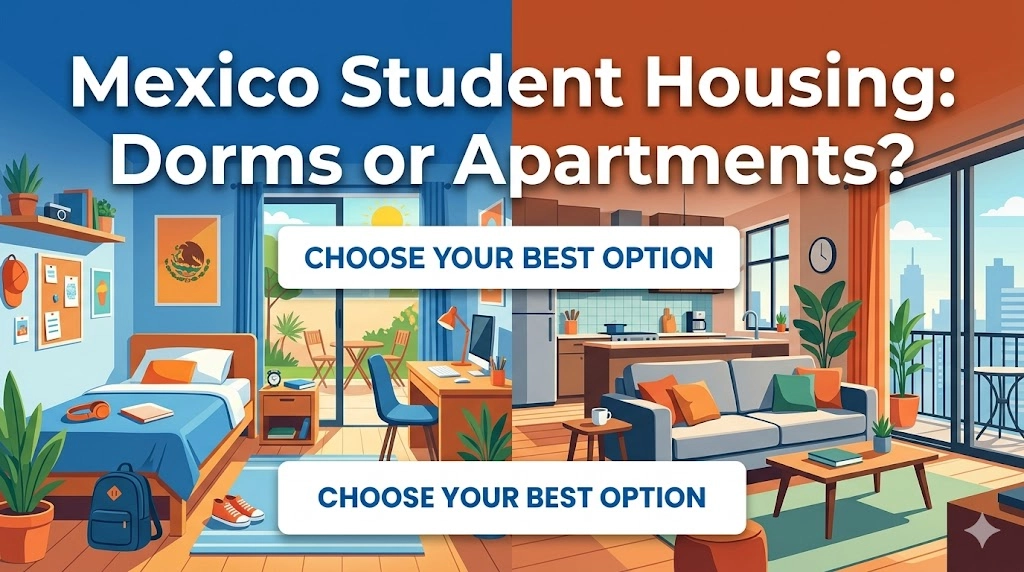
The Pros and Cons of Student Dorms
Built-In Community and Networking
The most significant advantage of choosing an on-campus dorm or a dedicated student residence is the immediate, built-in social network. Moving to a new country is incredibly isolating, and the cultural shock in Mexico can be intense during the first few weeks. Dormitories force you into proximity with both local Mexican students and other international expats. This environment organically fosters friendships, study groups, and weekend travel plans. You do not have to put in exhausting effort to meet people; your social life begins the moment you step out of your room.
Furthermore, university-run dorms and high-end private student residences employ staff dedicated to student life. They organize welcome mixers, cultural exchange nights, intramural sports, and holiday celebrations. For an international student, these events are vital lifelines for cultural integration. You will learn the local slang, figure out the best street food spots, and understand the unwritten rules of the city simply by hanging out in the common areas.
However, the communal nature of dorm life is a double-edged sword. If you are an older student, a graduate student, or simply someone who values deep quiet and solitude, the constant hum of a dorm can be overwhelming. Mexican culture is inherently social and festive; late-night gatherings, loud music, and communal dinners are the norm. If you require absolute silence to study or sleep, a student residence might severely test your patience.
Administrative Simplicity and Utilities
When you sign a contract for a student dorm or a private residence, you are paying for peace of mind. The administrative simplicity is unmatched. Your monthly fee typically covers absolutely everything: rent, electricity, water, gas, high-speed internet, and sometimes even a weekly cleaning service. You write one check or make one bank transfer a month, and you are done. There are no surprise bills, no waiting in line at the local electricity commission, and no arguing with roommates over who used too much hot water.
This bundled model is a massive relief for newly arrived foreigners who do not yet have local bank accounts or the language skills to set up utility contracts. The facilities are fully furnished down to the mattress and desk, meaning you can literally arrive with just your suitcases and begin living immediately. Because you will be relying on the shared Wi-Fi networks provided by these large residences, which host hundreds of devices, maintaining your digital privacy is important. Running NordVPN on your laptop and phone will protect your personal data, especially when you are logging into your home country’s banking apps or submitting university coursework.
The primary con to this bundled simplicity is the cost. You are paying a high premium for convenience. When you break down the math, the actual square footage you get in a student residence is quite small compared to what you could rent on the open market for the same price. You are essentially paying an “expat tax” for the luxury of not dealing with local bureaucracy.
Strict Rules and Lack of Privacy
The trade-off for the safety and simplicity of a dormitory is a significant reduction in personal freedom. University-run housing in Mexico tends to have surprisingly strict rules compared to European dorms. It is common to encounter strict guest policies, where non-residents must hand over their ID at the front desk and leave by 10:00 PM. Some traditional university dorms even prohibit alcohol entirely on the premises, regardless of the fact that the legal drinking age in Mexico is 18.
Privacy is also a major concern. If you are placed in a shared room, you will have zero personal space. Even in private single rooms, the walls in newer constructions can be thin, and the shared bathrooms and kitchens mean you are constantly interacting with others. The administration also retains the right to enter your room for maintenance or inspections. If you value your independence and want to host friends for dinner parties or have family visit and stay with you, a dorm will make this practically impossible.
You must honestly assess your lifestyle preferences before committing to a dorm. If you are someone who likes to cook elaborate meals, the shared dorm kitchen—often crowded and under-equipped—will be a daily source of frustration. If you prefer to set your own rules and live entirely on your own terms, the transition into a highly regulated dorm environment will feel like a massive step backward in your independence.
| Feature | University Dormitories / Residences | Private Apartments |
| Fiador (Guarantor) Required | No. Usually just university acceptance. | Yes, almost always. Or a paid póliza jurídica. |
| Utilities Included | Yes (Water, electricity, gas, Wi-Fi). | Rarely. You must set them up and pay separately. |
| Furnishings | Fully furnished (bed, desk, closet). | Often unfurnished (sometimes lacking basic appliances). |
| Privacy & Rules | Low privacy, strict rules (guests, noise, alcohol). | High privacy, set your own rules entirely. |
| Contract Length | Tied strictly to the academic semester (4-5 months). | Usually a strict 12-month minimum lease. |
The Realities of Renting an Apartment
The Dreaded Fiador Requirement
If you decide to rent a private apartment, you will immediately crash into the biggest barrier in the Mexican rental market: the fiador (guarantor) requirement. Because evicting a non-paying tenant under Mexican law is a lengthy and expensive legal nightmare for landlords, they protect themselves fiercely. A fiador is a person who co-signs your lease and puts up a piece of debt-free real estate (usually located in the exact same city) as collateral. If you stop paying rent, the landlord can legally seize the fiador’s property. As a newly arrived international student, finding a local property owner willing to risk their house for you is virtually impossible.
When I was desperately hunting for an apartment during my first year in Guadalajara, I found the perfect place, only to be rejected because the only Mexican friend willing to be my fiador owned property in neighboring Michoacán, not Jalisco. So, how do foreigners bypass this? The most common legal alternative is a póliza jurídica (legal policy). This is essentially an insurance policy and background check that you, the tenant, pay for via a third-party legal firm. It usually costs between 30% and 50% of one month’s rent. If you default, the legal firm handles the eviction on behalf of the landlord.
Not all landlords will accept a póliza jurídica, but an increasing number do, especially in cosmopolitan areas or neighborhoods near major universities. Another alternative, though less common, is offering to pay several months of rent in advance. Navigating these negotiations requires nuance and tact. Utilizing SpanishPod101 to master the specific terminology of Mexican real estate (aval, fiador, póliza jurídica, escrituras) will prevent you from being taken advantage of by brokers who assume you do not understand the system.
Furnished versus Unfurnished Spaces
The definition of an “unfurnished” (sin amueblar) apartment in Mexico differs drastically from what you might expect. In the US or Canada, an unfurnished apartment still comes with major appliances like a refrigerator, an oven, and usually a washer and dryer. In Mexico, an unfurnished apartment is often just an empty concrete box. You will likely walk into a space that has no refrigerator, no stove (just a gas hookup), and sometimes not even light fixtures or closet doors—just bare wires and empty alcoves.
For an international student staying for a year or two, renting an unfurnished apartment makes very little financial sense. The initial outlay to purchase major appliances and furniture will completely negate any savings you made on the monthly rent. When you eventually leave the country, trying to sell second-hand appliances on Facebook Marketplace in a rush is a stressful nightmare. For a deeper breakdown of this dynamic, read our guide on Furnished vs Unfurnished Rentals in Mexico: What to Expect and Cost Differences.
Therefore, you must explicitly search for amueblado (furnished) or at least semi-amueblado (semi-furnished, which usually includes the major kitchen appliances) properties. Fully furnished apartments are highly sought after by the expat and student community, which means they carry a hefty premium and move off the market incredibly fast. When viewing a furnished apartment, carefully document the condition of every piece of furniture with photos on move-in day. Mexican landlords are notorious for attempting to withhold security deposits for preexisting wear and tear on cheap furniture.
Managing Utilities and Hidden Costs
When you rent a private apartment, the advertised monthly rent is rarely your final monthly cost. Unless specifically stated in the contract, you will be responsible for setting up and paying for your own utilities. Electricity is managed by the state-owned CFE (Comisión Federal de Electricidad) and is billed bi-monthly. Water is managed municipally, and gas is usually delivered via trucks that fill a stationary tank on your roof (gas estacionario) or by exchanging heavy metal cylinders.
Setting up internet requires a visit from providers like Telmex, Izzi, or Totalplay. They will typically require a 12-month contract, which can be problematic if you are only studying for one semester. You also need to factor in the mantenimiento (maintenance fee). If you rent an apartment in a building with an elevator, security guard, or communal areas, there is a monthly maintenance fee. Sometimes this is included in the advertised rent, but often it is an additional cost that can add 10% to 20% to your monthly housing budget. You can learn exactly how to navigate these systems in Home Utilities in Mexico: Setting Up Electricity, Water, Gas, and Internet.
Paying these bills requires organization. While internet and electricity can now easily be paid via mobile apps or at local convenience stores like OXXO, the initial setup can involve bureaucratic delays. If you are managing your home country bank accounts to transfer money to pay these local bills, maintaining digital security is paramount. I always activate NordVPN before initiating international bank transfers from my local Wi-Fi to ensure the transaction is encrypted and secure from potential local network vulnerabilities.
Budgeting for Your Mexican Student Home
Monthly Rent Comparisons by City
The cost of student housing in Mexico varies wildly depending on the city and the neighborhood. Mexico City (CDMX) is by far the most expensive rental market in the country. If you want to live in popular, central neighborhoods like Roma, Condesa, or near the UNAM campus in Coyoacán, a private furnished room in a shared apartment will cost you anywhere from $400 to $700 USD per month. A private one-bedroom apartment in these areas can easily exceed $1,000 USD. For a granular look at the capital’s expenses, see our Cost of Living in Mexico City (2026): Detailed Expat Budget Guide.
In contrast, industrial hubs like Monterrey, home to the main campus of Tec de Monterrey, offer slightly more modern housing stock but at similar price points near the university district (known as Zona Tec). However, if you are studying in smaller, more traditional student cities like Puebla, Guanajuato, or Xalapa, your housing budget will stretch significantly further. In these cities, you can often find a beautifully furnished room in a historic colonial home or a modest private apartment for $250 to $400 USD per month.
When budgeting, you must be realistic about your lifestyle. Choosing a cheaper apartment that requires a 45-minute commute on crowded public transit might save you money on rent, but it will cost you in time, stress, and eventual Uber rides when you study late at the library. Always prioritize safety and proximity to your campus or major transit lines over a seemingly incredible deal in an isolated neighborhood.
Factoring in Deposits and Move-in Fees
The upfront costs of moving into a private apartment in Mexico can be a severe shock to a student budget. You cannot simply pay your first month’s rent and grab the keys. The standard move-in requirement is one month’s rent upfront, plus a security deposit (depósito en garantía) equal to another month’s rent. If you do not have a fiador and must use a póliza jurídica, that is an additional non-refundable fee equivalent to roughly half a month’s rent.
This means that to move into a $600 USD/month apartment, you need to hand over approximately $1,500 USD in cash or via transfer on the day you sign the contract. Furthermore, landlords almost never accept international credit cards or foreign checks. You will need to arrange a wire transfer, which involves heavy banking fees and terrible exchange rates, or withdraw cash locally over several days to meet the requirement.
It is also vital to understand that getting your security deposit back at the end of your lease can be notoriously difficult in Mexico. Landlords frequently invent reasons—such as requiring a full repaint of the apartment or replacing an old appliance that finally broke—to keep the deposit. You must budget with the assumption that retrieving this deposit will take months of negotiation, and in some cases, you may have to accept the loss. To protect yourself legally, review the key clauses detailed in Understanding Mexican Rental Contracts: Key Terms and Tenant Rights.
Strategies to Split Costs with Roommates
Given the high upfront costs and the difficulty of securing a lease as a foreigner, the most logical strategy for international students is to rent a room in a pre-existing shared apartment. In Mexico, roommates are universally referred to as roomies. By moving into a room where local students or other expats have already signed the master lease, you completely bypass the fiador requirement, the expensive legal policies, and the hassle of setting up utilities.
Finding roomies is almost entirely done through social media. Facebook groups are the primary engine of the Mexican student housing market. Searching for terms like “Roomies [City Name]” or “Departamentos Compartidos [University Name]” will yield dozens of active daily listings. You will typically just need to pay the departing tenant their portion of the deposit and start paying your share of the rent. It is a highly informal but incredibly efficient system.
When interviewing for a room, communication is key. You will need to quickly establish trust with potential roommates. If you are struggling to communicate your living habits, cleanliness standards, and financial reliability in Spanish, you will miss out on the best apartments. I highly recommend completing the practical conversation modules on SpanishPod101 so you can confidently navigate these informal roommate interviews and secure a comfortable living situation.
Practical Steps to Secure Your Housing
When to Start Looking
One of the biggest mistakes international students make is attempting to rent a private apartment sight unseen from their home country months in advance. The Mexican real estate market moves incredibly fast. Landlords do not want to hold an empty apartment for two months waiting for your semester to start; they want someone who can move in and start paying rent next week. Furthermore, photos online can be highly deceptive, hiding issues like severe water damage, lack of natural light, or noisy construction next door.
The best strategy is to arrive in your university city two to three weeks before orientation begins. Book a short-term Airbnb or stay in a hostel for this period. Treat apartment hunting as your full-time job. Walk the neighborhoods around your university during the day and at night to gauge the atmosphere and safety. You can cross-reference your findings with our guide on Safety in Mexico: What Expats Need to Know About Staying Safe.
During these walks, look for physical signs hanging in windows that say “Se Renta” (For Rent). Many of the best, most affordable apartments are never listed online; they are managed by older landlords who simply hang a sign and wait for a phone call. Having a local Mexican SIM card is absolutely crucial for this step, as you will need to call or send a WhatsApp message to the numbers on these signs immediately.
Navigating Scams and Unofficial Contracts
The informality of the Mexican rental market unfortunately makes it ripe for scams, particularly targeting naive foreign students. A common scam involves a “landlord” claiming they are currently out of the country but will mail you the keys as soon as you wire the deposit via Western Union or MoneyGram. Never, under any circumstances, transfer money for an apartment you have not physically stood inside, and never wire money to an untraceable service.
Always insist on a written contract. Even if you are just renting a room from roomies, there should be a written agreement detailing the rent amount, the rules of the house, and the conditions for the return of your deposit. According to PROFECO (Mexico’s consumer protection agency), rental contracts must be in writing to protect both parties. If a landlord insists on a purely verbal agreement and cash-only payments with no receipts, walk away.
When you do sign a contract, you will need to provide your official identification. As an international student, your passport and your university acceptance letter are your primary documents until you finalize your residency. If you are unsure of the timeline for obtaining your legal student resident card, which is often required by more formal landlords, review the steps in University Admissions in Mexico: How International Students Can Apply.
Arriving and Getting Connected
The moment your plane touches down in Mexico, your housing hunt officially begins, and you cannot afford to be disconnected. You will immediately need data to load Google Maps, translate documents, and, most importantly, communicate via WhatsApp. WhatsApp is the absolute lifeblood of Mexico; it is how you will contact landlords, arrange apartment viewings, and communicate with your university.
Relying on spotty airport Wi-Fi or trying to navigate to a local Telcel store with your luggage to buy a physical SIM card is a stressful way to start your journey. The most efficient expat hack is to download Airalo before you leave your home country and purchase a Mexican eSIM. By activating the eSIM as your plane is taxiing to the gate, you will have instant, reliable 5G data the second you step off the plane. You can instantly start messaging landlords and coordinating your temporary housing.
Once you have secured your long-term apartment or dorm, you can evaluate whether you want to stick with an eSIM or transition to a local physical plan for long-term savings. For a full breakdown of the best local carriers and data packages, check out Internet and Mobile Phone Plans in Mexico: Staying Connected as an Expat. With your connectivity sorted and a solid understanding of the rental landscape, you are fully equipped to find a safe, comfortable home and dive into the incredible experience of Campus Life in Mexico: What International Students Can Expect.
References
Primary sources (official)
- PROFECO – Derechos en materia de inmuebles y arrendamiento: https://www.gob.mx/profeco/documentos/proceso-para-rentar-casa-o-departamento?state=published
- Tecnológico de Monterrey – Preguntas Frecuentes Residencias Tec: https://tec.mx/en/frequently-asked-questions-residence-halls
Other helpful sources
- ANUIES – Asociación Nacional de Universidades e Instituciones de Educación Superior: https://www.anuies.mx/
Disclaimer
The information provided in this guide is for educational and informational purposes only and does not constitute legal or real estate advice. Mexican rental laws, visa requirements, and university housing policies are subject to frequent changes. Always verify contract terms directly with property owners, real estate professionals, or university housing offices, and consult with a legal professional in Mexico before signing any binding rental agreements or paying deposits.