How to Snorkel or Dive on Mexico’s Coasts
Oh, the sheer joy, and sometimes utter bewilderment, of trying to figure out how to truly experience Mexico's incredible underwater world! I know firsthand how alluring those turquoise waters are, whether you're dreaming of gliding alongside sea turtles or exploring vibrant coral gardens. But for many of us new to this magnificent country, figuring out where to go, who to trust, and what to expect can feel like navigating a whole different ocean of bureaucracy and local knowledge. This guide is here to cut through the confusion and get you confidently geared up to snorkel or dive some of the most breathtaking coastlines Mexico has to offer.
Disclosure: This post may contain affiliate links. We may earn a commission at no extra cost to you if you make a purchase through these links. Read full disclosure.
Choosing Your Underwater Playground: Best Regions for Snorkeling and Diving
When it comes to exploring under the waves in Mexico, you're spoiled for choice. It’s not just one vast ocean; it’s a mosaic of distinct marine ecosystems, each offering its own unique charm and challenges. Deciding which coast to explore first can feel like a delicious dilemma, but understanding the general differences between the Caribbean and Pacific sides can help you narrow down your perfect underwater adventure.
The Caribbean Side: Yucatán Peninsula's Wonders
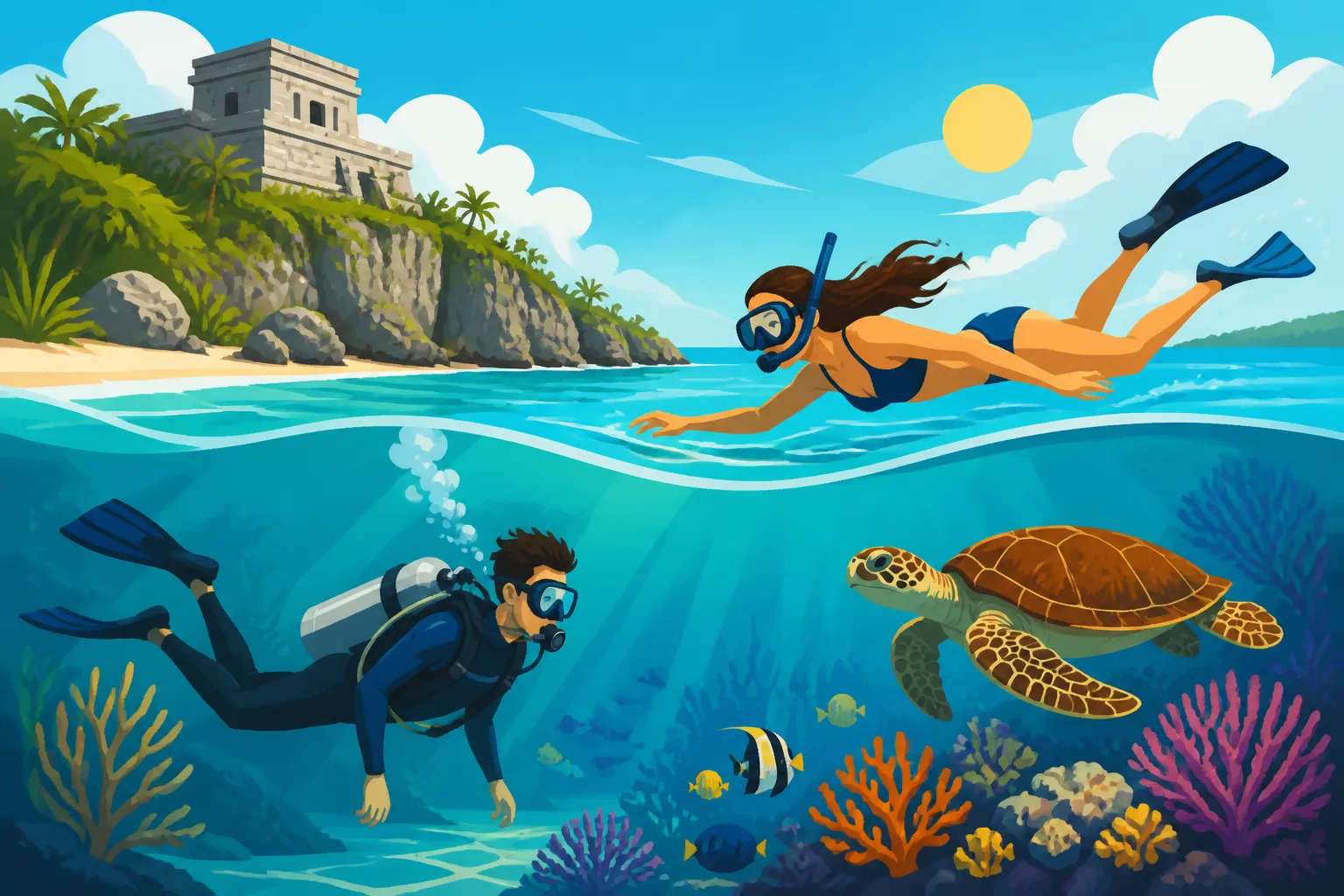
Ah, the Yucatán Peninsula! If you've spent any time researching Mexico, you've undoubtedly seen images of its impossibly clear, warm waters. This is where many first-time snorkelers and divers fall head over fins for Mexico's underwater magic. The main draw here is the Mesoamerican Barrier Reef, the second-largest barrier reef system in the world, stretching from the northern tip of the Yucatán all the way down to Honduras. This natural wonder makes the Riviera Maya—places like Cancún, Playa del Carmen, and Tulum—a prime spot for marine encounters.
Beyond the vibrant reef, the Caribbean coast offers something truly unique: the cenotes. These natural freshwater sinkholes, formed by the collapse of limestone bedrock, reveal ancient underground river systems. Snorkeling or diving in a cenote is an otherworldly experience, offering crystal-clear visibility, stunning light beams filtering through jungle canopy openings, and a completely different kind of marine life, sometimes even ancient stalactites and stalagmites. My first cenote dive near Playa del Carmen was absolutely unforgettable – it felt like stepping into a hidden cathedral, a calm, cool contrast to the bustling ocean. It's a must-do for any diver or snorkeler looking for something truly extraordinary.
The island of Cozumel, just a short ferry ride from Playa del Carmen, is particularly famous worldwide for its spectacular drift diving. The currents here gently carry you along magnificent walls of coral, allowing you to observe enormous sponges, gorgonians, and a kaleidoscope of reef fish with minimal effort. It’s also a frequent stop for cruise ships, so you'll find plenty of established dive shops and experienced guides. Nearby Isla Mujeres, while smaller, also offers fantastic snorkeling opportunities, including the chance to swim with whale sharks during migration season (typically May to September) and visit the underwater museum, MUSA, a truly unique art installation that doubles as an artificial reef. If you're planning a trip to this region, you'll find loads of specific tips in our guide to The Yucatán Peninsula: Beaches, Ruins, and Cenotes.
The Pacific Coast: Diverse Marine Life and Dramatic Scenery
Switching gears to the Pacific side, you'll find a different kind of underwater allure. The waters here can be cooler and have more dramatic topography, leading to encounters with larger marine species and impressive rock formations. Baja California Sur, particularly around La Paz and Cabo San Lucas, is a mecca for marine life enthusiasts. Imagine swimming alongside graceful whale sharks, the largest fish in the ocean, or diving with playful sea lions in their natural habitat. The contrast of the desert landscape meeting the rich ocean is simply stunning.
Further south, destinations like Puerto Vallarta and the Riviera Nayarit offer fantastic opportunities. The Islas Marietas National Park, a protected biosphere reserve, is famous for its "hidden beach" (Playa del Amor), which requires swimming through a tunnel to access, and offers great snorkeling and diving in its surrounding waters. You might spot giant manta rays, various reef fish, and during winter months, even hear the songs of humpback whales migrating through the area.
Then there's the Oaxaca coast, with gems like Puerto Escondido and Huatulco. While less renowned for diving than the Caribbean, these areas offer beautiful, less crowded sites, especially good for beginners and those looking for a more relaxed experience. Huatulco, with its nine bays, boasts several protected coves ideal for snorkeling, and seasonal diving can bring encounters with turtles, rays, and various reef species. I remember a particularly exhilarating dive near La Paz where a curious sea lion playfully nipped at my fins – a truly wild and unforgettable moment that really highlights the diversity of the Pacific. To explore more about this side of the country, check out The Pacific Coast: Puerto Vallarta to Oaxaca.
Here's a quick comparison of what you might expect from each region:
| Feature | Caribbean Coast (Yucatán Peninsula) | Pacific Coast (Baja, Puerto Vallarta, Oaxaca) |
|---|---|---|
| Water Temp | Generally warmer (26-30°C / 79-86°F) | Varies; can be cooler (20-28°C / 68-82°F) |
| Marine Life | Abundant reef fish, turtles, nurse sharks, whale sharks (seasonal), vibrant corals | Larger pelagics (whale sharks, manta rays), sea lions, humpbacks (seasonal), dolphins, diverse fish |
| Visibility | Excellent, especially in cenotes and Cozumel | Generally good, can vary with plankton blooms |
| Unique Features | Mesoamerican Reef, cenotes, MUSA underwater museum | Dramatic rock formations, kelp forests (Baja), open ocean encounters |
| Best For | Beginner snorkelers/divers, cave diving, colorful reefs | Advanced divers, big animal encounters, rugged beauty |
| Typical Cost | ~$80-150 for a 2-tank dive, ~$40-80 for snorkel tour | ~$90-180 for a 2-tank dive, ~$50-100 for snorkel tour |
Gearing Up for Your Underwater Adventure: Essentials and Equipment
Once you've picked your dream destination, the next step is getting ready! This means knowing what equipment you need, whether to rent or buy, and making sure you’re comfortable and safe in the water. Trust me, a bad mask fit can ruin an otherwise perfect snorkel, so a little preparation goes a long way.
Snorkeling Gear: What You Need and Where to Get It
For snorkeling, the basics are pretty straightforward: a mask, a snorkel, and fins. A good quality, properly fitting mask is paramount. There’s nothing more frustrating than a leaky mask that constantly fogs up. Test it on dry land: place it on your face without the strap, inhale gently through your nose, and it should suction to your face. If it falls off, it’s not the right fit. Fins help you move efficiently through the water without expending too much energy, which is especially important if you’re covering a larger area or dealing with gentle currents.
Beyond the core three, consider a rash guard for sun protection. Mexico’s sun is intense, and spending hours floating on the surface means your back can get seriously burned. A rash guard also offers a bit of warmth if the water is cooler or you're sensitive to temperature changes. And please, for the love of the ocean, invest in reef-safe sunscreen. Many traditional sunscreens contain chemicals like oxybenzone and octinoxate that are incredibly damaging to coral reefs. Don't make the mistake I did on my first trip to the Riviera Maya, showing up with regular sunscreen and realizing I was poisoning the very beauty I came to see. Nowadays, you can find reef-safe options at most major supermarkets like Walmart or local pharmacies in tourist areas, but it's always best to bring some from home if you have a preferred brand.
Deciding whether to rent or buy often comes down to how frequently you plan to snorkel. If this is a one-off trip, renting from a tour operator or a local shop (you'll see them everywhere in beach towns) is perfectly fine. However, if you envision many more underwater adventures in your future, buying your own mask and snorkel is a great investment for comfort and hygiene. Fins are bulkier to travel with, so those are often still best rented. You can find decent quality gear at sporting goods stores like Decathlon in larger cities, or at dedicated dive shops in tourist hotspots.
Diving Equipment and Certification: For the Deeper Dives
If you're looking to go beyond the surface, diving requires a bit more commitment, both in terms of equipment and training. Beyond your personal mask and fins (though many divers prefer their own), you'll need a buoyancy control device (BCD), a regulator (with primary and alternate air sources), pressure gauge, depth gauge, and of course, a tank. Most dive shops include tanks and weights in their dive packages, and often provide BCDs and regulators as rentals. Always check the condition of rental gear, ensuring everything is functioning correctly before you get on the boat.
For divers, certification is non-negotiable. Reputable dive shops in Mexico will require proof of your PADI, SSI, or equivalent certification (like Open Water Diver or Advanced Open Water). If you're not yet certified but are curious, Mexico is an excellent place to get your Open Water Diver certification. Many dive centers, especially in places like Playa del Carmen, Cozumel, and La Paz, offer multi-day courses with experienced, often bilingual, instructors. I got my advanced certification in the waters off Akumal and the patience and professionalism of the instructors made the learning process a joy, even when I was struggling with some of the trickier skills.
If you’re already certified, make sure to bring your C-card (certification card) or have digital proof readily available. Dive operators will also typically ask about your last dive and total number of dives to gauge your experience level. If it’s been a while, consider a refresher course (a "scuba review") with an instructor – it's a great way to brush up on skills and boost your confidence before heading out to deeper waters. Remember, safety always comes first, so don't hesitate to ask questions or voice concerns about your equipment or the dive plan.
Navigating the Waters: Tours, Guides, and Independent Exploration
So you've chosen your location and sorted your gear. Now, how do you actually get into the water? Mexico offers a spectrum of options, from organized tours that handle everything, to striking out on your own for a more adventurous experience. Knowing which approach suits your comfort level and skill is key.
Choosing Reputable Tour Operators and Dive Shops
For both snorkeling and diving, especially in popular or more challenging locations, hiring a reputable tour operator or dive shop is often the best choice. This isn't just about convenience; it's fundamentally about safety and maximizing your experience. A good operator will have well-maintained equipment, experienced guides who know the local waters like the back of their hand, and a strong emphasis on safety briefings and emergency protocols. My general rule of thumb is: if they seem too cheap to be true, they probably are. My first "bargain" snorkeling trip ended up being overcrowded, rushed, and with guides who seemed more interested in flirting than making sure everyone was safe. Never again.
Before booking, do your homework. Read reviews on platforms like Google, TripAdvisor, or Viator, which is fantastic for comparing different tours and seeing genuine feedback. Ask specific questions: What’s the group size? What’s included in the price (gear, wetsuits, snacks, transportation)? What are their safety procedures? Are their guides certified (PADI/SSI for divers, first aid for snorkel guides)? For diving, inquire about their boat maintenance, oxygen on board, and emergency plan. In places like Cozumel, with its famous drift diving, knowing your guide is experienced with currents is paramount. Look for operators who show a clear commitment to environmental protection too; they're often the ones who care most about the overall experience.
A good sign of a reputable shop is their transparency and willingness to answer all your questions. They should also provide a thorough briefing before you even get in the water, covering what you’ll see, potential hazards, and how to interact respectfully with marine life. Don't be shy about asking. Your safety and enjoyment depend on it! If you're concerned about finding a good doctor if anything goes wrong, you might want to read Finding English-Speaking Doctors and Specialists in Mexico.
Guided vs. Independent Exploration: When to Go Solo (and When Not To)
The decision to go with a guide or explore independently largely depends on the activity and location. For snorkeling, especially in very calm, well-known areas, independent exploration is often feasible. For example, in certain protected coves around Akumal or some of the shallower areas off Isla Mujeres, you can often rent gear from a beach vendor and swim out. Just make sure you understand local currents, potential hazards (like boat traffic), and always use a buddy system.
However, for most diving, a certified guide is essential. This is particularly true for boat dives to offshore reefs, exploring deeper cenotes, or any site with potential currents or complex navigation. Diving with a local guide not only ensures your safety but also significantly enhances your experience. They know where the interesting marine life hides, the best parts of the reef to visit, and how to navigate the conditions safely. In places like Cozumel, where dive sites are often accessible only by boat and involve drift diving, trying to go without a seasoned guide would be reckless.
Even for snorkeling, a guided tour to places like the open ocean for whale shark encounters or a multi-cenote trip can be invaluable. Guides provide transportation, often food, and most importantly, their expert knowledge. They can point out things you might miss, ensure you respect the rules of marine protected areas, and handle any unexpected situations. If you're traveling between coastal towns to hit different dive spots, considering services like Busbud can help you find convenient and affordable transportation to your next adventure. Many bus routes serve popular beach towns, making it easy to travel without needing your own car, an aspect you can read more about in Getting Around Mexico: Buses, Flights, and Car Hire.
Respecting the Reef: Sustainable Practices for Underwater Exploration
As expats and visitors, we have a responsibility to protect the incredible natural beauty that draws us to Mexico's coasts. The delicate marine ecosystems, particularly coral reefs and their inhabitants, are incredibly vulnerable to human impact. Practicing sustainable and responsible tourism is not just a nice idea; it's absolutely crucial for the long-term health of these magnificent underwater worlds.
Protecting Marine Life and Fragile Ecosystems
The cardinal rule for any underwater explorer, whether snorkeling or diving, is simple: look but don't touch. This seems obvious, but it's often overlooked. Coral reefs are living organisms, and even a slight touch can damage them, leading to disease or death. The oils from our skin, accidental kicks from fins, or standing on coral can have devastating effects. Likewise, never feed fish or any other marine animal. This disrupts their natural feeding patterns, makes them dependent on humans, and can introduce unnatural foods that are harmful to them.
Another critical step is using reef-safe sunscreen, which I mentioned earlier but cannot emphasize enough. The chemicals in standard sunscreens wash off into the water and contribute to coral bleaching and damage. Many local communities and tour operators in Mexico are now enforcing this, so you might even find yourself asked to rinse off conventional sunscreen before getting into the water. Support this initiative by making the switch! Furthermore, maintain excellent buoyancy control if you’re diving. This means hovering neutrally in the water column without touching the bottom or rising too quickly to the surface, showing respect for the environment you're exploring. It truly breaks my heart to see tourists touching turtles or standing on coral for a photo. We have to be better stewards of these incredible places.
Being a Responsible Underwater Tourist
Beyond direct interaction with marine life, being a responsible underwater tourist involves a broader set of practices. First and foremost, proper waste disposal is essential. Plastics, in particular, are a massive threat to marine environments. Always take your trash with you, and if you can, pick up any litter you find. Many dive and snorkel operators participate in clean-up efforts, and you can contribute by simply being mindful of your footprint.
Support operators who demonstrate a clear commitment to ecological practices. These are often the ones who will brief you on marine etiquette, use moorings instead of anchoring on reefs, and limit group sizes to minimize disturbance. When you choose to spend your money with these businesses, you're directly investing in the preservation of these sites. You can often find eco-conscious accommodations and tour packages through sites like Booking.com, which sometimes highlights properties and activities with sustainability certifications. While Booking.com is more for accommodation, it can be a good starting point to research environmentally conscious options in dive destinations that indirectly support the conservation efforts. If you're planning a trip around Mexico and want to combine diving with other activities, our Mexico's Regions and Where to Go: A Traveler's Overview might offer some inspiration.
Lastly, be aware of and respect local regulations. Many areas are designated marine protected areas, national parks, or reserves, and they often have specific rules regarding entry fees, activities allowed, and interaction with wildlife. These rules are in place for a reason – to protect these fragile environments for future generations. Education is power, and by understanding these guidelines, we can all contribute to preserving Mexico’s stunning underwater treasures. Don't forget, general travel logistics are always important too, so make sure to check out Travel Logistics in Mexico: Safety, Money, and Connectivity before you head out.
Disclaimer
Please remember that while I strive to provide accurate and up-to-date information, circumstances in Mexico can change rapidly. Always cross-reference critical information with official sources, especially regarding travel restrictions, safety advisories, and visa requirements. This guide is for informational purposes only and should not be taken as legal or professional advice.