Do Expats Need to File Mexican Taxes on Foreign Income?
I remember the cold sweat I felt when a local accountant told me I might owe the Mexican government thousands of pesos on my US salary. Trying to figure out if your remote job or foreign pension is taxed by Mexico is terrifying for most expats. This guide explains Mexican tax residency and worldwide income rules so you can avoid audits and double taxation.
Disclosure: This post may contain affiliate links. We may earn a commission at no extra cost to you if you make a purchase through these links. Read full disclosure.
The 183 Day Rule and Tax Residency
The biggest misconception in the expat community is that your immigration status dictates your tax status. People assume that because they work for an American or Canadian company, the Mexican tax authority (the SAT) has no right to touch their paycheck. This is dangerously false. Tax residency in Mexico is determined by your physical presence and economic ties to the country, not the color of your passport or the origin of your visa.
The Center of Vital Interests
Under Mexican tax law, you automatically become a tax resident if you establish your primary home in Mexico. If you maintain a home in both Mexico and another country, the SAT looks at your “Center of Vital Interests” (Centro de Intereses Vitales). You are considered a tax resident of Mexico if either of the following conditions are met:
- More than 50% of your total global income in a calendar year comes from Mexican sources.
- The core center of your professional activities is located in Mexico.
For expats, the second point is the trap. If you are physically sitting in an apartment in Guadalajara or Puerto Vallarta for nine months out of the year, typing on your laptop for a foreign employer, Mexico is the core center of your professional activities. Once you spend more than 183 days in the country during a 12-month period, you are generally considered a tax resident. Understanding how this intersects with your immigration status is complex and is covered deeply in Understanding the Residente Temporal: Lucrativa vs No Lucrativa (With/Without Work).
Temporary Residents and Digital Nomads
Many remote workers operating under a Digital Nomad Life in Mexico: Remote Work Living Guide setup try to fly under the radar. Because they are on tourist visas or temporary visas without explicit permission to work for a local Mexican company, they assume the SAT isn’t looking at them.
While enforcement has historically been lax on temporary tourists, the Mexican government is rapidly modernizing its digital tax infrastructure. If you successfully execute Opening a Bank Account in Mexico, or if you sign a long-term residential lease in your name, you are leaving a massive paper trail. The moment you are legally classified as a tax resident, the reality changes entirely, shifting how you must handle your cross-border finances.
How the SAT Treats Foreign Income
Once you cross that 183-day threshold and become a Mexican tax resident, the law is explicitly clear: you must report and pay taxes on your worldwide income.
Remote Salaries and Pensions
It does not matter if your salary is deposited into a Chase account in New York or a Barclays account in London. If you performed the work while physically located on Mexican soil, the SAT expects their cut. Mexico utilizes a progressive tax bracket system, and if you earn a relatively standard expat salary (e.g., $60,000 USD and up), you will likely hit the top tier of around 35%.
This is incredibly stressful for expats trying to manage their Cost of Living in Mexico: A Realistic Budget Breakdown. Suddenly, your budget is completely derailed by a 35% tax liability you never planned for. Furthermore, if you are a retiree bringing down a foreign pension, the rules are slightly different. Mexico generally offers generous exemptions on pension income up to certain limits (usually measured in daily minimum wage equivalents), but you still must formally report it. For an exhaustive breakdown of the specific tax brackets, you must read Taxes in Mexico for Expats: A Complete Guide to Income Tax and More.
| Tax Status | Determining Factor | Mexican Tax Liability | Primary Risk for Expats |
|---|---|---|---|
| Non-Resident | Spends < 183 days in Mexico; Center of vital interests is abroad. | Taxed only on income strictly sourced from within Mexico (e.g., local rental property). | Accidental overstays leading to residency reclassification. |
| Tax Resident | Spends > 183 days in Mexico OR Center of vital interests is in Mexico. | Taxed on worldwide income, regardless of where it is paid or earned. | Double taxation if proper treaties and foreign tax credits are not claimed. |
Keeping Investments Safe
Capital gains and dividends earned on foreign investments are also considered taxable worldwide income by the SAT. If you are day-trading on a consumer app or selling property back home, the Mexican government expects you to declare that profit.
This is where maintaining strict separation between your local spending money and your global wealth is absolutely critical. Veteran expats almost universally rely on Interactive Brokers to manage their major investment portfolios. By keeping your retirement funds and active stock portfolios offshore in an institutional platform like Interactive Brokers, you maintain a clean, highly structured accounting trail. Interactive Brokers provides the pristine, USD-denominated reporting that cross-border accountants need to accurately assess your global tax liabilities without mingling your life savings with the domestic Mexican banking system.
Avoiding the Double Taxation Trap
The immediate fear every expat has upon learning about the worldwide income rule is getting taxed twice—once by their home country and once by Mexico.
Leveraging International Tax Treaties
Fortunately, Mexico has extensive double taxation treaties with the United States, Canada, the UK, and dozens of other nations. These treaties are designed specifically so that you do not pay tax on the exact same dollar twice.
For American expats, the burden is particularly heavy because the US taxes based on citizenship, not geography. However, if you owe taxes to the SAT as a Mexican tax resident, you can generally claim the Foreign Tax Credit (FTC) on your IRS return for the taxes paid to Mexico. Because Mexico’s tax rates are often higher than the US rates, this credit usually wipes out your US tax liability entirely. To understand how to legally implement this strategy on your federal returns, you must review Do US Expats Living in Mexico Still Need to Pay US Taxes?.
Moving Money and Paying Your Taxes
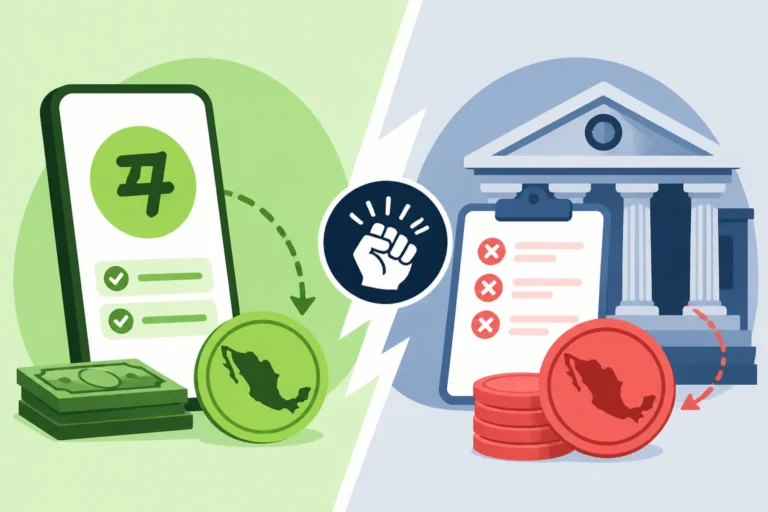
When it actually comes time to pay your Mexican tax bill, you must pay the government in Mexican Pesos. If your income sits in a foreign bank account, relying on a traditional wire transfer to fund your Mexican tax payments is a terrible idea. Traditional banks will hit you with hidden SWIFT fees and predatory exchange rate markups that can artificially inflate the cost of your tax bill by hundreds of dollars. To survive these hidden margins, you need to read Bank Fees in Mexico: Tips to Avoid Unnecessary Charges.
To bypass these predatory fees, I use Wise for all my cross-border tax payments. Wise allows me to move my US dollars or Euros directly into my Mexican bank account at the exact mid-market exchange rate. By using Wise to execute a domestic SPEI transfer in pesos, I can pay the SAT instantly and transparently, ensuring I don’t lose a massive percentage of my income just trying to comply with the law.
Likewise, if I need to liquidate foreign stocks to cover a massive end-of-year tax bill, I execute the conversion through Interactive Brokers. Because Interactive Brokers gives you access to the institutional Forex spot rate, you can convert massive sums for mere pennies in commission before sending the funds locally. Using these platforms protects your net worth from international banking monopolies.
Steps to Get Compliant with the SAT
Securing Your RFC and E.Firma
Before you can even declare your foreign income or claim a double taxation exemption, you must formally enter the Mexican tax system. The very first step is obtaining your Registro Federal de Contribuyentes (RFC). This is your unique Mexican tax identification number. Following that, you must secure your e.firma, which is an encrypted digital signature stored on a USB drive that acts as your legal signature for all federal tax filings.
Navigating the SAT office to get these credentials is often a grueling experience for expats. You must book an appointment online (which can take months in major cities), show up with your original residency card, a translated proof of address, and your passport. Without your e.firma, you cannot file your monthly or annual declarations. If you are entirely lost on where to start this administrative process, you must meticulously follow the steps in How to Get an RFC and e.firma in Mexico.
Finding a Cross Border Accountant
Do not attempt to navigate the SAT alone. The Mexican tax code is incredibly dense, changes frequently, and relies on an entirely digital electronic invoicing system known as CFDI that is baffling to foreigners.
The smartest move you can make is hiring a certified Mexican accountant (Contador Público) who specializes specifically in expats and cross-border taxation. They will help you legally classify your income, ensure you are taking advantage of the correct treaty exemptions, and calculate exactly what you owe. Furthermore, a good accountant will advise you on how to utilize platforms like Wise to ensure your tax payments to the Mexican government are properly routed and receipted without massive banking losses. Ignoring the SAT is no longer a viable expat strategy; getting compliant early is the only way to protect your new life and wealth abroad.
References
Primary sources (official)
- Internal Revenue Service (IRS) – US/Mexico Tax Treaty: Official US government guidelines explaining how expats can claim treaty benefits to avoid double taxation on their worldwide income. https://www.irs.gov/individuals/international-taxpayers/tax-treaties
Other helpful sources
- PwC Worldwide Tax Summaries – Mexico: An exhaustive, professionally maintained breakdown of Mexican individual income tax laws, deductions, and worldwide income determinations for the 2026 tax year. https://taxsummaries.pwc.com/mexico/individual/income-determination
Disclaimer
The information provided in this guide is for educational, logistical, and informational purposes only and does not constitute formal tax, legal, or financial advice. I am a veteran expat sharing practical experiences, not a Certified Public Accountant (CPA) or a tax attorney. However, international tax treaties, the 183-day residency rule, and Mexican income brackets are highly complex and subject to frequent legislative changes. The penalties for failing to report worldwide income or file taxes in Mexico are severe. Digital transfer platforms and brokerage services operate under their own strict terms of service and fluctuating fee structures. If you earn foreign income or reside in Mexico, you must consult with a certified cross-border tax professional to ensure absolute compliance with your legal obligations.