Booking for Visiting Parents in Mexico: Lifts, Access, and Comfort Checks
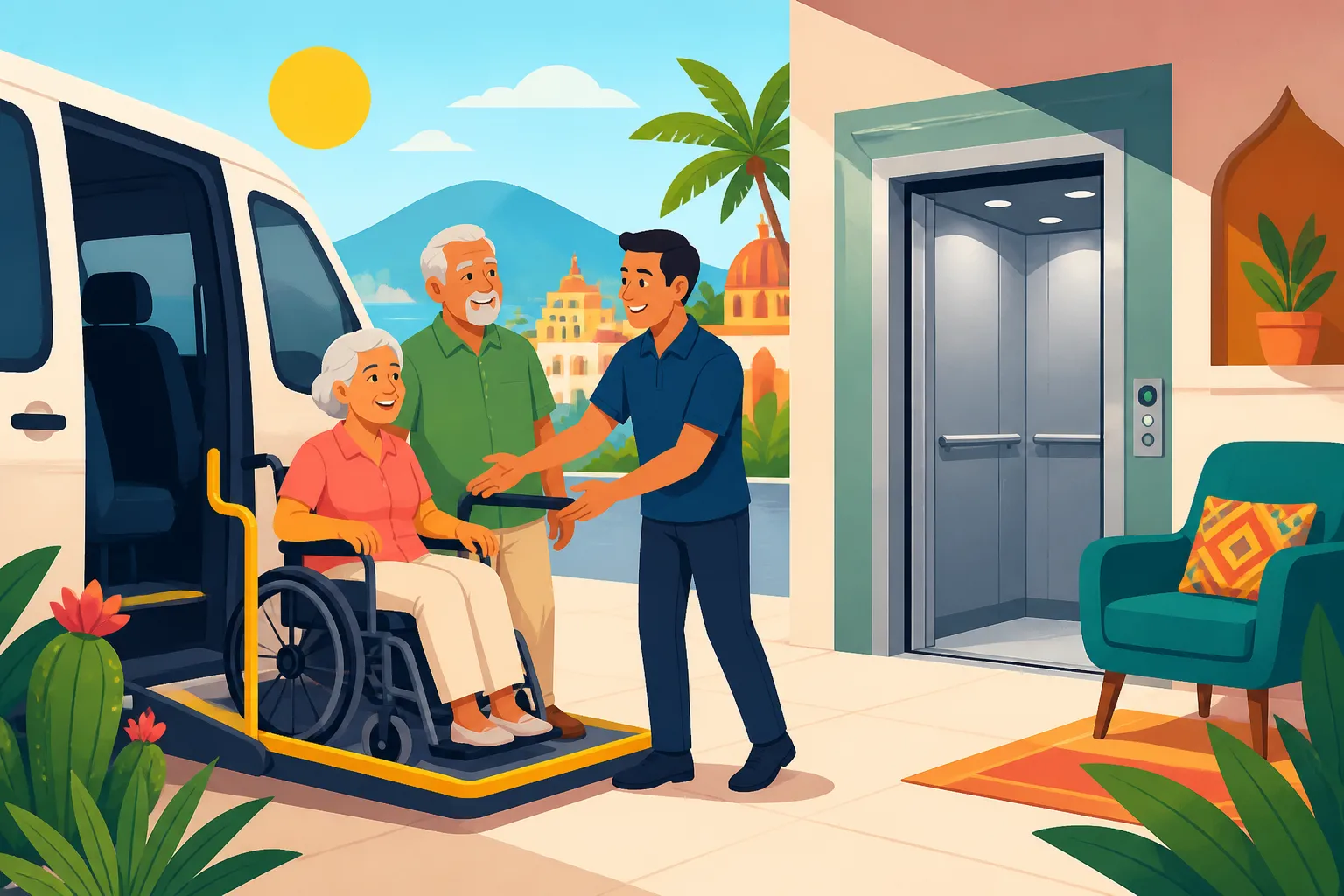
Your parents finally said yes to visiting you in Mexico. Then you open a gorgeous colonial hotel listing and realise you have no idea whether your dad’s knees can handle three flights of stone stairs, or whether your mum can step into that photogenic sunken shower. This guide shows you how to book a stay that actually works for older visitors: lifts, step-free access, beds, bathrooms and comfort checks.
Disclosure: This post may contain affiliate links. We may earn a commission at no extra cost to you if you make a purchase through these links. Read full disclosure.
Why Booking for Visiting Parents in Mexico Takes Extra Care
I have hosted my own parents, my partner’s parents, and a rotating cast of aunts and family friends over the years. One lesson came through every time. The hotel that looks perfect for a couples’ getaway is often a quiet nightmare for a seventy-something with a bad hip. Mexico’s most charming accommodation tends to sit inside the very buildings that are hardest to move around in. Knowing why that happens makes you a far sharper screener.
Colonial Architecture Was Not Built With Lifts in Mind
Most of the boutique hotels in places like San Miguel de Allende, Oaxaca, Guanajuato, Puebla and the historic centre of Mexico City are converted casonas. These are old family mansions built around a central courtyard, with thick stone walls, high ceilings and staircases that wrap around the patio. They are beautiful. Many are also legally protected, which means owners often cannot punch a lift shaft through the structure even if they want to.
Here is a scenario I see constantly. A friend books a twelve-room boutique hotel in Oaxaca’s Centro for her parents. The listing says “terrace with mountain views” and “breakfast included.” What it does not spell out is that breakfast is served on that rooftop terrace, two narrow flights above the guest rooms. Her mother managed the climb once, then ate pan dulce in her room for the rest of the week. Nothing in the listing was false. It simply was not written with a less mobile guest in mind.
The takeaway is not “avoid colonial hotels.” Plenty have ground-floor rooms around the courtyard that are perfectly manageable. You just have to ask about the specific room, not the property in general. If you are weighing a central location against these trade-offs, see Booking a Room Inside the Historic Centre: Rates, Noise, and Parking.
Cobblestones, Hills and Altitude Change the Whole Equation
Access does not stop at the hotel door. San Miguel de Allende’s streets are steep and paved with uneven river stones. Guanajuato is built into a ravine, with callejones that are really just staircases between houses. Taxco climbs a hillside. Even a hotel with a lift can be a struggle if the only way to reach a restaurant is a slippery downhill lane.
Then there is altitude. Mexico City, Puebla, Toluca and San Cristóbal de las Casas all sit high enough that older visitors often feel breathless on stairs they would handle easily at home, especially in the first couple of days. Combine thin air with a third-floor walk-up and you have a tired, grumpy parent on day one. For more on how elevation affects daily life, see Living at High Altitude: Tips for Expats in Mexico City and Highland Areas.
The coastal and lowland cities have the opposite problem. In Mérida, Cancún, Puerto Vallarta and Veracruz, heat and humidity make even short walks exhausting at midday. A hotel five blocks from where you live might be fine for you and draining for your father in the afternoon sun.
The Floor Numbering Trap
This one catches nearly everyone the first time. In Mexico, the ground floor is the planta baja, often marked PB in lifts. The primer piso is one level up. So if a listing or a receptionist tells your parents their room is on the “first floor,” that means one flight of stairs, not street level.
When you message a property, always ask for a room en planta baja if you need zero steps. And ask whether the planta baja itself has steps up from the street or from the courtyard, because many old buildings sit a few steps above the pavement.
How to Screen Listings for Lifts and Step-Free Access
This is where Booking.com earns its place as my go-to tool for parent visits. It is not the only platform out there, but its combination of detailed facility filters, room-level information, guest reviews you can search, and a built-in messaging channel to the property makes it the most efficient way I have found to separate genuinely accessible stays from merely attractive ones. Here is the exact process I follow.
Using Booking.com Filters Without Trusting Them Blindly
Start with the filters, but treat them as a first pass. On Booking.com you can narrow results by facilities such as a lift, and by accessibility features such as wheelchair-accessible properties, ground-floor units, toilets with grab rails, or walk-in showers. The exact filter names and options can shift over time, so explore the accessibility section of the filter panel each time you search.
My usual sequence looks like this:
- Enter the city and your parents’ exact dates, plus the correct number of adults, so you see real availability.
- Apply the lift filter first if your parents can manage a few steps but not full flights.
- Add accessibility filters if either parent uses a walker, cane or wheelchair, or has trouble stepping over a shower lip.
- Sort by distance from your home or from a central point you plan to use as a base, rather than by price.
- Shortlist five to eight properties, then read every one of them in detail before messaging any.
Why not trust the filter completely? Because facility information is supplied by the property, and a lift that serves only the upper floors of a new wing, or one that is out of service, can still be ticked. Filters narrow the field. Your questions confirm the room. For a deeper look at the specific accessibility options and how reliable each one tends to be, see Wheelchair-Accessible Hotels in Mexico: The Filters That Matter.
Reading Photos, Room Descriptions and Reviews Like a Detective
Once you have a shortlist, slow down. Go through the photo gallery and look for the things your parents will physically touch. Is there a step into the bathroom? Is the shower a raised tub or a level floor? Are the beds very low platform beds, which can be hard to get out of? Is the entrance reached by a ramp or a set of stone steps? Photos of the lobby and pool are marketing. Photos of the bathroom are information.
Next, open the specific room types. A property might have one accessible room and a dozen that are not. On Booking.com each room type has its own description and facility list, and that is where you will often find details like “ground floor,” “walk-in shower,” or “upper floors accessible by stairs only.” Picking the right room type matters more than picking the right hotel. If you find the room labels confusing, see Reading Mexican Hotel Listings: Room Types, Bed Sizes, and Terms Decoded.
Finally, search the reviews. Booking.com lets you search review text, and this is gold. Try words like “stairs,” “elevator,” “lift,” “steps,” “parents,” “elderly,” “mobility,” “walker,” and the Spanish “escaleras” and “elevador.” A review that says “we travelled with my 80-year-old mother and the staff moved us to a ground-floor room” tells you more than any facility list. So does “beautiful hotel but lots of stairs, not for anyone with bad knees.” Prioritise reviews from guests who describe travelling as a family or with older relatives.
Messaging the Property With the Right Questions
Before you pay, message the property through Booking.com. Keeping the conversation inside the platform means you have a written record if the room on arrival does not match what was promised, which is useful if you need to ask for a different room or raise an issue later.
Keep your message short, specific and friendly. Mexican hospitality staff are usually warm and helpful, but a vague “is it accessible?” gets a vague “yes.” These are the questions I send, adapted to the parent in question:
- Is there an elevator to the floor of the room I am booking, and does it reach every floor including the breakfast area?
- Can you guarantee a room in planta baja, and are there any steps between the street entrance and that room?
- Is the shower level with the bathroom floor, or is there a step or a tub to climb into?
- Are there grab bars next to the toilet or in the shower?
- How high are the beds, and can you provide two separate beds if requested?
- Where is breakfast served, and can it be reached without stairs?
- Can a taxi or car drop guests right at the door, or is the entrance on a pedestrian street?
If your Spanish is shaky, it helps to include a few key terms so nothing gets lost in translation:
| What you need | Spanish phrase to include |
|---|---|
| A lift | ¿Hay elevador? |
| Ground-floor room with no steps | Habitación en planta baja sin escalones |
| Level shower | Regadera sin escalón |
| Grab bars | Barras de apoyo |
| Two separate beds | Dos camas separadas |
| Door-to-door car access | ¿Puede llegar un taxi hasta la puerta? |
| Breakfast area without stairs | ¿El desayuno es accesible sin escaleras? |
A good property will answer clearly, often with photos. A property that dodges the questions or answers only “no problem” is telling you something too.
Comfort Checks That Make or Break a Parent Visit
Getting your parents through the front door is only half the job. The other half is making sure the room is somewhere they can actually rest. Older travellers tend to be more sensitive to noise, temperature, bed comfort and water pressure, and they are less likely to shrug off a rough night. These are the checks I run on every shortlisted property.
Matching the Property Type to Your Parents’ Needs
Different accommodation styles come with very different trade-offs. This is the comparison I keep in my head when I scroll through Booking.com results for a parent visit:
| Property type | Lift likelihood | Typical access issues | Best for |
|---|---|---|---|
| Colonial boutique hotel | Low, varies by building | Courtyard steps, rooftop breakfast, narrow stairs | Mobile parents who love character |
| Modern chain or business hotel | High | Usually few, sometimes a step at the entrance | Parents with limited mobility |
| Aparthotel or serviced apartment | Medium to high in newer buildings | Kitchen counters and shower design vary | Longer stays, parents who like to cook |
| Private apartment rental | Varies widely | Walk-ups common in older buildings, no front desk | Independent parents with good mobility |
| Beach resort | High, but large grounds | Long walks between rooms, pool and restaurants | Parents who want everything on site |
| Small family posada | Low | Often stairs, fewer adapted bathrooms | Budget-minded, fully mobile parents |
The modern business hotel is the unsung hero of parent visits. It may lack the bougainvillea and carved wooden doors, but it usually has a reliable lift, level bathrooms, a front desk around the clock, and a lobby where taxis can pull up. For a parent with genuine mobility limits, that predictability matters more than charm.
Resorts deserve a warning. A sprawling property on the Riviera Maya or in Nuevo Vallarta can have a lift in every building and still involve long walks along sun-baked paths to reach the beach or the buffet. Look for resorts that run golf-cart shuttles, and read reviews for mentions of distance between areas.
Beds, Bathrooms and the Hot Water Question
Beds first. Mexican hotel listings use terms like matrimonial, queen and king, and a matrimonial bed is narrower than many North American and European visitors expect. If your parents are used to a larger bed, or simply sleep better apart, request two separate beds or a larger bed type explicitly. Also check bed height in photos where you can. Very low beds are a struggle for anyone with stiff knees.
Bathrooms are where most accessibility problems hide. Watch for showers inside a tub, glass shower screens that leave only a narrow gap, a raised step into the bathroom itself, and slippery tiled floors with no mat. Ask for a level shower if possible. Packing a small non-slip mat for the shower is a cheap insurance policy I now recommend to every family member who visits.
Then there is hot water and temperature. In many Mexican buildings, hot water comes from a boiler or a gas heater, and in older properties it can take a while to arrive or run out if several rooms shower at once. In highland cities, nights can get genuinely cold in the dry season, and many older hotels have no central heating. On the coast, a room without strong air conditioning can mean a sleepless night for anyone sensitive to heat. For how to confirm these before you commit, see Air Conditioning and Hot Water in Mexican Accommodation: What to Verify.
Noise, Location and the Last Few Metres
Noise is a real comfort issue in Mexico, and older visitors often feel it more. Rooms facing a busy street in Mexico City’s Centro, a plaza in San Miguel de Allende, or a nightlife strip in Playa del Carmen can be loud well into the night. Church bells, fireworks for local fiestas, street vendors with recorded calls and early morning garbage trucks all add up. Look for rooms facing an internal courtyard or garden, and search reviews for “noise,” “ruido,” “loud,” and “quiet.”
Location should be judged by your parents’ legs, not yours. A neighbourhood that is “walkable” for you might mean a long uphill stroll for them. I like to pick a hotel where a taxi or ride-hailing car can stop right outside, with a café and a pharmacy within a short, flat walk, and ideally close enough to my home that a visit is not a production. If your parents are staying in the capital, see Where to Stay in Mexico City for Families: Quiet Colonias With Space for calmer areas with flatter streets and more breathing room.
Finally, think about the last few metres. Can the car reach the door? Is the entrance on a pedestrian-only street? In some historic centres, cars cannot get close, and the “short walk” to the hotel is across a cobbled plaza with luggage. Ask the property directly.
Booking Logistics: Rates, Timing and Arrival Day
Once you have found the right room, a few practical decisions will smooth the whole trip. Parents’ plans change, flights get delayed, and long journeys are tiring. Building flexibility in from the start saves stress later.
Choosing Flexible Rates and Booking in the Right Name
When older relatives are travelling, I almost always lean towards refundable or free-cancellation rates, even when a non-refundable rate is cheaper. Health hiccups, flight changes and family emergencies happen, and being able to cancel or move dates without losing the full cost is worth a lot of peace of mind. Booking.com clearly shows the cancellation policy for each rate, so compare the conditions carefully, including the deadline for free cancellation. For a closer look at when the discount is worth the risk, see Refundable vs Non-Refundable Rates in Mexico: When the Discount Is Worth It.
Then there is the question of whose name goes on the booking. If you book for your parents from your own account, make sure their names appear as the guests and check how the property handles payment. Some hotels want to see the card used to pay at check-in, or will ask for a card in the guest’s name for incidentals. Sort this out ahead of time by messaging the property, rather than leaving your parents to deal with it at the front desk after a long flight. The details are covered in Booking Mexican Hotels From Abroad: Cards, Names, and Passport Matching.
If you host visitors regularly, it is also worth understanding how Booking.com’s loyalty perks work, since benefits like discounts on selected properties or room upgrades can apply to bookings you make for family. See Booking.com Genius Levels in Mexico: What the Discounts Are Actually Worth for what to expect.
Arrival Day Planning for Tired Travellers
Arrival day is where a lot of parent visits wobble. Long-haul flights into Mexico City or Cancún often land early in the morning or late at night, and standard check-in times can leave older travellers sitting in a lobby for hours. Request early check-in when you book, and reconfirm a day or two before arrival. Many hotels will do their best, especially for a ground-floor or accessible room that has been reserved in advance. If the timing really matters, consider booking the night before so the room is ready the moment they arrive. For which kinds of properties tend to be flexible, see Early Check-In and Late Check-Out in Mexico: Who Actually Offers It.
Getting from the airport to the hotel deserves its own plan. A pre-booked private driver who meets them in arrivals with a sign, helps with luggage and drops them at the door is, in my experience, the single biggest stress reducer for older visitors. It removes the chaos of the taxi ranks and the need to navigate in Spanish while jet-lagged. See Airport Transfers and Private Drivers in Mexico: Booking vs Taxi Ranks for how to arrange this well.
I also like to run through a short arrival-day checklist with the property a few days before:
- Confirm the room type and that it is the ground-floor or lift-access room you requested.
- Confirm any bed configuration you asked for.
- Ask whether a wheelchair is available at the entrance, if needed for the walk from the car.
- Confirm the check-in time and whether luggage can be stored if the room is not ready.
- Share your own phone number with the hotel in case your parents need help.
Building in Rest Days and a Plan B
The final piece is pacing. Parents often want to see everything, and the excitement of a visit can push them past their limits. I schedule a quiet first day, with a short walk to a nearby café and an early dinner. I avoid booking hotels that require taxis for every single meal, because those journeys add up. And I keep one backup property in mind, close to the first, in case the room does not work out on arrival.
If something does go wrong, such as a lift that is out of service or a room that turns out to have more steps than promised, raise it politely with the front desk first. Point to your written messages on Booking.com showing what you asked for and what was confirmed. Mexican hotel staff are usually keen to fix problems for older guests and will often move them to a better-suited room. If that fails, contacting Booking.com customer service with your message history gives you a solid basis for asking for help.
Hosting your parents in Mexico should be about long lunches, slow afternoons in the plaza and showing them the life you have built here, not about watching them struggle up a staircase. Take the extra twenty minutes to screen properly, ask the right questions in plain language, and book a flexible rate. When you are ready, open Booking.com, set your parents’ dates, switch on the lift and accessibility filters, and start building a shortlist that puts their comfort first.
Disclaimer
This article is for general informational purposes only and does not constitute professional advice. Laws, prices and regulations vary by location and change over time. Consult a qualified professional for guidance on your specific situation.