Over-the-Counter Medications: What Can You Get in Mexico Without a Prescription?
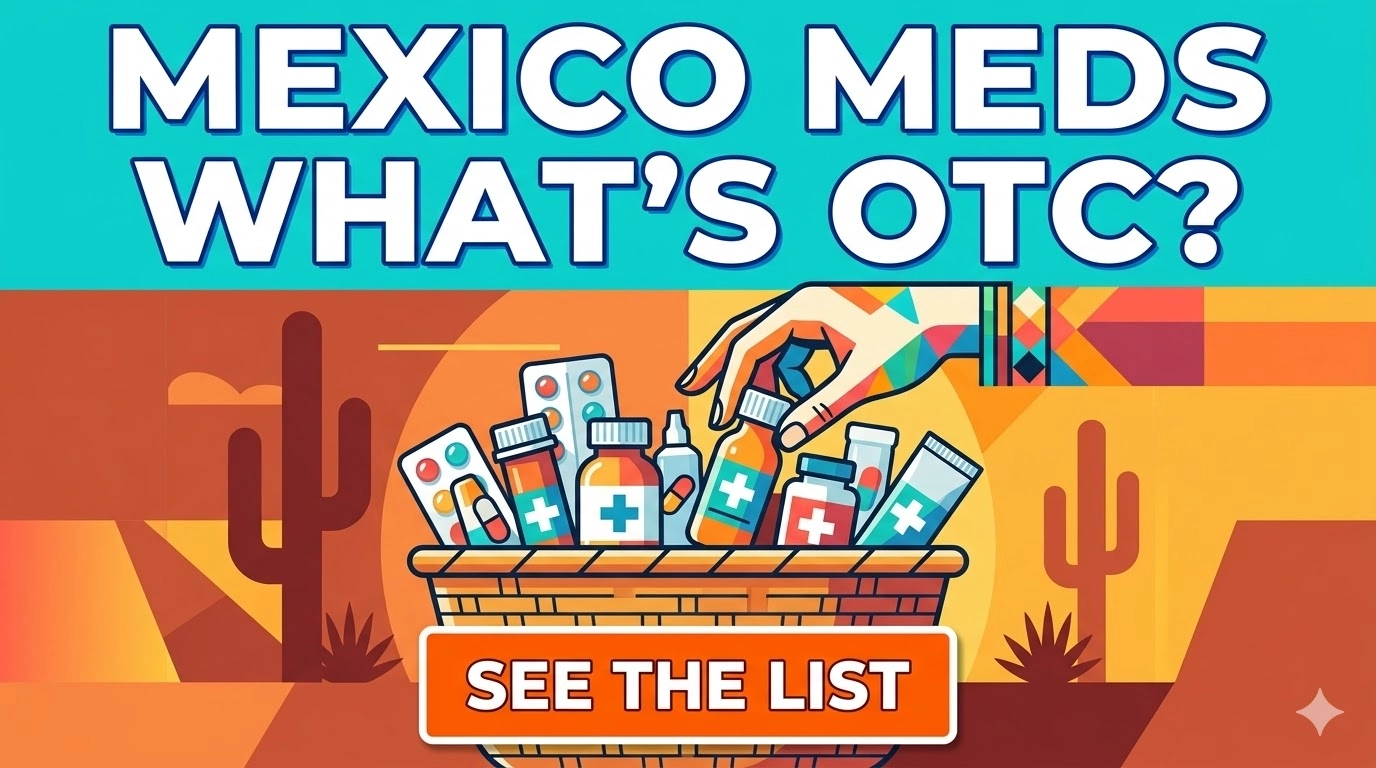
Standing at a Mexican pharmacy counter with a throbbing headache, realizing your usual painkiller is hidden behind locked glass, is a uniquely frustrating expat experience. I once spent an hour miming stomach cramps because I did not realize I just had to ask the pharmacist directly. This guide explains exactly what medications you can buy without a prescription in Mexico and how to navigate the local system.
Disclosure: This post may contain affiliate links. We may earn a commission at no extra cost to you if you make a purchase through these links. Read full disclosure.
The Reality of Mexican Pharmacy Classifications
Walking into a pharmacy in Mexico for the first time requires a complete recalibration of your consumer habits. In the United States, Canada, or the United Kingdom, pharmacies feature massive, open aisles where you can freely browse hundreds of boxes of cold medicine, allergy pills, and pain relievers. In Mexico, the physical layout is entirely different.
How the Open-Aisle System Differs
When you enter a Mexican farmacia, you will typically see a clean, brightly lit space with very few products on the actual customer floor—perhaps just some shampoo, toothpaste, and basic first-aid tape. The vast majority of the medications, including the most basic over-the-counter (OTC) drugs, are stacked high on shelves located securely behind a long counter manned by clerks in white coats.
You cannot simply grab a box of ibuprofen and walk to a cash register. You must approach the counter, interact with the attendant, and verbally request exactly what you need. For newly arrived expats whose Spanish is still developing, this forced interaction is incredibly intimidating. It feels like you are asking for a controlled substance when, in reality, you are just trying to buy a basic headache pill. To familiarize yourself with how these corporate and independent establishments operate on a daily basis, reviewing our comprehensive guide on Pharmacies in Mexico: How to Get Medications (OTC vs Prescription) is an essential first step.
Understanding COFEPRIS and Medication Fractions
To understand why the system works this way, you must understand the legal framework. The Mexican pharmaceutical market is strictly regulated by the federal health authority known as COFEPRIS (Comisión Federal para la Protección contra Riesgos Sanitarios). Under Article 226 of the Mexican General Health Law, COFEPRIS categorizes every single medication into one of six distinct groups, known as Fracciones.
Fractions I, II, and III contain highly controlled substances (like strong narcotics, psychiatric drugs, and severe neurological medications) that require specialized, closely monitored prescriptions. Fraction IV covers antibiotics, which also strictly require a prescription.
However, Fractions V and VI are the over-the-counter categories. Fraction V medications do not require a prescription but can only be legally sold within registered pharmacies (which is why they are kept behind the counter). Fraction VI medications are entirely unrestricted and can be sold in convenience stores like OXXO or on the open shelves of massive supermarkets like Chedraui or Walmart. Knowing this legal distinction saves you hours of panic when trying to cure a sudden ailment.
Common Daily Medications Available Over the Counter
The most profound culture shock for North American expats moving to Mexico is not the language barrier; it is the sheer, incredible accessibility of chronic care medications. The Mexican healthcare system places significantly less bureaucratic gatekeeping between patients and their daily maintenance drugs.
Blood Pressure, Cholesterol, and Chronic Care
In the United States, managing a chronic but stable condition like high blood pressure or hypothyroidism requires a constant, expensive loop of mandatory doctor visits, insurance copays, and pharmacy authorizations just to get a piece of paper that allows you to buy your necessary pills.
In Mexico, this bureaucratic loop simply does not exist for most maintenance medications. The vast majority of drugs used to treat hypertension (like Lisinopril or Losartan), high cholesterol (like Atorvastatin), and Type 2 Diabetes (like Metformin) are classified as Fraction V or VI. They are completely, 100% available over the counter. You simply walk up to the pharmacy counter, ask for a three-month supply, pay, and leave. You do not need a doctor’s permission slip to continue living your life. For expats retiring here, this accessibility fundamentally transforms their healthcare budget. You can learn more about structuring this long-term care securely in Managing Chronic Illness in Mexico: Access to Medication and Specialists.
Pain Relief, Stomach Issues, and Birth Control
The leniency extends heavily into pain management and gastrointestinal care. While standard painkillers like acetaminophen and ibuprofen are easily accessible, Mexico also allows the over-the-counter sale of highly potent NSAIDs (Non-Steroidal Anti-Inflammatory Drugs) that would strictly require a prescription up north. For example, Ketorolac (known as Toradol in the US) is widely available OTC in Mexico and is heavily relied upon for severe migraines or acute muscle pain.
Similarly, powerful proton-pump inhibitors for severe acid reflux, such as Pantoprazole and Omeprazole, require no paperwork. If you fall victim to the infamous local food-borne illnesses, you can easily access loperamide and advanced rehydration salts without seeing a doctor, though understanding exactly how to treat these specific local bugs is best detailed in Traveler’s Diarrhea (Montezuma’s Revenge): Prevention and Treatment.
Reproductive health is also highly accessible. Daily birth control pills, contraceptive patches, and emergency contraception (the morning-after pill) are all legally sold over the counter to anyone who asks. You do not need to schedule a gynecological exam to get your monthly refill. For a deeper breakdown of specific women’s health options, explore Access to Birth Control and Reproductive Health Services in Mexico.
To help you visualize this shift in accessibility, here is a comparison of common medical needs and their typical regulatory status:
| Condition / Medication Type | U.S. / Canada Status | Mexico Status | Common Active Ingredient (Spanish) |
| High Blood Pressure | Prescription Required | OTC (No Script Needed) | Lisinopril, Losartán, Amlodipino |
| High Cholesterol | Prescription Required | OTC (No Script Needed) | Atorvastatina, Rosuvastatina |
| Hypothyroidism | Prescription Required | OTC (No Script Needed) | Levotiroxina |
| Type 2 Diabetes | Prescription Required | OTC (No Script Needed) | Metformina |
| Daily Birth Control | Prescription Required | OTC (No Script Needed) | Drospirenona, Levonorgestrel |
| Severe Acute Pain (NSAID) | Prescription Required (Toradol) | OTC (No Script Needed) | Ketorolaco |
Navigating the Pharmacy Counter as an Expat
Knowing that your medication is legally available without a prescription is only half the battle; successfully communicating exactly what you want to the pharmacist requires a specific strategy.
Finding the Right Active Ingredients
You cannot walk into Farmacias del Ahorro and ask for “Advil,” “Tylenol,” or “Lipitor.” Those are regional brand names owned by massive North American pharmaceutical marketing divisions, and they hold zero weight south of the border. If you use these foreign brand names, the clerk will simply stare at you and tell you they do not carry it.
You must exclusively use the sustancia activa (active pharmaceutical ingredient). Before you leave for the pharmacy, look at the microscopic print on your current pill bottle from home. If you take Tylenol, the active ingredient is acetaminophen, which in Mexico is called paracetamol. If you take Zoloft, the active ingredient is sertralina. By handing the pharmacist a piece of paper with the translated chemical name and the exact milligram dosage, you completely bypass the language barrier. To learn exactly how to map your entire medicine cabinet to local equivalents, read Mexican vs U.S. Medication Brands: Finding Equivalent Drugs.
When the pharmacist finds your chemical, they will ask you a crucial question: “¿Patente o genérico?” Patente refers to the expensive, original name-brand version of the drug. Genérico refers to the generic version. Generic medications in Mexico are heavily regulated for bioequivalence and typically cost 70% to 80% less than the patente versions. Learning the exact phrasing to request these cheaper options is vital, which you can master by reviewing Pharmacy Spanish: Phrases to Help You Buy Medicine in Mexico.
Managing Payments and Imported Supplements
When you realize you can buy a six-month supply of your daily maintenance medications without a doctor’s visit, you will likely want to stock up. However, handing over a foreign debit or credit card at a Mexican pharmacy terminal to pay a 3,000 MXN bill is a massive financial mistake.
Payment terminals in tourist zones and major pharmacies frequently utilize Dynamic Currency Conversion (DCC), essentially offering to charge your card in your home currency at an incredibly predatory, hidden exchange rate. To avoid bleeding your healthcare budget on invisible banking fees, seasoned expats utilize Wise. By keeping your daily living funds in a Wise multi-currency account, you can convert your home currency into Mexican Pesos at the exact, transparent mid-market rate. You simply tap your Wise debit card at the pharmacy counter, paying directly in local pesos without incurring massive foreign transaction penalties from your home bank.
Furthermore, while Mexican pharmacies are exceptionally well-stocked with allopathic, chemical pharmaceuticals, they are severely lacking in the holistic wellness department. If your health protocol relies heavily on clinical-grade dietary supplements, specific multi-strain probiotics, specialized joint cartilage support, or adaptogenic herbs, you will not find them behind the local pharmacy counter. To bridge this critical gap, expats consistently rely on iHerb.
Rather than settling for low-quality local vitamins, you can order massive global wellness brands through iHerb and have them shipped securely and directly to your Mexican residential address. Using your Wise card to pay for these iHerb orders ensures you get the best currency conversion rate possible, allowing you to seamlessly blend the cheap, accessible Mexican pharmaceuticals with the high-tier, over-the-counter holistic support you need from abroad.
When You Actually Need a Prescription
Despite the incredible freedom of the Mexican pharmacy system, there are absolute, hard regulatory limits designed to protect public health. You cannot buy everything over the counter.
Antibiotics and Controlled Substances
Perhaps the most common mistake tourists and new expats make is assuming they can walk into a pharmacy and buy a Z-Pak or amoxicillin for a sudden sinus infection. In 2010, the Mexican government enacted strict federal laws aggressively moving all antibiotics into Fraction IV. You absolutely cannot buy antibiotics in Mexico without a formal, written prescription from a licensed Mexican doctor. The pharmacist is legally required to stamp and physically retain your prescription document to prove to government auditors that the sale was authorized. You can read the specific details regarding these strict laws in Can You Buy Antibiotics Without a Prescription in Mexico?.
Similarly, all heavy psychotropics (like Xanax or Valium), severe sleep aids (like Ambien), and heavy narcotic painkillers (like oxycodone) fall into Fractions I, II, and III. These require highly specialized, barcoded prescriptions from a registered specialist. Additionally, certain medications that are common in the US, like Adderall or specific pseudoephedrine-based cold medicines, are entirely banned and illegal in Mexico. If you rely on these, you must read What If a Medication You Need Isn’t Available in Mexico? to find legal, domestic alternatives.
Using Consultorios and Private Specialists
If you suddenly need an antibiotic for strep throat, the solution is astonishingly simple and affordable. Almost all major national pharmacy chains feature a consultorio adyacente a farmacia (a small doctor’s office attached to the building). You do not need an appointment. You walk in, pay roughly 50 to 100 pesos (about $3 to $5 USD), and a licensed general practitioner will examine you and write the necessary Mexican prescription on the spot. You then walk next door and buy the medication. To understand how to utilize these clinics for your routine needs, review Running Out of Medication: Getting a Prescription Refill in Mexico.
However, these $3 pharmacy doctors are general practitioners; they cannot legally prescribe heavy Fraction I or II controlled substances, and they are not equipped to manage complex, multi-systemic chronic flare-ups. If you require specialized medications, psychiatric care, or advanced diagnostics, you must step into the private medical sector and see a board-certified specialist.
This is exactly why holding a robust international health insurance policy like Cigna Global is absolutely vital. While you can pay out-of-pocket for cheap OTC meds, a sudden diagnosis requiring a top-tier private neurologist or oncologist will decimate your savings. A premium Cigna Global plan ensures you have immediate, financially secure access to Mexico’s elite private specialists when an over-the-counter pill is no longer sufficient to protect your health. Because the private sector operates as a free market, you can use your Cigna Global coverage to book these specialists directly, completely bypassing the bureaucratic wait times of the public system. For a complete guide on how to navigate this tier of care, read Seeing Specialists in Mexico: Do You Need a Referral or GP Recommendation?.
References
Primary sources (official)
- COFEPRIS (Comisión Federal para la Protección contra Riesgos Sanitarios): The definitive federal regulatory body in Mexico, operating as the local equivalent to the FDA. https://www.gob.mx/cofepris
- U.S. Food and Drug Administration (FDA) – Personal Importation Policy: – A critical federal resource for snowbirds and expats who plan to buy affordable OTC medications in Mexico and transport them back across the border. https://www.fda.gov/about-fda/center-drug-evaluation-and-research-cder/frequently-asked-questions-about-drugs
Other Helpful Sources
- Expat Focus – Prescriptions and Medications in Mexico: A highly trusted, boots-on-the-ground guide explaining the visual cues of Mexican farmacias, standard operating hours, and how to utilize the wildly convenient “pharmacy doctor” consults. https://www.expatfocus.com/mexico/guide/mexico-prescriptions-and-medications
- Focus on Mexico – Prescription & OTC Drugs: An excellent foundational breakdown for retirees, explaining how to leverage the INAPAM senior discount card for massive savings. https://focusonmexico.com/prescription-medication-counter-drugs-mexico/
Disclaimer
The information provided in this guide is for educational and informational purposes only and does not constitute formal medical or legal advice. Mexican pharmaceutical regulations, COFEPRIS drug classifications (Fractions I-VI), and the legal availability of specific active ingredients over the counter are subject to frequent and unannounced changes. Always consult directly with a licensed, board-certified Mexican physician or a registered local pharmacist regarding your specific health condition and medication needs before beginning or altering any treatment protocol.