Travel eSIM vs AT&T Mexico and Movistar Prepaid: Options for Longer Stays
The moment you land in Mexico, often the first thing on your mind after finding your way to your accommodation is, "How am I going to stay connected?" The initial thrill of a new country can quickly turn into a headache if you can't access maps, call a friend, or even just update your family. This guide is here to untangle the often-confusing world of mobile connectivity for longer stays in Mexico, specifically comparing the cutting-edge ease of travel eSIMs, with a focus on Airalo, against the traditional local prepaid SIM card options offered by providers like AT&T Mexico and Movistar.
Disclosure: This post may contain affiliate links. We may earn a commission at no extra cost to you if you make a purchase through these links. Read full disclosure.
The Frustration of Staying Connected in Mexico
Anyone who has spent more than a fleeting vacation in Mexico knows the struggle is real when it comes to getting set up. It’s not just about having internet; it’s about having reliable, affordable internet without jumping through endless hoops. For those of us living here, or planning an extended stay, connectivity is less a luxury and more a fundamental utility, right up there with electricity and water.
Why Connectivity is a Top Concern for Expats and Long-Term Visitors
Let's be honest, in this day and age, our phones are extensions of ourselves. For expats and long-term visitors in Mexico, having a functioning phone isn't just for scrolling Instagram, although that's certainly part of it! It's crucial for everything from navigating a new city with Google Maps, hailing a ride on Uber, checking your bank balance, or staying in touch with family back home. Imagine trying to coordinate a doctor's appointment in Spanish without the ability to quickly look up a phrase or translate a message. The thought of being disconnected, especially during those vulnerable first few weeks or months, can be genuinely anxiety-inducing. We've all been there, squinting at a tiny paper map, trying to decipher street names while feeling utterly lost, simply because our phone decided to lose signal or we ran out of data.
Moreover, if you're exploring the exciting digital nomad scene or even just working remotely for a few months, a stable internet connection isn't just convenient, it's your livelihood. You can read more about Remote Work and the Digital Nomad Scene in Mexico here. The fear of missing an urgent email or a crucial video call due to patchy service is a constant companion for many. Getting a phone plan set up quickly and efficiently can alleviate a huge chunk of this stress, allowing you to focus on the truly exciting parts of your Mexican adventure.
The Old Way vs. The New Way: SIM Cards and eSIMs
For years, the standard practice when arriving in a new country was to find a local phone store or even a convenience store like OXXO, buy a physical SIM card, and swap it into your phone. This involved figuring out which provider was best, understanding the plan options (often in Spanish), and sometimes even dealing with registration requirements. It was a rite of passage, yes, but often a time-consuming and frustrating one, especially when you're jet-lagged and just want to get to your casa or hotel.
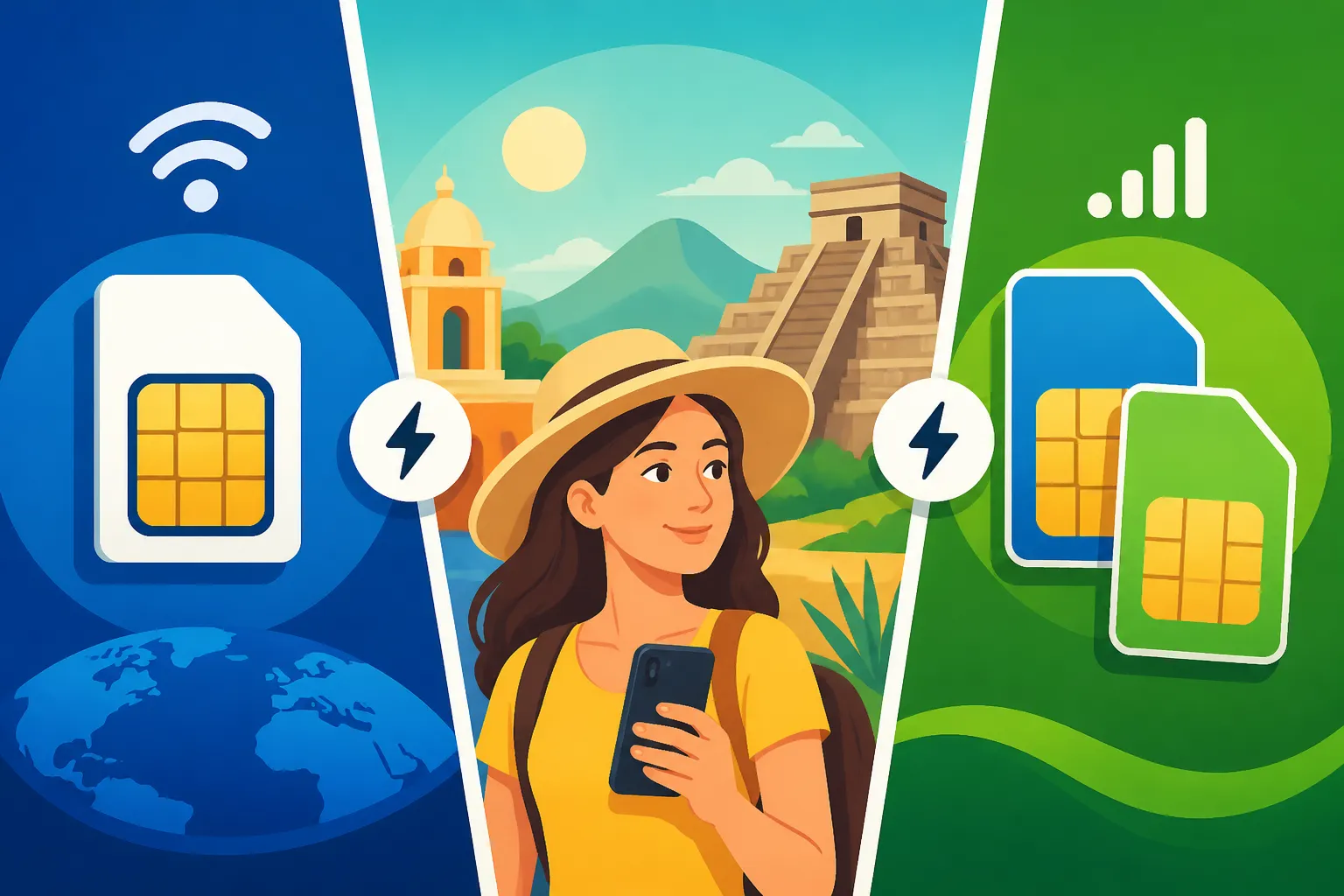
But things are changing. Enter the eSIM. This newer technology is shaking up how we get connected abroad, offering a significantly more streamlined and often immediate solution. Instead of a tiny plastic chip, an eSIM is a digital SIM profile that's downloaded directly to your phone. For those planning a long stay or even just a temporary visit, understanding this shift is key to ensuring you're connected from the moment your plane touches down. We'll dive into the specifics of both options, so you can make an informed decision that best suits your needs and travel style.
Embracing the Future: Travel eSIMs for Mexico (Featuring Airalo)
If you're anything like me, you want to hit the ground running when you arrive in Mexico, not spend your precious first hours fumbling with tiny SIM cards or trying to explain your data needs in broken Spanish. This is where the travel eSIM truly shines, and platforms like Airalo are leading the charge in making instant global connectivity a reality.
What Exactly is an eSIM and How Does it Work?
Let's break it down simply. "eSIM" stands for "embedded Subscriber Identity Module." Think of it as a tiny, reprogrammable chip that's already built into many newer smartphones, tablets, and smartwatches. Instead of needing a physical plastic SIM card that you insert into a tray, an eSIM allows you to activate a cellular plan digitally. You essentially download a "profile" from a carrier or, in this case, a global eSIM provider like Airalo, directly onto your phone.
The beauty of it is that you can have multiple eSIM profiles stored on your device, though only one (or sometimes two, depending on your phone's capabilities) can be active at a time. This means you can keep your home country's physical SIM or eSIM active for calls and texts, and add a local Mexican data eSIM for all your internet needs without having to physically swap anything out. It's truly a game-changer for those who travel frequently or plan extended stays, as it eliminates the hassle of hunting down local SIM cards, dealing with language barriers in stores, or worrying about losing your primary SIM. All it takes is a few taps on your phone, and you're good to go – usually, before you even clear customs!
Why Airalo is a Game-Changer for Longer Stays
For expats and long-term visitors, Airalo stands out as a genuinely revolutionary tool. The primary reason is unparalleled convenience. You can purchase your data package for Mexico days or even weeks before you travel, activate it with a few simple steps, and have internet access the moment your plane lands at Benito Juárez or Cancún International. No more frantic searching for a Wi-Fi signal, no more trying to navigate a new airport to find a phone store. You're connected, instantly.
Airalo offers various data-only plans for Mexico, catering to different durations and data needs. For instance, you might find options for 1GB over 7 days, or larger packages like 10GB or 20GB for 30 days or even longer. These plans are specifically designed for travelers and digital nomads who primarily need data for navigation, communication apps, and remote work. While they typically don't include a local Mexican phone number for calls and texts (which we'll discuss later), for most modern communication needs, data is paramount. The peace of mind that comes with knowing you have immediate connectivity upon arrival is invaluable. It frees you up to focus on finding your way, getting settled, and exploring, rather than worrying about your phone plan. If you're looking for ultimate convenience and immediate connectivity, Airalo is your go-to solution to kickstart your life in Mexico.
Pros and Cons of Using an eSIM in Mexico
Like any technology, eSIMs come with their own set of advantages and disadvantages that are important to weigh, especially for longer stays in Mexico.
On the pro side, the biggest selling point is definitely the instant connectivity. You can set up your Airalo eSIM before you even leave home, meaning you're online as soon as you step off the plane in Mexico. This eliminates the frantic search for a Wi-Fi hotspot or a local phone store, which can be a real blessing when you're jet-lagged and unfamiliar with your surroundings. Secondly, there's no physical SIM card to lose or swap out. This is a small but significant detail – who hasn't fumbled with those tiny SIM ejector tools or worried about misplacing their home SIM while it's out of their phone? Thirdly, eSIMs offer flexibility. You can easily switch between different data plans or providers without changing physical cards. If your initial Airalo plan isn't quite enough, it's usually just a few taps to top up or buy a new package. Finally, for those with dual SIM phones (which many modern smartphones are), an eSIM allows you to keep your home number active for important calls or texts, while using your Mexican eSIM for data. This hybrid approach is incredibly convenient for expats who need to maintain ties with their home country while enjoying local data rates.
However, there are some cons to consider. The most significant is that most travel eSIMs, including those from Airalo, are typically data-only. This means you won't get a local Mexican phone number for traditional calls and SMS messages. While apps like WhatsApp and Messenger can handle most communication, some local services (like banking apps, utility companies, or even some local delivery services) might require a Mexican phone number for verification or contact. If you need a local number for these purposes, an eSIM alone might not be sufficient. Another consideration is phone compatibility; not all phones support eSIM technology. While newer models generally do, it's crucial to check your device's specifications before relying solely on an eSIM. Lastly, while setting up an eSIM is simple, it does require an internet connection to download the profile. If you've arrived without having set it up, you'll need to find Wi-Fi first, which ironically defeats some of the "instant connectivity" advantage. For more on ensuring your device is ready for Mexico, check out our guide on Will Your Foreign Phone Work in Mexico? Using SIM Cards and Unlocked Phones.
The Traditional Route: Local Prepaid SIM Cards (AT&T Mexico and Movistar)
While eSIMs offer modern convenience, the traditional route of buying a local prepaid SIM card in Mexico is still a very popular and often necessary option for many expats and long-term residents. It's a tried-and-true method that provides a local phone number, something many find indispensable for day-to-day life here.
Navigating the World of Physical SIM Cards
Once upon a time, this was the only way to get connected in a foreign country, and it’s still a perfectly viable, often preferred, method for many in Mexico. The process typically starts when you arrive. You'll need to head to a store – either a dedicated mobile provider store like an AT&T Mexico or Movistar branch, or a ubiquitous convenience store like OXXO, 7-Eleven, or even a supermarket like Walmart. Here, you can purchase a "chip" or SIM card. The prices for the SIM itself are usually very low, often under 100 pesos.
The critical step that comes next is activation and loading your initial recarga (top-up). While OXXO might sell you the SIM, they often can't handle the full activation process beyond the initial credit load. For that, you might need to insert the SIM, make an initial call or send a text, and then follow automated prompts or visit a dedicated store for full registration. You'll definitely need your passport for this, as Mexican law requires identification for SIM card purchases to combat fraud. Make sure your phone is unlocked before you arrive, as locked phones won't accept a local SIM card. If you're used to buying a full-package plan, remember that prepaid in Mexico often means buying the SIM, then buying credit for paquetes (packages) of data, calls, and texts separately or together. It can feel a bit like a scavenger hunt initially, but once you've done it, the subsequent recargas are a breeze.
AT&T Mexico Prepaid: Reliability and Coverage
AT&T Mexico is a significant player in the Mexican telecommunications landscape, and their prepaid services are a solid choice for many foreigners. What typically draws people to AT&T Mexico is its generally reliable coverage, particularly in major cities, tourist hubs, and along well-traveled highways. While Telcel often boasts the most extensive coverage, AT&T Mexico provides a very strong alternative with competitive plans and good network quality, especially for data speeds.
Their prepaid plans, often marketed as "AT&T Más" or similar, usually offer various bundles that include a combination of data, unlimited calls and texts within Mexico and to the US/Canada, and sometimes even unlimited access to popular social media apps like WhatsApp, Facebook, and Twitter, which doesn't count against your main data allowance. This "unlimited social media" feature is a common and highly valued perk among Mexican carriers. Topping up your AT&T Mexico balance is incredibly easy; you can do it at almost any OXXO, 7-Eleven, pharmacy, or supermarket checkout, simply by giving them your phone number and the amount you wish to add. You can also do it online through their app or website. For expats who need a dependable local number for things like setting up utilities, registering for services, or receiving delivery notifications, AT&T Mexico offers a robust and user-friendly solution. You can find more comprehensive details about various carriers in our guide on Getting a SIM Card in Mexico (Telcel, AT&T, Movistar).
Movistar Prepaid: Budget-Friendly and Accessible
Movistar, another major telecommunications company in Mexico (part of the global Telefónica group), often appeals to expats and long-term visitors who are looking for a more budget-conscious option without necessarily sacrificing too much on service. While some might argue that Movistar's overall network coverage might not be as widespread as Telcel's or sometimes AT&T Mexico's, especially in very rural or remote areas, it still provides excellent coverage in most urban centers, popular expat destinations, and along significant corridors. Many parts of cities like Mexico City, Guadalajara, and Mérida have strong Movistar signals.
Movistar's prepaid plans are competitive and often provide great value. Like AT&T Mexico, their paquetes typically bundle data, unlimited calls and texts within Mexico, and often include those valuable unlimited social media allowances. You'll find different tiers of data packages, so you can choose what best fits your usage and budget. For instance, a basic plan might offer 3GB for 30 days, while larger plans will obviously provide more. Topping up is just as convenient as with other carriers; recargas are available at OXXO stores, supermarkets, and through their online platform or app. If you're someone who is careful with your monthly expenses and wants to minimize your phone bill without feeling completely disconnected, Movistar can be an excellent choice. It’s also often a good option if you plan to explore a bit off the beaten path but still within established towns, as their network can be surprisingly resilient in unexpected places.
Head-to-Head Comparison: eSIM vs. Local Prepaid for Longer Stays
Deciding between an eSIM and a traditional local prepaid SIM for your extended stay in Mexico isn't always straightforward. It really boils down to your personal priorities: is it absolute convenience, cost-effectiveness over time, or the need for a local phone number that truly matters most? Let's dissect these options.
Cost Analysis for Extended Periods
When it comes to the financial side of things, both eSIMs and local prepaid SIMs have their nuances. With a service like Airalo, you're often purchasing data-only packages. For example, you might buy a 20GB plan valid for 30 days. The cost can vary, but let's say a plan like that runs you around $25-35 USD. If you're a heavy data user, or if you plan to stay for several months, this could mean recurring costs of this amount. The benefit is that you know exactly what you're paying for data, and there are no hidden fees. However, if you need to make local calls, you'd rely on internet-based calling apps (like WhatsApp calls), which would eat into your data, or incur charges if you use your home country's number for international roaming.
On the other hand, local prepaid options from AT&T Mexico or Movistar often present a different cost structure. The initial SIM card purchase is usually negligible. Then, you'll choose a paquete that typically bundles data, unlimited calls within Mexico, and often unlimited social media. A common prepaid package from AT&T Mexico might offer, say, 5GB of data for 30 days, plus unlimited calls/texts within Mexico/US/Canada, and unlimited social media, all for around 200-300 pesos (roughly $12-18 USD). Movistar offers similar competitive packages. For longer stays, if you're consistently using these bundled services, a local prepaid plan can often be more cost-effective overall, especially considering you get a local number and integrated calling. The key is to manage your recargas effectively to avoid losing unused data or benefits. If you're trying to budget your expenses in Mexico, understanding these differences is crucial; you can find more tips in our Cost of Living in Mexico: 2026 Comprehensive Guide.
Connectivity, Coverage, and Convenience
When comparing connectivity and coverage, it's important to understand that many global eSIM providers, including Airalo, often leverage the infrastructure of local carriers in Mexico. This means that an Airalo eSIM for Mexico will typically connect to one of the major networks like Telcel, AT&T Mexico, or Movistar. So, in terms of the actual signal strength and reach, a well-configured eSIM should, in theory, offer comparable coverage to a physical SIM from one of those networks. However, the data prioritization can sometimes differ, and local SIMs might occasionally have an edge in peak usage times or specific, less-covered locales.
The real difference lies in convenience. Nothing beats the convenience of Airalo for immediate setup. Imagine landing in Mexico City, knowing your phone will connect instantly, allowing you to seamlessly call an Uber or check directions to your AirBnB. This eliminates initial arrival stress. However, as your stay lengthens, the convenience of a local phone number becomes increasingly apparent. For day-to-day life, many local services in Mexico, such as banking, setting up internet at home, ordering food for delivery, or even receiving important notifications from various companies, operate on local Mexican phone numbers. For instance, when you're trying to set up utilities like electricity or water, having a local number is almost always a requirement. You can even use your local number for services like Telemedicine in Mexico: Accessing Online Doctor Consultations as an Expat. Without one, you might find yourself constantly providing an international number, which can be cumbersome or simply not accepted. This friction can definitely add up over a long stay.
Ideal Scenarios for Each Option
So, when is an eSIM, particularly from Airalo, the undisputed champion, and when do the traditional local prepaid options from AT&T Mexico or Movistar take the lead?
Airalo (and other eSIMs) are ideal for:
- Initial Arrival: If you want instant data connectivity the moment you land, without any fuss, an Airalo eSIM is unparalleled. It's perfect for those first few days or weeks while you get your bearings.
- Data-Centric Users: If your primary need is data for internet browsing, social media, WhatsApp messaging, and app-based calls, and you rarely make traditional phone calls, an eSIM is a fantastic fit. Many remote workers and digital nomads fall into this category, leveraging high-speed data for their professional needs. Read more about this lifestyle in our guide on Remote Work and the Digital Nomad Scene in Mexico.
- Short to Medium-Term Stays: For visits lasting a few weeks to a couple of months, where the hassle of getting a local physical SIM might outweigh the benefits of a local number, Airalo offers a flexible and straightforward solution.
- Keeping Your Home Number: If you absolutely need to keep your primary international number active for calls and texts from your home country, but want affordable local data, a dual-SIM setup with an eSIM for data is perfect.
Local Prepaid SIMs (AT&T Mexico, Movistar) are better for:
- Long-Term Residents and Expats: If you're planning to live in Mexico for several months or years, a local SIM from AT&T Mexico or Movistar becomes almost essential. A local Mexican phone number simplifies daily life significantly – from setting up a How to Open a Bank Account in Mexico: Requirements and Tips to receiving delivery confirmations or interacting with local businesses and government offices (which can involve a lot of Dealing with Bureaucracy in Mexico: Tips for Handling Paperwork and Appointments).
- Integrated Communication Needs: For those who rely on a balance of traditional calls, texts, and data, a local prepaid bundle is often more comprehensive and cost-effective in the long run.
- Budget Optimization: While initial eSIM plans can be convenient, consistently topping up data-only plans from Airalo for very long periods might become more expensive than a bundled local prepaid plan, especially if you also need calls and texts.
- Wider Local Acceptance: Some Mexican services simply prefer or require a Mexican phone number. Having one eliminates potential headaches in these situations.
Many seasoned expats employ a hybrid approach: starting with an Airalo eSIM for immediate connectivity upon arrival, then, once settled, purchasing a local prepaid SIM from a provider like AT&T Mexico or Movistar to get a local number and take advantage of bundled plans for the bulk of their stay. This way, you get the best of both worlds – instant peace of mind and long-term integration.
Practical Steps and Tips for Expats
Navigating new technology and foreign administrative processes can be daunting, but with a bit of guidance, getting connected in Mexico can be surprisingly smooth. Here’s how to set yourself up for success, whether you choose an eSIM or a traditional SIM.
Getting Set Up with Airalo: A Step-by-Step Guide
The beauty of Airalo is its simplicity, but a few key steps will ensure a flawless experience:
- Check Phone Compatibility: Before you do anything, verify that your smartphone supports eSIM technology. Most newer models (iPhone XS and later, Samsung Galaxy S20 and later, Google Pixel 3 and later, etc.) do, but it's always best to double-check.
- Download the Airalo App: Find the Airalo app in your phone's app store and download it. This is where you'll manage everything.
- Choose Your Mexico Plan: Open the app, search for "Mexico," and browse the available data packages. Consider how much data you anticipate using and for what duration. Remember, these are data-only plans. I usually pick a slightly larger plan than I think I'll need, just for peace of mind in those initial days.
- Purchase Your eSIM: Select your desired plan and complete the purchase within the app.
- Install the eSIM: This is the clever part! You'll receive clear instructions within the Airalo app, usually involving scanning a QR code or manually entering details into your phone's cellular settings. Do this before you leave home or while you have stable Wi-Fi.
- Activate Your eSIM: Crucially, once installed, the eSIM will only activate and start its validity period when it connects to a supported network in Mexico. Ensure "Data Roaming" is turned on for your Airalo eSIM line in your phone settings (don't worry, this only applies to the eSIM, not your primary line, and it won't incur extra charges from Airalo). You'll typically label it something like "Mexico Data" to keep things clear.
- Manage Settings: Once you land, your phone should automatically connect to a local partner network. In your phone's cellular settings, you can designate your Airalo eSIM for "Cellular Data" and keep your primary physical SIM (if you have one) for "Default Voice Line." This ensures your home number still works for calls/texts, while your Mexican data is active.
That's it! You'll be connected the moment you power on your phone in Mexico, giving you invaluable peace of mind.
Activating a Local Prepaid SIM Card
If you're opting for a local prepaid SIM from AT&T Mexico or Movistar, here's what to expect:
- Purchase the SIM: Head to a carrier's official store (AT&T or Movistar), or a major convenience store like OXXO. They'll sell you a "chip" or SIM card. Prices are usually under 100 pesos.
- Required Documents: You will need your passport. Mexican law requires foreign residents and visitors to register their SIM cards with valid identification. Have it ready.
- Initial Setup: In an official store, they might help you with the full activation and registration, and even load your first recarga (top-up). If buying from OXXO, they might just sell you the SIM and the recarga. You'll then need to insert the SIM into your unlocked phone.
- First Recarga (Top-Up): Once your SIM is in, you'll need to purchase a recarga to get a data/call/text package. You can do this at almost any OXXO, supermarket, or online via the provider's app or website. Just tell the cashier "una recarga de [amount] pesos para Movistar/AT&T al número [your Mexican phone number]".
- Activate Your Package: After topping up, you'll usually receive an SMS offering various data/call/text packages. You'll need to reply with a specific code to activate your chosen bundle. Don't worry, these messages are often quite clear.
- Using Your Local Number: Once activated, you'll have a local Mexican phone number. Use this for everything local – signing up for apps, giving contact info to businesses, or setting up your home internet connection. Many services even offer dedicated apps that only work with Mexican numbers. For those moving here, getting a CURP is also important for various administrative tasks, including some related to phone service, as detailed in Getting a CURP as a Foreigner in Mexico.
It's a bit more hands-on than an eSIM, but once it's done, you have a fully functional local connection.
Maximizing Your Connectivity Experience
No matter which option you choose, or if you go for a hybrid approach, here are some tips to make the most of your mobile connectivity in Mexico:
- Understand Recarga Expiration: Local prepaid recargas often have a validity period (e.g., 30 days). Make sure you top up before your benefits expire to avoid losing unused data or having to reactivate your number.
- Utilize Wi-Fi: Always connect to Wi-Fi whenever available – at home, cafes, restaurants, or hotels. This saves your mobile data, whether it's an Airalo plan or a local prepaid bundle. This is especially vital if you're working remotely or streaming content.
- Dual SIM Phones Are Your Friend: If your phone supports both a physical SIM and an eSIM (or two eSIMs), consider running both your home country's number and your Mexican data (via eSIM) or Mexican local SIM simultaneously. This offers maximum flexibility.
- WhatsApp is King: Most communication in Mexico happens on WhatsApp. Even with an Airalo data-only eSIM, you can make calls and send messages via WhatsApp using your data. If you have a local SIM, it integrates even more seamlessly.
- Data Saving Settings: Turn off background app refresh for non-essential apps and use data-saver modes on your browser and streaming apps.
- Local Number for Critical Services: If you plan on a very long stay, eventually acquiring a local Mexican phone number (via a traditional SIM like AT&T Mexico or Movistar) is almost unavoidable for seamless integration into daily life, especially for financial services or setting up local accounts.
- Explore Local Internet Options: For your home, look into dedicated internet providers. While mobile data is great on the go, a stable home internet connection is usually much faster and more reliable for daily life. You can read more about Best Internet Providers in Mexico: Expats' Top Picks for Reliability to help you choose.
By combining the convenience of Airalo for initial setup with the practicality of a local prepaid SIM for long-term living, you can ensure you're always connected, without unnecessary stress or expense.
Connectivity Options for Longer Stays: A Quick Comparison
| Feature | Airalo eSIM (Data Only) | AT&T Mexico Prepaid SIM (Bundled) | Movistar Prepaid SIM (Bundled) |
|---|---|---|---|
| Ease of Setup | Very easy, can be done before arrival, fully digital. | Requires physical SIM, in-store/OXXO purchase, ID scan. | Requires physical SIM, in-store/OXXO purchase, ID scan. |
| Local Mexican Number | No (data only) | Yes | Yes |
| Primary Use Case | Immediate data, temporary, digital nomads, backup. | Integrated daily use, local calls, long-term residents. | Budget-friendly integrated use, local calls, long-term. |
| Coverage (General) | Leverages local networks (e.g., Telcel, Movistar). | Strong in urban/tourist areas, decent overall. | Good in urban/tourist areas, may vary regionally. |
| Cost (Approx. Monthly) | $25-35 USD for 10-20GB (data only). | $12-18 USD for ~5GB + unlimited calls/social media. | $10-15 USD for ~3-5GB + unlimited calls/social media. |
| Required Documents | None (for purchase/activation) | Passport/ID for registration | Passport/ID for registration |
| Top-up Method | Via app, credit card | OXXO, pharmacies, supermarkets, online. | OXXO, pharmacies, supermarkets, online. |
| Ideal For | First few weeks, data-heavy usage, avoiding hassle. | Established expats, integrated daily life, local needs. | Cost-conscious expats, integrated daily life. |
Disclaimer
The information provided in this guide is for general informational purposes only and is subject to change. While we strive to keep the content up-to-date and accurate, telecommunication plans, pricing, and government regulations in Mexico can change without prior notice. Always confirm specific details with the respective service providers (e.g., Airalo, AT&T Mexico, Movistar) or official government sources before making any decisions. We are not responsible for any inaccuracies or outdated information.