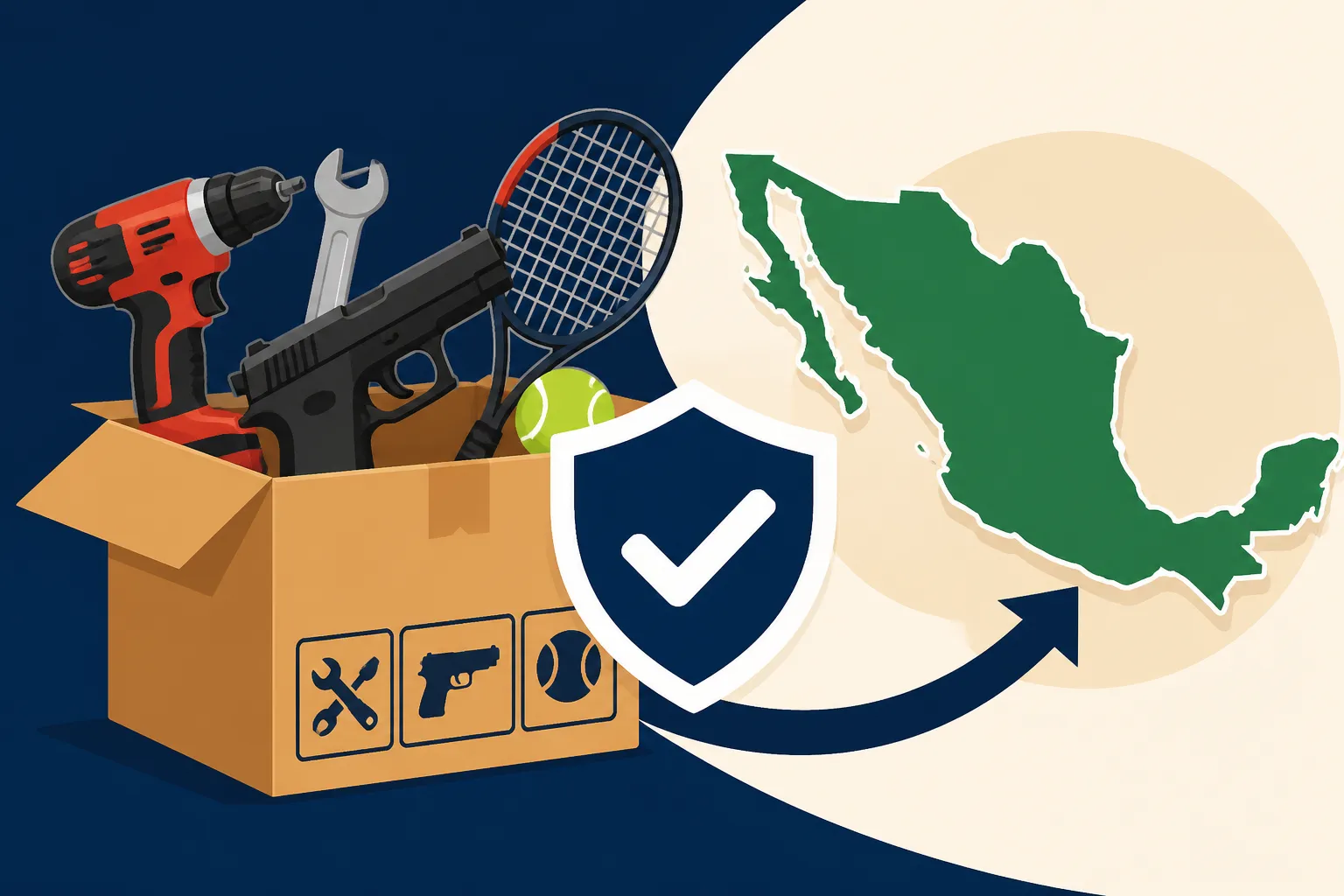
Shipping Tools, Firearms, and Sports Equipment to Mexico: Legal Limits
You are packing up a garage in Colorado or a workshop in Ontario, and the moving company’s surveyor stops in front of your table saw, your road bike, your golf clubs and, in the corner, the shotgun you inherited from your grandfather. “Which of these are going to Mexico?” It is a simple question with complicated answers. Tools, firearms and sports equipment are treated very differently by Mexican customs, and getting it wrong can mean seized goods, fines or, in the case of firearms, criminal charges. This guide sets out the legal limits and shows how to plan a shipment that clears customs smoothly.
Disclosure: This post may contain affiliate links. We may earn a commission at no extra cost to you if you make a purchase through these links. Read full disclosure.
When I moved down, I shipped more tools than I needed and agonised for weeks about a set of fishing rods. What I learned is that most sporting goods and personal tools are easy, a few categories need careful paperwork, and firearms are in a category of their own. Let us take them one at a time.
How Mexican Customs Treats Your Belongings
Before looking at specific items, it helps to understand the framework that decides whether you pay duty, and what can enter at all.
Menaje de Casa: The Duty-Free Household Allowance
If you are moving to Mexico with a temporary or permanent resident visa, you can usually import your used household goods free of import duty once, under a scheme called menaje de casa. You prepare a detailed inventory in Spanish, listing items with brands, models and serial numbers where relevant, and present it with your visa and passport when the shipment is cleared.
Menaje de casa covers the ordinary contents of a home: furniture, clothes, kitchenware, books, and, importantly for this guide, personal tools, sports equipment and hobby gear, provided they are used and for personal use. It does not cover goods for resale, new items still in boxes, or anything prohibited or restricted by other laws.
The timing and paperwork are explained in Menaje de Casa in Practice: Timing Your Consulate Filing Around the Shipment, and the items that still attract duty are listed in What Menaje de Casa Does Not Cover: Items That Still Attract Duty.
Prohibited, Restricted and Permitted Items
Every item in your shipment falls into one of three groups:
| Category | Meaning | Examples relevant to this guide |
|---|---|---|
| Permitted | Can be imported as part of menaje de casa or with normal duty | Hand tools, power tools for personal use, bicycles, golf clubs, surfboards, camping gear, fishing rods |
| Restricted | Allowed only with a specific permit or under specific conditions | Firearms for registered hunters or sport shooters, some knives and blades, motorised watercraft, drones in some cases, certain chemicals |
| Prohibited | Cannot be imported by private individuals | Military-calibre weapons, most ammunition in household shipments, explosives, some pesticides and solvents |
The broader picture of what gets seized is set out in Prohibited and Restricted Items in a Move to Mexico: What Gets Seized.
Why You Need a Customs Broker
Household shipments arriving by sea or truck are generally cleared through a licensed customs broker, an agente aduanal. The broker checks your inventory, files the import declaration and deals with customs officers if an inspection is triggered. A good broker will spot problem items before the shipment leaves, which is far cheaper than discovering them at the port of Manzanillo or Veracruz. Why You Need a Customs Broker (Agente Aduanal) for a Mexican Import explains the role in detail.
This is one of the reasons I always recommend choosing a mover with real Mexico experience. Using Sirelo, you can compare quotes from international removal companies, and when the quotes come in, you can ask each company directly whether they work with a customs broker in Mexico and how they handle restricted items. The answers tell you a lot about which mover really knows the route.
Tools and Workshop Equipment
Tools are among the most common items in a household move, and also among the most frequently questioned at customs, because officers need to decide whether they are personal belongings or equipment for a business.
Hand Tools and Power Tools for Personal Use
A normal home toolkit, including hammers, wrenches, screwdrivers, drills, sanders and a circular saw, is generally accepted as part of menaje de casa. The key is that the tools are clearly used and the quantity is reasonable for a household.
Practical points:
- List tools by type and brand on your inventory. A line such as “assorted hand tools” is often fine for small items, but power tools should be listed individually.
- Note serial numbers for expensive items such as table saws, compressors and generators.
- Clean tools before packing. Soil on garden tools can trigger agricultural inspection.
- Drain fuel and oil from petrol-powered equipment such as lawnmowers, chainsaws and generators. Fuel is a hazardous material and will be refused by most movers.
- Check voltage. Mexico uses 127 volts at 60 hertz, so tools from the United States and Canada work directly, while tools from Europe or the United Kingdom need a transformer. See Do You Need Power Adapters in Mexico? Understanding Voltage and Plugs.
Professional and Workshop Equipment
If you are bringing a full woodworking shop, a welding set-up, a pottery kiln or professional equipment you will use to earn money in Mexico, the picture changes. Customs may treat it as commercial equipment rather than household goods.
Menaje de casa can include the tools and instruments of your profession in some circumstances, but large quantities or industrial machinery can be classed as commercial imports and subject to duty, IVA and other charges. If your workshop is extensive, ask your customs broker before shipping whether it will be accepted under menaje de casa or should be imported separately and declared.
Batteries, Chemicals and Compressed Gas
Lithium-ion batteries for cordless tools are accepted, but movers often have rules about packing them, such as taping terminals or limiting quantities. Paints, solvents, thinners, aerosols, propane bottles and welding gas cylinders are generally refused by movers as hazardous materials. Use them up or give them away before moving day.
Firearms and Ammunition
This is the section that matters most legally. Mexico’s approach to firearms is very different from that of the United States or Canada, and the consequences of getting it wrong are severe.
Mexico’s Firearms Law in Brief
Mexico’s Federal Law on Firearms and Explosives tightly controls who may own a gun and what type. Private ownership is permitted only for certain calibres and purposes, usually home defence with a registered weapon kept at home, or hunting and sport shooting with membership of a registered club and a specific licence. All firearms must be registered with the national defence ministry. There is essentially one legal civilian gun shop in the country, operated by the military in Mexico City.
Calibres and types reserved for the armed forces, which include many common handgun and rifle calibres in the United States, cannot be owned by civilians at all.
Can You Ship a Firearm in Your Household Goods?
In practice, no. Firearms and ammunition cannot be included in a menaje de casa shipment, and international movers will refuse to pack them. Attempting to conceal a firearm or ammunition in a shipment, a vehicle or luggage is a serious federal offence in Mexico, with long prison sentences possible even for a single weapon or a handful of cartridges.
The only legal routes for bringing a firearm into Mexico are:
- Temporary import for hunting, with a permit from the defence ministry, an invitation or membership arranged through a registered Mexican hunting club or outfitter, and strict limits on the number of guns and cartridges.
- Temporary import for sport shooting competitions, under similar permits.
- Permanent import by a resident, through a lengthy permit process with the defence ministry, for permitted calibres only, and usually only after establishing residence.
None of these routes involves a household moving company.
What to Do With Your Firearms Before You Move
For most people moving to Mexico, the realistic options are:
- Sell the firearm through a licensed dealer in your home country before you leave.
- Leave it with a family member who can legally own it, following your home country’s transfer rules.
- Store it with a licensed storage provider or dealer at home.
Check your vehicles, luggage, boats and boxes thoroughly for stray ammunition before crossing the border. Many arrests at Mexican crossings involve people who forgot a single round in a glovebox or a range bag.
Knives, Air Guns and Self-Defence Items
Kitchen knives, pocketknives and ordinary hunting and fishing knives are usually fine in a household shipment. Large blades, swords and anything that looks like a weapon may attract questions. Air rifles, airsoft guns, crossbows, stun devices and pepper spray fall into grey or restricted areas and are best left behind. If in doubt, ask your broker or leave it out.
Sports Equipment and Outdoor Gear
The good news is that most sports equipment is easy to bring.
Bicycles, Golf Clubs, Surfboards and More
Bicycles, golf clubs, tennis rackets, surfboards, paddleboards, kayaks without motors, skis and snowboards, climbing gear, camping equipment and gym equipment are all generally accepted as part of menaje de casa when they are used and in personal quantities.
| Item | Typical customs treatment | Shipping tips |
|---|---|---|
| Bicycles | Permitted in personal quantities | Clean tyres and frames; remove pedals and turn handlebars; protect derailleurs |
| E-bikes | Permitted, battery rules apply | Ask your mover about lithium battery packing |
| Golf clubs | Permitted | Use a hard travel case or wrap heads individually |
| Surfboards and paddleboards | Permitted | Pad rails and nose; ship in board bags |
| Kayaks and canoes without motors | Permitted | List with dimensions; may increase volume charges |
| Fishing rods and tackle | Permitted | A fishing licence is needed to fish in Mexico |
| Gym equipment | Permitted | Heavy weights add significant cost; consider buying locally |
| Diving gear | Permitted | Tanks must be empty with valves open or removed |
| Motorised boats, jet skis, motorcycles | Separate import rules | Usually a separate temporary or permanent import process |
For bikes, boards and outdoor gear, the biggest cost is usually volume rather than duty. A garage full of kayaks and gym equipment can add a surprising amount to a container. When you get quotes through Sirelo, list your sports equipment separately so movers price it accurately rather than estimating.
Motorised Equipment
Boats with engines, jet skis, motorcycles and ATVs generally cannot travel under menaje de casa as simple household goods. They need their own import process, which may be a temporary import permit linked to your residency status or a permanent import with duty. The process is explained in Shipping a Boat, RV, or Motorcycle to Mexico: Costs and Paperwork.
Electronics and Sports Gadgets
GPS units, fitness trackers, action cameras and drones are personal electronics. Drones can be imported, but flying them is subject to Mexican aviation rules, and larger drones may need registration. Smart trainers and electronic gym equipment should be checked for voltage. More on electronics in Shipping Electronics to Mexico: Warranty, Voltage, and Service Availability.
Planning a Shipment That Clears Customs
Bringing all of this together, here is the process I would follow.
Choosing a Mover Who Knows the Rules
A mover who ships to Mexico every week will know which items cause trouble at the border and which brokers handle them well. A mover who rarely does the route may pack whatever you hand over and leave the problem for customs to discover. That is why the choice of company matters as much as the price.
When you compare quotes on Sirelo, use these questions to separate experienced Mexico movers from the rest:
- Which customs broker do you use in Mexico, and at which ports or border crossings?
- Will you review my inventory for restricted items before packing?
- How do you pack lithium batteries, e-bikes and power tools?
- What happens if customs questions an item, and who pays for any resulting storage?
- Is insurance for high-value tools and sports equipment included, or an extra?
Sirelo also lets you read reviews from other customers, which is a quick way to spot movers with a history of delays or surprise charges. Check Sirelo’s own pages for how its quote requests and reviews currently work, and then compare the answers you get side by side rather than choosing on price alone.
Step-by-Step Checklist
- Sort your belongings into three piles: ship, sell or give away, and restricted items that need a decision. Firearms and ammunition go straight into the last pile and do not leave it.
- Get comparable quotes on Sirelo. Describe your volume honestly, including tools and sports gear, and ask every mover about their Mexican customs broker.
- Prepare your menaje de casa inventory in Spanish, with serial numbers for valuable tools and equipment.
- Clean and prepare tools and gear: drain fuel, remove batteries where required, clean off soil.
- Ask your broker about any borderline items such as professional equipment, knives or drones.
- Insure the shipment. Tools and sports equipment are often high-value. See Moving Insurance for Shipments to Mexico: Coverage, Valuation, and Claims.
- Keep receipts and photos for valuable items in case customs or your insurer asks.
- Be present or reachable for customs clearance, because questions about specific items are answered faster that way.
Avoiding Hidden Costs
Customs inspections, storage while documents are sorted out, and demurrage when containers are held at port can all add to your costs. A restricted item discovered at inspection can delay the entire shipment. Hidden Costs in Mexican Moving Quotes: Customs Agents, Storage, and Demurrage explains how these charges arise.
Final Thoughts
Your tools, bike and golf clubs can almost certainly come with you. Your firearms almost certainly cannot, at least not in your shipment. Between those two extremes, a good customs broker and an experienced mover will guide you through the grey areas.
Start by getting quotes through Sirelo from movers who ship to Mexico regularly, ask each of them the hard questions about restricted items, and choose the one whose answers are clearest. Then pack with confidence, knowing that what arrives at your new home in Mexico is exactly what you planned.
Disclaimer
This article is for general informational purposes only and does not constitute professional advice. Laws, prices and regulations vary by location and change over time. Consult a qualified professional for guidance on your specific situation.