What’s the Best Region in Mexico for a First-Time Visitor?
Mexico is enormous, and that is the problem for a first-time visitor. You have perhaps ten days, a friend insisting you must see Oaxaca, a cousin who swears by Tulum, and a nagging feeling that you should start with Mexico City. Try to do all three and you will spend half your holiday in airports. This guide compares the regions that work best for a first trip, explains who each one suits, and helps you pick one base so your first visit is relaxed rather than rushed.
Disclosure: This post may contain affiliate links. We may earn a commission at no extra cost to you if you make a purchase through these links. Read full disclosure.
When friends ask me where to go for their first trip, I always answer with a question: what do you want to come home having done? Lying on a white beach, eating your way through markets, climbing pyramids, or wandering colonial streets? The best region depends almost entirely on that answer.
The Main Regions Compared for a First Visit
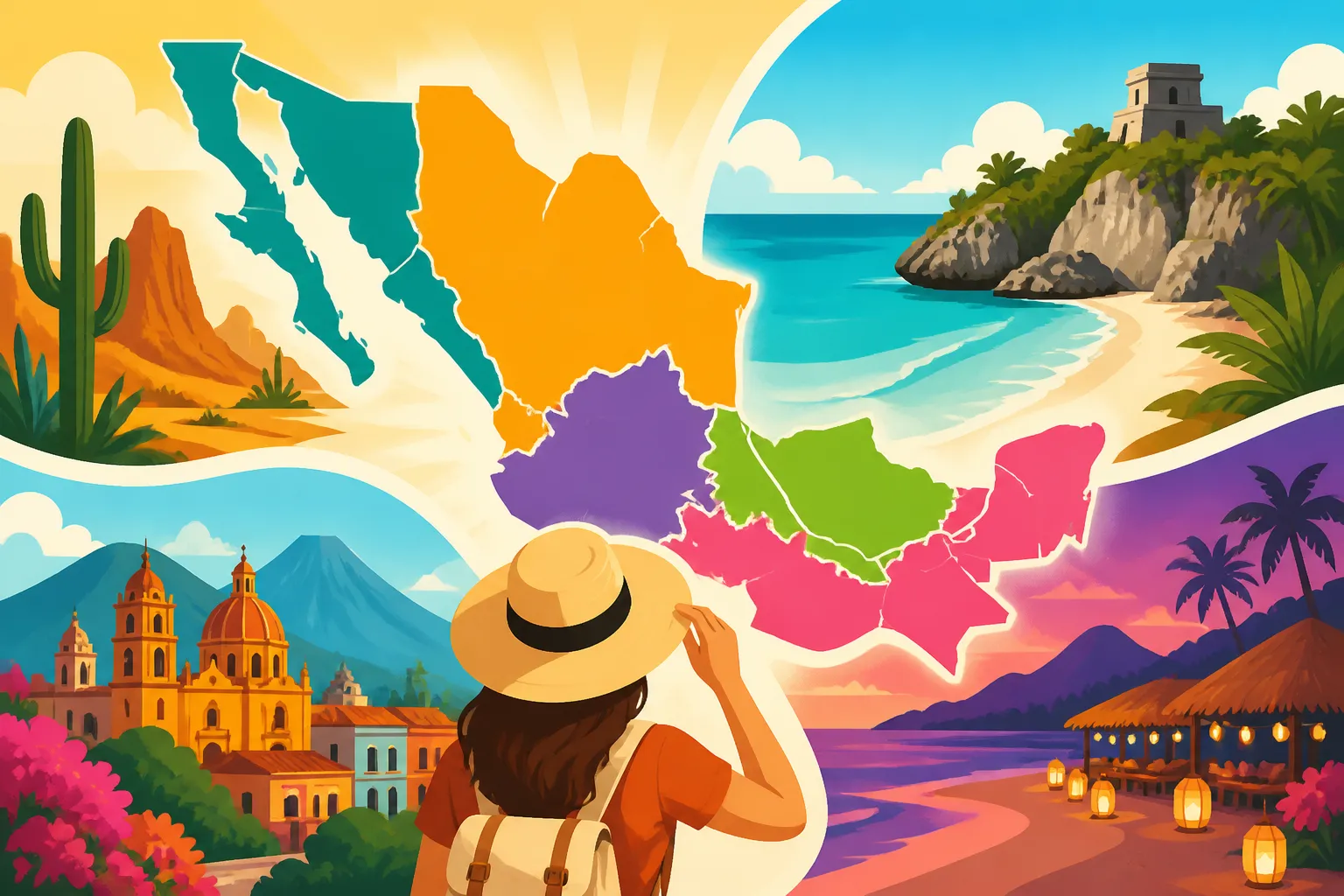
There are four regions that most often make sense for first-timers. Each has excellent infrastructure, a wide choice of places to stay, and enough to fill a week or two without long journeys.
At a Glance
| Region | Best for | Ideal first-trip length | Main airport | Travel style |
|---|---|---|---|---|
| Yucatán Peninsula and Riviera Maya | Beaches, cenotes, Maya ruins | 7 to 14 days | Cancún | Easy, very tourist-friendly |
| Mexico City and the central highlands | Food, museums, history, colonial towns | 5 to 10 days | Mexico City | Urban, culture-heavy |
| Oaxaca | Food, crafts, indigenous culture, mezcal | 5 to 8 days | Oaxaca City | Relaxed, cultural |
| Pacific coast around Puerto Vallarta | Beaches with mountains, small towns, surfing | 5 to 10 days | Puerto Vallarta | Laid-back beach |
Yucatán Peninsula and the Riviera Maya
For a first visit, the Yucatán Peninsula is the easiest region to recommend. Cancún has a huge international airport with direct flights from many countries, the roads are good, the tourist infrastructure is extensive, and the variety is remarkable: Caribbean beaches, swimming in cenotes, Maya cities such as Chichén Itzá, Tulum and Cobá, and colonial towns like Valladolid and Mérida.
The trade-off is that the coast between Cancún and Tulum is very developed and can feel more international than Mexican. Spend at least a few nights inland in Valladolid or Mérida to see a different side. The region is introduced in The Yucatán Peninsula: Beaches, Ruins, and Cenotes, and if you are torn between the two beach bases, read Which Is Better for a Beach Holiday: Cancún or Tulum?.
Mexico City and the Central Highlands
If you are more excited about food and culture than beaches, Mexico City is an extraordinary first stop. It has world-class museums such as the National Museum of Anthropology, the pyramids of Teotihuacan an hour away, some of the best restaurants and street food in the Americas, and leafy neighbourhoods such as Roma, Condesa and Coyoacán.
From the capital, comfortable buses reach colonial cities like Puebla, Querétaro, Guanajuato and San Miguel de Allende in a few hours. Best Day Trips From Mexico City has ideas for building a week around it.
Mexico City sits at about 2,240 metres above sea level, so take it easy on your first day or two, drink plenty of water and go light on the mezcal until you adjust.
Oaxaca
Oaxaca City is smaller and calmer than the capital, with a beautiful historic centre, an outstanding food scene built around moles and markets, craft villages in the surrounding valleys, and the hilltop ruins of Monte Albán. It is ideal for a slower, food-focused trip, and pairs well with Mexico City if you have ten days or more. Oaxaca: Food, Crafts, and Culture gives a fuller picture.
The Oaxacan coast, with towns such as Puerto Escondido and Mazunte, is a separate trip in itself, so do not try to fit it into a short first visit unless beaches are your priority.
The Pacific Coast Around Puerto Vallarta
Puerto Vallarta combines a walkable old town, a long beach and jungle-covered mountains that drop straight into the sea. North of the city, the Riviera Nayarit has smaller towns such as Sayulita and San Pancho, popular with surfers and families. It is a gentler alternative to the Caribbean side, with a more Mexican feel in many places. See Puerto Vallarta and the Riviera Nayarit.
Which Region Suits You?
The table gives you the outline. Here is how I would choose in practice, based on what you want from the trip.
If You Want Beaches First
Choose the Riviera Maya for turquoise Caribbean water, or Puerto Vallarta for a Pacific setting with mountains. The Caribbean side generally has calmer, clearer water, while the Pacific has more dramatic scenery and bigger waves.
One thing to know about the Caribbean coast: from late spring to early autumn, sargassum seaweed can wash up on some beaches in large quantities. It varies from year to year and beach to beach.
If You Want Culture and Food
Choose Mexico City, possibly paired with Oaxaca or a colonial town like Puebla or San Miguel de Allende. The variety of food, from street tacos to tasting menus, is hard to match anywhere in the world.
If You Want Ruins and History
The Yucatán gives you Chichén Itzá, Uxmal, Cobá and Ek Balam within easy reach, while Mexico City gives you Teotihuacan and the Templo Mayor. Chiapas has Palenque, one of the most atmospheric Maya sites, but it is further from the main airports and better saved for a second trip.
If You Want an Easy, Low-Stress Trip
The Riviera Maya is the most straightforward region for a first-timer. Many people speak English, transport between the main towns is simple, and organised excursions run to almost every sight. Mexico City is also very manageable if you stay in a central neighbourhood such as Roma or Condesa.
Sample First-Trip Plans
| Trip length | Beach-focused plan | Culture-focused plan |
|---|---|---|
| 7 days | Playa del Carmen or Tulum for 4 nights, Valladolid for 2 nights, last night near Cancún airport | Mexico City for 5 nights, day trip to Teotihuacan, 2 nights in Puebla |
| 10 days | Tulum for 4 nights, Valladolid for 2 nights, Mérida for 3 nights, last night near Cancún | Mexico City for 5 nights, fly or bus to Oaxaca for 5 nights |
| 14 days | Riviera Maya for 5 nights, Valladolid for 2 nights, Mérida for 4 nights, Bacalar for 3 nights | Mexico City for 5 nights, Oaxaca for 5 nights, San Miguel de Allende for 4 nights |
For the Yucatán specifically, How Many Days Do You Need in the Yucatán? goes into more detail on pacing.
Practical Tips for Your First Trip
Once you have chosen a region, a few practical points make all the difference.
When to Go
The dry season, roughly November to April, is the most comfortable time to visit most of Mexico. December to March is peak season on the coasts, with higher prices and busier beaches. The rainy season, roughly June to October, brings afternoon downpours in much of the country, and the Atlantic hurricane season runs from June to November, affecting the Caribbean and Gulf coasts. Mexico City’s weather is mild year-round, with a rainy season in the summer months.
Getting Around
Within each region, long-distance buses are comfortable, punctual and much cheaper than flying. First-class and luxury coaches have reclining seats, toilets and air conditioning. Platforms such as Busbud let you compare and book long-distance bus routes in advance, which is helpful on popular routes such as Cancún to Tulum or Mexico City to Puebla during holidays. For longer distances between regions, domestic flights save a full day. More detail is in Long-Distance Buses in Mexico: ADO and Premium Lines.
Where to Stay
Choose one or two bases rather than changing hotels every night. In the Riviera Maya, Playa del Carmen is central and practical, while Tulum is more boutique. In Mexico City, Roma and Condesa are walkable and well connected. Booking.com lists a huge range of options in all of these places, from small guesthouses in Valladolid to boutique hotels in Oaxaca, and the reviews help you check things like noise and air conditioning before you commit.
Tours and Excursions
Some sights are easiest on an organised tour, especially for first-timers: Chichén Itzá early in the morning before the crowds, a cenote circuit near Tulum, or Teotihuacan by hot-air balloon. Tour platforms such as Viator collect these excursions in one place with reviews and clear meeting points, which takes the stress out of planning when you do not speak much Spanish.
Safety and Common Sense
Mexico’s main tourist regions welcome millions of visitors every year without incident, but common sense matters. Check your government’s travel advice for the specific states you plan to visit, use authorised taxis or ride-hailing apps, avoid driving long distances at night, and keep valuables out of sight. Safety in Mexico: What Expats Need to Know About Staying Safe covers the details, and Common Cultural Surprises for First-Time Visitors to Mexico will help you feel at home faster.
My Recommendation
If you are still undecided, here is my honest advice. For a first trip with beaches on the wish list, choose the Yucatán Peninsula and split your time between the coast and an inland town. For a first trip driven by food and culture, start with Mexico City and add Oaxaca if you have the time. Either way, you will leave planning your second trip, which is exactly how it should be.
Disclaimer
This article is for general informational purposes only and does not constitute professional advice. Laws, prices and regulations vary by location and change over time. Consult a qualified professional for guidance on your specific situation.