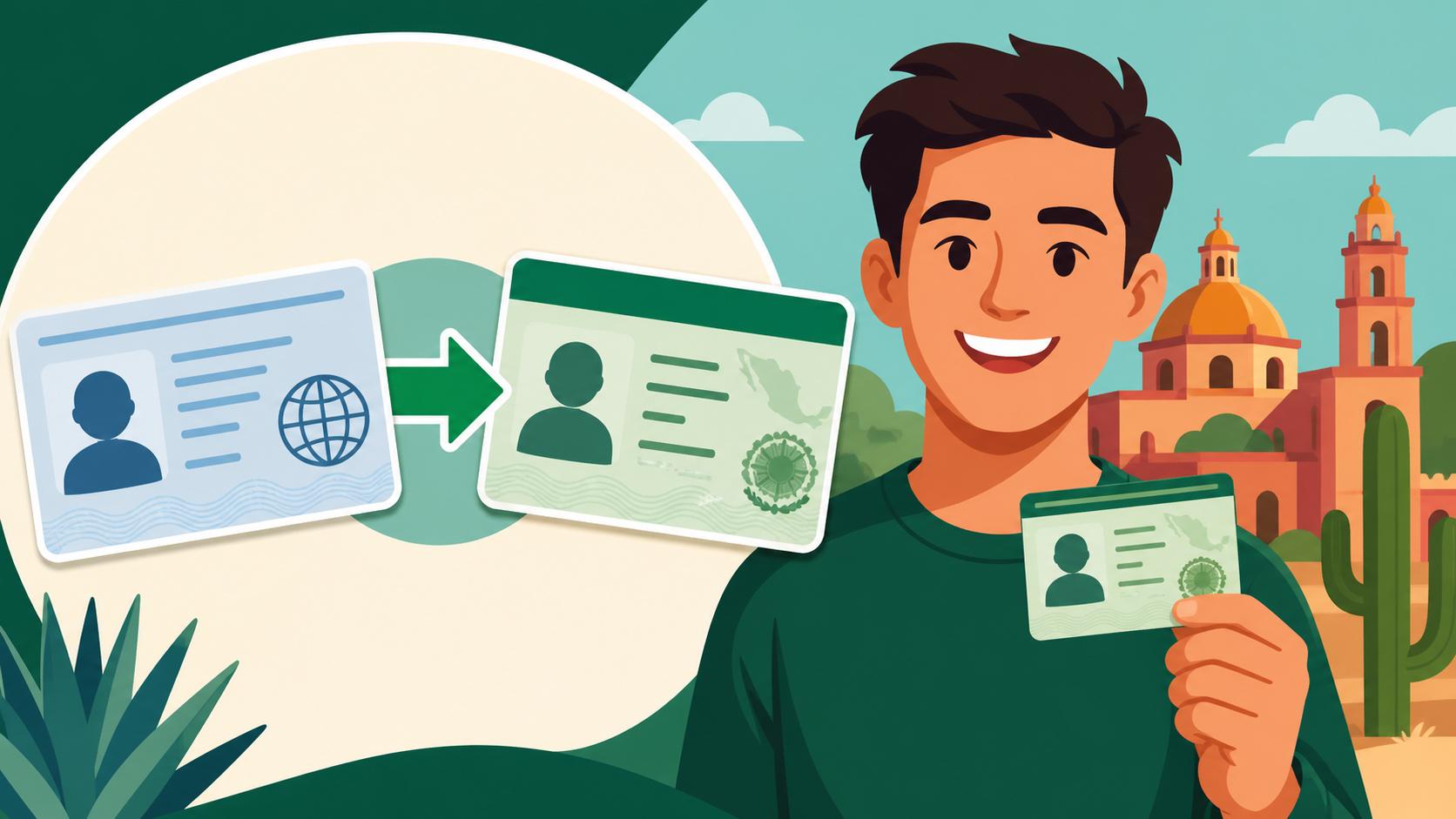
Exchanging a Foreign Driver’s License for a Mexican License
Expats often find themselves caught in a loop of confusion when it comes to driving legally in Mexico, especially after the initial "honeymoon phase" of their residency. I remember the cold sweat I felt being pulled over in Guadalajara, clutching my home country's plastic card and wondering if it still held any weight now that I had a residency sticker in my passport. This guide solves the mystery of the licensing "exchange" and provides a roadmap to getting your local Mexican credentials without losing your mind in the process.
Disclosure: This post may contain affiliate links. We may earn a commission at no extra cost to you if you make a purchase through these links. Read full disclosure.
Understanding the Mexican Licensing System as an Expat
The first thing you need to realize is that Mexico doesn’t have a centralized, federal Department of Motor Vehicles. Licensing is handled at the state level, meaning the rules in Mexico City are vastly different from the rules in Yucatán or Jalisco. When we talk about "exchanging" a license, it’s rarely a 1-to-1 swap where you hand over your old card and get a new one. In most cases, it is a process of validation where your foreign experience allows you to skip certain steps, but you are still applying for a brand-new Mexican document.
Is an Exchange Actually Possible
In the strictest sense, Mexico does not "exchange" licenses. You get to keep your original foreign driver’s license, which is a relief for those of us who travel back home frequently. What the Mexican authorities are doing is issuing you a Licencia de Conducir based on your legal status in the country. Some states are very friendly toward foreign drivers and will waive the driving or written exam if you present a valid, unexpired license from your home country. Others treat every applicant as a first-timer, regardless of whether you have been driving for thirty years.
I’ve seen friends in Quintana Roo walk in with a US license and walk out with a Mexican one in forty minutes, while folks in other regions had to parallel park a manual transmission car around orange cones just to prove their worth. Before you head to the office, you should check the specific requirements of the Secretaría de Movilidad (SEMOV) or the equivalent traffic authority in your specific state. This is where having a reliable data connection is vital so you can double-check office locations and hours on the fly. I usually recommend using Airalo to ensure you have local data the moment you start navigating these government buildings, as public Wi-Fi in these offices is non-existent.
The Role of Immigration Status
Your eligibility for a Mexican driver's license is tied directly to your residency status. If you are here on a 180-day tourist permit (FMM), you are generally allowed to drive using your valid foreign license for the duration of your stay. However, the moment you transition to a Mexico Temporary Resident Visa: Comprehensive Guide for Expats (2026 Update), the clock starts ticking. Most states require residents to obtain a local license within a certain window—often 30 to 90 days—of receiving their residency card.
There is a common debate in expat circles: "Can I just keep using my home license?" Legally, once you are a resident, you are expected to follow local administrative laws. More importantly, if you are involved in an accident, your Car Insurance in Mexico: Understanding Coverage and Costs might be voided if the adjuster determines you were driving as a resident without a local license. Navigating the Temporary vs Permanent Residency in Mexico: Key Differences and Benefits is hard enough; don't let a simple traffic stop turn into a legal nightmare because you skipped the licensing office.
State by State Requirements and Local Nuances
Because every state operates like its own little kingdom, you have to play by their specific rules. The documents required are generally the same, but the "flavor" of the experience changes. In some states, the process is digitized and efficient; in others, it involves multiple windows, carbon copies, and a lot of standing in the sun.
Licensing in Mexico City CDMX
Mexico City is often the path of least resistance for expats. The city government has streamlined many processes to encourage formalization. If you are Living in Mexico City: An Expat's Guide to Neighborhoods and Lifestyle, you will find that the Secretaría de Movilidad (SEMOVI) often allows foreigners with a valid foreign license to skip the written and practical exams entirely. You essentially provide your documents, pay the fee, get your photo taken, and walk out.
However, don't let the simplicity fool you. You still need a mountain of paperwork. The most critical piece is the comprobante de domicilio (proof of address). This can be a water bill, a CFE electricity bill, or a landline phone bill. It must be in your name or accompanied by a rental contract, and it absolutely must be less than 90 days old. If you've been Paying Utility Bills in Mexico: Methods and Tips for Expats, you know how protective people are of these original paper bills. Make sure you have the original and at least two high-quality photocopies.
The Process in Jalisco and the Lake Chapala Region
Jalisco, home to the massive expat hubs of Guadalajara and Ajijic, is a bit more rigorous. Here, you are almost certainly going to face a written exam. The exam is in Spanish, though some modules occasionally offer an English translation that is, frankly, quite poor. I spent weeks studying a PDF of Mexican road signs I found on Amazon Mexico just to make sure I didn't fail on a technicality like "What does a solid yellow line mean in a school zone?"
In Jalisco, they also require a blood type test. You can't just tell them you're O-positive; you need a signed and stamped certificate from a local lab (laboratorio clínico). This is a small extra step, but it catches many expats off guard. The good news is that these labs are everywhere, and you can usually get the results in twenty minutes for about 200 pesos. Once you have that, you head to the Recaudadora to pay your fees before finally getting in the queue for the actual license.
Coastal Rules in Quintana Roo and Baja
The coastal states, particularly Quintana Roo (Cancún, Playa del Carmen) and Baja California Sur (Los Cabos), are very accustomed to foreigners. The process here is often described as "fast but pricey." Because these areas are transit-heavy, the local police are more likely to check for valid local credentials. If you are living the Digital Nomad Life in Mexico: Remote Work Living Guide in a place like Playa del Carmen, you might find the licensing office is located within the municipal palace or a dedicated transit hub.
In these regions, they often offer licenses for different durations—1 year, 3 years, or 5 years. I always suggest going for the longest duration possible. The price difference is negligible compared to the headache of returning to the office to renew. Some expats staying at Selina locations use their time there to gather their local documents, but remember, you generally need a permanent or long-term address to satisfy the comprobante requirement.
| State | Exam Required for Foreigners? | Key Requirement | Estimated Cost (3 Years) |
|---|---|---|---|
| Mexico City (CDMX) | Rarely | Valid Foreign License | $1,050 – $1,200 MXN |
| Jalisco | Yes (Written & Practical) | Blood Type Certificate | $900 – $1,100 MXN |
| Quintana Roo | Sometimes | Residency Card (CURP) | $1,200 – $1,800 MXN |
| Yucatán | Yes | Proof of Address (Recent) | $800 – $1,000 MXN |
Step by Step Guide to the Application Process
Now that you know the landscape, let’s talk about the actual day of the appointment. This is where most expats lose their patience. The "system" is often slow, and "the system is down" is a phrase you will likely hear at least once. Go in with a fully charged phone, a bottle of water, and zero expectations of a quick exit.
Gathering the Correct Paperwork
The "The Comprobante Struggle" is a real thing. In Mexico, the bill is king. If your name isn't on the electricity bill because you are renting, you need to bring your lease agreement and a copy of the landlord’s ID (INE). This is the number one reason people are turned away. You also need your How to Get a CURP as a Foreigner: The Mexican ID Number Explained. The CURP is your unique population registry code, and it must be the "verified" version from the official government website.
Here is your essential checklist:
- Valid Passport (Original and 2 copies).
- Residency Card (Temporal or Permanente – Original and 2 copies).
- CURP (Printed within the last 30 days).
- Proof of Address (Electricity, Water, or Landline – Original and 2 copies).
- Your foreign driver's license (Original and 2 copies).
- Blood type certificate (if required by your state).
Navigating the Exam and Medical Requirements
If your state requires an exam, don't panic. The written portion is usually multiple-choice and focuses on basic safety, right-of-way, and sign recognition. If your Spanish is shaky, bring a dictionary or use a translation app. Some offices are lenient and will let a friend translate, but don't count on it. The practical exam is usually very basic—starting the car, signaling, and parking. The officer just wants to see that you aren't a danger to society.
There is also a brief medical screening. Usually, this just involves an eye exam where you read a chart from a few meters away. If you wear glasses, make sure you have them with you, or your license will be marked with "with lenses" (con lentes). This is a legal requirement; if you are caught driving without your glasses and it's on your license, that’s an automatic fine.
Paying the Fees and Receiving Your Card
Payment is usually handled at a separate window or sometimes at a nearby bank or OXXO. You will be given a "linea de captura" (a payment slip with a barcode). Once you pay, keep that receipt like it’s made of gold. You bring that receipt back to the licensing office to prove you've settled your debt with the state.
After payment, you’ll go to the "Biometrics" area. They will take your photo, scan your fingerprints, and ask for a digital signature. My pro-tip: Dress somewhat decently. This photo will be your primary ID for the next several years in Mexico. Once the photo is taken, the card is usually printed on the spot. You wait about 15 to 20 minutes, and a clerk will call your name to hand over your shiny new Licencia de Conducir.
Driving Safely and Legally While You Wait
While you are in the process of getting your Mexican license, you are in a bit of a legal gray area. If you’ve just arrived and are still on your tourist permit, you are fine. But if you’ve already started your residency paperwork at the INM (National Institute of Migration), things get tricky.
Using International Driving Permits IDP
An International Driving Permit (IDP) is NOT a license; it is merely a translation of your home license. While it’s helpful if you are pulled over by an officer who doesn't speak English, it does not replace the requirement for a local license once you are a resident. Some people think an IDP gives them a free pass to ignore local licensing laws, but that is a dangerous assumption.
If you are planning to take a long-distance trip before your local license is ready, check out Is It Safe to Drive at Night in Mexico? Road Safety Tips for Expats. Driving in Mexico is an art form, involving the navigation of topes (massive speed bumps) and the creative use of hazard lights. Having the right paperwork is only half the battle; understanding the road culture is the other half.
Insurance Implications for Foreign License Holders
This is the most critical point: your insurance policy. Almost every Mexican auto insurance policy requires the driver to have a "valid license." If you are a resident but still using a US or Canadian license, an insurance company might argue that your license isn't "valid" under Mexican law because you failed to obtain a local one within the required timeframe.
I’ve heard horror stories of expats being denied coverage for a total-loss accident because of this technicality. When you get your Mexican license, call your insurance agent immediately and have them update your policy with your new license number. It usually doesn't change your premium, but it ensures that you are 100% covered in the event of a claim. Dealing with the bureaucracy of the license office is a small price to pay for the peace of mind that comes with being fully legal on the road.
Disclaimer
The information provided in this guide is for informational purposes only and does not constitute legal advice. Immigration laws and traffic regulations in Mexico are subject to frequent change at both the federal and state levels. Always verify requirements with the official government offices in your specific jurisdiction before proceeding with any application.