Credit vs Cash: What Do Locals Prefer and How Should Expats Pay?
Standing at a bustling market with a fistful of foreign debit cards while the vendor stares blankly, demanding physical pesos, is an incredibly humbling expat experience. I once had to abandon a full cart of groceries because the card terminal suddenly lost signal. This guide decodes Mexico’s complex payment landscape so you can navigate cash and credit effortlessly.
Disclosure: This post may contain affiliate links. We may earn a commission at no extra cost to you if you make a purchase through these links. Read full disclosure.
The Reality of the Mexican Cash Economy
When you relocate to Mexico from a hyper-digitized society like the United States, Canada, or Northern Europe, the sheer volume of physical currency exchanging hands daily is jarring. Despite the rapid modernization of the country’s banking infrastructure, cash remains the undisputed king of the Mexican economy.
Why Locals Still Prefer Physical Pesos
According to reports from the Bank of Mexico, over 80 percent of small transactions across the country are still handled entirely in physical currency. The reasons for this are deeply structural. A massive portion of the Mexican workforce operates within the informal economy. Vendors at the tianguis (open-air mobile markets), neighborhood taquerías, and independent artisans do not want to sacrifice 3 to 5 percent of their razor-thin profit margins to corporate credit card processors. Furthermore, operating purely in cash keeps these small businesses off the radar of the SAT, Mexico’s federal tax authority.
For an expat, understanding this cash-first mentality is essential for your financial survival. If you attempt to live your life entirely via Apple Pay or credit cards, you will be forced to shop exclusively at premium supermarkets, luxury malls, and tourist-trap restaurants. By avoiding the cash economy, you miss out on the freshest produce, the most authentic local cuisine, and the most affordable services, artificially inflating your Cost of Living in Mexico: A Realistic Budget Breakdown. To truly integrate and enjoy the vibrant local culture, you must become comfortable carrying and transacting in physical pesos every single day.
The 500 Peso Note Dilemma
The most immediate and frustrating struggle every expat faces involves the distribution of bills from local ATMs. Mexican ATMs overwhelmingly dispense 500-peso notes (roughly $25 to $30 USD). While this seems like a small denomination to a foreigner, handing a 500-peso bill to a street vendor for a 30-peso bottle of water is a massive social faux pas.
Many small vendors start their day with a very limited amount of physical change. If you hand them a 500-peso note early in the morning, you will completely wipe out their ability to break bills for the next ten customers. You will hear the phrase “No tengo cambio” (I don’t have change) constantly.
To survive the cash economy, you must become a strategic hoarder of small bills and coins. Whenever you make a large purchase at a corporate supermarket like Chedraui, Walmart, or a major convenience store like OXXO, intentionally use your 500-peso notes to break them down into 100s, 50s, 20s, and coins. You must maintain a steady supply of small denominations to pay for localized services, street parking, and to navigate the complex social expectations detailed in Tip Culture: How Much to Tip for Services From Maids to Waiters.
When to Use Credit and Debit Cards
While cash dominates the streets and independent markets, formal establishments in Mexico are heavily equipped to handle modern credit and debit cards. However, the cultural protocols and hidden fees associated with swiping your plastic require careful navigation.
The Rise of Digital Payments and SPEI
Credit and debit cards are universally accepted at modern supermarkets, pharmacies, established restaurants, toll booths, and intercity bus terminals. Visa and Mastercard are king; American Express is generally only accepted at high-end restaurants and international hotel chains.
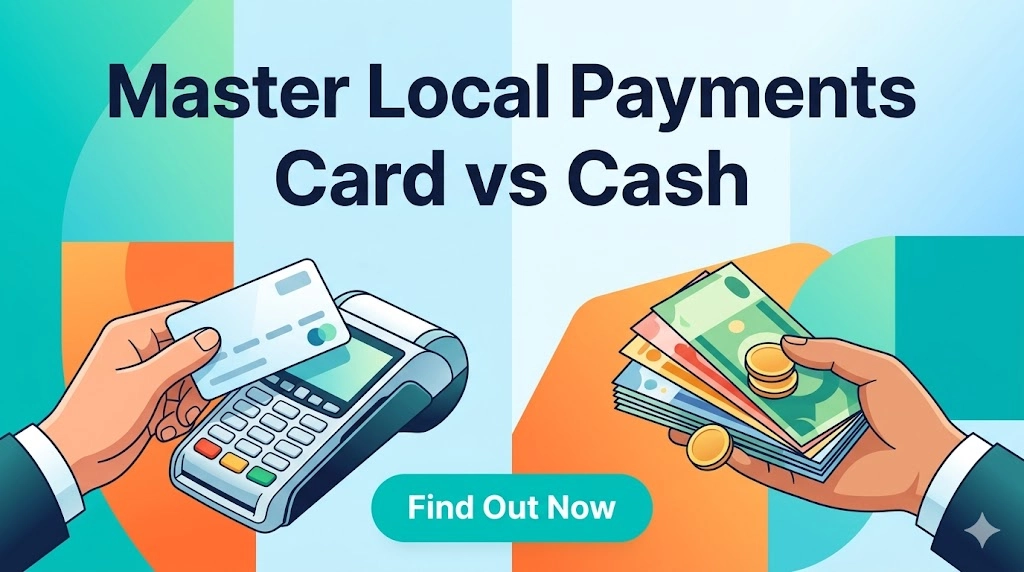
One major cultural difference you will notice immediately is the restaurant payment protocol. In Mexico, a waiter will never take your credit card away from the table to process it. Taking a customer’s card out of their sight is considered a massive security risk. Instead, the waiter will bring a wireless point-of-sale terminal directly to your table, allowing you to insert or tap your card and input your PIN while maintaining visual contact with your card at all times.
Beyond plastic, Mexico has an incredibly robust domestic digital transfer system called SPEI. Operating 24/7, SPEI allows for instant, free bank transfers between any two Mexican accounts. Locals use SPEI for everything from paying their monthly rent to settling a bill with a plumber. Understanding how this instant transfer network operates is crucial, and it requires familiarizing yourself with the banking codes explained in What Is a CLABE? Understanding Mexican Bank Account Numbers.
Navigating Point of Sale Scams and Fees
When paying with a foreign card in Mexico, you are walking into a minefield of hidden surcharges and predatory banking traps. First, you will frequently encounter small retail businesses or independent clinics that will attempt to pass the bank’s processing fee directly onto you. They will inform you that paying with a card carries a 3% to 5% “comisión.” The Mexican federal consumer protection agency (PROFECO) has repeatedly stated that this practice is entirely illegal. Businesses must absorb the cost of offering card services. You have the right to decline the surcharge or take your business elsewhere.
The second, and far more dangerous trap, is Dynamic Currency Conversion (DCC). When you use a foreign card at a Mexican ATM or a restaurant payment terminal, the screen will often pause and offer to “lock in” your exchange rate, asking if you want to be charged in your home currency (like USD or CAD).
The terminal will present the “Accept” button in bright green and the “Decline” button in small red text. This is a deliberate psychological trick. The exchange rate offered by the ATM or terminal is universally terrible, often 5% to 8% worse than the actual market rate. Always explicitly decline the conversion and choose to be charged in Mexican Pesos. By declining, you force your home bank to process the conversion at a vastly superior, localized rate, a vital strategy outlined in Bank Fees in Mexico: Tips to Avoid Unnecessary Charges.
Smart Payment Strategies for Expats
Navigating the dual nature of Mexico’s cash and digital economies requires a highly deliberate financial setup. If you attempt to run your entire life abroad using your home-country retail bank, the accumulated foreign transaction fees, wire fees, and out-of-network ATM charges will bleed your savings dry.
Managing Daily Expenses Without Extortion
For day-to-day spending, carrying a dedicated multi-currency tool is absolutely essential. I rely almost exclusively on Wise for my daily life in Mexico. Instead of swiping a foreign bank card and crossing my fingers on the exchange rate, I hold a localized balance in Mexican Pesos directly within my Wise account.
When I go to the supermarket or need to pull cash from a local ATM to fund my market trips, I use my Wise debit card. Because the card is pulling from an already converted peso balance, I secure the true mid-market exchange rate and completely bypass the predatory foreign transaction fees traditional banks charge. Integrating a tool like Wise into your daily routine ensures that your budget remains predictable. Establishing this localized spending strategy should be your very first priority after completing the steps for Opening a Bank Account in Mexico.
Funding Large Purchases and Life Events
While digital wallets and travel cards are perfect for buying groceries and paying for dinner, they are entirely insufficient for major capital movements. If you are preparing to secure an apartment, purchase a vehicle, or move funds for residency requirements, standard consumer apps and credit cards will hit their security limits and fail.
For massive capital conversions, veteran expats utilize Interactive Brokers. If you are transferring fifty thousand dollars to secure a down payment for Buying Real Estate in Mexico: A Step-by-Step Guide for Foreigners, executing that wire through a standard retail bank means losing thousands of dollars to hidden SWIFT network spreads. Because Interactive Brokers acts as a sophisticated institutional trading platform, it grants you direct access to the actual Forex spot rate. You can convert massive sums of USD, CAD, or EUR into Mexican Pesos for mere pennies in commission.
Once your capital is safely converted to pesos within Interactive Brokers, you can wire those funds directly to a Mexican notary, a real estate developer, or your own local Mexican bank account. This strategy protects your overarching net worth from the quiet extortion of retail banking margins. Keeping your daily spending accounts separate from your primary investment and real estate capital is also a foundational requirement for maintaining clean international tax records, a reality explored thoroughly in Taxes in Mexico for Expats: A Complete Guide to Income Tax and More.
The Complete Expat Payment Guide
To help you make quick, on-the-ground decisions, here is a breakdown of the optimal payment methods for various Mexican scenarios.
| Situation / Vendor | Preferred Payment Method | Strategy & Notes |
|---|---|---|
| Street Food & Tianguis | Cash (Small Bills) | Never use 500-peso notes here. Vendors do not accept cards. |
| Grocery Baggers & Gas Stations | Cash (Coins) | Keep 10 and 20 peso coins accessible in your car or pocket. |
| Major Supermarkets (Walmart) | Debit / Credit Card | Great place to break 500-peso notes or safely use a travel card. |
| High-End Restaurants | Credit Card | Always decline Dynamic Currency Conversion (DCC) on the terminal. |
| Paying Rent to a Landlord | SPEI Bank Transfer | Cash is risky for large sums; SPEI provides a legal, digital paper trail. |
| Buying Real Estate / Vehicles | Institutional Wire | Convert funds globally at spot rates before sending locally to a notary. |
References
Primary sources (official)
- Banco de México (Banxico): The official 2024 quantitative report from the central bank detailing the exact percentage of the population that still relies entirely on physical cash for daily transactions. https://www.banxico.org.mx/billetes-y-monedas/estudios-e-indicadores/%7B2757BE4B-4BB2-5330-7224-DF85F85C18B2%7D.pdf
- Procuraduría Federal del Consumidor (PROFECO): The federal consumer protection agency bulletin explicitly declaring that transferring the 3% to 5% bank terminal commission onto the consumer is an illegal violation of the Federal Consumer Protection Law. https://www.gob.mx/profeco/prensa/profeco-reitera-que-el-cobro-de-comision-por-pago-con-tarjeta-es-una-violacion-a-la-ley
Other helpful sources
- Deloitte Mexico – Digital Payments: An industry analysis highlighting that for purchases under 500 pesos, over 85% of Mexican consumers continue to strictly use physical cash. https://www.deloitte.com/latam/es/our-thinking/dnoticias/avance-pagos-digitales-mexico.html
Disclaimer
The information provided in this guide is for educational, logistical, and informational purposes only and does not constitute formal financial, banking, or legal advice. The Mexican banking landscape, ATM withdrawal limits, and acceptance of digital payments vary drastically between major metropolitan hubs and rural municipalities. While PROFECO regulates that point-of-sale terminal surcharges are illegal, enforcement is challenging, and independent businesses may simply refuse service if you decline the fee. Digital transfer platforms like Wise and institutional brokerage services like Interactive Brokers operate under their own strict terms of service, compliance checks, and fluctuating fee structures.