Bringing Your Car vs Buying in Mexico: Pros and Cons for Expats
Staring at a steaming radiator on the side of a mountainous highway in Michoacán, I cursed the day I decided to drive my imported SUV across the border. Navigating the brutal bureaucracy of temporary vehicle permits or buying a car locally presents a massive dilemma for expats. This guide breaks down the true financial and logistical realities of both choices.
Disclosure: This post may contain affiliate links. We may earn a commission at no extra cost to you if you make a purchase through these links. Read full disclosure.
The Bureaucracy of Bringing Your Foreign Car
The romantic idea of packing your entire life into the trunk of your car, turning up the radio, and driving south across the border is incredibly appealing for thousands of incoming expats. However, the Mexican government heavily regulates foreign vehicles to protect their own domestic auto manufacturing industry. This creates a massive, heavily enforced administrative hurdle before your road trip even begins.
Understanding the Temporary Import Permit
If you plan to drive your foreign-plated vehicle past the designated Free Zones, you must legally obtain a Temporary Import Permit from Banjercito, the official Mexican military bank. The Free Zones generally include the entire Baja California peninsula, the state of Quintana Roo, the Sonora Free Zone, and a narrow 25-kilometer strip south of the US land border.
If you drive past these specific geographic checkpoints into the interior of Mexico without a valid permit, your vehicle is legally considered contraband. It can be immediately confiscated by federal authorities, and you will face severe, life-altering fines. You can apply for this permit online between 10 to 60 days prior to your trip, or you can endure the chaotic lines in person at the border crossing. The administrative fee is roughly $51 USD, but that is only the beginning of your financial commitment.
The Financial Deposit and Visa Expiration Trap
In addition to the non-refundable administrative fee, Banjercito requires a massive guarantee deposit, ranging from $200 to $400 USD depending exclusively on the manufacturing year of your vehicle. This deposit acts as a federal guarantee that you will not illegally sell the car in Mexico and that you will eventually drive it back out of the country.
The most critical, often-misunderstood rule that destroys many expats’ plans is that your vehicle’s permit is inextricably tied to your specific immigration status. If you enter on a 180-day tourist visa, your car is only legal for 180 days. If you hold a Temporary Resident card, your car permit is tied directly to the exact expiration date of that card. If your visa expires, even by a single day, your car instantly becomes illegal contraband.
Furthermore, Permanent Residents are strictly forbidden from holding a temporary import permit. If you eventually upgrade your residency status to permanent, you must physically drive the car out of the country and surrender the permit before your new immigration card is issued. To deeply understand the strict timelines and financial requirements of your visa status, you must review Mexico Immigration Fees and Costs: Budgeting for Your Residency.
The Nightmarish Reality of the Nationalization Process
Many eager expats assume they can simply drive their US or Canadian car down on a temporary permit for a few years and then smoothly “nationalize” or permanently import it later to get Mexican license plates. This is a catastrophic logistical assumption that costs people thousands of dollars.
Permanently importing a foreign vehicle into Mexico is incredibly expensive, highly restrictive, and legally requires hiring a licensed customs broker at the northern border. You cannot do this in the interior of the country; you must drive the car back to a border city like Nuevo Laredo or Tijuana. Only specific vehicles manufactured in North America that strictly comply with NAFTA and USMCA rules, and fall within very specific model years, are eligible.
The import taxes, broker fees, and physical inspection costs can easily cost thousands of dollars, completely wiping out any perceived savings of bringing your own car. The vast majority of expats who attempt this fail due to bureaucratic red tape, forcing them to drive the car all the way back to Texas or California just to sell it at a massive loss.
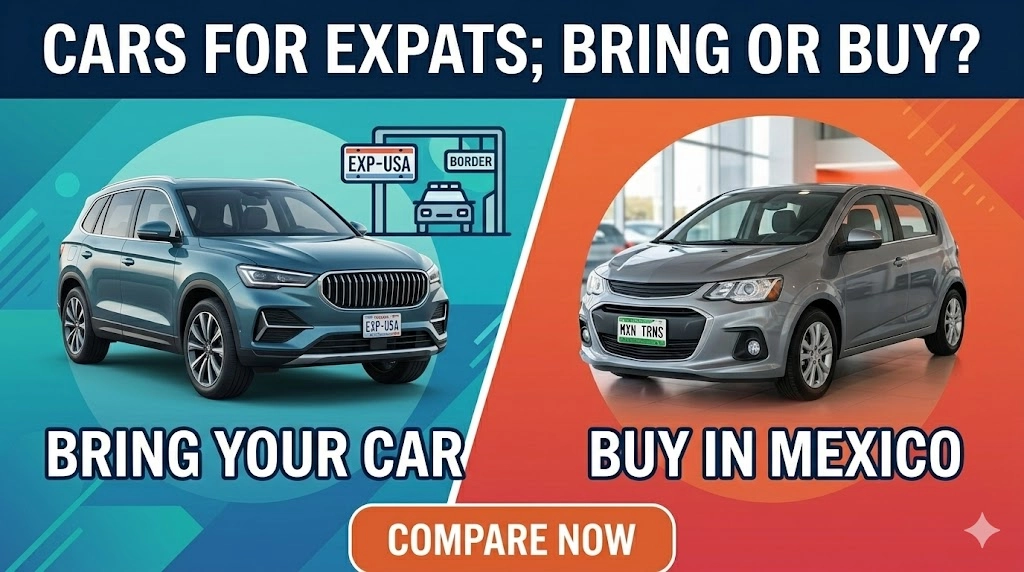
The Realities of Driving a Foreign Plated Vehicle
If you successfully secure your temporary permit, pay your deposit, and cross the border into the interior, your daily life driving a foreign-plated vehicle carries entirely different psychological and logistical stressors than driving a local Mexican car.
Police Targeting and the Mordida Phenomenon
It is an undeniable, unfortunate reality that foreign license plates are absolute magnets for corrupt local transit police looking for a fast bribe, commonly known in Mexico as a mordida (a bite). Officers know that foreigners driving foreign cars are generally unfamiliar with local traffic laws, often carry cash, and are easily intimidated by the threat of having their vehicle impounded in a foreign country.
You will likely be pulled over for fabricated, highly subjective infractions, such as a “missing” front license plate (even if your home state or province does not issue them) or allegedly running a yellow light. The absolute best defense against this extortion is unwavering, polite patience. Never hand over your original passport or your original driver’s license; only offer color photocopies.
To further protect yourself and completely change the dynamic of the traffic stop, veteran expats order high-definition, dual-channel dashcams through Amazon Mexico before they hit the road. When a corrupt transit officer sees a flashing red light recording the interaction on a premium dashcam sourced from Amazon Mexico, they are drastically less likely to demand a bribe. Utilizing Amazon Mexico to equip your vehicle with these vital security tools ensures you are not a vulnerable target on the highway.
Navigating Mexican Auto Insurance Hurdles
Your comprehensive, expensive auto insurance policy from the United States or Canada is legally worthless the absolute second your tires touch Mexican soil. Mexican federal law explicitly requires all drivers to hold third-party liability insurance issued by a Mexican-domiciled insurance company.
If you are involved in a severe accident and do not possess this specific, localized coverage, you can be physically detained in a local jail until the damages are paid in full. Mexican traffic accidents are treated as civil matters where fault must be legally and financially determined before anyone is allowed to leave the scene. Securing premium coverage that explicitly includes legal assistance and bail bond coverage is absolutely non-negotiable. For a deep dive into highway safety, avoiding dangerous areas, and route planning, you must read Taking Road Trips in Mexico: Safety and Planning Tips.
Finding Parts and Mechanics for Foreign Specs
A massive, hidden cost of bringing your own car is the absolute nightmare of the local automotive supply chain. Even if you drive a globally common car like a Honda CR-V, a Ford F-150, or a Toyota RAV4, the US or Canadian version often features completely different computer systems, emissions sensors, and suspension components than the Mexican domestic version of the exact same model.
When your imported car breaks down, local mechanics will not have the correct parts in stock. You might wait weeks for a specialized oxygen sensor or a specific alternator to be shipped across the border, leaving you stranded. To bypass this, resilient expats heavily utilize Amazon Mexico to order specialized OBD2 diagnostic scanners, premium synthetic fluids, and highly specific replacement parts directly to their doors. By relying on Amazon Mexico, you circumvent the massive delays of the local auto parts stores and ensure your mechanic has exactly what they need to get you back on the road.
Buying a Car in Mexico as an Expat
If the relentless bureaucracy of the border deters you, buying a car locally provides total legal peace of mind and allows you to blend in. However, it introduces an entirely new set of intense, uniquely Mexican administrative hurdles.
The RFC and Residency Requirements for Purchasing
Five years ago, a tourist could walk into a dealership with a suitcase of cash, point at a car, and drive it off the lot. Today, the Mexican government has aggressively modernized its tax tracking, making that completely impossible. To purchase a vehicle from a legitimate, licensed dealership, you must possess a formal resident card and a Mexican Tax ID number, known as the RFC.
Without an RFC, dealerships cannot legally issue the electronic tax invoice required for the vehicle, and the state transit authority will flatly refuse to issue license plates in your name. Securing an RFC requires navigating the heavily backlogged digital appointment system of the Mexican tax authority. To ensure you understand how to navigate this federal requirement and remain compliant with the local tax laws, you must thoroughly read Taxes in Mexico for Expats: A Complete Guide to Income Tax and More.
New vs Used Dealerships vs Private Sellers
When buying a car locally in Mexico, you have three primary avenues, each carrying drastically different risk profiles. Certified dealerships offer absolute legal safety and warranties, but their prices for new and certified pre-owned vehicles are shockingly high due to import taxes and high local interest rates.
The private market, largely operating on Facebook Marketplace or local expat community forums, offers significantly better financial deals but extreme legal risk. Buying a used car from a stranger in Mexico means you are potentially inheriting any unpaid traffic tickets, hidden mechanical disasters, or worse, a stolen vehicle.
The highly popular middle ground that many expats utilize today is Kavak, a massive digital used-car platform. Kavak inspects the vehicles, guarantees the mechanical status, and handles all the complex title transfer paperwork for a slight premium. This offers a much safer transaction than a private handshake deal in a supermarket parking lot.
The Infamous Factura and Title Transfers
The most critical cultural difference in the Mexican auto market is the concept of ownership documentation. Mexico does not use a state-issued “Title” printed on secure paper like the United States or Canada. Instead, they use the Factura Original (the original dealership invoice).
The Factura is the single most important document you will own in Mexico. It lists the original purchase price, the VIN, and the issuing dealership. When a car is sold privately, the chain of ownership is proven by the seller writing a short, legally binding paragraph on the physical back of the Factura, stating they cede the rights to the buyer, followed by their signature. This process is called el endoso.
If you lose the original Factura, the car becomes virtually worthless. It cannot be legally sold, it cannot be registered, and it cannot be insured. You must guard the Factura Original in a fireproof safe. Furthermore, before buying any used car, you must run the VIN through the federal REPUVE system to ensure it has not been reported stolen, as buying a stolen car, even accidentally, carries severe criminal penalties.
Financial Comparison Import Costs vs Local Pricing
The decision to import your current vehicle versus buy one locally ultimately comes down to a brutal, honest mathematical calculation regarding your available capital and your long-term timeline.
The Premium on Mexican Used Cars
Expats from the United States are frequently stunned and outraged by the pricing of the Mexican used car market. Unlike in North America, where vehicles depreciate aggressively the moment they leave the dealership lot, Mexican used cars hold their value incredibly well.
This is largely due to the extraordinarily high cost of automotive credit and the 16% Value Added Tax applied to all new cars, which artificially inflates the baseline value of the entire market. A ten-year-old Toyota Tacoma, Honda Civic, or Nissan Versa might cost 30% to 40% more in Jalisco or Yucatan than it would in Texas or Florida.
If you are buying a car in Mexico, you must arrive with massive cash liquidity. Securing a local Mexican auto loan as a brand-new expat with no local credit history carries exorbitant, double-digit interest rates that will financially ruin you.
Hidden Taxes Tenencia and Registration Fees
When you own a Mexican-plated car, you are subject to highly specific local state taxes. The most infamous of these is the Tenencia, an annual vehicle ownership tax that varies wildly by state. Some states, like Jalisco or Quintana Roo, have abolished it completely to attract residents and businesses, while others, like Mexico City, still charge a percentage of the vehicle’s depreciated value.
Additionally, you must pay annual registration fees, known as the refrendo, and navigate periodic mandatory license plate replacements ordered by the state government. To legally register a car and secure your plates, you must provide a flawless proof of address matching your exact name, which ties directly into the legitimacy of your housing contract. To navigate these residential requirements securely and ensure your lease is legally binding, review Real Estate in Mexico: Renting vs Buying for Expats.
Calculating the True Long Term Value
When breaking down the actual financial commitment, the numbers reveal a stark contrast in where your money is allocated.
| Expense Category | Bringing a Foreign Car (Banjercito TIP) | Buying a Car Locally in Mexico |
| Upfront Capital | Very Low ($51 administrative fee + $400 maximum deposit) | Extremely High (Full cash purchase required) |
| Vehicle Depreciation | High (Harder to sell later, must leave the country) | Low (Mexican market cars hold their value exceptionally well) |
| Legal and Police Risk | High (Massive target for police extortion and bribes) | Low (Blends in perfectly with local domestic traffic) |
| Auto Insurance Costs | High (Requires specialized, premium expat tourist policy) | Standard (Qualifies for local domestic rates) |
| Ultimate Exit Strategy | Must physically drive the car back to the US/Canada border | Can easily and legally sell for pesos before leaving |
Alternatives and Transition Strategies
Do not let the panic of transportation force you into making a terrible, rushed financial decision during your first month abroad. You need a structured, low-stress transitional strategy while you evaluate your neighborhood.
Surviving the First 30 Days Without a Car
When you first arrive in Mexico, your primary focus should be unpacking, overcoming culture shock, and completing your complex immigration paperwork, not test-driving used cars in a foreign language. In major, highly connected cities like Mexico City, Guadalajara, Puebla, or Merida, you absolutely do not need a vehicle immediately.
Ride-sharing applications like Uber, DiDi, and Cabify are incredibly cheap, ubiquitous, and drastically safer than hailing unverified street taxis. Relying entirely on ride-shares for your first few months allows you to safely observe the chaotic flow of Mexican traffic, understand the aggressive right-of-way rules, and figure out if your specific neighborhood even requires a personal vehicle. To ensure your residency paperwork takes absolute priority during this transitional phase, review How to Apply for Temporary Residency in Mexico: Step-by-Step.
Securing a Basecamp While You Decide
You should never, under any circumstances, buy a car until you firmly know exactly where you will be living long-term. If you rush out and buy a massive, extended-cab pickup truck and then decide to rent an apartment in a historic colonial center with narrow alleys, you will not be able to navigate the streets, let alone park it.
To give yourself the necessary time to scout neighborhoods and used car markets safely, book a transitional basecamp at a Selina location. Utilizing a private room or a suite at Selina for your first month provides a highly secure environment with commercial-grade internet. More importantly, Selina instantly plugs you into a massive, active community of other expats and digital nomads. You can network in the Selina co-working space to find out which local dealerships are honest, which mechanics to avoid, or potentially buy a reliable used car directly from another expat who is leaving the country, completely bypassing the sketchy private market.
Digital Preparedness for the House and Car Hunt
Hunting for a car in a foreign country requires you to be hyper-responsive, highly mobile, and completely digitally secure. If you are test-driving a vehicle across town or taking an Uber to a dealership deep in the suburbs, you cannot rely on spotty public Wi-Fi to keep you safe.
You must localize your cellular data the absolute second your plane lands. By downloading an eSIM profile through Airalo, you instantly connect to Mexico’s premier cellular network, Telcel, bypassing the need to hunt for a physical SIM card. Having a dedicated, high-speed Airalo data package ensures that your GPS mapping apps work flawlessly while you test-drive a vehicle in an unfamiliar city, keeping you out of dangerous neighborhoods. Furthermore, Airalo allows you to immediately contact your mechanic, translate complex automotive terms, or run online VIN checks on the side of the road.
Making the Right Choice for Your Timeline
Ultimately, the agonizing decision to import your current vehicle versus taking the financial hit to buy one locally is heavily dictated by your immigration status and your long-term vision for your life in Mexico.
When Bringing Your Car Makes Absolute Sense
Bringing your foreign vehicle on a Temporary Import Permit is the absolute best, most financially sound strategy for “snowbirds” who only spend six months a year in Mexico during the winter. It is also highly logical for digital nomads operating on short-term visas, or temporary residents who know definitively that they will return to their home country within one to two years.
If you already own a reliable, fully paid-off vehicle, the incredibly low upfront cost of the Banjercito permit heavily outweighs the massive capital requirement of buying a car locally. You simply accept the risk of police stops as a trade-off for keeping your cash liquid.
When Buying Locally is the Only Logical Choice
If you have successfully secured your Permanent Resident card, the debate is officially over; you are legally prohibited from driving a foreign-plated car on a permit, and you must buy locally to avoid federal confiscation.
Furthermore, if you plan to stay in Mexico for more than three years, buying a local car is the most financially sound and stress-free decision you can make. A Mexican-plated car blends in seamlessly, significantly reducing the anxiety of police harassment and extortion. You will have instant access to local mechanics who know the exact specifications of your vehicle, readily available replacement parts, and straightforward domestic insurance claims.
While the upfront sticker shock of the Mexican auto market is severe, the peace of mind, the legal security, and the surprisingly high resale value make it an incredible long-term investment in your new life. To understand the broader domestic utilities, government services, and local infrastructure you must set up to sustain this permanent life smoothly, read Setting Up Utilities in Mexico: Electricity, Water, and Internet.
References
Primary sources (official)
- Banjercito: The official Mexican military bank portal outlining the exact requirements, maximum guarantee deposits, and the secure digital application process for securing a Temporary Import Permit for foreign-plated cars. https://www.gob.mx/banjercito/articulos/sistema-de-importacion-temporal-de-vehiculos
Other helpful sources
- Mexperience: A highly practical, veteran expat guide explaining the specific, confusing nuances of Free Zones, the devastating consequences of expired permits, and the formal cancellation process required at the border. https://www.mexperience.com/temporary-import-permit-tip-vehicles-mexico/:
- Mexpro: A comprehensive insurance resource detailing the exact physical documentation required, including notarized permission letters for financed vehicles, before legally crossing the border. https://www.mexpro.com/mexico/vehicle-import-permit.html
Disclaimer
The information provided in this guide is for educational, logistical, and informational purposes only and does not constitute formal legal, tax, or financial advice. Mexican customs regulations regarding Temporary Import Permits, NAFTA/USMCA permanent importation rules, and SAT requirements for issuing electronic tax invoices are highly complex and subject to frequent and sudden legislative changes without public notice. Always consult with a certified bilingual Mexican customs broker or a registered immigration facilitator before attempting to import a vehicle, and rigorously verify your auto insurance liability limits directly with your provider before driving on Mexican highways.