Furnished vs Unfurnished Rentals in Mexico: What to Expect and Cost Differences
I will never forget unlocking the door to my first long-term Mexican rental, only to discover it lacked a refrigerator, a stove, and literally had bare wires hanging where light fixtures belonged. Navigating the extreme differences in Mexican rental terminology is a brutal rite of passage for foreigners. This guide decodes what furnished and unfurnished actually mean, breaking down the true costs and logistical hurdles of each.
Disclosure: This post may contain affiliate links. We may earn a commission at no extra cost to you if you make a purchase through these links. Read full disclosure.
1. Decoding Mexican Rental Terminology
The Reality of Sin Muebles Unfurnished
In the United States and Canada, “unfurnished” generally means you simply need to bring your own bed, couch, and dining table. The kitchen is fully operational, and the closets are ready for your clothes. In Mexico, sin muebles (unfurnished) is taken to its most literal, extreme definition. You are essentially renting a painted concrete box. I have walked into countless property viewings where landlords proudly showed off an apartment that completely lacked a kitchen sink, a stove, and a refrigerator.
Culturally, Mexican tenants often purchase their own major appliances and transport them from house to house whenever they move. This means when a tenant leaves, they strip the apartment entirely bare. You might literally find exposed, live wires hanging from the ceiling where light fixtures should be, and empty alcoves in the bedrooms because built-in wooden closets (clósets) were never installed by the developer.
Even crucial infrastructural elements can be missing or severely degraded. You must actively check if the apartment includes a functioning hot water heater (boiler), a pressurized underground water pump (hidroneumático), or a rooftop gas cylinder (tanque de gas estacionario). If you sign a lease for a sin muebles property without thoroughly inspecting these details, you are legally responsible for outfitting the basic livability of the home out of your own pocket. We discuss how to navigate these aggressive contract specifics in our Renting a Home in Mexico: Complete Expat Guide to Leases, Deposits, and More.
Semi Amueblado The Gray Area
The term semi-amueblado (semi-furnished) is arguably the most dangerous classification in Mexican real estate because it lacks any standardized definition. Every single landlord interprets it differently. For some, it simply means the apartment features built-in wooden kitchen cabinets and bedroom closets, distinguishing it from a raw concrete shell. For others, it means it comes with a stove and a refrigerator, but absolutely no soft furniture.
This confusion routinely leads to intense frustration on move-in day. You might assume a “semi-furnished” listing automatically includes a washing machine, only to find an empty laundry patio with disconnected plumbing lines when you arrive with your suitcases. The only way to survive this linguistic gray area is to demand a highly detailed, written inventory (inventario) before handing over your security deposit. Do not rely on assumptions.
If you are touring a semi-amueblado unit, you need to ask explicit, pointed questions. Ask if the heavy appliances currently sitting in the kitchen belong to the current tenant (who will take them) or the landlord. During this frantic viewing phase, having constant mobile data is non-negotiable so you can immediately text the landlord follow-up questions or translate appliance terms. I heavily rely on an Airalo eSIM to ensure my smartphone stays permanently connected to the local Telcel network during these neighborhood scouting missions, preventing me from losing a great apartment just because I couldn’t connect to a cafe’s public Wi-Fi.
Ultimately, semi-furnished units can be the perfect financial sweet spot for expats staying one to two years. You avoid the massive upfront cost of buying heavy, difficult-to-move appliances, but you retain the freedom to purchase your own high-quality mattress and ergonomic couch, bypassing the famously uncomfortable, stiff furniture that plagues many fully furnished Mexican rentals.
Amueblado Fully Furnished Comfort
Amueblado means the property is fully furnished and move-in ready. At a bare minimum, it will include beds, a dining table, a sofa, a refrigerator, and a stove. High-end, premium listings geared heavily towards the expat market will often be completely “turnkey” (llave en mano), meaning they include televisions, microwaves, basic cookware, cutlery, and even bed linens.
For digital nomads and short-term remote workers, this is the absolute Holy Grail. You can literally show up with a single suitcase, connect to the Wi-Fi, and start working the very next morning. However, you must carefully inspect the actual quality of the furnishings during your tour. Many opportunistic Mexican landlords buy incredibly cheap, rock-hard mattresses and flimsy, plastic-feeling sofas simply to check the “furnished” box on their online listing, only to subsequently hike the monthly rent by 40%.
Furthermore, you instantly inherit the liability of the landlord’s property. When you sign the lease, every single fork, throw pillow, and bedside lamp will be documented. If you break a cheap blender or scratch a veneer coffee table, the replacement cost comes directly out of your security deposit. Therefore, taking a timestamped, narrated video of the apartment’s condition on day one is an absolute necessity to protect your capital when you eventually move out.
Keep in mind that fully furnished apartments are predominantly clustered in heavily gentrified expat zones, such as Roma Norte in Mexico City or the Zona Romántica in Puerto Vallarta. Because these neighborhoods cater exclusively to foreigners with foreign salaries, they operate on highly inflated pricing models. You can review the exact price differences and lifestyle expectations in these hubs in our Digital Nomads in Mexico: Remote Work Guide.
2. The Financial Breakdown Costs and Deposits
Monthly Rent Premiums for Furnishings
The unparalleled convenience of walking into a fully furnished apartment comes with a remarkably steep monthly premium. In Mexico, landlords view furnished properties as high-risk, high-maintenance investments. They assume transient foreigners will damage their goods. Consequently, they charge significantly more to offset the perceived depreciation of their furniture.
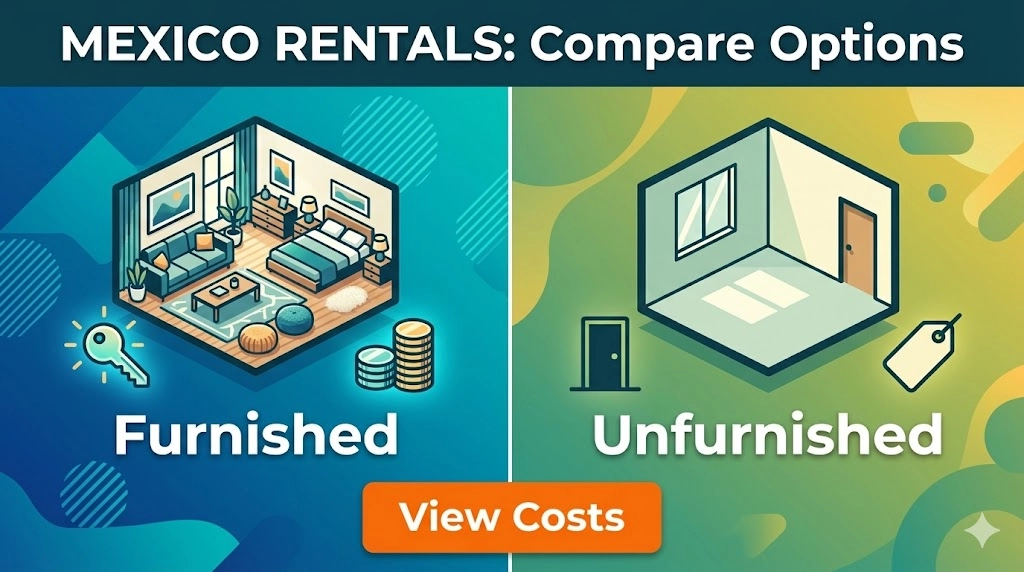
On average, you can expect to pay a staggering 30% to 50% premium on your monthly rent for an amueblado apartment compared to an identical sin muebles unit located in the exact same building. For example, if a beautifully renovated, unfurnished two-bedroom apartment in a local Guadalajara neighborhood costs 15,000 MXN (roughly $750 USD) a month, the landlord will easily list that same unit fully furnished for 22,000 MXN ($1,100 USD) a month.
Over the course of a standard 12-month lease, that monthly premium translates to thousands of dollars in “lost” capital. You are essentially paying off the full retail value of the landlord’s cheap furniture in just one single year, but you do not get to keep a single chair when you eventually move out. For expats living on strict fixed incomes or pensions, paying the furnished premium is mathematically inefficient over the long term. For more on structuring your long-term budgets defensively, see our Cost of Living in Mexico City (2026): Detailed Expat Budget Guide.
Semi-furnished units naturally fall in the middle of this spectrum, generally commanding a modest 10% to 15% premium over naked apartments. This slight bump is often entirely worth it simply to avoid the migraine of hauling a massive refrigerator up three flights of narrow, concrete Mexican stairs.
Upfront Capital Needed for Empty Rentals
If you choose to go the sin muebles route to save thousands on your annual rent, you must be prepared for a massive initial capital outlay. Moving into an empty Mexican apartment is not a gradual, piece-by-piece process; you need thousands of dollars in liquid cash ready to deploy during your first 72 hours in the country just to survive.
Let’s do the brutal math. A basic, reliable refrigerator in Mexico costs roughly $400 to $600 USD. A functional gas stove is another $300 USD. A baseline washing machine is $400 USD. Add in a quality mattress, a sofa, dining chairs, and essential lighting installations, and you are easily staring at a $2,500 to $4,000 USD upfront setup cost just to make the concrete box livable.
To fund these massive local purchases, you cannot rely on traditional SWIFT wire transfers from your home bank, as they will skim 3% to 5% off your money through terrible retail exchange rates and flat fees. Savvy expats utilize specialized fintech platforms to move large sums of setup capital securely into the local economy without bleeding equity. We break down the safest ways to fund these major purchases in Banking in Mexico: Complete Guide for Foreigners.
The financial math requires a strict break-even analysis. If the unfurnished apartment saves you $350 USD a month in rent, but costs you $3,500 USD to furnish, it will take you exactly ten months to break even. If you are only staying in Mexico for one year, buying all your own furniture barely pays off. If you are staying for three to five years, it is the smartest, most lucrative investment you can make.
Security Deposits and Wear and Tear
Mexican landlords are fiercely protective of their properties, and the security deposit (depósito en garantía) operates very differently depending on the furnishing level of the apartment you choose.
For an unfurnished apartment, the standard deposit is strictly one month’s rent. Because there is very little inside the apartment to physically damage—mostly just paint, doors, and basic plumbing fixtures—the friction surrounding the return of this deposit is generally lower. However, Mexican landlords are still notoriously evasive and slow when it comes to handing physical cash back at the end of a lease.
For fully furnished apartments, the risk to the landlord multiplies exponentially. Consequently, it is incredibly common for landlords to demand a massive two-month security deposit for amueblado properties. Tying up three months of inflated rent (the first month plus a two-month deposit) in a foreign legal system is a massive financial risk for you. If you accidentally stain a velvet couch or crack a dining table glass, the landlord controls the sole assessment of the damage and will aggressively deduct from your deposit.
To mitigate this severe risk, you must conduct a hyper-detailed walkthrough on move-in day. Take extensive, narrated video of every scratch on the refrigerator and every stain on the mattress, and immediately send it to the landlord via WhatsApp. Having continuous mobile data from Airalo allows you to instantly upload and timestamp these crucial defensive videos to the cloud before you even unpack your bags, locking in your proof.
| Rental Type | Monthly Cost Premium | Typical Inclusions | Target Expat Demographic |
| Sin Muebles | Baseline Price (Lowest) | Nothing (Concrete shell, no appliances) | Long-term residents (3+ years), retirees |
| Semi-Amueblado | 10% – 15% Premium | Stove, fridge, built-in closets | Mid-term expats (1-2 years) |
| Amueblado | 30% – 50% Premium | Turnkey: Beds, sofa, all appliances | Digital nomads, short-term remote workers |
3. The Logistics of Outfitting a Mexican Home
Sourcing Appliances and Furniture Locally
If you take the plunge and rent an unfurnished or semi-furnished home, you must quickly learn to navigate the local Mexican retail landscape. The big-box stores you will become intimately familiar with include Liverpool, Palacio de Hierro (premium), Coppel, Elektra, and Home Depot.
Liverpool and Palacio de Hierro offer phenomenal, high-end furniture and reliable global appliance brands (Samsung, LG, Whirlpool). However, shopping in these massive stores requires immense patience. The checkout process is deeply bureaucratic, often requiring multiple printed receipts, signatures, and physical stamps just to authorize the release of the goods from the warehouse loading dock.
For budget-friendly, immediate furniture, many expats scour Facebook Marketplace. You can often find perfectly good refrigerators or couches being sold by other foreigners who are breaking their leases and returning to the US or Canada. However, you must arrange your own transport for these items, which brings us to the most frustrating aspect of setting up a Mexican home.
When shopping at physical stores for these massive items, always use a credit card with zero foreign transaction fees to protect your purchasing power and accumulate points. You can learn exactly which international cards offer the best protection in our guide: Using Credit and Debit Cards in Mexico: What Expats Need to Know.
Delivery Frustrations and Freight Realities
In the United States, if you buy a mattress or a washing machine from a major retailer, they schedule a precise delivery window, bring the item directly inside your home, and often install it for you. In Mexico, freight delivery (flete) operates under a completely different, highly chaotic paradigm.
When you buy appliances from local stores, delivery is often outsourced to independent truck drivers (fleteros) waiting in the parking lot. These drivers operate heavily on “La Hora Mexicana” (Mexican Time). If they say they will deliver your new refrigerator between 10:00 AM and 6:00 PM on Tuesday, they might actually show up at 8:00 PM on Thursday. You will lose entire days sitting in an empty apartment, staring at the wall, waiting for a truck.
Furthermore, independent fleteros are generally only contracted to deliver the item to your front door or the ground-floor lobby of your building. If you live on the third floor of a walk-up apartment in Condesa, they will literally drop the 200-pound washing machine on the sidewalk and leave. You must aggressively negotiate (and heavily tip) in Spanish to convince them to help you carry heavy items up the stairs.
If you do not own a personal vehicle, dealing with local fletes is one of the most draining, sweat-inducing experiences of your first month in Mexico. We explore whether investing in a personal vehicle is actually worth the hassle to bypass these localized issues in Bringing Your Car vs Buying in Mexico: Pros and Cons for Expats.
The E Commerce Shortcut for Expats
To completely bypass the agonizing friction of local Mexican delivery logistics, seasoned expats heavily leverage the power of e-commerce. Specifically, Amazon Mexico has become the ultimate logistical cheat code for outfitting a naked house.
Amazon’s logistics network across Mexico is surprisingly robust, highly modernized, and entirely circumvents the unreliability of independent street-level truck drivers. Instead of fighting with a fletero to haul a bed up three flights of stairs, you can order a premium memory-foam mattress in a box, a smart TV, a microwave, power tools, and high-quality patio furniture directly to your new address.
Utilizing Amazon Mexico allows you to rapidly build out the baseline comforts of your empty home, often with free and reliably tracked delivery via Amazon Prime. You can orchestrate the entire setup of your apartment directly from your smartphone while sitting comfortably in a cafe, saving you days of frustrating negotiations and lost time.
This e-commerce shortcut fundamentally changes the break-even math of renting an unfurnished apartment. By sourcing affordable, high-quality flat-pack furniture and small appliances via Amazon Mexico, you drastically lower the upfront capital required, making the sin muebles option financially viable and logistically manageable even for expats on a slightly shorter timeline.
4. Choosing the Right Option for Your Timeline
Digital Nomads and Short Term Stays
If your timeline in Mexico is six to twelve months, your housing strategy should ruthlessly prioritize agility and frictionless living over long-term cost optimization. As a digital nomad, your primary focus is maintaining your remote income and exploring the culture, not playing interior decorator in a foreign language.
For this demographic, a fully furnished (amueblado) apartment is absolutely the correct choice, despite the painful 30% monthly premium. The ability to arrive at the airport with a single suitcase, connect to the Wi-Fi, and start your workday immediately is invaluable. You do not want to spend your precious six months in Oaxaca or Playa del Carmen arguing with appliance delivery drivers over a broken stove.
Furthermore, digital nomads often value the flexibility to break a lease if a city suddenly doesn’t suit them. Disposing of an entire apartment’s worth of furniture in a frantic fire sale before a sudden relocation is a massive logistical nightmare. Paying the premium for a furnished unit buys you the ultimate freedom to remain transient.
When negotiating a furnished lease, simply ensure the provided furniture is actually ergonomic enough to support remote work. A cheap, wobbly plastic dining chair will destroy your back if you sit in it for eight hours a day taking zoom calls.
The Transitional Basecamp Strategy
Regardless of whether you ultimately plan to rent furnished or unfurnished, you should never make that binding 12-month decision on your first day in the country. To properly scout neighborhoods and physically tour both types of properties, you need a secure, temporary landing pad.
This is where the transitional basecamp strategy becomes your greatest asset. By booking your first three to four weeks at a reputable, globally recognized coliving space like Selina, you completely eliminate the panic of rushing into a bad lease. Staying at a Selina property provides you with a fully furnished, professionally managed environment, absolute security, and enterprise-grade internet from day one.
More importantly, a basecamp like Selina surrounds you with an instant community of local bilingual staff and veteran expats. You can ask them directly: “Is the unfurnished market in this specific neighborhood worth the hassle, or do the apartments flood?” Their boots-on-the-ground intelligence will guide you toward the right decision for that specific micro-geography.
Once you have physical boots on the ground and a safe place to sleep, you can utilize the local real estate platforms to tour concrete shells and turnkey condos in person, ensuring your eventual 12-month commitment is backed by actual data, not just pretty internet photos.
Long Term Residents and Retirees
If you are relocating to Mexico permanently, retiring, or planning a stay of three years or more, signing a lease for a fully furnished apartment is a profound financial mistake. Over a multi-year timeline, the 40% monthly rent premium will needlessly consume tens of thousands of dollars of your fixed income.
For long-term expats, the sin muebles (unfurnished) route is the only mathematically sound choice. While the initial capital outlay of $3,000 to $5,000 USD is painful to swallow in month one, you will fully recoup that cost in rent savings within the first calendar year. Every subsequent year you live in the property, you are pocketing pure, compounding savings.
Beyond the financial benefits, renting unfurnished allows you to truly design your sanctuary. You are not forced to live with a landlord’s highly questionable aesthetic choices or sleep on a decade-old, sagging mattress. You can invest in high-quality, ergonomic furniture that actively supports your long-term health and happiness in your new host country.
If you are an older retiree concerned about the physical labor, simply budget a few hundred extra dollars to hire local workers (cargadores) or a specialized domestic moving company to handle the heavy lifting and installation of your new appliances. The upfront headache is a very small price to pay for establishing a true, personalized, and financially optimized home in Mexico.
References
Primary Sources (Official)
- Procuraduría Federal del Consumidor (PROFECO): Official Mexican consumer protection agency detailing the legal rights of tenants and landlords. https://www.gob.mx/profeco/documentos/proceso-para-rentar-casa-o-departamento
- Secretaría de Desarrollo Agrario, Territorial y Urbano (SEDATU): Federal agency overseeing urban development and housing metrics. https://www.gob.mx/sedatu
Other Helpful Sources
- Vivanuncios: A massive classifieds portal for finding localized, budget-friendly real estate listings directly from owners. https://www.vivanuncios.com.mx/
Disclaimer
The information provided in this article is for educational and informational purposes only and does not constitute financial, investment, legal, or real estate advice. Mexican real estate laws, tenant rights, security deposit regulations, and the exact definitions of furnishing levels vary significantly by state, municipality, and individual landlord contracts. The cost estimates and premiums described are generalizations based on 2026 market averages and will fluctuate based on local inflation and gentrification. Always physically inspect properties, document inventory thoroughly, and consult with a licensed bilingual real estate attorney before signing legally binding contracts or transferring massive capital deposits. Ensure that any services or platforms mentioned meet your specific individual requirements and legal residency status.